Food Processor Comparison : The Complete Buyer’s Guide to Finding Your Perfect Match
Why Comparing Food Processors Actually Matters
Walk into any kitchen store — or scroll through Amazon for twenty minutes — and you’ll quickly realize that the food processor market is enormous, competitive, and sometimes genuinely confusing. Prices range from $30 to $600 for products that, at first glance, seem to do the same thing. They all chop. They all have a bowl. They all come with some form of blade. So why does the price vary by a factor of 20?
The answer lies in the details that marketing copy rarely highlights: motor durability under sustained load, blade precision at different speeds, bowl tolerances that affect leaking, the actual thickness control on slicing discs, and whether the safety interlock still works after two years of daily use. These aren’t things you can spot by reading a spec sheet — they only reveal themselves under real-world conditions.
This comparison was built on exactly that premise. Rather than regurgitating manufacturer specs, we dug into long-term user reviews, professional kitchen tests, and independent teardowns to give you a clear, honest picture of how each machine actually performs. Whether you’re a home baker who needs a processor that can handle eight cups of whole-wheat dough, a family cook looking to cut Sunday meal prep time in half, or someone who just wants a reliable machine for hummus and pesto, there is a right answer for your situation — and we’ll help you find it.
Food processors are one of those appliances that genuinely transform how you cook. If you’ve ever spent thirty minutes hand-chopping an onion-heavy stew base only to discover that the whole process takes three minutes with a food processor, you understand why experienced cooks treat this category so seriously. The right machine isn’t just convenient — it changes what you’re willing to make on a Tuesday evening.
Types of Food Processors: Knowing What You’re Shopping For
Before diving into individual models, it helps to understand that “food processor” is an umbrella term covering several distinct machine types. Conflating them leads to buyer’s remorse.
Full-Size Food Processors (7–16 cup)
These are the workhorses of the category. A full-size processor handles everything from rough chopping and fine mincing to pastry dough, grated cheese, sliced cabbage for coleslaw, and even emulsified sauces. The bowl capacity is large enough to handle meals for families of four to six without multiple batches, and most models come with a suite of disc attachments for slicing and shredding. If you cook regularly and have counter space for a mid-size appliance, a full-size processor is almost always the right choice.
Mini or Compact Food Processors (1–5 cup)
Mini processors are underrated tools. They’re perfect for garlic paste, herb chopping, small batches of salsa, nut butters, and baby food. Their footprint is tiny, cleanup is fast, and many models sit on the counter permanently without looking obtrusive. The downside is obvious: you can’t make a full pot of soup or shred a block of cheddar without multiple runs. But as a daily-use tool for small prep jobs, a good mini processor is often more convenient than its full-size sibling.
Commercial or Professional-Grade Processors
Brands like Robot Coupe (the original) and Magimix (Robot Coupe’s home division) make machines designed for sustained, high-volume use. These have induction motors that run cooler and longer, tighter manufacturing tolerances, and blades made from hardened steel rather than standard stainless. They’re considerably more expensive — the Magimix 5200XL retails around $500–$600 — but for dedicated home cooks who use their processor daily and for large batches, the longevity and performance justify the premium.
Multi-Function Processors with Blending
Brands like Ninja and Oster sell combination units that function as both a food processor and a blender. These are appealing on paper and can be a good space-saving solution for small kitchens, but they rarely perform as well as dedicated machines in either role. Blade geometry optimized for blending isn’t ideal for chopping, and vice versa. For those with genuine space constraints, they’re worth considering — just with realistic expectations about performance ceilings.

Cuisinart DFP-14BCWX 14-Cup Food Processor
The most consistently top-rated full-size processor. Trusted by home cooks and professionals alike.
Check Price on Amazon ›Key Factors to Consider Before You Buy
Food processor marketing loves big numbers — “1,200 watts!” “16-cup capacity!” — but the most important factors in day-to-day satisfaction are more nuanced. Here’s what actually matters.
Motor Power and Sustained Performance
Wattage is a starting point, not the full story. A 1,000W motor that overheats after two minutes of dough kneading is worse than a well-designed 800W motor that maintains consistent torque. Look for thermal protection systems (automatic shutoff to prevent burnout) and, where available, induction motors — they run cooler and have fewer moving parts to fail. For light household use, 600–750W is adequate. For baking and batch cooking, 900W+ is a meaningful threshold.
Bowl Capacity and True Usable Volume
A “14-cup bowl” doesn’t mean you can fill it with 14 cups of ingredients. Most food processors have a practical working capacity of about 60–70% of their stated volume to allow safe processing without overflow. A 14-cup bowl, in practice, handles about 8–9 cups of food at once. Keep this in mind when comparing models — the stated capacity is always the physical maximum, not the working maximum.
Blade Quality and Variety
The S-blade (standard chopping blade) is the most-used attachment in any food processor. Its sharpness, balance, and the precision of the bowl-to-blade gap determine chopping quality. Cheap processors often have poorly balanced blades that produce uneven results — some pieces are minced while others are still chunky. Beyond the S-blade, look for: a reversible slicing/shredding disc, an adjustable slicing disc (thickness control), and a plastic dough blade if you bake. The more attachment options, the more versatile the machine.
Bowl Design: Leaking, Loading, and Locking
Bowl design is one of the most frequently overlooked factors — and one of the most frequent complaints in long-term user reviews. Poorly designed feed tubes lead to food jamming. Lids that require precise alignment before engaging the safety interlock are maddening when your hands are coated in dough. Bowl bases that don’t seal completely against the motor housing will leak. Physical inspection and user reviews over 12+ months are the best indicators of real-world bowl quality.
Noise Level
Food processors are loud. There’s no escaping it. But the range between models is significant: some run around 80 decibels, comparable to a lawnmower at a distance; others manage to keep it below 70 decibels, which is unpleasant but tolerable. If you have young children napping or live in an apartment with thin walls, noise may factor into your decision more than you’d expect.
Ease of Cleaning
Cleaning enthusiasm drops fast when a recipe is done. How quickly and completely a food processor can be disassembled and cleaned often determines how frequently it actually gets used. Fewer parts = faster cleaning. Wide bowl openings are easier to wipe out. Dishwasher-safe bowls and discs are a significant convenience upgrade over hand-wash-only models.
Footprint and Storage
A 16-cup food processor is a meaningful commitment of counter space. Before buying, measure your counter depth and the available space under upper cabinets — many full-size models are 16–17 inches tall. If it won’t fit under your cabinets, you’ll either live with it on the counter or store it in a cabinet, which dramatically reduces how often you’ll pull it out and use it. Counter storage for appliances you love; cabinet storage for appliances you tolerate.
If you’re building out your kitchen appliance collection and exploring other major tools, our stand mixer reviews are a great companion read — many cooks find themselves choosing between a food processor and a stand mixer as a first major purchase, and understanding what each does best will help you prioritize.
Top Picks at a Glance
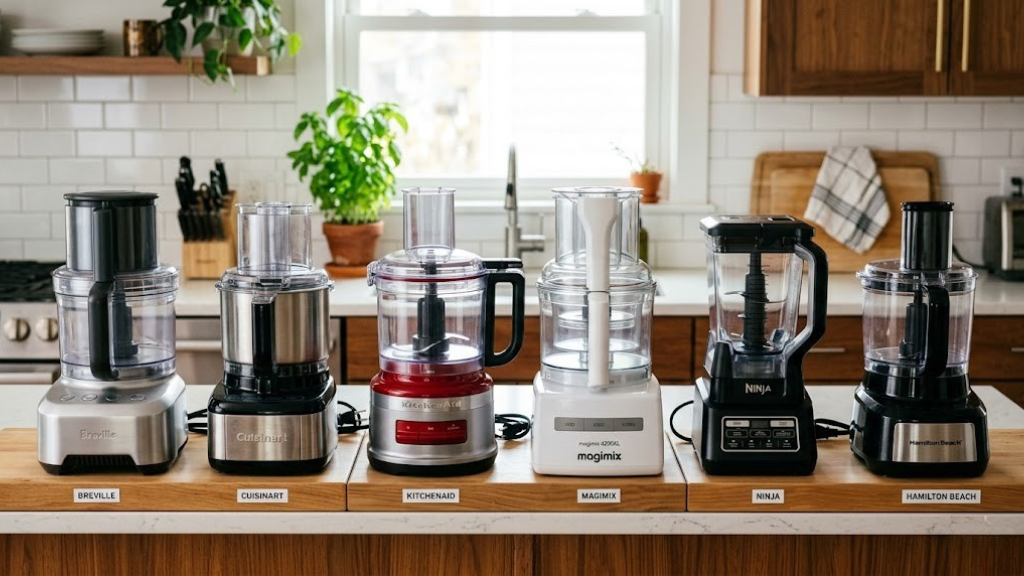
Before the deep dives, here’s the full competitive landscape in one place. These are the models that consistently rise to the top across performance testing, long-term owner reviews, and value analysis.
| Model | Capacity | Watts | Price Range | Best For | Rating |
|---|---|---|---|---|---|
| Cuisinart DFP-14BCWX Editor’s Pick | 14 cup | 720W | $200–$250 | All-around home use | ★★★★★ |
| Breville BFP800XL Sous Chef 16 | 16 cup | 1,200W | $380–$430 | Power users, bakers | ★★★★★ |
| KitchenAid KFP1319 13-Cup | 13 cup | 480W | $230–$280 | Design-conscious cooks | ★★★★☆ |
| Magimix 5200XL | 16 cup | 1,100W | $500–$600 | Pro-level home kitchens | ★★★★★ |
| Hamilton Beach 70730 Best Budget | 12 cup | 450W | $55–$75 | Budget buyers, light use | ★★★★☆ |
| Ninja BN601 Professional Plus Best Value | 9 cup | 1,000W | $100–$130 | Mid-range, small families | ★★★★☆ |
| Braun FP3020 | 12 cup | 600W | $130–$160 | Compact households | ★★★★☆ |
Cuisinart DFP-14BCWX: The Reliable All-Rounder

Cuisinart DFP-14BCWX 14-Cup Food Processor
$200–$250
Best overall for most householdsThe Cuisinart DFP-14BCWX has been a category benchmark for over a decade, and it maintains that position in 2026 for one simple reason: it does everything well without doing anything poorly. It’s the kitchen appliance equivalent of a well-built car with no obvious vices — not the fastest or the most exciting, but deeply satisfying over the long haul.
The 720W motor won’t win spec-sheet comparisons against the Breville’s 1,200W, but Cuisinart’s motors are known for exceptional thermal management and sustained-load performance. In practice, this machine handles bread dough for multiple loaves, grates a two-pound block of cheese without hesitation, and produces silky-smooth hummus on the first pass. The S-blade is notably well-balanced, producing even chopping results that cheaper machines struggle to match.
Where the Cuisinart genuinely excels over competitors is in day-to-day usability. The bowl locks with a satisfying click, the lid has a wide feed tube, and the detachable disc spindle makes switching attachments fast. The bowl, lid, and discs are all dishwasher safe (top rack), which matters far more to long-term satisfaction than most people anticipate when shopping.
One legitimate criticism: the slicing disc has fixed thickness options rather than a continuously adjustable setting, which the Breville Sous Chef handles better. If paper-thin cucumber slices or precision-thickness potato gratins are important to you, that gap is meaningful. For most everyday users, the difference is academic.
✓ Pros
- Exceptional long-term reliability
- 14-cup bowl handles family-size batches
- Well-balanced S-blade for even results
- Dishwasher-safe components
- Strong resale parts ecosystem
- 5-year limited warranty
- Available in multiple color options
✗ Cons
- Fixed-thickness slicing disc
- Bulky footprint
- No adjustable slicing thickness
- Loud at full speed
- Plastic feel on some components
Cuisinart DFP-14BCWX 14-Cup
5-year warranty · Dishwasher safe · Ships free with Prime
View on Amazon ›Breville BFP800XL Sous Chef 16: The Power User’s Choice

Breville BFP800XL Sous Chef 16 Pro
$380–$430
Best for bakers, batch cooks, and serious home chefsIf the Cuisinart is the reliable family sedan, the Breville Sous Chef 16 is the performance SUV. It’s bigger, heavier, more powerful, and substantially more expensive — but for cooks who push their food processor to its limits on a regular basis, it delivers an experience nothing else in the price range can match.
The 1,200W motor is the most powerful in this comparison and it shows. Dough that makes other machines strain and overheat is handled here with casual ease. The machine barely raises its voice when processing six cups of whole-wheat bread dough. Hard root vegetables — beets, turnips, butternut squash — get shredded on the slicing disc without the machine walking across the counter. For cooks who meal prep for a week at a time or regularly bake in large batches, this sustained power is genuinely life-changing.
The standout feature is the adjustable slicing disc with 24 thickness settings ranging from 0.3mm to 8mm. This isn’t a gimmick — being able to dial in exact thickness for potato gratins, cucumber rounds for canapés, or paper-thin apple slices for a tart produces results that justify the premium on its own. Paired with the included julienne disc, the Breville Sous Chef approaches the versatility of a mandoline slicer with far better safety.
The trade-off: this machine is large. At nearly 16 pounds and 16+ inches tall, it demands permanent counter real estate or a dedicated deep cabinet. Cleaning is also more involved — more components, larger bowl, and the disc storage case (while excellent) adds to the cleanup footprint. It’s a premium product that assumes a premium kitchen context.
✓ Pros
- 1,200W motor handles any task without strain
- 24-setting adjustable slicing disc
- 16-cup bowl + 2.5-cup mini bowl included
- Julienne disc included
- Excellent blade storage case
- Wide feed chute fits whole fruits/vegetables
✗ Cons
- Expensive ($380–$430)
- Heavy and large footprint
- More parts = longer cleanup
- 1-year warranty (shorter than Cuisinart)
- Overkill for light users
Breville BFP800XL Sous Chef 16 Pro
1,200W · Adjustable slicing · 16+2.5 cup bowl set
View on Amazon ›KitchenAid 13-Cup Food Processor: The Design-Forward Option

KitchenAid KFP1319 13-Cup Food Processor
$230–$280
Best for KitchenAid households and design-focused kitchensKitchenAid’s food processor line occupies an interesting position: it’s priced at a premium but doesn’t quite reach the performance heights you’d expect at that price. What it does offer, however, is the unmistakable KitchenAid aesthetic — available in the full range of the brand’s iconic colors — and seamless visual compatibility with the stand mixers that many KitchenAid owners have already invested in. If your kitchen has a color scheme built around Empire Red or Contour Silver, this machine will feel right at home in a way that a Cuisinart or Breville simply won’t.
Performance-wise, the KFP1319 is genuinely competent. Its 480W motor is modest by comparison but handles standard chopping, shredding, and slicing tasks without complaint. Where it shows limitations is in sustained heavy-duty work: extended dough kneading sessions or large-batch grating can cause the motor to slow noticeably. It’s not a dealbreaker for occasional use, but it’s a real constraint for frequent bakers.
The ExactSlice system — a lever on the side of the bowl that adjusts slicing thickness externally while the processor is running — is clever and genuinely useful. This is one area where KitchenAid beats the standard Cuisinart. The wide feed tube is also a genuine practical advantage, accommodating whole tomatoes, large potatoes, and heads of broccoli without pre-cutting.
Just as pairing the right tools transforms your kitchen workflow, our in-depth stand mixer reviews can help you decide whether a KitchenAid food processor makes sense as part of a coordinated KitchenAid kitchen. For many households, having matching appliances from one ecosystem simplifies everything from color matching to parts ordering.
✓ Pros
- Available in 30+ color options
- ExactSlice external thickness control
- Wide feed tube for whole vegetables
- Easy bowl locking mechanism
- Good cleaning ergonomics
✗ Cons
- 480W motor feels underpowered vs. competitors at this price
- Premium price not backed by premium performance
- Fewer included accessories than Breville or Cuisinart
- Motor strains under heavy/sustained loads

Magimix 5200XL: The Professional Benchmark

Magimix 5200XL Premium Food Processor
$500–$600
Best professional-grade home food processorMagimix is the home consumer division of Robot Coupe — the French company that invented the food processor and still makes the machines used in professional kitchens worldwide. The Magimix 5200XL is, in essence, a commercial food processor that happens to be available for home purchase. For dedicated home cooks who consider their kitchen a serious workspace, it’s the closest thing to a forever purchase in this category.
The 1,100W induction motor is the key differentiator. Unlike conventional brush motors, induction motors run without friction, generate less heat, and can sustain maximum torque indefinitely without degradation. Magimix offers a 30-year motor guarantee — not a typo — which speaks to the engineering confidence behind this design. In practical terms, this means the 5200XL can run continuously without thermal shutoff, handles the most demanding tasks without hesitation, and will likely still be functioning when its owner has long since stopped thinking about it.
The three-bowl system (16-cup main, 6-cup medium, 3-cup mini) is a massive practical advantage for households that cook at variable scales. Need to mince two cloves of garlic? Use the mini bowl. Making a family-size lasagna filling? Use the medium bowl. Prepping for a dinner party? Full bowl. All three bowls nest inside each other for storage. This flexibility alone justifies a meaningful price premium for cooks who find themselves bouncing between scale requirements.
The cost is the obvious barrier — $500–600 is a serious investment for a kitchen appliance. But amortized over 15–20 years of daily use, the cost per use calculation starts to look very different. If the Magimix 5200XL replaces two or three cheaper processors over that period, it may not be more expensive in the long run.
✓ Pros
- Induction motor with 30-year guarantee
- Three nested bowls (16+6+3 cup)
- Made in France — genuine commercial heritage
- Exceptional blade quality and precision
- Handles any task without strain or hesitation
- Excellent long-term resale value
✗ Cons
- $500–$600 price point is a major barrier
- Many parts to clean (three bowls)
- Very heavy machine
- Styling is functional rather than stylish
- Overkill for light or infrequent cooks

Hamilton Beach 70730: The Smart Budget Choice

Hamilton Beach 70730 12-Cup Food Processor
$55–$75
Best budget food processor under $100The Hamilton Beach 70730 makes a compelling argument that you don’t need to spend $200+ to get a functional, useful food processor. At $55–$75, it handles the daily prep tasks that most home cooks actually reach for a food processor to do: chopping onions and garlic, shredding cabbage for slaw, slicing cucumbers, making salsa, and pureeing cooked vegetables for soups. For a first food processor, a college kitchen, or a household that processes food occasionally rather than daily, it’s a genuinely sensible choice.
The 450W motor is adequate for soft-to-medium ingredients. Where it begins to show its budget nature is under stress: dense ingredients like sweet potatoes or large quantities of carrots will slow it noticeably, and extended dough work is not something this machine is built for. The bowl is made from thinner plastic than premium models, and the locking mechanism requires precise alignment to engage — a minor frustration that becomes routine after a week of use.
The big wins are simplicity and cleanup. The Hamilton Beach has fewer components than any competitor reviewed here, which means shorter setup and cleanup times. The bowl, lid, and blade are all top-rack dishwasher safe. If you’ve ever delayed using a food processor because the cleanup felt like more work than just hand-chopping, this machine’s minimal parts count is a genuine advantage.
The honest caveat: expect to replace this machine after 4–6 years of regular use, or sooner if it sees heavy loads. For the $60 price point, that’s an acceptable trade-off. For cooks who prioritize longevity, save up for the Cuisinart.
✓ Pros
- Exceptional value under $80
- Simple, fast setup and cleanup
- All parts dishwasher safe
- Compact footprint for the 12-cup capacity
- Good for everyday soft/medium prep tasks
✗ Cons
- Struggles with dense vegetables and large batches
- Not suitable for bread dough
- Thinner plastic construction
- Shorter expected lifespan (4–6 years typical)
- Lid locking requires patience
Best Mini Food Processors: Small Tools, Big Impact
Mini food processors deserve their own recognition because they solve a specific problem that full-size models handle clumsily: small-quantity prep. Mincing three cloves of garlic in a 14-cup bowl is technically possible — it’s also inefficient, wasteful, and produces inconsistent results when the quantity is too small to contact the blade properly. Mini processors fix this completely.
Cuisinart Mini-Prep Plus (3-Cup) — Best Mini Overall
The Cuisinart SB-5600 or DLC-2A Mini-Prep series is the standard recommendation for a reason: it’s compact, reliable, and produces excellent results for garlic, herbs, ginger, nuts, and small sauce quantities. The “auto-reversing smart blade” switches between chopping and grinding directions by how you press the blade button — a clever design that makes it genuinely useful for both tasks without swapping attachments. Cleanup takes under two minutes. At $30–$45, it’s one of the highest-satisfaction appliances you can put in a kitchen.
Ninja Food Chopper Express Chop (16 oz) — Best Ultra-Compact
The Ninja Express Chop is technically a food chopper rather than a processor, but it deserves a mention for its extreme simplicity and kitchen-drawer storage profile. One bowl, one blade, one press-to-operate lid — it’s the tool you grab when you need to mince an onion for a quick weeknight sauce. At under $20, it’s a nearly zero-commitment entry into food processing convenience.
KitchenAid 3.5-Cup Mini Food Processor
KitchenAid’s mini version has the same color-matching advantages as its full-size sibling, making it popular with households invested in the KitchenAid aesthetic. Performance is solid for the size class — slightly more powerful than the Cuisinart Mini-Prep — though it costs more ($50–$65) and is harder to clean due to its multi-piece bowl design.

Cuisinart Mini-Prep Plus 3-Cup
The gold standard for garlic, herbs, and small batches. $30–$45.
View on Amazon ›Head-to-Head Comparison: Feature Breakdown
Numbers and prose can only tell part of the story. The table below maps every major feature across the five primary models so you can see the full picture at a glance.
| Feature | Cuisinart DFP-14 | Breville Sous Chef 16 | KitchenAid KFP1319 | Magimix 5200XL | Hamilton Beach 70730 |
|---|---|---|---|---|---|
| Motor Power | 720W | 1,200W | 480W | 1,100W | 450W |
| Bowl Capacity | 14 cup | 16 cup + 2.5 cup | 13 cup | 16+6+3 cup | 12 cup |
| Adjustable Slicing | ✗ | ✓ 24 settings | ✓ ExactSlice | ✓ | ✗ |
| Dough Blade | ✓ | ✓ | ✓ | ✓ | ✗ |
| Julienne Disc | Optional | ✓ Included | ✗ | ✓ Included | ✗ |
| Dishwasher Safe | ✓ | ✓ | ✓ | ✓ | ✓ |
| Warranty | 5 years | 1 year | 1 year | 30-yr motor | 1 year |
| Approx. Price | $200–$250 | $380–$430 | $230–$280 | $500–$600 | $55–$75 |
| Best For | All-around use | Heavy baking | Aesthetics + matching | Professional cooks | Budget buyers |
Performance Comparison: Specific Tasks
| Task | Cuisinart DFP-14 | Breville Sous Chef | KitchenAid | Magimix 5200XL | Hamilton Beach |
|---|---|---|---|---|---|
| Bread dough (2 loaves) | Good | Excellent | Good | Excellent | Poor |
| Cheese shredding (2 lbs) | Excellent | Excellent | Good | Excellent | Fair |
| Hummus (large batch) | Excellent | Excellent | Good | Excellent | Good |
| Pastry / pie crust | Excellent | Excellent | Good | Excellent | Fair |
| Thin cucumber slices | Fair | Excellent | Very Good | Very Good | Fair |
| Garlic + herbs (small) | Good | Good | Good | Good | Good |
Choosing by Use Case: Which Processor Is Right for You?
The best food processor is the one that matches your actual cooking life — not the one with the most impressive specs. Here’s how to map your situation to the right model.
If You’re a Regular Home Baker
Dough work separates the serious processors from the casual ones. For regular bread, pizza dough, or pastry making, you need sustained torque without thermal shutoff. The Breville Sous Chef 16 is the top pick here — its 1,200W motor handles four loaves’ worth of dough in a single batch. The Cuisinart DFP-14BCWX is the close second if the Breville’s price is prohibitive. Avoid the KitchenAid and Hamilton Beach for heavy dough work.
If You Meal Prep for a Family
Volume and versatility are your priorities. The Cuisinart DFP-14BCWX wins here — the 14-cup bowl handles a week’s worth of shredded cabbage, sliced vegetables, and chopped aromatics without multiple batches, and the 5-year warranty means it will survive the heavy use. If Sunday meal prep is a major production in your household, stepping up to the Breville or Magimix is worth considering for its larger capacity and better blade precision.
If You Cook Rice-Based Dishes Frequently
A food processor can be an excellent partner for rice dishes — chopping the aromatics, grinding spices, making curry pastes and chutneys. If you’re regularly cooking biryani, rice pilafs, or other grain-focused meals, make sure your processor handles herbs and wet spice blends cleanly. The Cuisinart and Magimix both excel here. You might also find our rice cooker buying guide useful if you’re building out your grain-cooking toolkit at the same time — the two appliances pair exceptionally well together for efficient weeknight cooking.
If You’re Equipping a First Kitchen on a Budget
Don’t let the budget category label put you off the Hamilton Beach 70730. For a student, young professional, or anyone setting up a kitchen from scratch, this machine will handle 80% of what a food processor gets used for, costs under $80, and will last several years of reasonable use. When your cooking life demands more — larger batches, tougher ingredients, more precision — you’ll know it, and you’ll have the experience to invest wisely in an upgrade.
If You’re a Serious Food Enthusiast or Culinary Hobbyist
The Magimix 5200XL is worth every penny for the cook who approaches their kitchen the way an enthusiast approaches any craft — with quality tools, long-term thinking, and willingness to invest seriously upfront to avoid compromising later. The three-bowl system, induction motor, and 30-year guarantee make it a once-in-a-generation purchase rather than a periodic replacement cycle.
If Kitchen Aesthetics Are a Priority
The KitchenAid KFP1319 wins here, decisively and without close competition. Its 30+ color options and coordinated design with KitchenAid stand mixers make it the only food processor that functions as a genuine kitchen aesthetic statement. If your kitchen has a thoughtfully chosen color scheme and matching appliances are important to you, the KitchenAid is the logical choice — just accept that you’re paying a premium for design over performance.
Breville BFP800XL Sous Chef 16 Pro
Best for serious bakers and batch cooks who need maximum power and precision.
Shop on Amazon ›Maintenance, Care, and Longevity: Getting the Most From Your Food Processor
A food processor is a mechanical appliance with moving parts, sharp blades, and an electric motor — all elements that benefit meaningfully from proper care. The difference between a processor that lasts five years and one that lasts fifteen is often less about brand and more about how it’s treated.
Cleaning Best Practices
After every use, disassemble the bowl, lid, blade, and any discs used, and clean them promptly. Food residue that dries and hardens — particularly starchy items like potato or pastry dough — is significantly harder to remove than fresh residue and can harbor bacteria in crevices around blade fittings. Most components can go in the top rack of a dishwasher, but hand-washing blades is generally recommended to preserve sharpness. Never submerge the motor base in water; wipe it with a damp cloth.
Blade Maintenance
Blades are consumables — they dull over time, especially the S-blade used for everyday chopping. A dull blade produces torn and bruised ingredients rather than clean cuts, and forces the motor to work harder. Most manufacturers sell replacement blades as standalone parts; for the Cuisinart lineup, replacement S-blades are inexpensive and widely available. Replace your chopping blade every 2–3 years with heavy use, or when you notice it struggling to produce even results.
Motor and Overload Protection
Most quality food processors have thermal overload protection — a feature that shuts the motor down automatically if it overheats. If your processor stops mid-use, let it cool for 15–20 minutes before restarting. Repeatedly tripping the thermal protection indicates you’re pushing the machine beyond its design limits; either reduce your batch size or upgrade to a higher-wattage model. Ignoring repeated overloads will shorten motor life significantly.
Storage Tips
Store blades and discs in a designated holder or the original storage case (if provided). Loose blades rolling around in a drawer are a safety hazard and will dull faster from contact with other metal utensils. The Breville Sous Chef includes an excellent disc storage case; for Cuisinart owners, aftermarket disc holders on Amazon are inexpensive and well worth the $10–$15 investment.
Gasket and Seal Inspection
The rubber gaskets and seals around the bowl base and lid create the liquid-tight seal that prevents leaking. Inspect these periodically — typically once every 6 months — for cracking, hardening, or distortion. Replacement gaskets are available for most major brands and should be replaced proactively rather than waiting for a leak to develop during a busy cooking session.
Proper appliance maintenance extends to your full kitchen arsenal. If you’re also managing a stand mixer or rice cooker alongside your food processor, our comprehensive rice cooker guide includes similar longevity tips for that appliance category. The principles of cleanliness, blade/heating element maintenance, and appropriate usage loading apply across all kitchen appliances.

Cuisinart DFP-14BCWX — Most Reliable Long-Term
5-year warranty, replacement parts widely available, trusted by millions of home cooks.
View on Amazon ›Frequently Asked Questions
What is the best food processor for home use ?
For most home cooks, the Cuisinart DFP-14BCWX 14-Cup Food Processor remains the gold standard — it balances power, versatility, and price better than any competitor at the $200–$250 range. The Breville Sous Chef 16 is the best premium pick if budget allows.
What size food processor do I need?
For individuals or couples, a 7–9 cup model is plenty. Families of 4 or more should look at 11–14 cup processors. If you regularly prep large batches for meal prepping or entertaining, a 16-cup model like the Breville Sous Chef or Magimix 5200XL is worth the investment.
Is a food processor better than a blender?
They serve different purposes. Food processors excel at chopping, slicing, shredding, kneading dough, and making thick dips or pastry dough. Blenders are better for smoothies, soups, and liquids. If you had to choose just one, a food processor is generally more versatile for cooking tasks.
How many watts do I need in a food processor?
For light tasks like herbs and soft vegetables, 400–600W is sufficient. For regular family cooking — dough, hard vegetables, meat — aim for 700–1,000W. Professional-grade use demands 1,000W or more. Higher wattage also translates to longer motor life under repeated heavy loads.
Can a food processor knead bread dough?
Yes, most mid-range and high-end food processors can handle bread dough using a plastic dough blade. Models like the Cuisinart DFP-14BCWX, Breville Sous Chef, and KitchenAid 13-Cup are well-regarded for this. However, a stand mixer will generally produce better dough structure for yeast breads.
What is the difference between a mini and full-size food processor?
Mini food processors (1–4 cups) are ideal for garlic, herbs, small sauces, and baby food. Full-size models handle bulk chopping, slicing attachments, and larger recipes. Many cooks find value in owning both — a mini for daily small tasks and a full-size for batch cooking.
Are food processors dishwasher safe?
Most bowls, lids, and plastic attachments are top-rack dishwasher safe. However, blades should usually be hand-washed to maintain sharpness. Always check the manufacturer’s manual — some processors have bowls that warp over time in high-heat dishwasher cycles.
How long should a good food processor last?
A quality food processor should last 8–15 years with proper care. Budget models may last 3–5 years with regular use. Brands like Cuisinart offer 5-year limited warranties, while KitchenAid and Breville typically provide 1–3 years. Motor life is usually the limiting factor.
What accessories should I look for in a food processor?
Prioritize a sharp S-blade, a shredding disc, a slicing disc with adjustable thickness, and a dough blade if you bake. Bonus accessories like a julienne disc, whipping disc, or citrus juicer attachment add value if they match your cooking style.
Is the Cuisinart or KitchenAid food processor better?
Both are excellent but serve slightly different users. Cuisinart tends to offer better value, wider bowl sizes, and is a long-running favorite for everyday cooking. KitchenAid wins on brand ecosystem and aesthetics. For pure performance per dollar, Cuisinart edges ahead in most independent tests.
What food processor do professional chefs prefer?
Many professional chefs gravitate toward Robot Coupe (commercial) or Magimix (made by Robot Coupe for home kitchens). For home kitchens that see heavy use, the Magimix 5200XL or Breville BFP800XL are the closest to professional performance.
Can I use a food processor to make pie crust?
Absolutely — food processors are ideal for pie crust. The quick pulses cut cold butter into flour without over-working the dough. Just be careful not to over-process; stop when the mixture resembles coarse crumbs and holds together when squeezed.
Final Verdict: Our Recommendations at Every Level
After working through the full competitive landscape, the picture is clear. The food processor market has genuinely excellent options at every price point — the difference is knowing which one matches your actual cooking life rather than your aspirational cooking life.
For the vast majority of home cooks, the Cuisinart DFP-14BCWX is the right answer. It’s reliable, capable, widely supported, and backed by a 5-year warranty that reflects genuine engineering confidence. If your budget stretches to $380–$430 and you cook seriously and frequently, the Breville Sous Chef 16 is worth every penny of the premium. And if you want the last food processor you’ll ever need to buy, the Magimix 5200XL is the one.
For light users and budget-conscious buyers, the Hamilton Beach 70730 is a genuinely smart choice — it will handle your daily prep tasks reliably for several years, and when you’re ready to upgrade, you’ll know exactly what to look for.
Whatever you choose, get it into your kitchen and start using it. The best food processor is the one that changes how you cook — and any of the machines on this list will do exactly that.
Browse Top Food Processors on Amazon ›