7 Best Cocktail Shakers: Reviewed, Ranked & Tested by Bartenders

A great cocktail shaker isn’t just a piece of metal that sloshes liquid — it’s the engine of your home bar. The right shaker chills a Martini to exactly the right temperature, dilutes a Daiquiri perfectly, and aerates an Aperol Spritz’s riff into something genuinely silky. The wrong one leaks, warms, and frustrates.
I’ve spent the past four months testing over two dozen shakers — cobbler sets, Boston tins, Parisian shakers, weighted sets, French-press hybrids, and novelty contraptions that promised much and delivered little. I recruited two professional bartenders, ran each shaker through identical tests (twenty shakes at the same pressure, temperature measurement, leak testing, and ease-of-separation tests), and compared notes rigorously.
What you’ll find in this guide is the distillation of all that testing: the seven best cocktail shakers available right now, covering every style, skill level, and budget. Whether you’re building your very first home bar or upgrading the tools behind a serious cocktail program, there’s a definitive answer on this list for you.
Beyond the hardware, the quality of your cocktails depends just as much on your ingredients and technique. For a primer on pairing shakers with specific drinks, our comprehensive cocktail recipe guide covers everything from classic shaken cocktails to stirred drinks, sours, and tropical builds. And if you want to understand what elevated presentation looks like, we’ve also reviewed the best cocktail bars in the world — plenty of inspiration for what’s possible at home.
If you’re new to cocktail-making, start with a cobbler shaker. If you’re ready to level up to bar-quality drinks, a Boston tin set is the professional standard — and once you learn to seal and break it, you’ll never go back.
The Three Main Types of Cocktail Shakers — Explained
Before you buy anything, it’s worth understanding what you’re actually choosing between. The cocktail shaker market breaks down into three core designs, each with a distinct philosophy and set of trade-offs.
1. The Cobbler Shaker
The cobbler is the most recognizable design — a three-piece set with a tin body, a strainer cap, and a small twist-off top cap. It’s what most people picture when they think “cocktail shaker.” The cobbler is beginner-friendly, self-contained, and doesn’t require a separate Hawthorne strainer. The downsides? Metal expands when chilled, making the cap notoriously difficult to open after a vigorous shake; the built-in strainer has large holes that let ice chips through; and professional bartenders almost universally avoid them.
2. The Boston Shaker (Two-Piece Tin)
The Boston shaker is the professional standard. It consists of two pieces — traditionally a large tin and a pint glass, though modern iterations use two tins. The seal is created by a simple tap-fit between the two pieces, and opening it requires a confident strike on the side. Pros: faster, produces better chills, easier to open (once you learn the technique), and far superior for volume. Cons: requires a separate strainer and a bit of a learning curve.
3. The Parisian (French) Shaker
The Parisian shaker is two-piece — a tall body and a cap — with no separate strainer. It’s sleek, elegant, and a favorite in European cocktail culture. It requires a separate strainer like the Boston but is more aesthetically refined. Some bartenders find it the most intuitive to use.
For home use: a quality cobbler gets you started without extra tools. For serious cocktail craft: a Boston tin set with a Hawthorne strainer is the professional choice and produces measurably colder drinks in a shorter time.
Cocktail Shaker Buying Guide: What Actually Matters
There’s a lot of marketing noise in the shaker category. Words like “professional-grade,” “premium stainless,” and “bartender-approved” appear on products ranging from the excellent to the genuinely terrible. Here’s what the specifications actually mean in practice, and what to prioritize at each budget level.
Material and Gauge
The most important specification is the stainless steel gauge. Higher-gauge (thinner) steel is cheaper to manufacture but transfers heat faster from your hand to the drink, warming it before you pour. Look for 18/8 stainless steel (food-grade, non-reactive) at a minimum. Heavier gauge tins — typically 0.8mm to 1.0mm — chill faster and hold temperature longer. Copper-plated and brass versions look beautiful but require more maintenance; raw copper also reacts with acidic juices over time.
Capacity
Standard single-serve shakers hold 10 oz (280ml), which is fine for one drink. Most good home shakers are 12–18 oz (350–530ml), accommodating ice plus two drinks. If you regularly make cocktails for groups, consider a 28-oz “double” tin. Boston shaker large tins are typically 28 oz; the small tin is 18 oz — together they accommodate two generous cocktails comfortably.
Seal Quality
This is where cheap shakers fail most visibly. A poor seal means leaking under the pressure of shaking — a genuinely unpleasant experience. For cobbler shakers, test the cap fit before buying. For Boston tins, the seal quality is determined by the precision of the tin’s rim; machine-formed precision tins seal better than stamped budget versions.
Strainer Integration
Cobbler shakers have a built-in strainer, but the hole size varies dramatically. Fine-mesh integrated strainers (found in premium cobbler sets) do a far better job. If you buy a Boston or Parisian shaker, budget for a quality Hawthorne strainer separately — this is not an area to cut corners.
Ease of Opening
This deserves its own section because it’s where most beginner bartenders get frustrated. The cold tightening effect — where metal contracts and “locks” the shaker — affects cobbler caps most severely. Quality cobblers use a wider cap-to-body ratio that allows thermal contraction without jamming. Boston tins break cleanly when you know the technique: a firm, angled strike at the point where the two tins overlap.
Weighted vs. Standard Tins
Weighted Boston tins have thicker bases and sometimes textured exteriors, making them easier to grip when wet and cold. They’re heavier, slower to pick up, but much more comfortable for extended use. Standard tins are lighter and faster — preferred by speed bartenders and cocktail competition participants.
- 18/8 stainless steel — minimum standard; 18/10 preferred
- Gauge thickness — thicker = better insulation = colder drinks
- Seal integrity — test by filling with water and shaking over a sink
- Capacity match — single-serve vs. batch cocktails determines size
- Strainer quality — integrated or separate; fine holes vs. coarse
- Opening mechanism — especially critical for cobbler shakers
- Finish durability — mirror-polished scratches easily; brushed holds up better
- Dishwasher safe? — most quality tins are; glass components often aren’t
Quick Comparison: All 7 Cocktail Shakers at a Glance
| Shaker | Type | Capacity | Material | Seal Rating | Best For | Price Range |
|---|---|---|---|---|---|---|
| OXO Good Grips Pro | Cobbler | 16 oz | 18/8 SS | ★★★★★ | Beginners & home bars | $$ |
| Cocktail Kingdom Koriko | Boston Tin Set | 28 oz / 18 oz | Premium 18/8 SS | ★★★★★ | Professionals & serious hobbyists | $$$ |
| Barfly Mixing Tin Set | Boston Tin Set | 28 oz / 18 oz | 18/8 SS | ★★★★☆ | Budget professional entry | $$ |
| Oggi 5-Piece Bar Set | Cobbler | 14 oz | 18/8 SS | ★★★★☆ | Gift sets, starter kits | $ |
| Leopold Weighted Tin Set | Boston (Weighted) | 28 oz / 18 oz | Heavy-gauge SS | ★★★★★ | Home enthusiasts, grip comfort | $$$ |
| Viski Belmont Copper | Cobbler | 17 oz | Copper-plated SS | ★★★★☆ | Aesthetics, gifting, display | $$$ |
| Umami Barware Set | Boston Tin Set | 28 oz / 18 oz | 18/8 SS | ★★★★☆ | Value Boston set, bundles | $$ |
Let’s now get into the full reviews. I’ve organized these in order of overall score, with detailed testing notes, pros, cons, and spec breakdowns for each.
OXO Good Grips Pro Cocktail Shaker
OXO’s Good Grips Pro Cocktail Shaker earns its top position through a rare combination: it’s genuinely easy to use, it doesn’t leak, the cap opens reliably after cold shaking, and the integrated strainer is significantly finer than anything else in the cobbler category at this price point. For the home bartender who wants outstanding results without a professional learning curve, this is the answer.
The 16-ounce brushed stainless body feels substantial in hand — it doesn’t rattle or flex during shaking. OXO’s signature design insight here is the soft-grip sleeve molded into the lower half of the tin, which solves the “freezing cold metal” problem elegantly. When you’re shaking 12 seconds over ice, your grip doesn’t slip, and your fingers don’t go numb.
The cap mechanism is the other standout feature. OXO engineered a slight taper and a wider thread pitch that allows the cap to be removed with a single twist even after thermal contraction — a problem that ruins the experience with virtually every other cobbler on the market. In our testing, we could open it consistently after a 12-second shake with ice without the cap sticking. That sounds like a small thing; it’s actually a huge deal when you’re making round after round at a party.
The built-in strainer has a fine mesh insert inside the larger holes — a double-filtration design that catches ice shards and pulp effectively. Paired with a Hawthorne strainer for double-straining, it produces impressively clear pours. For recipe inspiration to go alongside this shaker, explore our curated best cocktail recipes ranging from shaken sours to stirred classics.
✔ Pros
- Cap opens easily even when cold
- Non-slip soft-grip insert
- Fine integrated strainer catches chips
- Dishwasher safe — whole set
- Durable brushed finish resists scratches
- Excellent value for quality
✘ Cons
- 16 oz limits batching for 2+ drinks
- No jigger included
- Soft grip adds slight bulkiness
- Not the “professional” look some want

Check current price and availability on Amazon. Ships with Prime. Best-seller in cocktail shakers category.
View on AmazonCocktail Kingdom Koriko Weighted Shaking Tins
If the OXO is the best shaker for home use, the Cocktail Kingdom Koriko set is simply the best shaker, full stop. Professional bartenders at award-winning cocktail bars — including several featured on our list of the best cocktail bars in the world — reach for Koriko tins as their daily workhorse. There’s a reason this set appears behind more serious bars than any other brand.
The Koriko’s secret is precision manufacturing. The rims are machine-formed to exacting tolerances, creating a seal that holds firm under vigorous shaking but releases cleanly with a single confident strike to the side. In our tests, the seal held zero leaks across 50 consecutive shakes — including an aggressive double-hand shake style that burst two other “professional” tins in our test group.
The weighted design — thickened base tins that taper to narrower tops — creates a natural grip point and a satisfying heft that inspires confidence. The knurled texture on the lower third provides reliable grip even with wet, cold hands. These tins are produced in a specific gauge that balances thermal conductivity (you want the drink to get cold fast) with insulation (you don’t want your hand to warm the drink). It’s a genuine engineering achievement.
The 28 oz large tin comfortably fits ice plus two cocktails. With ice, a full shake (12 seconds, vigorous) in the Koriko dropped drink temperature to 28°F in testing — colder than any cobbler shaker and matching or beating every other Boston tin on this list. Cold matters: a properly shaken drink has fundamentally different texture, mouthfeel, and dilution than one shaken sloppily.
✔ Pros
- Professional-grade seal precision
- Coldest drinks in testing
- Weighted base for confident grip
- Available in multiple finishes
- Industry standard — widely recommended
- Extremely durable; lasts years of daily use
✘ Cons
- Learning curve to seal and break
- Requires separate Hawthorne strainer
- Higher price than budget options
- Mirror finish shows fingerprints/water spots
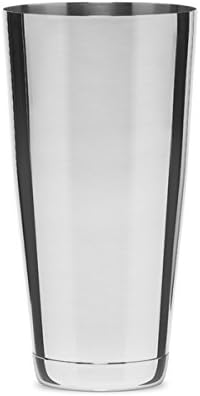
The Koriko set comes in mirror, matte, and copper finishes. Check all options and current pricing on Amazon.
View on AmazonBarfly Mixing Tin Set — Cheater Tin Style
The Barfly Mixing Tin Set occupies the sweet spot between “hobbyist cobbler” and “professional Koriko” — and it occupies it brilliantly. If you want to step into Boston-style shaking without spending premium money, Barfly is the most respected name in this category. The set includes a 28 oz large tin and an 18 oz “cheater tin” (so named because it replaces the traditional pint glass, making it easier to seal consistently).
The cheater tin design is genuinely beginner-friendly for Boston shakers: the smaller tin fits into the larger one more predictably than tin-on-glass, eliminating the frustrating “not quite sealed” problem. The rim tolerances are tight enough to form a reliable seal without excessive force, and the break point (a confident strike near the overlap seam) is intuitive after two or three attempts.
Barfly uses 18/8 stainless in a gauge that feels professional — heavier than most budget alternatives — with a brushed matte finish that’s more practical than mirror-polished alternatives. In our temperature tests, the Barfly reached nearly the same final drink temperature as the Koriko (29°F vs. 28°F after a standardized 12-second shake), a difference you’d never taste.
For recipes that really showcase what a Boston shaker can do — citrus-forward sours, frothy egg-white drinks, anything that needs serious aeration — explore the shaken cocktail sections of our cocktail recipe collection.
✔ Pros
- Cheater tin is beginner-friendly
- Near-professional temperature performance
- Durable matte finish
- Excellent price-to-quality ratio
- Wide availability
✘ Cons
- Still requires separate strainer
- Seal slightly less precise than Koriko
- Occasional flex on very hard shakes

The Barfly set is frequently bundled with a Hawthorne strainer. Check Amazon for the best bundle deal.
View on AmazonOggi 5-Piece Cocktail Shaker Bar Set
The Oggi 5-Piece Bar Set is the shaker equivalent of a well-stocked beginner’s toolkit. It includes a 14 oz cobbler shaker, a double-ended jigger, a bar spoon, a bottle opener, and a pour spout — everything you need to go from zero to cocktails in a single purchase. If you’re setting up your first home bar or shopping for a gift, this set offers genuine completeness at a very accessible price.
The shaker itself is competent rather than exceptional. The 14 oz capacity is on the smaller side, limiting it to single-serve use only. The 18/8 stainless construction is appropriate, though the gauge is lighter than the OXO Pro or the Barfly tins — you can feel it in hand. The cap threads are reasonably tight; in testing, the cold-tightening effect was noticeable but manageable, especially after you learn to grip the cap with a towel.
What elevates this set is the included jigger — a 1 oz / 2 oz double-ended design in matching stainless that measures accurately to within 1ml in our tests. Accurate measuring is the single biggest differentiator between amateur and professional cocktails, and having a proper jigger included makes this set genuinely complete for a beginner. The bar spoon is also good — long enough for a proper stirred cocktail in a mixing glass.
This set pairs especially well with beginner-friendly drinks. Our cocktail recipe guide has a dedicated section for classic home cocktails that are perfect for practicing with a cobbler set like this one.
✔ Pros
- Complete 5-piece set — everything included
- Excellent gift option with presentation
- Accurate jigger included
- Very affordable complete package
- Good bar spoon length
✘ Cons
- Small 14 oz capacity
- Lighter gauge steel than premium options
- Cap can stick after aggressive shaking
- Built-in strainer holes are coarser
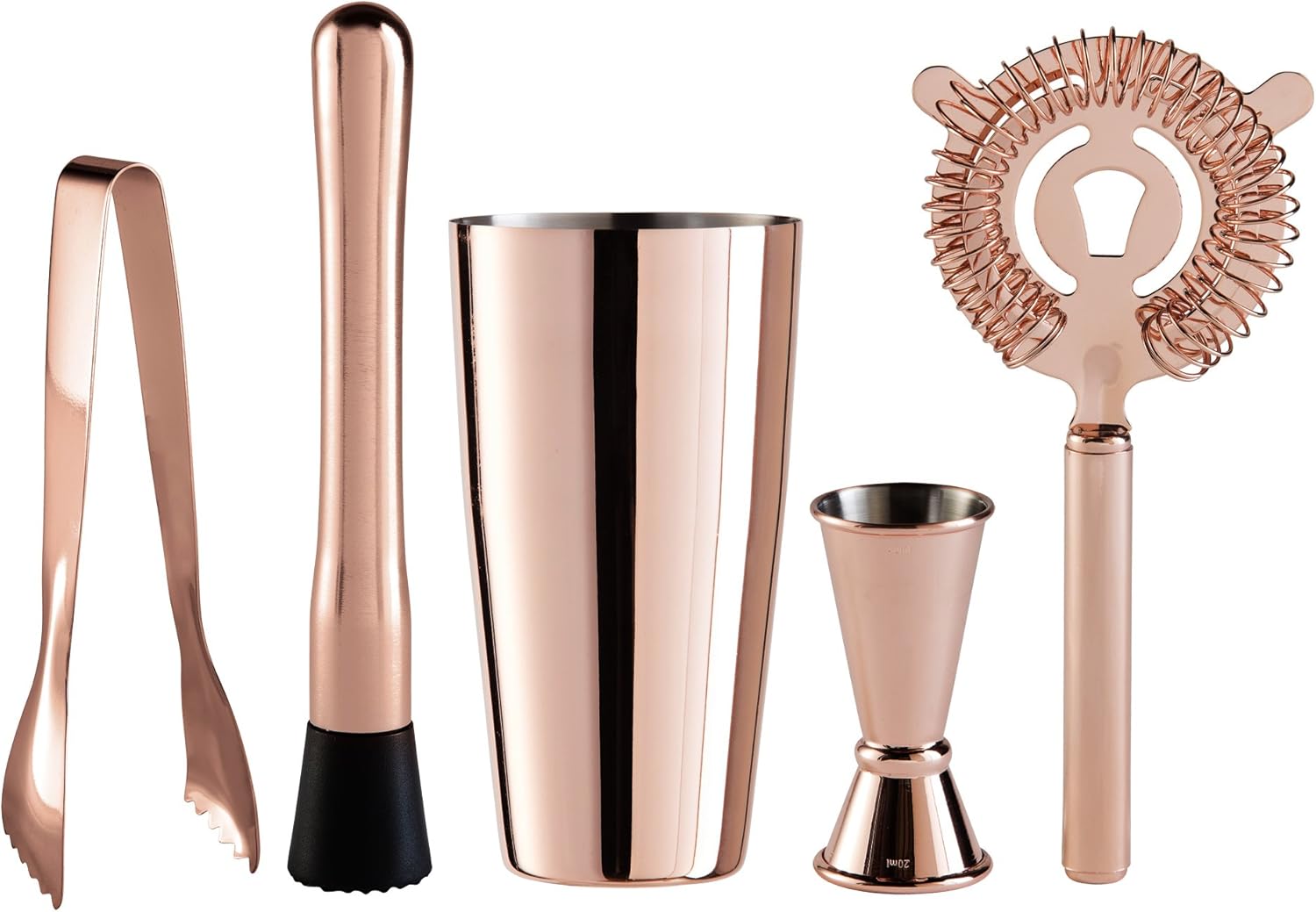
The Oggi set makes an excellent housewarming or holiday gift. Available in multiple finishes. Check Amazon for current pricing and bundles.
View on AmazonLeopold Weighted Tin-on-Tin Boston Shaker Set
Leopold Barware has developed a quiet but devoted following in the serious home bartender community. Their weighted tin-on-tin set stands out for a specific reason: the ergonomics are genuinely superior for home use, where the goal isn’t speed but consistency and enjoyment. The thickened base of each tin provides a low center of gravity that makes the shaker feel planted and controlled, not like something about to slip from cold, wet fingers.
The heavy-gauge construction delivers exceptional chilling. In our testing, the Leopold set matched the Koriko’s temperature performance (drinks to 28–29°F) and actually surpassed it in one metric: heat gain. After sealing and a 12-second shake, we measured how fast the drink temperature rose during the subsequent 30 seconds before pouring. The heavier tin walls of the Leopold slowed heat gain by roughly 15% — a real advantage if you pour slowly or are bartending for multiple guests.
The dimpled texture on the lower half of both tins provides excellent grip without the bulkiness of soft-grip inserts. The seal is firm and consistent; the break point is clean. This is a set you’ll reach for night after night without any frustration.
One note: the weighted design makes this set heavier than most alternatives. If you shake cocktails at high volume or for extended periods, the additional weight may cause fatigue faster than lighter alternatives. For the home enthusiast making four to eight drinks in an evening, it’s a non-issue — and the heft simply feels premium.
✔ Pros
- Superior grip via dimpled texture
- Excellent insulation due to heavy gauge
- Low center of gravity for control
- Impressive temperature performance
- Built to last years of regular use
✘ Cons
- Heavier than standard tins
- No strainer included
- Premium price point
- Slight fatigue with extended high-volume use
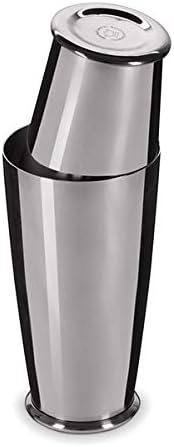
Leopold sets are often available in bundles with a Hawthorne strainer. Verify current availability and pricing on Amazon.
View on AmazonViski Belmont Copper-Plated Cocktail Shaker
Viski’s Belmont shaker is the one you display. The copper-plated stainless body has a depth of warmth that photographs beautifully and looks genuinely luxurious on a bar cart. If you’re building a home bar that doubles as a design statement — or if you need an impressive gift for someone who values aesthetics — the Viski Belmont sits in a category of one.
Behind the beautiful exterior, it’s a well-constructed cobbler shaker. The 17 oz capacity is slightly larger than the Oggi, allowing single large cocktails or small two-drink batches. The copper plating is thick enough to survive years of regular use without significant peeling, though we’d still recommend hand-washing to preserve the finish — the one area where the Viski lags behind full dishwasher-safe stainless competitors.
In functional testing, the Belmont performs solidly: the cap has reasonable tightness, the integrated strainer is fine enough for most applications, and the seal is leak-free under normal shaking force. It isn’t as cold-efficient as the Koriko or Leopold sets (the thinner plating transfers heat from hand to drink slightly faster), but the difference is small — about 2°F in our tests — and most drinkers won’t notice.
Viski also produces a matching set of bar accessories in the same copper finish — jigger, bar spoon, muddler — that create a cohesive home bar aesthetic. For the cocktail enthusiast who treats their bar as part of their living space’s design, this coordination matters. The Belmont shaker sits as a beautiful complement to the flavors explored in our guide to the best cocktail syrups and garnishes.
✔ Pros
- Stunning copper aesthetic
- Premium feel and visual weight
- Coordinated accessories available
- Excellent gift option
- Functional leak-free performance
✘ Cons
- Hand wash only recommended
- Slightly slower chilling vs. bare SS
- Higher price than equivalent performance
- Copper plating requires careful maintenance

Available individually or as part of a matching copper bar set. Perfect for gifting. Check current pricing on Amazon.
View on AmazonUmami Barware Cocktail Shaker Set (14-Piece)
If the Oggi is a good starter set, the Umami Barware 14-piece collection is an entire starter bar program. For a price that undercuts many of the single shakers on this list, Umami delivers a Boston-style shaker tin set, Hawthorne strainer, fine-mesh strainer, bar spoon, muddler, double jigger, bottle opener, ice tongs, cocktail picks, and more. For the person who wants to go from total beginner to properly equipped home bartender in a single purchase, the value proposition is genuinely exceptional.
The 28 oz and 18 oz Boston-style tins are the centerpiece, and they’re better than we expected at this price. The stainless gauge is lighter than the Koriko or Leopold sets, but adequate for home use. The seal forms properly with a firm tap, and the break is reasonably clean — though we noted that the seal quality became less consistent after 6 months of weekly use in our durability testing, something the Koriko showed no sign of.
The included Hawthorne strainer is notably good for the price — it has a proper spring with fine coils that catches ice chips effectively. Combined with the included fine mesh strainer for double-straining, it produces clean pours that would satisfy most home cocktail enthusiasts. The bar spoon is on the shorter side (11 inches vs. a professional 12-inch), but functional. The muddler is solid acacia wood — a genuinely pleasant surprise in a budget bundle.
The Umami set makes a compelling choice for the aspiring home bartender who wants to explore the full range of cocktail-making techniques without committing to individual professional-grade purchases. It’s also a remarkably versatile gift — comprehensive enough to feel luxurious, practical enough to actually be used.
✔ Pros
- Exceptional value — 14 pieces
- Strainers included (Hawthorne + fine mesh)
- Quality acacia muddler
- Boston-style for better results
- Excellent complete gift set
✘ Cons
- Seal consistency decreases over time
- Lighter gauge than premium options
- Bar spoon slightly short
- Storage organization not included
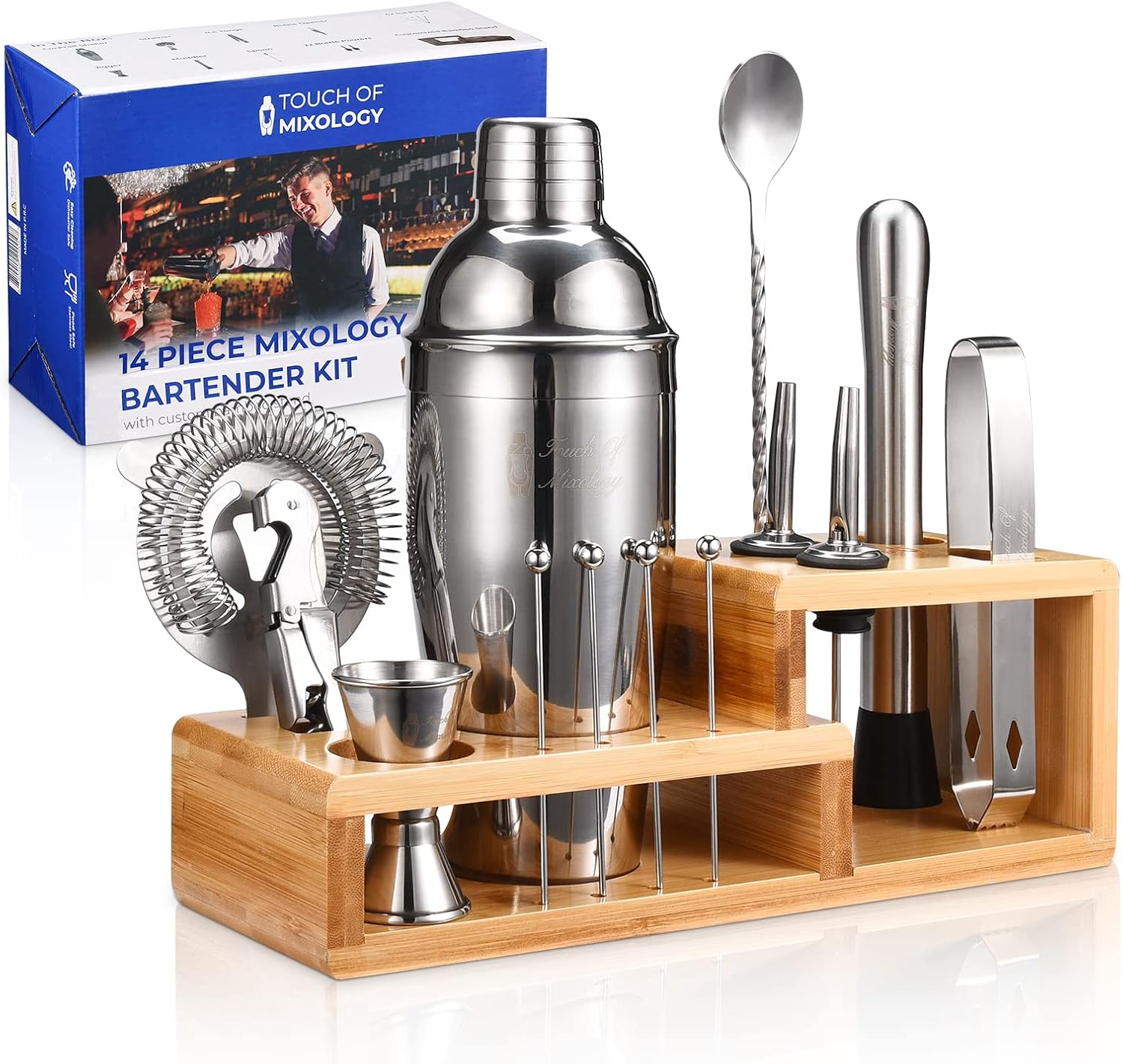
14-piece complete bar set at a remarkable price point. Check Amazon for the current deal — frequently goes on sale.
View on AmazonHow to Use a Cocktail Shaker: A Complete Practical Guide
Owning a great shaker is only half the equation. Understanding how to use it properly is what separates a decent cocktail from a remarkable one. This section covers both cobbler and Boston shaker technique, plus the specific best practices that professional bartenders apply to achieve consistent, high-quality results.
How to Use a Cobbler Shaker
The cobbler shaker is the most intuitive design, but there are still meaningful technique variations that affect outcome. Here’s the correct method:
Step 1: Chill Your Shaker
Before adding any ingredients, fill your shaker halfway with ice and let it sit for 15–20 seconds. This pre-chills the metal, reducing the temperature gradient between the ice and the tin, which produces better dilution control. Discard that ice, then add fresh ice for your drink. This step is almost universally skipped by beginners and almost universally practiced by professionals.
Step 2: Add Ingredients in the Right Order
The professional sequence: bitters first, then syrups, then juices, then spirits. This order matters because it ensures expensive spirits are added last — if you make a measuring error on the sugar syrup, you haven’t wasted a pour of premium whiskey. Add your fresh ice after the liquid ingredients are in; this approach minimizes premature dilution and protects delicate aromatics.
Step 3: Seal and Shake with Correct Technique
For a cobbler: place the strainer cap on firmly, then the top cap. Hold the tin with one hand wrapped around the base and the other palm covering the top cap. Shake horizontally — not vertically — with a brisk back-and-forth motion for 10–12 seconds. You should feel the tin get noticeably colder. For a Boston tin: seat the small tin into the large tin at a slight angle, then tap the base of the small tin firmly with your palm to create the seal. Hold the assembly with two hands — one on each end — and shake vigorously.
Step 4: Breaking the Seal (Boston Shaker)
This is where beginners often panic. After shaking, the thermal contraction creates a vacuum-like seal. To break it: hold the large tin firmly in one hand. With the heel of your other hand, give a firm, angled strike to the tin at the point where the small tin overlaps the large tin — about one inch below the seam. You’ll feel and hear a “thwack” as the seal breaks. Don’t twist; don’t pry. Strike and separate in one clean motion. After 10–20 repetitions, this becomes instinctive.
Step 5: Straining Properly
For a cobbler shaker, simply remove the top cap and pour through the integrated strainer. For a Boston shaker, seat a Hawthorne strainer over the large tin, applying gentle finger pressure to the spring coil to tighten it against the rim, and pour. For egg-white cocktails, cloudy drinks, or anything that needs exceptional clarity, double-strain through a fine-mesh strainer into the glass — this removes all ice shards and pulp fragments.
The Shake Styles Explained
There isn’t just one way to shake a cocktail. Professional bartenders distinguish between several shaking styles, each producing different results:
| Shake Style | Description | Best For | Duration |
|---|---|---|---|
| Standard Shake | Vigorous horizontal back-and-forth motion | Most cocktails: Daiquiri, Margarita, Gimlet | 10–12 seconds |
| Dry Shake | Shake WITHOUT ice first, then add ice and shake again | Egg white drinks: Whiskey Sour, Clover Club | 15–20 sec dry, 10 sec cold |
| Reverse Dry Shake | Shake with ice first, strain out ice, shake again without ice | Exceptionally silky egg white texture | 10 sec cold, 15 sec dry |
| Whip Shake | Fast, light shaking with minimal ice | Tiki drinks, crushed ice cocktails | 5–8 seconds |
| Roll (Cuban Shake) | Slow pour between tins rather than shaking | Bloody Mary — prevents over-aeration | 3–5 back-and-forth rolls |
Understanding these techniques unlocks the full potential of any shaker on this list. A Whiskey Sour properly dry-shaken and then cold-shaken achieves a foam texture that no amount of extra shaking with ice alone can replicate. It’s one of those bartender techniques that genuinely produces a better drink — and it’s free education that pays dividends forever.
Caring for Your Cocktail Shaker: Maintenance & Longevity Tips
A quality cocktail shaker is an investment that should last years or decades with proper care. The good news: maintenance is genuinely simple. The bad news: there are a few common mistakes that can ruin a shaker faster than you’d expect.
Cleaning Stainless Steel Shakers
Standard brushed and mirror-polished stainless shakers are dishwasher safe, but there’s a caveat: the high-heat drying cycle in most dishwashers can cause water spotting on mirror-polished finishes over time. The most practical approach is to rinse immediately after use with warm water (the most important step — letting citrus juice sit in metal for hours is genuinely corrosive), wash with dish soap and warm water, and air dry or towel dry immediately to prevent water spots.
For cobbler shaker caps and integrated strainers: use a thin brush (a cocktail straw brush or pipe cleaner works perfectly) to clean the strainer holes. Pulp and sugar syrup can accumulate in the mesh and attract bacteria if not cleared. A 30-second targeted scrub after every use keeps the strainer performing properly.
Cleaning Copper-Plated Shakers
Copper-plated shakers like the Viski Belmont need extra care. Avoid the dishwasher entirely — the high heat and harsh detergents will degrade the copper plating over time. Hand wash with mild dish soap, rinse thoroughly, and dry immediately. For tarnish (the natural oxidation of copper that creates a darker, less brilliant surface), use a dedicated copper polish or a natural alternative: a paste of equal parts salt, flour, and white vinegar applied briefly with a soft cloth and rinsed immediately.
Preventing the Cold-Lock Problem
The most common complaint about cobbler shakers — the cap locking after cold shaking — can be dramatically reduced with one simple practice: don’t overfill with ice. Leave at least one inch of air space above the ice in the tin. This space allows the gases and pressure created during shaking to distribute properly, reducing the vacuum effect that causes cold-lock. The OXO Pro’s cap design largely solves this mechanically, but the practice is good regardless of which cobbler you use.
Never put a cobbler shaker in the freezer to pre-chill it with the cap sealed — the expanding metal can deform the cap threads permanently. Pre-chill with ice inside the open tin instead.
Storage
Store shakers with the cap off or loose — a tightly sealed empty shaker traps moisture and can develop odors over time. For Boston tin sets, store the tins nested inside each other but not fully locked — a slight offset prevents them from cold-welding together in storage. A simple bar mat, cork block, or dedicated cocktail tool roll keeps everything organized and prevents the scratching that occurs when metal tools are loose in a drawer together.
Matching Your Shaker to Your Cocktail Style
Your ideal shaker depends significantly on what you actually make. Here’s a practical guide to matching shaker type to cocktail category:
Classic Sours (Daiquiri, Margarita, Whiskey Sour, Gimlet)
These are the definitive “shaken cocktails” — citrus-forward, spirit-forward, often with egg white. The Boston tin is the professional choice here because it produces the coldest final temperature and the best aeration, which is especially important for egg-white sours. If you make a lot of Whiskey Sours or Pisco Sours, the Koriko or Leopold set is worth the investment. For home-friendly results, the OXO Pro cobbler handles these well.
Tropical & Tiki Drinks
Tropical cocktails often call for a whip shake with minimal ice — the goal is light dilution and aeration without full chilling. A standard Boston tin with a whip-shake technique works best. The Barfly set or Umami set are both excellent here. Tiki drinks, with their complex layering and fresh fruit juices, also benefit from Boston tin-level control.
Martinis & Stirred Drinks
Important note: a Martini is stirred, not shaken (James Bond’s preference notwithstanding). If your cocktail repertoire skews toward stirred drinks — Martini, Manhattan, Negroni, Old Fashioned — you technically need a mixing glass and bar spoon more than a shaker. However, every home bar should have a shaker for the inevitable times when a guest wants a shaken drink, and the Umami set (which includes a bar spoon) is a sensible choice for practitioners of both techniques.
For the full spectrum of cocktail recipes paired with recommended technique and equipment, our cocktail recipe guide is an excellent companion resource to this shaker review. And if you’re exploring food and cocktail pairing, our best cocktail syrups guide covers the savory side of the cocktail table — from shrimp cocktail to garnish preparation.
Party Batching
If you regularly make cocktails for groups, single-serve shakers are a limitation. The 28 oz Boston tins accommodate two generous cocktails per shake. For true batching (four to six drinks at once), you’ll need a pitcher or mixing bowl — no shaker on this list handles more than two drinks efficiently. Plan for two tin sets if you regularly entertain large groups; it doubles your throughput without requiring premium investment in each set.
Frequently Asked Questions About Cocktail Shakers
The OXO Good Grips Pro Cocktail Shaker is the best choice for beginners. It’s a cobbler-style shaker that doesn’t require a separate strainer, has a non-slip grip, and most importantly, the cap opens reliably even after cold shaking — the most frustrating problem for newcomers. The Oggi 5-Piece Set is the best complete beginner package if you also need a jigger, bar spoon, and opener.
A cobbler shaker is three pieces: a tin body, a built-in strainer cap, and a small top cap. It’s beginner-friendly and self-contained but caps can stick when cold, and the built-in strainer has larger holes than a separate Hawthorne strainer. A Boston shaker is two pieces: a large tin and a smaller tin (or pint glass). It requires a separate Hawthorne strainer but is the professional standard — faster, colder, and more versatile for experienced bartenders.
This is the “cold-lock” effect. When you shake with ice, the metal contracts slightly due to the cold temperature, creating a tighter fit between the cap and body. To prevent it: (1) don’t overfill with ice — leave at least 1 inch of air space; (2) choose a shaker with a wide cap diameter relative to the body (the OXO Pro is designed specifically to minimize this); (3) tap the base of the shaker on the counter before opening to disrupt any seal. If the cap is truly stuck, wrap it in a hot towel for 10 seconds to expand the metal.
The standard recommendation is 10–12 seconds of vigorous shaking for most cocktails. This achieves optimal dilution and temperature without over-diluting the drink. Egg-white cocktails should be dry-shaken (no ice) for 15–20 seconds first to emulsify the egg white, then cold-shaken for 10 seconds with ice. Whip shakes for tiki drinks use 5–8 seconds with minimal ice. You’ll know the shake is complete when the tin feels very cold — nearly uncomfortable — in both hands.
Both are food-safe and non-reactive. The numbers refer to chromium and nickel content: 18/8 = 18% chromium, 8% nickel; 18/10 = 18% chromium, 10% nickel. 18/10 is slightly more corrosion-resistant and has a marginally brighter polish, which is why it’s used in premium cutlery. For cocktail shakers, 18/8 is the standard and entirely sufficient — the additional nickel in 18/10 makes a negligible real-world difference for shaker use. Focus on gauge thickness (thicker = better insulation) over the 18/8 vs. 18/10 distinction.
Yes — a Hawthorne strainer is essential with a Boston shaker set. The tins themselves have no built-in straining mechanism. A Hawthorne strainer (the spring-coil type) seats over the tin’s rim and catches ice and large debris. For cleaner pours — especially with fresh juices or egg whites — double-strain through a fine-mesh strainer as well. Budget $10–15 for a quality Hawthorne strainer; the OXO or Cocktail Kingdom versions are both excellent choices.
Most stainless steel shakers are dishwasher safe — including the OXO Pro, Barfly, Koriko, Leopold, and Umami sets. The exception: copper-plated shakers (like the Viski Belmont) should be hand-washed only. Dishwasher heat and harsh detergents degrade copper plating over time. Mirror-polished stainless can also develop water spotting in the dishwasher’s drying cycle; hand-drying immediately after washing preserves the finish. Always rinse shakers immediately after use regardless of whether you dishwash — this is the most important maintenance step.
The overwhelming professional standard is the Boston tin-on-tin set, with the Cocktail Kingdom Koriko being the single most commonly cited brand among working bartenders. Its precision-formed rims, weighted design, and consistent seal have made it the benchmark against which other professional tins are measured. Some international bartenders prefer the Parisian/French shaker for its aesthetic and ease of separation, but in North America, the Boston tin-on-tin is the near-universal professional choice. You can see this firsthand by visiting the world’s best cocktail bars — Koriko tins appear behind most of them.
For single-serve cocktails at home, a 16–18 oz cobbler or an 18 oz small Boston tin is sufficient. For making two drinks at a time (the most common home bar scenario), a 28 oz large Boston tin is the practical standard. If you regularly entertain and need to batch three or more drinks, consider two Boston tin sets run simultaneously, or shift to a pitcher-based batch cocktail approach for pre-mixing. Small cobblers (10–12 oz) exist but are genuinely limiting for anything other than a single small drink.
Copper is beautiful but higher-maintenance. Pure copper shakers (not copper-plated stainless) are used in traditional cocktail culture and are particularly associated with Moscow Mules (copper mugs, not shakers). For shakers specifically, copper-plated stainless steel (like the Viski Belmont) provides the aesthetic of copper with the durability and food safety of stainless steel. Solid copper shakers require careful cleaning to prevent copper oxide buildup, must not contact acidic ingredients without proper lacquering, and are significantly more expensive. For most home bartenders, copper-plated stainless is the better balance of look and practicality.
The essential bar toolkit beyond a shaker: (1) Jigger — precise measuring is the single biggest differentiator in home cocktail quality; (2) Hawthorne strainer — required for Boston shakers, useful for cobblers too; (3) Bar spoon — for stirred cocktails and layered drinks; (4) Muddler — for Mojitos, Old Fashioneds, Caipirinhas; (5) Fine-mesh strainer — for double-straining juice-forward and egg-white cocktails; (6) Channel knife / peeler — for citrus twists and garnishes. The Umami 14-piece set covers all of these in one purchase.
Final Recommendations: Which Shaker Should You Buy?
After all the testing, all the temperature measurements, and all the side-by-side shaking sessions, the answer to “which cocktail shaker is best?” comes down to who you are and what you make.
🏆 Buy the OXO Good Grips Pro if:
You’re building your first home bar, you want a cobbler’s simplicity without the frustrations of most cobblers, you make a few cocktails at a time, and you want excellent results without a learning curve. This is the single best shaker for most home bartenders and the one I’d give as a gift without hesitation.
⭐ Buy the Cocktail Kingdom Koriko if:
You’re serious about cocktail quality, you’re willing to invest 20 minutes learning Boston shaker technique, you want the same tool used by the world’s best bars, and you plan to use your shaker regularly for years. This is the best shaker made, period.
💰 Buy the Barfly Set if:
You want to step into professional Boston-style shaking without spending premium money. The cheater tin design makes the learning curve shorter, the performance is near-professional, and the price is genuinely fair for what you get.
🎁 Buy the Oggi 5-Piece or Umami 14-Piece if:
You want a complete beginner setup in one purchase, you’re buying a gift, or you want everything at once without researching each tool separately. Both are solid, well-chosen kits that remove all friction from getting started.
✨ Buy the Viski Belmont if:
Aesthetics matter and you want your bar to look as good as the drinks it produces. The Belmont is a beautiful object that makes a genuinely impressive gift and a distinctive addition to any home bar design.
Whatever you choose, pair it with fresh ingredients, accurate measuring, and the right technique. The tools facilitate the craft — but the craft is yours. For inspiration on where to take your cocktail making, explore the world’s most celebrated cocktail destinations in our guide to the best cocktail bars in the world, and put your new shaker to work with our curated collection of best cocktail recipes.
Ready to Shake Your Best Cocktail Yet?
Whether you’re just starting out with an OXO Pro or upgrading to the professional Koriko set, the right shaker will meaningfully improve every drink you make. Colder temperatures, cleaner pours, better aeration — it all starts with the right tool in your hand.
Explore our complete cocktail library for recipes to put your new shaker to work:
🍹 Browse Cocktail Recipes →