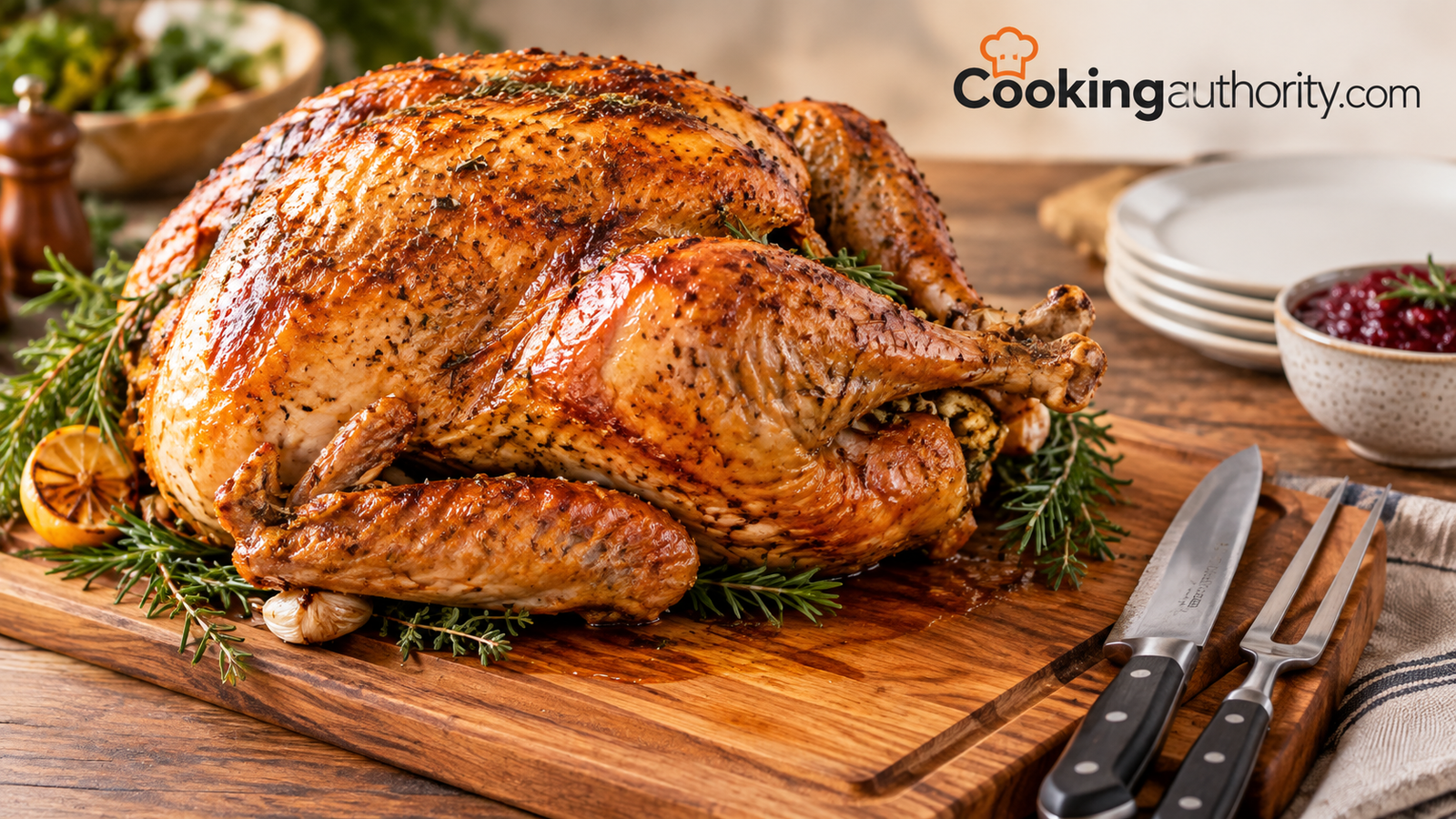
How Long Should a Turkey Rest After Cooking?
The short answer, the science behind it, and a practical timeline so your bird comes to the table juicy, safe, and still warm.
There is a particular kind of silence that falls over a kitchen when a turkey comes out of the oven. The skin is crackling, the smell is everywhere, and everyone in the house suddenly has an opinion about when dinner should start. The most common instinct is to grab a knife right away. It is also the most common way to end up with a puddle on the cutting board and meat that tastes drier than it should.
Resting is the fix, and it costs you nothing but patience. The bird sits quietly while the heat inside evens out, the juices settle back into the muscle, and the whole thing becomes easier to carve and noticeably more tender. The real question most cooks have is simply how long that patience needs to last. Too short and you lose the benefit. Too long and you start worrying about a cold dinner or about food safety.
This guide answers the question directly and then goes deeper: how rest time changes with the size of the bird, what actually happens inside the meat, how to rest a turkey so it stays warm, what to do for different cooking methods, and how to schedule the whole meal around that waiting period. Whether you are feeding four people with a small breast or twenty with a monster bird, you will leave with a clear plan.
1. The Short Answer: How Long Should a Turkey Rest?
Most turkeys should rest for 30 to 45 minutes after coming out of the oven. Smaller birds and bone-in breasts can rest 20 to 30 minutes, and very large turkeys over 20 pounds can rest up to an hour. Resting longer than about an hour and a half is rarely worth it.
That window works for the vast majority of home cooks, and it holds up across almost every recipe you will find from trusted sources. Thirty minutes is the practical minimum for a whole roasted turkey. Below that, the juices have not had enough time to redistribute, and the meat is still hot enough that slicing releases a lot of liquid.
Here is the quick version of what the numbers look like:
- Turkey breast only (3 to 6 pounds): 15 to 25 minutes.
- Small whole turkey (8 to 12 pounds): 25 to 35 minutes.
- Standard whole turkey (12 to 16 pounds): 30 to 45 minutes.
- Large whole turkey (16 to 20 pounds): 40 to 50 minutes.
- Extra-large turkey (20+ pounds): 45 to 60 minutes.
Notice that the range is generous. Rest time is not a precise science the way oven temperature is. A turkey that rests 35 minutes and one that rests 50 minutes will both be excellent, provided the bird is covered loosely and the kitchen is not freezing. What you are really protecting against is the extremes: carving in the first five minutes, or leaving the bird out for hours.
Why the range exists
Several things push the ideal time up or down. A bigger bird holds more heat, so the interior takes longer to equalize. A bird roasted at a higher temperature has a bigger gap between its hot outer layer and its cooler center, which means more equalizing to do. A cold kitchen sheds heat faster, so you may want a shorter rest or better insulation. The shape matters as well: a spatchcocked turkey is flat and thin, so it loses heat quickly and needs a shorter rest than a tall, deep, stuffed bird.
The practical rule of thumb
If you want one number to carry in your head, use roughly 2 to 3 minutes of rest per pound, with a floor of 20 minutes and a ceiling of about an hour. A 14-pound turkey lands somewhere around 30 to 42 minutes. A 22-pound turkey lands around 45 to 60. It is a handy way to sanity-check any recipe that gives you a vague instruction like “let it rest before carving.”
You will also hear that you should rest a turkey as long as you rested the roast beef or the pork loin. That comparison does not hold up well, because a turkey is a much larger, hollow-cavity piece of meat with a different structure. If you are curious how the same idea plays out on a different protein, our guide on how long steak should rest after cooking shows how much shorter the window is for a thin cut and why.
2. Why Resting a Turkey Matters So Much
Resting sounds like a fussy extra step, the sort of thing cookbook authors insist on and nobody quite believes. But there are three concrete, physical reasons it makes a difference, and understanding them will make you far more willing to wait.
Reason one: juices need to resettle
Turkey muscle is made of long fibers packed with water, proteins, and a little fat. As the bird roasts, the heat causes those fibers to tighten and squeeze moisture toward the cooler center of the meat. If you cut it right away, that pressurized liquid has nowhere to go but out onto the board. As the meat cools slightly, the fibers relax and the proteins that have been holding water begin to set. The juices thicken a little and redistribute throughout the muscle instead of rushing out when you slice.
You can see the difference clearly if you carve one half of a breast immediately and rest the other half. The un-rested half leaves a visible pool behind. The rested half stays moist on the plate, and the slices look glossy rather than wet and pale.
Reason two: the temperature evens out
A roasting turkey is not a uniform object. The skin and outer layer of meat can be well above 200°F while the center of the thigh is just reaching its target. When the bird leaves the oven, that gradient starts to level out. Heat flows from the outside toward the middle, which finishes cooking the thickest parts gently without overcooking the outside any further. We cover this effect, called carryover cooking, in detail in the next section.
Reason three: carving becomes easier and cleaner
A very hot turkey is slippery and delicate. The meat can shred when you slice and you risk burning your hands trying to hold it steady. After a proper rest, the meat firms up just enough that a sharp knife glides through, the slices hold together, and you get the neat, presentable pieces that make a holiday table look good.
What happens if you skip the rest entirely
Skipping the rest does not ruin a turkey, but it does cost you. You will lose noticeably more liquid during carving, the slices will be less tender, and the breast in particular, which has very little fat to protect it, will taste drier. Many people who say they dislike turkey breast are actually reacting to under-rested, overcooked, or both. Giving the bird 30 to 45 minutes is the cheapest upgrade available to the home cook.
A word on the “juice redistribution” debate
Food scientists have pointed out that juices do not literally travel back from the center to the edges like water through a sponge. What really happens is a combination of the proteins relaxing, the liquid thickening as it cools, and the temperature gradient shrinking, all of which reduce how much fluid escapes when you cut. The practical conclusion is the same, and every controlled side-by-side test shows the rested meat retaining more moisture. So you can rest assured the technique works, even if the popular explanation is a little simplified.
What the experts and test kitchens keep finding
Side-by-side tests are surprisingly consistent. When cooks weigh a turkey breast before and after carving, the rested portion loses noticeably less liquid than the one sliced straight from the oven. Tasters then describe the rested meat as more tender and more flavorful, even though both pieces came from the same bird. The effect is strongest in the breast, which is lean and tight-fibered, and weaker in the thigh, which has more fat and connective tissue to hold moisture. If you only have patience for one part of the bird, make it the breast.
This is also why a turkey that was brined, dry-brined, or injected tends to be more forgiving. Salt changes how muscle proteins hold water, so a brined bird keeps more moisture even if the rest is imperfect. Resting and brining work as a team: one improves how much water the meat holds, and the other keeps it from escaping at the moment you cut.
3. Carryover Cooking and the Temperatures That Matter
Carryover cooking is the reason resting is more than a matter of juiciness. When you remove a large piece of meat from a hot oven, its surface is much hotter than its center. For the next 15 to 30 minutes, that stored heat keeps flowing inward, and the internal temperature continues to climb even though the oven is off.
How much does the temperature rise?
For a whole turkey, expect the deepest part of the breast to rise roughly 5 to 10 degrees Fahrenheit during the rest, and sometimes a little more with a very large bird or a very hot oven. The thigh, which sits deeper and is surrounded by more mass, can also climb several degrees. The bigger the bird and the hotter the roasting temperature, the larger the carryover effect.
| Factor | Effect on carryover |
|---|---|
| Larger bird | More stored heat, bigger rise, and a longer period before the center peaks |
| Higher oven temperature | Steeper gradient between skin and center, so more temperature climb |
| Stuffed cavity | Extra mass in the center holds heat and slows the cooling |
| Spatchcocked or flat | Thin profile, less stored heat, smaller rise |
| Cold kitchen or drafts | Heat escapes faster and the rise ends sooner |
| Tight foil wrap | Traps heat and steam, increases the rise but softens the skin |
The official safe temperature
The USDA safe minimum internal temperature for poultry is 165°F, measured in the thickest part of the breast, the innermost part of the thigh, and the innermost part of the wing. That is the number that matters for safety, and no amount of resting changes it. If you have never taken the temperature of a bird before, our roundup of the best cooking thermometers will help you pick a model that gives fast, accurate readings.
Many cooks aim to pull the turkey from the oven when the breast reads around 155 to 160°F and let carryover finish the job, because by the time it peaks the breast has reached 165°F without being overshot. This is a legitimate technique and it produces a juicier breast. The condition is that you verify the temperature during the rest. Watch the thermometer, confirm the breast and thigh have hit at least 165°F, and only then carve. If the reading stalls below 165°F, return the bird to the oven for a few more minutes. If you are cooking for anyone in a higher-risk group, such as young children, older adults, pregnant guests, or anyone with a weakened immune system, simply pull it at 165°F and skip the early-pull shortcut.
Why the thigh is different
Dark meat tolerates, and even benefits from, higher temperatures. The thigh contains more connective tissue that needs to break down to become tender, and many cooks like it at 175 to 180°F. This is the central tension in roasting a whole turkey: the breast is ready around 160 to 165°F while the thighs want to keep going. A rest helps a little by letting the breast coast to its finish, but if your thighs are noticeably undercooked, you may want to separate the legs and return them to the oven while the breast rests.
Reading the thermometer during the rest
Insert the probe into the thickest part of the breast, angled so the tip sits in the center and does not touch bone. Check again at the 10-minute and 20-minute marks. You will typically see the number climb for the first 10 to 20 minutes and then plateau and slowly fall. That peak is your confirmation the bird is done. If you have a leave-in probe thermometer with an alarm, you can set a target and let it tell you when the carryover has finished.
If you want a point of comparison for how poultry temperatures differ across cuts, our guide to the safe temperature for cooking chicken explains the same 165°F standard and how it applies to breasts, thighs, and whole birds.
4. Turkey Rest Time Chart by Weight and Type
This chart consolidates the guidance into one place so you can screenshot it or save it for the holidays. Times assume a bird that is loosely tented and resting in a room that is comfortably warm, roughly 68 to 72°F.
| Turkey Type & Weight | Recommended Rest | Expected Carryover | Notes |
|---|---|---|---|
| Boneless breast roll, 2 to 4 lb | 10 to 15 min | 3 to 5°F | Small mass, so rest briefly and serve quickly |
| Bone-in breast, 4 to 7 lb | 15 to 25 min | 5 to 8°F | Tent loosely and check for 165°F in the thickest part |
| Whole turkey, 8 to 12 lb | 25 to 35 min | 5 to 10°F | Great size for small gatherings |
| Whole turkey, 12 to 16 lb | 30 to 45 min | 5 to 10°F | The standard holiday bird |
| Whole turkey, 16 to 20 lb | 40 to 50 min | 8 to 12°F | Plan the oven schedule around a longer rest |
| Whole turkey, 20 to 25 lb | 45 to 60 min | 8 to 15°F | Check temperature at several points |
| Spatchcocked turkey, any size | 15 to 25 min | 3 to 6°F | Flat shape loses heat quickly |
| Deep-fried turkey | 20 to 30 min | 3 to 5°F | Drain well, then rest uncovered or very loosely tented |
| Smoked turkey | 20 to 40 min | 5 to 8°F | Lower cooking temperature, so a gentler rise |
| Grilled turkey | 20 to 35 min | 5 to 8°F | Rest away from direct heat |
How to use the chart
Find the row closest to your bird and treat the range as flexible. If your oven schedule is tight, the lower end is fine. If you have the time and a warm spot to leave the turkey, the upper end gives a little extra insurance for tenderness. If your turkey falls between two rows, go with the larger one. A slightly longer rest rarely hurts, while a rest that is too short can.
The effect of stuffing
If you roasted the turkey with stuffing inside the cavity, the stuffing must also reach 165°F, and it will act as extra insulation. Leave the stuffing in during the first part of the rest if you like, but scoop it into a serving dish before carving. A stuffed bird typically holds its heat for a long time, so you can lean toward the longer end of the range without worrying about it getting cold.
Frozen versus fresh birds
Once the turkey is cooked, there is no difference in how it rests. What matters is the weight and the way it was cooked. If you started with a frozen turkey that was brined or injected with solution, it will usually be more forgiving, and the juices tend to hold up well even if the rest runs a little long or short.
Adjusting for your own oven and kitchen
Every oven runs a little differently, and every kitchen has its own temperature. If your oven runs hot, your turkey will likely finish with a bigger gap between the skin and the center, so lean toward the longer end of the range. If your kitchen is cold, say a garage fridge-cold pantry or an open-plan room in winter, lean toward the shorter end and use a snugger tent to compensate. Over time you will learn how your own setup behaves, and writing down the weight, the pull temperature, the rest time, and the result will make next year’s turkey even better.
It also helps to think in terms of the turkey’s temperature instead of the clock alone. A reasonable target is to carve when the breast has stopped climbing and has begun to drift down by a degree or two, and the meat feels warm and slightly firm when you press gently on it. The clock gives you a plan; the thermometer gives you the truth.
5. Setting Up the Perfect Resting Station
A good rest depends less on any single trick and more on a few sensible choices. Think of it as creating a calm, slightly warm spot where the turkey can sit undisturbed while you finish the rest of dinner.
Choose the right surface
You have two good options. The first is to leave the bird in the roasting pan, on the rack, so the bottom does not sit in its own juices. This keeps the skin from getting soggy underneath and makes cleanup simple. The second is to transfer the turkey to a large cutting board, ideally one with a groove to catch the runoff. Whichever you pick, move the bird carefully. A hot turkey is heavy and slippery, so use sturdy tongs or two large forks, or lift it with clean, heat-safe gloves or the rack handles.
Pick a warm, draft-free spot
Resting near an open window or under a ceiling vent speeds up cooling and can leave the outer layer chilly before the center has finished. A counter away from drafts, ideally in a room that is already warm from cooking, is perfect. Avoid placing the turkey next to a cold stone surface or on top of a cold appliance.
Do not move it around
Once the turkey is resting, leave it alone. Poking, shifting, and tilting it releases juices and lets heat escape. The best resting turkey is the one that sits untouched until you are ready to carve.
A step-by-step flow for the first minute
- Take the pan out of the oven and set it on a heat-safe surface.
- Insert the thermometer in the breast and thigh to confirm the current temperature.
- If the temperature is on target, move the bird to the resting spot, or leave it on the rack in the pan.
- Tent loosely with foil if desired.
- Set a timer for the first check at 15 minutes.
Save the pan drippings
While the turkey rests, the roasting pan is free. This is the moment to make gravy, which we cover in the timeline section. Pour the drippings through a fine strainer or into a fat separator and keep them warm. Do not discard those browned bits stuck to the pan. They are the foundation of the best gravy you will make all year.
6. Foil, Towels, and Coolers: Should You Cover a Resting Turkey?
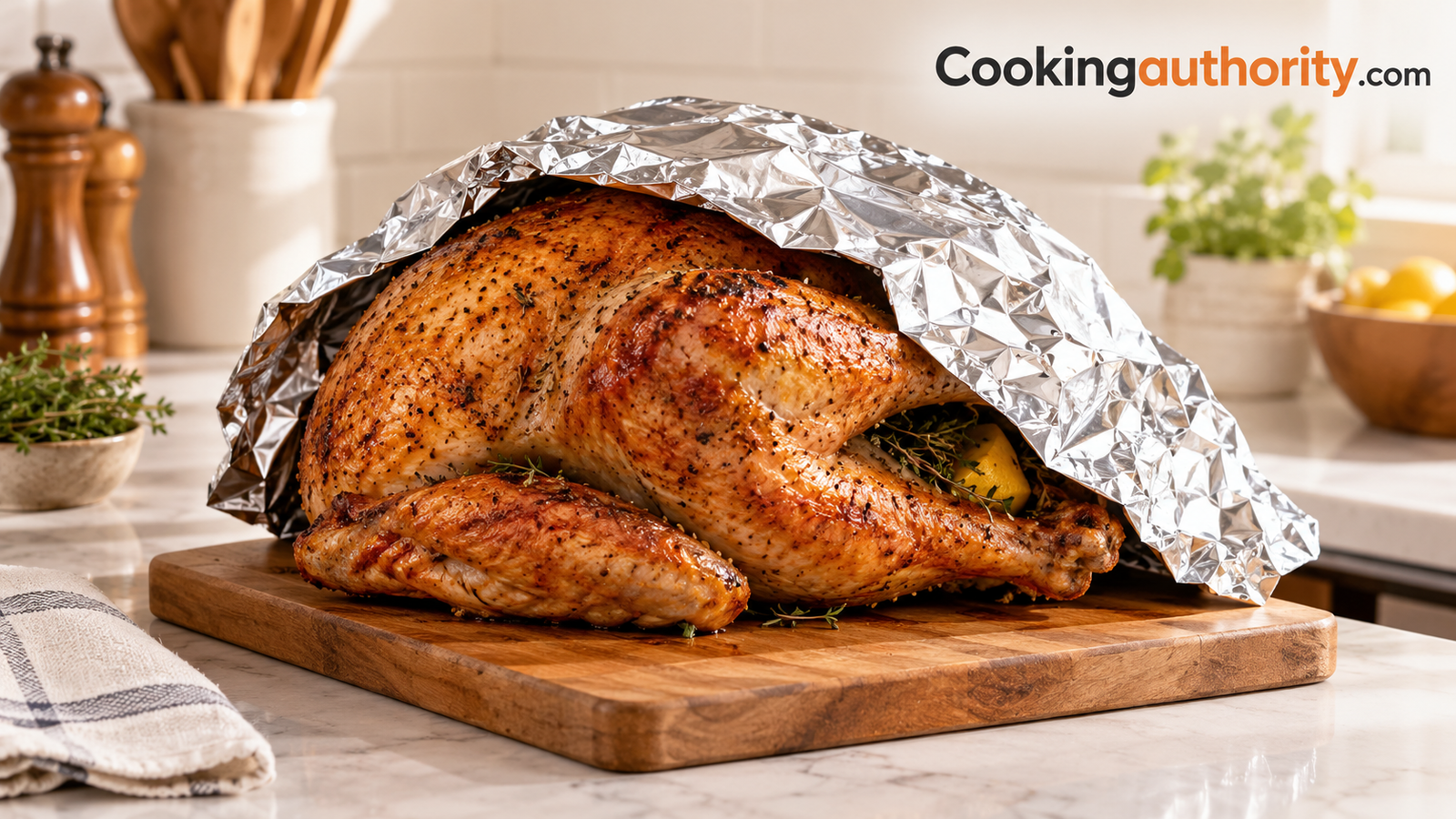
This is one of the most debated parts of the whole process, and the answer is a nuanced one. Covering a resting turkey slows heat loss, which helps keep it warm. But it also traps steam, which can soften the crisp skin you worked hard to get. The sweet spot is a loose, partial cover that holds in heat without sealing in moisture.
Loosely tented foil
The most common method is to drape a sheet of aluminum foil over the bird so it forms a loose tent, shiny side facing in, with plenty of space between the foil and the skin. The foil should not touch the skin and should not be crimped tightly around the edges. A gap at the sides lets steam escape. This approach holds the heat for 30 to 45 minutes while keeping most of the crispness. For a deeper look at the broader question of covering turkey during cooking and afterward, see our article on whether you cover a turkey when cooking.
Tight foil wrap
Wrapping the turkey tightly in foil keeps it hot for a long time, which is useful if you need to hold it for an hour or more. The cost is the skin: it will steam and turn soft and rubbery. If crisp skin is non-negotiable, avoid the tight wrap, or consider flashing the bird under the broiler for a minute or two just before serving.
Leaving it uncovered
An uncovered bird keeps the crispest skin and works well when the kitchen is warm and you plan a short rest of 20 to 30 minutes. The downside is that the surface cools faster, and the bird may be a little less hot at serving time. For smaller turkeys and breasts, this is often a perfectly good choice.
Towels and the cooler method
For an extra-long hold, some cooks wrap the foiled turkey in thick clean towels and place it in an empty cooler. This acts like a thermos, and a large bird can stay at a safe holding temperature for a surprisingly long time. It is a clever trick for juggling a crowded oven schedule, but it should be used with care and always with a thermometer so you can verify the turkey stays above 140°F. Keep the total time that the bird spends between 40°F and 140°F under two hours, as we explain in the food safety section.
Pros of Covering Loosely
- Keeps the turkey warmer longer
- Protects the meat from drafts
- Retains most of the skin texture
- Gives you flexibility with timing
Cons of Covering Tightly
- Steam softens the crispy skin
- Can increase carryover and overshoot the target
- Moisture can pool under the foil
- Harder to monitor the bird
The verdict
For most people, a loose foil tent is the best compromise. It works for the standard 30 to 45 minute rest and does not noticeably hurt the skin. Save the tight wrap and towel-and-cooler method for situations where you really need to buy extra time.
7. Food Safety While Your Turkey Rests
A turkey resting on the counter for half an hour or more raises a fair question: is it safe? The answer is yes, provided you follow a few simple rules. Understanding them also removes the anxiety that pushes many cooks to carve too early or to refrigerate a bird that has barely cooled.
The danger zone explained
Food safety agencies describe a “danger zone” between 40°F and 140°F, the range in which bacteria multiply fastest. The standard guidance is that cooked food should not spend more than two hours in that range, and only one hour if the room is hot, above roughly 90°F. The key point is that a freshly roasted turkey begins its rest well above 140°F, usually in the 150s to 160s inside and far hotter on the surface. It will take a long time to fall into the danger zone, and during a normal 30 to 45 minute rest it stays comfortably above it in the middle.
The two-hour clock
The two-hour clock starts when the bird drops below 140°F, not when it leaves the oven, but the cautious habit is to count from the moment the turkey comes out. By that conservative method, you should aim to have the turkey carved, served, and the leftovers refrigerated within two hours of removing it from the oven. A 30 to 45 minute rest, followed by carving and a leisurely meal, fits easily within that window as long as you do not let the leftovers sit around the table all afternoon.
| Stage | Target | What to do |
|---|---|---|
| Out of the oven | 165°F minimum in breast, thigh, wing | Confirm with an instant-read thermometer |
| During the rest | Stay above 140°F in the thickest parts | Tent loosely, keep in a warm spot, check once or twice |
| After carving | Serve promptly | Keep sliced meat covered and warm until the meal starts |
| After the meal | Refrigerate within 2 hours | Store in shallow containers so it chills quickly |
What if the turkey needs to wait longer?
Occasionally dinner is delayed. A late guest, a pie that will not set, a gravy that is misbehaving: the turkey ends up sitting. If you expect to hold the bird for more than an hour, do not simply leave it on the counter and hope. Instead, carve it, place the slices in a covered dish with a splash of warm broth, and keep it in a low oven set to 170 to 200°F, or in a chafing dish. This keeps it above 140°F and safe, and the broth stops the slices from drying out.
Handling raw and cooked poultry
Safe resting also means keeping cross-contamination in check. The board, knife, tongs, and platter that touched the raw bird should never touch the cooked turkey without being washed first. Use a clean board for carving, or wash the one you used for prepping with hot, soapy water. Along the same lines, avoid rinsing a raw bird at the sink, since it splashes bacteria around the kitchen. Our explainer on whether you should wash chicken before cooking applies equally to turkey and explains why skipping the rinse is the safer move.
Leftovers and cooling
When the meal is over, strip the meat from the carcass and refrigerate it in shallow containers so it cools quickly. A giant pile of meat in a deep dish stays warm in the center for hours. Leftover turkey is generally good in the refrigerator for three to four days, and it freezes well for several months.
8. How Long to Rest a Turkey by Cooking Method
The way you cook the bird changes how much heat it holds and how fast it sheds it. Here is how rest time adjusts for the most popular techniques.
Traditional oven-roasted turkey
A classic roast at 325 to 350°F is the baseline for every number in this guide. The bird is dense, the oven heat is moderate, and the carryover is predictable. Rest it 30 to 45 minutes for a typical 12 to 16 pound turkey and the results are excellent. If you roasted at a higher temperature to brown the skin quickly, extend the rest by about 5 to 10 minutes, since the outer layers hold more heat.
Spatchcocked (butterflied) turkey
Removing the backbone and flattening the bird cuts roasting time dramatically, often to 1.5 to 2.5 hours for a 12 to 14 pound turkey. The flat shape exposes more surface area, which also means it loses heat more quickly. A rest of 15 to 25 minutes is usually plenty. Because the breast and thighs sit in the same plane, they finish closer together, and the rest does not need to do as much to even things out.
Deep-fried turkey
Frying cooks the bird very quickly in oil at about 350°F, usually three to four minutes per pound. Carryover is smaller here, and the exterior is extremely hot. Let the turkey drain over the pot for a few minutes, then move it to a rack or board and rest 20 to 30 minutes, uncovered or very loosely tented. Do not wrap it tightly, because the crispy skin turns soggy fast. After the meal, you will have a large amount of used oil to deal with, and we have a practical guide on how to dispose of cooking oil safely and responsibly.
Smoked turkey
A smoked turkey cooks at a low temperature, typically 225 to 275°F, so the temperature gradient is gentler and the carryover is smaller. Rest for 20 to 40 minutes. Smoked skin can be leathery rather than crisp, so you do not need to worry as much about protecting it, and a tighter foil tent is fine if you need to hold the bird for longer.
Grilled or rotisserie turkey
Grilling and rotisserie cooking brown the exterior quickly and can produce an extremely hot outer layer. Remove the turkey from the heat source and rest it 20 to 35 minutes on a board away from the grill. Rotisserie birds, which self-baste as they turn, often finish with an unusually juicy breast, and a modest rest preserves that quality.
Turkey breast, bone-in or boneless
A turkey breast has less thermal mass than a whole bird, so it cools and equalizes faster. Fifteen to twenty-five minutes works well for a bone-in breast, while a boneless roast needs only 10 to 15. Since breasts are lean, they dry out easily if overcooked, so pulling them at 160°F and relying on a short rest can be especially helpful.
Pressure-cooked or slow-cooked turkey
Moist-heat methods such as a pressure cooker or slow cooker produce meat that is very tender and sits in its own liquid. These do not need a long rest. Ten to fifteen minutes is enough to let the meat firm up slightly for slicing, and you can keep it warm in the cooking liquid until you are ready to serve.
| Method | Typical Rest | Covering |
|---|---|---|
| Oven-roasted whole | 30 to 45 min | Loose foil tent |
| Spatchcocked | 15 to 25 min | Loose tent or uncovered |
| Deep-fried | 20 to 30 min | Uncovered or very loose |
| Smoked | 20 to 40 min | Loose or snug foil |
| Grilled or rotisserie | 20 to 35 min | Loose tent |
| Breast only | 10 to 25 min | Loose tent |
| Pressure or slow cooker | 10 to 15 min | Keep in liquid, covered |
9. Using the Rest Time Well: A Holiday Dinner Timeline
Here is the secret experienced hosts know: the resting period is not dead time. It is the most valuable half hour of the whole meal, because the oven is suddenly free and the turkey is perfectly content to be left alone. Planning your menu around it turns a stressful scramble into a smooth finish.
The oven is free: use it
When the turkey comes out, your oven is hot and empty. This is the moment to slide in side dishes that need high heat: rolls, roasted vegetables, a green bean casserole that needs browning, or a tray of crispy potatoes. Many cooks wait until the turkey is out to bake the dishes that need 20 to 30 minutes, and that timing lines up perfectly with the rest.
A sample timeline for a 4 PM dinner
- 12:15 PM Start roasting a 14-pound turkey (assuming a 3 to 3.5 hour roast, depending on your recipe and oven).
- 3:15 PM Start checking the breast and thigh temperatures.
- 3:30 PM Pull the turkey once the breast is about 160 to 165°F and the thighs are approaching their target. Tent loosely.
- 3:30 PM Raise the oven temperature and put rolls and hot sides in. Start the gravy on the stove using the drippings.
- 3:50 PM Re-check the turkey temperature to confirm the breast reached at least 165°F.
- 4:00 PM Carve and plate while the sides finish. Everything lands on the table hot together.
Making gravy during the rest
The drippings are the star. Pour them into a fat separator, set aside the flavorful juices, and return a few tablespoons of the fat to the pan with an equal amount of flour. Cook that paste for a minute or two over medium heat, then slowly whisk in the juices and some warm turkey or chicken stock until it thickens. Season with salt, pepper, and perhaps a little fresh thyme. By the time the gravy is simmering, the turkey is nearly ready to carve.
Do not forget the hot side dishes
Mashed potatoes, stuffing, and cranberry sauce can all be held warm in a low oven, a slow cooker, or covered on the back of the stove. The rest is a chance to finish the last-minute items, such as fluffing the potatoes, tossing a salad, or setting out butter. Treat the turkey as the centerpiece that anchors the schedule: when it comes out, the clock starts counting down to dinner.
Handling a crowded kitchen
If you do not have extra oven space, use a slow cooker for the stuffing, an electric roaster for the potatoes, and the stovetop for vegetables. Keep a few cold dishes, such as salads and cranberry relish, for the end so they do not compete for burners. And if a guest offers to help, hand them the carving board and a sharp knife to wash. A little delegation is the best seasoning in a holiday kitchen.
Keeping everyone out of the way
The rest is also the time when the kitchen tends to fill with hungry helpers. Give them jobs: filling water glasses, lighting candles, setting out serving spoons, and calling everyone to the table. A few minutes of delegation keeps people from hovering over the bird and poking at the skin, which is the fastest way to lose heat and disturb the rest.
If the sides are not ready yet
Sometimes the turkey is done earlier than the rest of the menu. That is a good problem to have, because a turkey can wait far more gracefully than mashed potatoes. Extend the rest toward the longer end of the range, keep the bird tented, and re-check the temperature before you carve. If you need more than an hour, switch to the carve-and-hold method described in the food safety section.
10. Carving Your Turkey After It Has Rested
You have waited patiently, the juices have settled, and the bird is ready. Carving is where all that effort pays off, and a few simple habits will make the slices look as good as they taste. You do not need professional skills, just a sharp knife, a steady board, and a plan.
Gather the right tools
A long, sharp carving or slicing knife makes clean cuts without shredding the meat. A pair of sturdy kitchen shears helps with the joints and the wishbone. A carving fork or large tongs steadies the bird. And a big board with a juice groove, set on a damp towel so it does not slide, keeps your counter clean. A dull knife is the most common cause of ragged slices, so give yours a quick pass on a honing steel beforehand.
Remove the legs and thighs first
Pull a leg away from the body and cut through the skin between the thigh and the breast. Bend the leg outward until the joint pops, then cut through the joint to free the whole leg. Separate the drumstick from the thigh by cutting through the joint between them. Slice the thigh meat off the bone in strips, or serve the drumsticks whole for guests who like them.
Take off the wings
Wings are quick work. Cut through the joint where the wing meets the body, give a gentle twist, and cut it free. Many families serve these whole or save them for gravy and stock.
Carve the breast
Run your knife along one side of the breastbone, following the curve of the rib cage, and gently peel the whole breast half away from the carcass in one piece. Set it skin-side up on the board and slice it crosswise, against the grain, into slices about a quarter-inch thick. Cutting against the grain shortens the muscle fibers and makes each bite more tender. Repeat on the other side.
Arrange and serve
Fan the slices on a warmed platter, tuck the legs and wings around them, and spoon a little warm broth over the sliced meat to keep it moist. Garnish with fresh herbs, citrus, or roasted grapes if you want it to look the part. If you will not serve right away, cover the platter and keep it warm in a low oven.
What to do with the carcass
Never throw away the bones. Simmer the carcass with onion, carrot, celery, a bay leaf, and a few peppercorns for a few hours, and you will have a rich stock for soups, risotto, and next year’s gravy base. It is one of the best ways to make a holiday bird stretch into a second and third meal.
Carve at the Table
- Makes a dramatic centerpiece moment
- Keeps the meat in larger pieces, so it stays warmer
- Lets guests choose white or dark meat
Carve in the Kitchen
- Faster, less messy, less pressure
- Easier to control portions
- Better for a large crowd or a very big bird
Either way, the principle is the same: let the rest do its job first, then slice with confidence. If you rushed the rest, you will see it in the cutting board, and next time you will know to wait a little longer.
11. Common Turkey Resting Mistakes and How to Fix Them
Even confident cooks stumble on this step. Here are the most frequent problems and what to do about each.
Mistake 1: Carving too soon
The classic. Everyone is hungry, the bird smells incredible, and the temptation to slice is strong. The result is a flood of juices and drier meat. If you have already started, you can still rescue things: tent the remaining unsliced portions and let them rest for 10 to 15 minutes, and spoon some warm broth over the slices already cut.
Mistake 2: Resting too long
A rest beyond about 90 minutes leaves the bird noticeably cooler, and if it dips into the danger zone for too long it becomes a safety concern. If your turkey has been waiting longer than planned, carve it and reheat the slices gently in a covered dish with warm broth in a 300°F oven until hot, then serve.
Mistake 3: Wrapping tightly and losing the skin
A tight foil wrap is great for heat retention but terrible for crisp skin. If you did wrap it, remove the foil for the last 5 to 10 minutes, or crisp the skin under the broiler for a minute or two, watching closely so it does not burn.
Mistake 4: Pulling too early and counting on the rest
Pulling the bird at 155°F to rely on carryover only works if the temperature actually climbs to 165°F. If the bird is cold in the kitchen or small, the rise may fall short. Always confirm the final reading. If the breast stalls under 165°F, put the turkey back in the oven.
Mistake 5: Skipping the thermometer
Guessing by time, color, or the pop-up timer is how birds end up either raw in the middle or dry as dust. A reliable instant-read thermometer takes the mystery out of the process and is worth far more than any gadget in the drawer.
Mistake 6: Letting the bird sit in its own juices
If the turkey rests flat on the bottom of the pan, the skin underneath turns soggy. Rest it on a rack, or move it to a clean board.
Mistake 7: Forgetting the cavity
Hot steam trapped in the cavity can keep the interior cooking longer than you expect, and any stuffing can overshoot or cool unevenly. Tilt the bird gently to release steam and remove the stuffing to a serving dish if you plan on a long rest.
Mistake 8: Not planning the oven and timeline
Many holiday disasters are scheduling problems, not cooking problems. Decide in advance when the turkey comes out, what goes in the oven next, and who will carve. A written plan is the cheapest insurance you can buy.
Mistake 9: Slicing with the grain
Even a perfectly rested turkey can taste tough if the slices run parallel to the muscle fibers. Look at the direction the fibers run on the breast and cut across them. The difference in tenderness is dramatic, and it costs nothing.
Mistake 10: Ignoring the dark meat
Cooks often fuss over the breast and forget that the thighs and drumsticks need to be done as well. If the dark meat looks pink near the bone or the joint is still stiff, return the legs to the oven while the breast rests. Cooking the parts to their own targets is a mark of a thoughtful cook, not a failure of the whole-bird method.
Troubleshooting quick guide
| Problem | Likely Cause | Fix |
|---|---|---|
| Lots of juice on the board | Rest was too short | Tent the remaining meat, rest 10 more minutes, spoon juices over slices |
| Turkey is lukewarm | Rest too long or drafty room | Warm slices in broth in a covered dish at 300°F |
| Soggy skin | Tight foil or sitting in the pan juices | Crisp skin under the broiler for 1 to 2 minutes |
| Breast under 165°F after resting | Pulled too early or small bird | Return to the oven until the breast reaches 165°F |
| Dry breast meat | Overcooked before resting | Serve with warm gravy or broth and pull earlier next time |
12. Tools That Make Resting and Carving Easier
You can rest a turkey with nothing but a pan and a sheet of foil, but a handful of inexpensive tools make the whole process smoother and more reliable. Here are the ones worth owning if you cook a turkey even once a year.
An instant-read thermometer
The single most important tool. It tells you when to pull the bird, confirms the carryover has finished, and makes sure you stay in the safe range. If you are shopping for one, our guide to the best cooking thermometers compares fast, accurate models at several price points.
A sturdy roasting pan with a rack
A heavy roasting pan distributes heat evenly and resists warping. A rack lifts the turkey out of the drippings so the underside browns instead of steaming, and it makes lifting the bird for the rest far easier. If you are updating your cookware, it is worth checking which materials are safest and most durable. Our guide on the best non-toxic cooking pans and the comparison of ceramic versus stainless steel cookware can help you decide what belongs in your kitchen.
A large carving board with a juice groove
A board with a deep groove catches the runoff and keeps the juices out of your counter, and it gives you a stable platform for a heavy bird. Wood and thick plastic are both good choices. Look for one that is large enough to hold the whole turkey plus a little elbow room.
A sharp carving knife
A long, thin blade glides through the meat instead of tearing it. Keep it honed and store it safely in a block or on a magnetic strip so it stays sharp.
Heavy-duty foil and parchment
Foil is the standard tool for tenting, and a wide, sturdy roll will save you from tears and patchwork. Keep extra on hand, because a big turkey eats it up quickly.
A fat separator and a fine strainer
These two small tools turn drippings into gravy without grease slicks or lumps. They take seconds to use and make a huge difference in the final sauce.
Heat-safe gloves or sturdy tongs
Lifting a 15-pound turkey out of a hot pan is awkward and risky. Insulated gloves or a pair of strong turkey lifters give you a safe, secure grip.
| Tool | Why You Need It | Priority |
|---|---|---|
| Instant-read thermometer | Confirms doneness and safe temperature | Essential |
| Roasting pan with rack | Even cooking, easy lifting and resting | Essential |
| Carving board with groove | Catches juices, stable carving surface | Highly recommended |
| Carving knife and fork | Clean slices and secure handling | Highly recommended |
| Fat separator | Faster, cleaner gravy | Helpful |
| Heavy-duty foil | Loose tent for resting | Essential |
Frequently Asked Questions About Resting a Turkey
How long should a turkey rest before carving?
Most whole turkeys should rest for 30 to 45 minutes before carving. A smaller 8 to 12 pound bird can rest 25 to 35 minutes, while a large turkey over 20 pounds can rest up to an hour. Bone-in breasts need only 15 to 25 minutes. This window gives the juices time to settle, lets the internal temperature finish rising, and makes the meat firm enough to slice cleanly. If you are unsure, aim for the middle of the range and keep the bird loosely tented in a warm spot.
Can a turkey rest for too long?
Yes. Beyond about 90 minutes, a turkey becomes noticeably cool and the quality of the meat suffers. More importantly, food safety guidance says cooked food should not stay between 40°F and 140°F for more than two hours. If you need to hold the turkey longer than an hour, carve it, place the meat in a covered dish with a little warm broth, and keep it in a low oven around 170 to 200°F until serving. That keeps it safe, moist, and hot.
Should I cover a turkey while it rests?
A loose foil tent is the best option for most cooks. It holds in warmth without trapping so much steam that the skin turns soggy. Keep the foil from touching the skin and leave the edges open slightly so moisture can escape. A tight wrap keeps the bird hotter for longer but softens the skin, so reserve it for situations when you need extra holding time. For smaller birds and short rests, leaving the turkey uncovered is also perfectly fine, especially in a warm kitchen.
Does a turkey keep cooking while it rests?
It does. This is called carryover cooking. The surface of the bird is much hotter than the center, so heat keeps moving inward after the turkey leaves the oven. The internal temperature usually rises by 5 to 10 degrees Fahrenheit during the rest, and sometimes more for large birds. That is why many cooks pull the turkey when the breast reaches about 160°F and let it climb to the safe 165°F minimum. Always confirm the final temperature with a thermometer before carving.
What temperature should a turkey be before resting?
The safe minimum internal temperature is 165°F in the thickest part of the breast, the innermost part of the thigh, and the wing. If you plan to rely on carryover, you can remove the bird when the breast reads around 155 to 160°F, then verify it reaches 165°F during the rest. For anyone serving high-risk guests or who prefers to be cautious, pull the turkey at 165°F. The thighs usually benefit from reaching 175°F or more for better tenderness.
Will my turkey get cold while resting?
Not if you rest it properly. A turkey is a large, dense piece of meat that holds heat for a long time. After a 30 to 45 minute rest under a loose foil tent, it will still be hot in the center and warm throughout. Serving it with hot gravy and warm sides will make it feel even hotter. If your kitchen is cold or drafty, use a snugger tent or place the bird in a warm spot away from windows and vents to slow heat loss.
Do I rest the turkey in the pan or on a cutting board?
Either works. Leaving the bird on the rack in the roasting pan is convenient and keeps the bottom skin from sitting in juices. Transferring it to a large carving board with a groove makes carving easier and lets you free up the pan for gravy. If you move it, use sturdy tongs, forks, or lifters, and be careful, because a hot turkey is heavy and slippery. Whichever you choose, avoid disturbing the bird during the rest.
How long should a turkey breast rest?
A bone-in turkey breast should rest for about 15 to 25 minutes, and a boneless breast roast for 10 to 15 minutes. Breasts have less mass than a whole bird, so they cool and equalize faster. Because they are lean, they can dry out easily, so removing them a few degrees under the final target and letting carryover finish the job often gives a juicier result. As always, confirm the temperature reaches 165°F before slicing.
How long should a deep-fried turkey rest?
A deep-fried turkey needs about 20 to 30 minutes of rest. Let it drain over the pot or on a rack for a few minutes first, then move it to a board. Keep it uncovered or very loosely tented so the crisp skin stays that way. Frying produces smaller carryover than roasting, so you do not need a long rest, but a short one still helps the juices settle. Be sure to dispose of the used oil safely once it cools.
Is it safe to leave a turkey on the counter to rest?
Yes, for a normal rest of 30 to 45 minutes, since the turkey starts well above 140°F and stays warm. The key rule is to keep cooked food out of the 40°F to 140°F danger zone for no more than two hours total, or one hour if the room is hot. Plan to serve within two hours of taking the turkey from the oven, and refrigerate leftovers promptly in shallow containers.
How do I keep a turkey warm if dinner is delayed?
If you need to hold the turkey for more than an hour, carve it first and arrange the meat in a covered pan with a splash of warm broth. Place it in a low oven set to 170 to 200°F, or in a chafing dish, so it stays above 140°F. A wrapped turkey in towels inside a cooler can also hold heat for a while, but check the temperature with a thermometer and keep an eye on the clock to stay within safe limits.
Does resting make the skin soggy?
It can if you wrap the bird tightly or let it sit in its own juices. A loosely tented turkey resting on a rack keeps most of its crisp texture. If the skin does soften, you can fix it by placing the turkey under a hot broiler for a minute or two just before serving, watching closely so it does not burn. Alternatively, remove the foil for the last five to ten minutes of the rest to let the surface dry out.
Is the rest time the same for stuffed and unstuffed turkeys?
Roughly, yes, but a stuffed bird holds more heat in the center, so it tends to cool a bit more slowly and may handle the upper end of the range well. The stuffing must reach 165°F as well, and it is best to scoop it into a serving dish before carving. If you skip stuffing the cavity and cook it separately, you can aim for the standard 30 to 45 minutes for a typical 12 to 16 pound bird.
Conclusion: Patience Makes a Better Turkey
So, how long should a turkey rest after cooking? For most home cooks, the answer is 30 to 45 minutes, with shorter rests for small birds and breasts, and up to an hour for the biggest turkeys. Keep it loosely tented, rest it somewhere warm and draft-free, and use the time to finish your gravy and sides. Check the temperature once or twice to make sure the breast has reached 165°F, and carve only after the bird has had its quiet moment.
The rewards are real: juicier slices, cleaner carving, and a calmer kitchen, because the rest gives you a built-in buffer between the oven and the table. Once you plan your dinner around the rest instead of fighting it, you will wonder how you ever carved straight out of the oven. A few good tools, such as an instant-read thermometer, a sturdy roasting pan, and a sharp knife, make the whole process even easier.
Next time you roast a turkey, set that timer, step away from the knife, and let patience do the work. Your guests will notice the difference with the very first bite.