Talk Like a Sommelier: The Ultimate Wine Terminology Guide (A–Z)
I still remember my first “serious” wine tasting. The sommelier swirled the glass, took a thoughtful sniff, and declared, “I’m getting notes of cassis, cigar box, and a hint of forest floor, with well-integrated tannins and a persistent finish.” I just stared at my glass of red wine, thinking, “It tastes… like grapes?” I felt completely out of my depth. If you’ve ever felt that way, you are not alone. The language of wine can seem like a secret code, designed to be exclusive and intimidating. But I’m here to tell you it’s not. Learning these terms is the key to unlocking a deeper appreciation for what’s in your glass—giving you the words to describe what you like (and don’t like), and transforming you from a passive drinker into an active, confident taster.
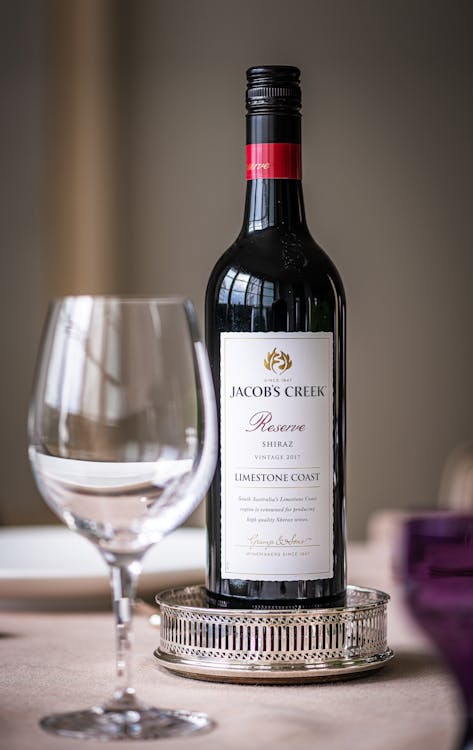
This guide is your Rosetta Stone for the world of wine. We’ve compiled a comprehensive A-to-Z list of the most important wine terms, explained in plain English with real-world examples. This post is an expanded version of our essential wine glossary for beginners, designed to be the only resource you’ll need to start talking, tasting, and thinking like a pro. Let’s decode the vocabulary together.
Affiliate Disclosure: This post contains affiliate links from Amazon. If you make a purchase through these links, we may earn a small commission at no extra cost to you. This helps us continue our mission of making wine accessible to everyone. We only recommend products we believe will genuinely help you on your wine journey.
How to Use This Guide
Jump directly to any letter using the navigation above, or read straight through for a full wine education. Each term includes a plain-English explanation and, where helpful, a real-world analogy to anchor it in memory. Terms marked Fault indicate wine flaws; Positive marks desirable qualities; French marks important French-origin terms; Structure marks the core structural components of wine.
Acidity Structure
One of the big three (along with tannin and alcohol) that gives wine its structure. Acidity is that mouth-watering, tart, zesty quality—the sensation of biting into a crisp green apple or squeezing a lemon. In wine, it’s what makes your mouth water and leaves your palate feeling refreshed. A wine with good acidity will feel lively and vibrant, while a wine lacking it will taste “flabby” or flat. It’s a key component for aging, acting as a natural preservative. Grapes grown in cooler climates, like Sauvignon Blanc from the Loire Valley or Riesling from the Mosel, are known for their high acidity.
Aeration
The process of intentionally exposing wine to oxygen before drinking. Aeration can soften harsh tannins and “open up” a wine’s aromas and flavors, especially in young, bold red wines that haven’t had years in the cellar to mellow naturally. The most effective way to aerate wine is by using one of the best wine decanters, which provides a large surface area for the wine to interact with air. Even just swirling the wine in your glass is a micro-form of aeration—which is why that ritualistic swirl isn’t just for show.
Aftertaste
The flavor and sensation that remains on your palate after swallowing wine. Closely related to “finish,” but aftertaste tends to describe the specific flavors that linger, while finish encompasses the entire impression—including texture and warmth. A long, pleasant aftertaste is one of the most reliable markers of wine quality. Unpleasant aftertastes (bitter, metallic, harsh) are often signs of a fault or poor winemaking.
Appellation French
A legally defined and protected geographical area where wine grapes are grown. Think of it as a wine’s official address. Examples include Napa Valley in California (AVA), Bordeaux in France (AOC), Chianti Classico in Italy (DOCG), and Rioja in Spain (DOCa). An appellation on the label guarantees that the grapes were grown in that specific location and often means the wine was produced according to certain rules—which grapes can be used, minimum alcohol levels, maximum yields—to ensure quality and authenticity.
Aroma vs. Bouquet
Often used interchangeably, but there’s a meaningful technical distinction. Aromas refer to the smells that come directly from the grape variety itself—fruity, floral, and herbal notes that are inherent to the grape. Bouquet refers to the more complex smells that develop during the winemaking and aging process: oak, vanilla, leather, tobacco, mushroom, and earth. In short, aromas come from the grape; bouquet comes from the winemaker and the cellar. A young wine has mostly aromas; a mature, aged wine has a complex bouquet.
Astringent
A textural sensation in wine—not a flavor—that creates a drying, puckering, or roughening feeling in the mouth and on the gums. Astringency is caused primarily by tannins. The most immediate analogy is over-steeped black tea: that dry, almost chalky sensation coating your mouth is astringency. In young, high-tannin red wines (young Barolo, young Cabernet Sauvignon), astringency can be pronounced. With age, tannins polymerize and soften, reducing astringency and replacing it with a smoother, silkier texture.
Autolysis
The process by which dead yeast cells break down and release compounds into the wine. This is the mechanism behind the toasty, biscuity, bread-dough complexity in Champagne and other wines aged on their lees (dead yeast). The longer a wine rests on its lees, the more pronounced the autolytic character. Prolonged autolysis is a hallmark of premium Champagne and is responsible for much of what makes it taste fundamentally different from other sparkling wines.
Balance Positive
The holy grail for winemakers. Balance is the harmonious relationship between all of the wine’s key components: acidity, tannin, alcohol, fruit, and sweetness. In a well-balanced wine, no single element overpowers the others. It feels seamless and complete on the palate—you don’t notice the individual parts, only the unified whole. Imbalance is immediately obvious: a wine that is too tannic feels harsh and astringent; too much alcohol creates a burning sensation; too much acidity makes it sharp; insufficient acidity makes it flat and lifeless.
Barnyard
A tasting descriptor for earthy, animalistic aromas reminiscent of a farm, hay, or manure. The compound primarily responsible is called Brettanomyces (or “Brett”), a wild yeast that can develop in the winery or barrel. In very small amounts, Brett is considered complex and interesting by many Old World wine enthusiasts, adding a rustic, earthy character to wines like Burgundy or Châteauneuf-du-Pape. In larger amounts, it is a wine fault that overwhelms the fruit. Whether “barnyard” is a positive or negative characteristic is one of wine’s great ongoing debates.
Biodynamic
A specific type of organic farming that views the vineyard as a complete, self-sustaining ecosystem. It uses holistic practices timed to astronomical cycles (like the phases of the moon) and employs specific preparations—composted herbs, minerals, and organic matter—to enhance soil life. While some of its philosophical underpinnings are unconventional, biodynamic viticulture consistently produces grapes and wines of remarkable vibrancy and specificity. These are often found among the finest organic and natural wines and are prized for their unique character. Look for Demeter certification on the label.
Body
The perceived weight and texture of a wine in your mouth. Is it light and delicate, or heavy and rich? The classic analogy: skim milk is light-bodied, whole milk is medium-bodied, and heavy cream is full-bodied. Alcohol and glycerin content are the primary contributors to body. A Pinot Grigio or Beaujolais is typically light-bodied; a Viognier or oaked Chardonnay is medium-to-full; a Napa Cabernet Sauvignon or Barossa Shiraz is full-bodied. Body is one of the first things to assess when evaluating any wine.
Bottle Shock Fault
A temporary condition where a wine’s flavors and aromas are muted, disjointed, or simply don’t show well. It typically occurs right after bottling (the physical trauma of the process temporarily disturbs the wine) or after a wine has traveled a long distance and endured significant shaking and vibration. The wine isn’t bad; it just needs time to rest. After receiving a shipment from one of the best wine subscription boxes, it’s wise to let bottles rest for a week or two before opening them.
Brettanomyces (Brett) Fault
A genus of wild yeast that can colonize winery equipment, barrels, and wine, producing a range of compounds responsible for barnyard, leather, horse stable, wet dog, or band-aid aromas. In the Old World—particularly Burgundy and the Southern Rhône—a low level of Brett is often considered part of a wine’s character and even a sign of authenticity. In the New World, it is almost universally considered a fault. Brett is the single most controversial compound in the world of wine criticism.
Breathing
Another term for aeration. Allowing a wine to “breathe” means exposing it to air to allow it to open up and reveal its full aromatic and flavor potential. Simply removing the cork and leaving the bottle on the counter does very little (the opening is too narrow). For meaningful breathing, either swirl vigorously in a wide-bowled glass or decant into a vessel with a large surface area.
Cassis
The French word for blackcurrant—both the fruit and the liqueur made from it. “Cassis” is the single most commonly used aromatic descriptor for Cabernet Sauvignon, describing the intensely ripe, slightly jammy, dark berry quality that is the grape’s signature character. When a sommelier says “notes of cassis,” they are describing a dark, rich, almost jam-like blackcurrant quality with a slightly sharp, green note underneath. It’s the flavor note that most defines Napa Valley Cabernet at its finest.
Cellaring
The process of aging wine in a controlled environment over an extended period. The ideal conditions are cool, dark, and humid with minimal vibration—the core wine cellar essentials. Proper cellaring allows a wine’s flavors and structure to evolve gracefully, softening harsh tannins and developing secondary and tertiary aromatic complexity. Most wine is not meant to be cellared and should be consumed within a few years of purchase. For wines that reward aging, see our guide to how to store wine without a wine fridge.
Chaptalization
The addition of sugar to grape juice or must before or during fermentation to increase the final alcohol content of the wine. Named after Jean-Antoine Chaptal, the French chemist who popularized the practice in the early 19th century. It is legal in some regions and wine styles (common in Burgundy in difficult cool vintages) and strictly prohibited in others (illegal in California and most warm-climate wine regions). Chaptalization does not add sweetness to a finished wine—the sugar is converted to alcohol by the yeast. It simply boosts the potential alcohol level in grapes that didn’t achieve full ripeness due to poor weather.
Clone
A grape vine that is a genetic replica of a specific “mother” vine, propagated through cuttings. Many grape varieties—Pinot Noir in particular—have hundreds of documented clones, each with slightly different berry size, cluster architecture, flavor profile, and ripening characteristics. A winemaker may plant multiple clones in a single vineyard to add layers of complexity to the final wine, with one clone providing structure, another providing aromatic intensity, and a third providing acidity.
Complex Positive
A highly valued tasting characteristic. A complex wine reveals many different layers of flavors and aromas that evolve as you taste it—on the nose, on the palate, and in the finish. It’s the opposite of a “simple” or “one-note” wine. The aromas might shift from fruit to earth to spice as the wine warms in the glass. The palate might reveal fruit, followed by a mid-palate development of savory notes, followed by a long mineral finish. Complexity makes you pause, reconsider, and return for another sip.
Corked (Cork Taint / TCA) Fault
A wine fault caused by a chemical compound called TCA (2,4,6-trichloroanisole), which forms when naturally occurring mold in a cork reacts with chlorine-based compounds. A corked wine smells and tastes like a damp basement, wet newspaper, wet cardboard, or wet dog. In severe cases it is immediately obvious; in mild cases, the wine simply seems flat and stripped of fruit without any obvious off-smell. A corked wine is not harmful, but it’s a significant flaw. Always feel comfortable returning a corked bottle to a restaurant or store—it’s a manufacturing defect, not a matter of preference.
Cuvée French
A French term meaning a specific blend or batch of wine. It can refer to the first-pressed, highest-quality juice from the grapes. More commonly, it denotes a specific bottling or blend from a producer. In Champagne, “Tête de Cuvée” (literally “head of the blend”) refers to a house’s prestige bottling—Dom Pérignon, Cristal, La Grande Dame.
Decant
The act of pouring wine from its original bottle into a separate vessel (a decanter) before serving. Decanting accomplishes two things: it aerates a young wine, softening tannins and opening up its aromas; and it separates an older wine from its sediment, ensuring a clear, grit-free glass. The two purposes require different techniques: young wines should be poured quickly and vigorously to maximize aeration; old wines should be poured very slowly and steadily over a light source so the winemaker can see sediment approaching the neck and stop pouring before it enters the decanter.
Demi-Sec French
French for “half-dry.” In sparkling wine, demi-sec indicates a noticeably sweet style, despite the word “sec” (dry). The official residual sugar range for demi-sec Champagne is 32–50 grams per liter. This is one of the confusing quirks of French wine terminology—the sweetness terminology for sparkling wines (Brut Nature, Extra Brut, Brut, Extra Dry, Sec, Demi-Sec, Doux) runs counterintuitively, with “Brut” being drier than “Extra Dry.”
Dosage French
In sparkling wine production (particularly Champagne), the dosage is a small amount of a wine-and-sugar mixture (called “liqueur d’expédition”) added to the bottle after disgorgement to determine the wine’s final sweetness level. The amount of dosage determines whether the wine will be Brut Nature, Brut, Extra Dry, Sec, Demi-Sec, or Doux. A winemaker’s dosage decision is a crucial artistic choice that shapes the final style of every Champagne.
Dry
One of the most commonly misunderstood terms in wine. In wine, “dry” is simply the opposite of “sweet.” It means the wine contains little to no perceptible residual sugar—the yeast has converted all or nearly all of the grape sugars into alcohol during fermentation. A wine can be very fruity in aroma but still be completely dry on the palate. The confusion arises because ripe fruit aromas can be perceived as “sweetness” even when no actual sugar is present. When someone says they “don’t like sweet wine” and reaches for a dry option, a full-bodied, ripe Cabernet Sauvignon delivers fruit intensity without sweetness.
Earthy Positive
A tasting descriptor for aromas and flavors reminiscent of the earth itself. This encompasses smells like soil, dust, mushrooms, forest floor (damp fallen leaves), wet stone, clay, and truffles. Earthiness is considered a positive and complex characteristic in most Old World wines—it’s part of what makes aged Burgundy, Barolo, and Bordeaux so compelling and distinctly different from New World expressions of the same grapes. It speaks directly to terroir—the wine tasting of its specific place on earth.
Élevage French
French for “raising” or “bringing up.” Élevage refers to the entire post-fermentation winemaking process of nurturing a wine from fermentation through to bottling—including decisions about barrel aging, fining, racking, blending, and filtration. It’s everything that happens between when fermentation ends and when the wine is bottled. A winemaker’s élevage decisions—how long in oak, what type of oak, how many times to rack, whether to fine or filter—leave profound marks on the wine’s final character.
Extraction
The process of drawing color, tannin, flavor, and other compounds from grape skins, seeds, and stems into the wine. Extraction happens during maceration—the period when grape skins are in contact with the fermenting juice. Greater extraction produces deeper-colored, more tannic, more concentrated wines. Less extraction produces lighter, softer, more approachable wines. The art of extraction management is one of winemaking’s most critical skills: too little and the wine lacks depth; too much and it becomes harsh, over-extracted, and tannic.
Fermentation
The magical, fundamental process at the heart of all wine. Fermentation is the metabolic process where yeast consumes sugar (from the grape juice) and converts it into alcohol and carbon dioxide. This is the step that transforms grape juice into wine. Fermentation can be conducted with commercial yeast strains (predictable, reliable, controlled) or ambient “wild” yeasts naturally present in the vineyard and winery (unpredictable, but proponents argue they express terroir more authentically). Temperature, vessel type (stainless steel, oak, concrete, amphorae), and duration all significantly affect the final wine.
Finish Positive
The impression and flavors that linger in your mouth after you have swallowed the wine. A wine with a long finish is considered a mark of quality—the flavors persist pleasantly for 30 seconds or even a minute after swallowing, continuing to evolve. A short finish means the flavors vanish almost immediately. Some tasters measure finish in “caudalies”—one caudalie equals one second of aftertaste. A truly great wine might have a finish of 60+ caudalies. Learning to assess finish is one of the single most useful skills a developing wine taster can cultivate.
Flabby Fault
A negative tasting descriptor for a wine that lacks sufficient acidity. It feels flat, lifeless, and heavy on the palate—like a cola that has lost its carbonation. The opposite of crisp or vibrant. Flabbiness is a particular risk in warm-climate white wines where natural acidity is low, and winemakers sometimes add tartaric acid to compensate (a legal practice called acidification in many wine regions).
Flinty
A tasting descriptor for a specific type of minerality—a dry, almost sparky quality reminiscent of striking flint stones together. It’s associated particularly with Chablis and other Chardonnays from very chalky or flinty limestone soils, and with Pouilly-Fumé made from Sauvignon Blanc. The aroma is sometimes described as gunflint (pierre à fusil in French) and is one of wine’s most distinctive and difficult-to-describe sensations.
Fortified Wine
Wine to which a grape-based spirit (usually brandy) has been added, raising the alcohol content to 15–22% and often stopping fermentation to retain residual sugar. The great fortified wines—Port, Sherry, Madeira, and Marsala—range from bone dry (Fino Sherry) to intensely sweet (Vintage Port, Pedro Ximénez Sherry). Their elevated alcohol content makes them significantly more resistant to oxidation and spoilage than table wines, and many fortified wines improve dramatically over decades or even centuries.
Glycerin
A natural byproduct of fermentation—a viscous, colorless, and essentially odorless liquid that contributes to a wine’s body and texture. A wine with high glycerin content feels fuller, richer, and almost oily or silky in the mouth. Glycerin is also partly responsible for the “legs” or “tears” that run down the side of the glass after swirling, though alcohol is the primary driver of this phenomenon.
Grand Cru French
French for “great growth.” In Burgundy, grand cru is the highest classification for a vineyard—meaning the specific plot of land has been officially designated as producing the finest wines in the region. There are only 33 grand cru vineyards in Burgundy’s Côte d’Or, and wines from these sites command extraordinary prices. In Bordeaux, “Grand Cru Classé” refers to a classified estate, not a specific vineyard. In Champagne, grand cru refers to villages whose grapes historically receive the highest price. The term has different precise meanings in different regions, but always connotes exceptional quality.
Green
A tasting descriptor for aromas and flavors suggesting unripe or insufficiently ripe grapes—notes of green pepper (pyrazines), green herbs, fresh-cut grass, or raw green bean. A slight “green” quality can be desirable and complex in wines like Cabernet Franc or certain Sauvignon Blancs. Pronounced greenness is generally considered a fault or a sign of harvesting before optimal ripeness, and creates an unpleasant, vegetal, or bitter character.
Hot Fault
A tasting descriptor for a wine with excessive, unbalanced alcohol. You’ll feel a burning or warming sensation in your throat, mouth, or nostrils that overpowers the wine’s fruit and other characteristics. “Hot” wines are generally considered flawed or at least poorly balanced. They often result from grapes harvested in very hot conditions with very high sugar levels, or from chapitalization going too far. Modern warm-climate viticulture and climate change are producing increasingly “hot” wines, which is a subject of serious concern within the wine world.
Herbaceous
A tasting descriptor for aromas and flavors reminiscent of fresh or dried herbs—grass, hay, sage, thyme, rosemary, mint, or green herbs. A degree of herbaceousness is a positive, varietal characteristic in Sauvignon Blanc (fresh-cut grass, elderflower), Cabernet Franc (leafy herbs, pencil shavings), Grüner Veltliner (white pepper), and Carmenère (green pepper). Pronounced, dominating herbaceousness in reds is often associated with under-ripeness and is generally considered a negative trait.
Integrated Positive
A highly positive tasting term describing how well the different components of a wine—tannin, acidity, alcohol, oak, and fruit—have come together into a seamless, harmonious whole. A “well-integrated” wine has no individual element that protrudes or demands attention. The oak doesn’t stand apart from the fruit; the tannins don’t scratch separately from the finish. Integration often comes with age, as a wine’s structural components gradually mellow and weave together. Tasting a young Barolo versus a 15-year-old Barolo illustrates integration beautifully.
Jammy
A tasting descriptor for red wines with flavors and texture reminiscent of cooked or preserved fruit—jam, fruit compote, or fruit preserve rather than fresh fruit. It implies a sense of very ripe sweetness and a thick, slightly sticky texture. Often used to describe warm-climate Zinfandel or Australian Shiraz. Jamminess can be positive if balanced by structure and acidity, but when a wine tastes primarily jammy without counterbalancing freshness, it can feel heavy, cloying, and one-dimensional.
Kabinett
The lightest and most delicate category in the German Prädikatswein classification system. Kabinett wines are made from grapes at the lowest required ripeness level. They are typically low in alcohol (7–9% ABV), crisp, and delicate, often with a slight off-dry sweetness balanced by racing acidity—particularly in Riesling from the Mosel. Despite being considered “entry-level” in the German quality hierarchy, Kabinett Rieslings from great producers and great vintages are among the world’s most elegant and food-friendly wines.
Kosher Wine
Wine produced under strict Jewish dietary laws (kashrut). To be certified kosher, the winemaking process—from harvest through bottling—must be handled exclusively by Shomer Shabbat-observant Jews. Equipment must be kashered (ritually cleaned), and certain winemaking agents (like some fining agents derived from non-kosher sources) cannot be used. Kosher wine has evolved dramatically in quality and now includes some world-class wines from Israel, France, California, and elsewhere. “Mevushal” kosher wines have been flash-pasteurized, which allows them to be handled by non-Jews without losing kosher status, but can affect the wine’s delicacy.
Lees
The sediment of dead yeast cells and grape solids that collects at the bottom of a tank or barrel after fermentation. Aging a wine “on its lees” (sur lie in French) keeps the wine in contact with this material, allowing compounds from the breaking-down yeast cells to enrich the wine with added texture, creaminess, and biscuity or bread-dough complexity. This is essential to the character of Champagne and is widely used for white Burgundy and Muscadet. The winemaker may periodically stir the lees (bâtonnage) to increase contact.
Legs (or Tears)
The streaks or droplets of wine that run down the inside of the glass after swirling. Many people believe legs indicate quality—more legs = better wine. This is a myth. Legs are primarily an indication of alcohol content, a result of the Marangoni effect: alcohol evaporates faster than water, creating surface tension that forms the characteristic droplets. Higher-alcohol wines show thicker, slower-moving legs. It’s interesting to observe in the best wine glasses for red wine, but it tells you nothing about quality.
Length
Another term for finish—the duration over which a wine’s flavors and sensations persist after swallowing. “Good length” is a high compliment; it means the wine continues to deliver pleasure and complexity for an extended period after you’ve swallowed. Length is often cited as one of the most reliable indicators of a wine’s quality and the most important characteristic to train yourself to observe.
Maceration
The process of soaking grape skins in the juice or wine to extract color, tannins, and flavor compounds. For red wines, maceration is essential—all the color and most of the tannin exists in the skins, not the juice. Longer maceration produces deeper color and more tannin. For white wines, maceration is generally avoided to maintain freshness and delicacy. “Orange wine” or “skin-contact white wine” is made by macerating white grape skins in the juice, producing a wine with an amber color, texture, and tannin structure more similar to a light red than a typical white.
Malolactic Fermentation (MLF)
A secondary fermentation process that virtually all red wines and many white wines (notably Chardonnay) undergo. Bacteria convert the sharper, tart-tasting malic acid (the acid in green apples) into the softer, creamier lactic acid (the acid in milk and yogurt). The result is a rounder, fuller, less sharp wine with a noticeable textural richness. It is also responsible for the production of diacetyl, the compound responsible for the buttery notes in many oaked Chardonnays. Winemakers who want to retain crispness and freshness—for Sauvignon Blanc, for example—actively block MLF.
Mouthfeel
The textural sensation of wine in your mouth, distinct from its taste or flavor. Mouthfeel encompasses: weight (body), astringency from tannins, the softness or creaminess from glycerin and MLF, the tingle and freshness from acidity and carbonation, and the warmth from alcohol. Describing mouthfeel precisely—”silky,” “velvety,” “grippy,” “creamy,” “sharp,” “round”—is a hallmark of experienced tasting vocabulary and communicates information about a wine’s texture that flavor descriptors alone cannot convey.
Minerality
A complex and genuinely controversial tasting descriptor for aromas or flavors reminiscent of non-fruit, non-herb, non-spice elements—wet stone, slate, chalk, flint, saline, or even the metallic quality of licking a clean coin. It is a textural sensation as much as a flavor. The scientific community debates whether soil minerals can actually be tasted in wine; the sensory community continues to use the term because it describes a real and reproducible experience. You’ll hear it often describing Chablis, Sancerre, German Mosel Riesling, and Galician Albariño.
Natural Wine
Wine made with minimal intervention in both the vineyard and the winery. “Natural” has no legal definition, but generally means: organic or biodynamic farming, native rather than commercial yeasts, no additions of commercial enzymes or fining agents, and little or no added sulfur. Natural wines can be exhilaratingly vibrant and expressive, or they can be cloudy, funky, and unstable depending on the producer’s skill and philosophy. They are a growing and passionate movement in the wine world. For a full deep dive, see our guide to organic and natural wines.
Négociant French
A wine merchant or producer who buys grapes, juice, or finished wine from growers and then blends, ages, and bottles it under their own label. Négociants are particularly important in Burgundy and Champagne, where the fragmented ownership of vineyard land makes it impractical for many small producers to bottle their own wines. Top Burgundy négociants (Maison Leroy, Joseph Drouhin, Louis Jadot) are among the most respected names in wine. The opposite of a négociant is a “domaine” or “estate” bottler who grows, makes, and bottles their own wine.
Nose
The complete collection of aromas and bouquet you smell in a wine before tasting it. “The nose” refers both to the act of smelling the wine and to what you find there. When a sommelier says a wine has a “big nose” or is “very aromatic on the nose,” they mean it has pronounced, complex, and expressive smells. When they say a wine has a “closed nose” or is “tight on the nose,” they mean the aromas are restrained and not yet showing—often the case with young, structured red wines that need time to open.
Oaky
Describes the aromas and flavors imparted to a wine by aging in oak barrels. Oak-derived flavors include vanilla, toast, smoke, coconut, cedar, dill, clove, and baking spice. When used well, oak adds complexity, rounds out acidity, and enhances texture. When overused—particularly with new, heavily toasted oak—it can dominate the wine and mask its varietal fruit character entirely. “Oaky” as a tasting descriptor exists on a spectrum from lightly toasty to aggressively vanilla-and-sawdust.
Orange Wine
A white wine made using extended skin contact during fermentation—sometimes for weeks or months—giving the wine an amber or orange color, textural tannins, and complex oxidative aromas not found in conventional white wines. Orange wine is one of the oldest winemaking traditions in the world (Georgian qvevri wines made this way date back 8,000 years) and one of the newest trends in contemporary natural winemaking. They tend to pair well with foods that would challenge most white wines: aged cheeses, fermented foods, rich stews, and spiced dishes.
Oxidized Fault
A wine that has been exposed to excessive oxygen, causing it to deteriorate. Oxidized wine loses its fresh fruit character and develops nutty, bruised-apple, or sherry-like flavors. The color appears brownish or amber rather than vibrant. Oxidation is one of the most common wine faults and can occur from a faulty cork, improper storage, or simply leaving an opened bottle too long before finishing it. Once oxidized, a wine cannot be restored. Prevention—through proper storage and wine preservation tools after opening—is the only solution.
Palate
Refers broadly to the flavors and sensations experienced inside your mouth when tasting wine, encompassing taste (sweet, sour, bitter, salty, umami), body, texture, and the interaction of all structural components. “On the palate” distinguishes what you taste from what you smell. It also refers to a taster’s personal sense of taste and learned ability to perceive and discriminate flavors—”she has an excellent palate” means she is a skilled and sensitive taster.
Pétillant Naturel (Pét-Nat) French
A style of naturally sparkling wine made by the ancestral method (méthode ancestrale)—bottled before primary fermentation is complete, so that the remaining sugar ferments in the bottle, producing natural carbonation. Unlike Champagne, pét-nat wines are not disgorged of their lees, so they are often hazy or cloudy. The result is a lively, often lower-alcohol, slightly rustic sparkling wine with great freshness and a unique textural softness from the lees contact. They are beloved in the natural wine world for their low intervention and approachable, joyful character.
Phylloxera
A microscopic, aphid-like insect that feeds on and eventually kills grapevine roots. Native to North America, it was accidentally transported to Europe in the mid-19th century and devastated nearly every vineyard on the continent, destroying centuries of viticultural heritage. The solution—still universal today—is to graft European wine grape varieties (Vitis vinifera) onto phylloxera-resistant American rootstocks. The few remaining ungrafted “pre-phylloxera” vines—in isolated pockets of Chile, Australia, and parts of Europe—are considered extraordinarily precious.
Premier Cru French
French for “first growth.” In Burgundy, premier cru vineyards are the second-highest classification (below grand cru), designating plots whose wine quality is officially recognized as superior to village-level wines. There are approximately 640 premier cru vineyards in Burgundy’s Côte d’Or. In Bordeaux, premier cru classé refers to the top five châteaux (Lafite, Latour, Mouton, Haut-Brion, Margaux) from the 1855 Classification. In Champagne, premier cru designates villages whose grapes receive the second-highest historical price.
Qualitätswein
The broad category of quality wine in Germany and Austria, sitting above basic table wine but below the Prädikat (special attributes) tier. To be labeled Qualitätswein, a German wine must meet minimum ripeness standards, come from one of Germany’s 13 designated wine regions, and pass an official quality inspection. In Germany, Qualitätswein wines include the famous Kabinett, Spätlese, Auslese, Beerenauslese, Trockenbeerenauslese, and Eiswein designations—some of the world’s most complex and age-worthy wines.
Qvevri (Kvevri)
A traditional Georgian clay vessel—an ovoid, beeswax-lined amphora—used to ferment and age wine. Qvevri winemaking is one of the oldest wine production methods on earth, dating back approximately 8,000 years in the South Caucasus. Grapes are crushed and the juice, skins, seeds, and stems are placed together in the buried qvevri, where fermentation and extended maceration occur naturally. The buried vessel maintains a stable cool temperature. Qvevri wines—particularly the skin-contact whites—are the direct ancestors of today’s “orange wine” movement and are recognized by UNESCO as an intangible cultural heritage.
Reductive / Reduction Fault
A winemaking fault caused by insufficient oxygen during fermentation, causing the yeast to produce sulfurous compounds—hydrogen sulfide and mercaptans. A reductive wine smells of struck match, rubber, raw garlic, onion, or rotten eggs. The good news is that reduction is often volatile and can dissipate with oxygen exposure. Vigorous swirling, or decanting into a wide vessel, introduces enough oxygen to banish these aromas within a few minutes in mild cases, revealing a clean wine underneath.
Residual Sugar (RS)
The amount of natural grape sugar that remains unfermented in the wine when fermentation is stopped or concludes. Expressed in grams per liter. A dry wine has less than 4g/L. An off-dry wine: 4–12g/L. Medium-sweet: 12–45g/L. Sweet: 45g/L and above. The interplay between residual sugar and acidity is crucial—high acidity balances sweetness so it doesn’t taste cloying, which is why a German Riesling Beerenauslese with 150g/L RS can still taste refreshing rather than heavy.
Ripe / Ripeness
The state of a grape at harvest, determined by its sugar content, acid levels, tannin maturity, and flavor development. Optimal ripeness is the point at which a grape has achieved the best possible balance of these factors. Under-ripe grapes produce wines that are harsh, sharp, and green-tasting. Over-ripe grapes produce wines that are heavy, jammy, and lacking in freshness. “Phenolic ripeness”—the ripeness of the grape’s skin and seed tannins—is considered by many winemakers to be even more important than sugar ripeness, as unripe tannins produce a harsh, green bitterness regardless of sugar levels.
Sec French
French for “dry.” In still wine, “sec” on a French label simply means the wine is dry. However, in sparkling wine, “Sec” (or “Extra Sec”) confusingly indicates a slightly sweet style—sweeter than Brut but drier than Demi-Sec. This counterintuitive nomenclature in sparkling wine is one of wine’s most common sources of beginner confusion.
Sediment
The dark, gritty deposit that can form at the bottom of a wine bottle over time, particularly in aged red wines and vintage Port. Sediment is composed of polymerized tannins and color pigments (anthocyanins) that have bonded together and precipitated out of solution—a natural and harmless sign of a wine’s age and development. Sediment should be allowed to settle before opening an old bottle (stand the bottle upright for 24 hours), and the wine should be carefully decanted to separate the clear wine from the gritty deposit.
Sommelier (sohm-el-YAY)
A trained and certified wine professional, typically working in a fine dining restaurant, who specializes in all aspects of wine service—selecting wines for the list, making pairing recommendations, conducting service, and managing the wine cellar. A skilled sommelier is there to help you, not intimidate you. The most important thing to communicate to a sommelier is your approximate budget and your flavor preferences (“I like something dry and not too heavy” or “We’re having steak and I want something bold”). The most prestigious certification is Master Sommelier, awarded by the Court of Master Sommeliers—one of the most demanding examinations in the world of food and beverage.
Spätlese French
German for “late harvest.” In the German Prädikat system, Spätlese wines are made from grapes harvested at least seven days after the main harvest at a higher ripeness level than Kabinett. Spätlese Rieslings are typically richer, more concentrated, and slightly riper in flavor than Kabinett, but are not necessarily sweet—a Spätlese can be fermented to dryness (Trocken) or left with residual sugar in varying degrees. They are among Germany’s most versatile and food-friendly wines.
Structure Structure
The architectural framework of a wine—the interplay of its core components: acidity, tannin, alcohol, and glycerin. Structure is what gives a wine its shape, its backbone, and its capacity to age. A wine with good structure feels well-built and purposeful on the palate. A wine lacking structure feels formless and uninteresting. The best analogy is architecture: structure is the steel-and-concrete frame of the building; the flavors and aromas are the beautiful finishes and furnishings inside.
Sulfites
Sulfur dioxide (SO2) is a natural byproduct of fermentation and is also commonly added by winemakers as a preservative and antioxidant, preventing spoilage and oxidation. The “Contains Sulfites” warning on U.S. labels is legally required for all wines containing more than 10 parts per million SO2. While a very small percentage of people have a genuine sulfite sensitivity (it typically presents as respiratory symptoms, not headaches), sulfites are not the cause of the notorious “red wine headache” for most people—that’s far more likely caused by histamines, tannins, or simply dehydration.
Sur Lie French
French for “on the lees.” Describes a wine that has been aged in contact with the dead yeast cells (lees) from fermentation rather than being racked off them immediately. Sur lie aging adds texture, richness, and the characteristic biscuity or bread-dough complexity associated with high-quality Champagne and Muscadet. The longer the contact, the more pronounced the effect. Winemakers may periodically stir the lees (bâtonnage) to increase contact and amplify the textural influence.
Tannin Structure
Naturally occurring polyphenols found in grape skins, seeds, and stems, as well as in oak barrels and black tea. Tannins create the drying, astringent, slightly bitter sensation you feel on your gums and the insides of your cheeks—exactly the same feeling as drinking strong, over-steeped black tea. Tannins are primarily a feature of red wines (white wines lack significant tannin because they are pressed immediately with minimal skin contact). High tannins provide structure, age-worthiness, and antioxidant protection. A “grippy” or “firm” wine has pronounced tannins. With years of cellaring, tannins polymerize and soften to produce the “silky” or “velvety” texture prized in a mature Bordeaux or Barolo.
Terroir (tare-WAHR) French
One of wine’s most important and most untranslatable concepts. Terroir refers to the complete natural environment in which a wine is produced—the soil type and composition, the topography (slope, aspect, elevation), the climate (macro and micro), the proximity to water, and even the specific microorganisms in the earth. It’s the “sense of place” that makes a Pinot Noir from Burgundy taste fundamentally different from a Pinot Noir from Oregon, even when both are made with equal care and skill. The most passionate wine lovers believe that terroir is the soul of a wine—the irreplaceable character that no amount of technology can manufacture or relocate.
Terroir-Driven
A wine style in which the winemaking is intentionally minimal and transparent, designed to allow the specific character of the vineyard to express itself without interference. Terroir-driven winemakers tend to use native yeasts, avoid heavy extraction, use neutral rather than new oak (or no oak), and make as few additions as possible to the wine. The goal is that the wine tastes of its specific place, not of the winemaker’s technical interventions. Most serious Old World wine is described as terroir-driven.
Ullage
The headspace—the gap between the wine and the cork or stopper in a sealed bottle. In a healthy young wine, ullage should be minimal (a centimeter or less). As a wine ages, a small amount of liquid can evaporate slowly through the cork, gradually increasing the ullage. A large ullage in an older bottle signals potential oxidation risk from a compromised cork. When buying old wines at auction, ullage is one of the first things to assess: “into the neck” (minimal ullage) is ideal; “mid-shoulder” or below is a warning sign.
Varietal
The specific type of grape used to make a wine. Cabernet Sauvignon, Chardonnay, Pinot Noir, Merlot, Riesling, and Tempranillo are all varietals. In the U.S., a wine labeled with a varietal name must by law contain at least 75% of that grape. In Europe, wines are more commonly labeled by their region of origin (Burgundy, Chianti, Rioja) even though they are dominated by specific grapes—Pinot Noir, Sangiovese, and Tempranillo respectively.
Vieilles Vignes French
French for “old vines.” Wines labeled vieilles vignes are made from older grapevines—generally accepted to mean 30+ years old, though the term has no legal definition. Old vines produce fewer grapes than young vines, but those grapes tend to be smaller, more concentrated, and more complex in flavor, with deeper root systems that access minerals and moisture unavailable to younger vines. Wines from very old vines (50–100+ years) are considered among the most distinctive and site-expressive wines in the world.
Vintage
The year in which the grapes for a particular wine were harvested. The vintage indicates the weather conditions of a specific growing season, which directly shaped the character of the wine. Warm, sunny vintages tend to produce riper, fuller wines; cool, difficult vintages may produce leaner, more acidic wines—sometimes of remarkable elegance and aging potential. A “Non-Vintage” (NV) wine, common in Champagne and Port, is a blend of wines from multiple years designed to maintain a consistent house style across vintages.
Volatile Acidity (VA) Fault
A wine fault caused by the presence of acetic acid (vinegar) in the wine, produced by acetic acid bacteria. At very low levels, VA adds complexity—a hint of nail polish or vinegar can be interesting in some wine styles. At higher levels, it becomes a dominant fault that renders the wine undrinkable. You’ll first notice VA as a sharp, slightly sour, vinegary edge to the smell. VA is one of the most common wine faults and a sign that the wine has been exposed to oxygen and allowed to spoil.
Wine Fault
A characteristic or defect in a wine that diminishes its quality, makes it unpleasant to drink, or masks its intended flavors. The most common wine faults include TCA cork taint (musty, wet cardboard), oxidation (flat, nutty, bruised apple), reduction (sulfurous, struck match, rubber), Brett (barnyard, wet dog, band-aid), volatile acidity (vinegar, nail polish), and heat damage (flat, jammy, cooked fruit). Understanding faults is important both for getting the most from your wine experiences and for knowing when it is legitimate to return a bottle.
Wine Legs
See “Legs” under L. A common alternate term for the same phenomenon.
Yeast
The microscopic fungus responsible for alcoholic fermentation—the organism that converts grape sugar into alcohol and carbon dioxide. Without yeast, wine would simply be fermenting grape juice. Yeast can be commercially cultivated strains selected for their predictability, reliability, and specific flavor contributions; or it can be ambient “wild” yeast that naturally exists on grape skins, in the vineyard, and in the winery. Natural winemakers use only wild yeast, believing it expresses the unique character of the place. Commercial yeast produces more consistent results but may create wines that taste more similar to each other than to their terroir.
Yield
The quantity of grapes or wine produced per unit area of vineyard, typically expressed in tons per acre or hectoliters per hectare. Lower yields generally produce higher-quality wines because each vine devotes its resources to fewer grapes, concentrating sugars, flavors, and phenolics into a smaller volume of fruit. Many premium appellations impose strict maximum yield limits to protect quality. Higher yields, common in mass-market wine production, dilute flavors and produce simpler wines at lower cost.
Zesty
A positive tasting descriptor indicating a wine with bright, lively, fresh acidity—like the spray of a freshly cut citrus rind. Zestiness suggests vitality and freshness. You’ll hear it applied to crisp white wines like Albariño, Vinho Verde, Picpoul de Pinet, or unoaked Sauvignon Blanc. A zesty wine is the opposite of flat or flabby; it wakes up your palate and invites another sip.
Zinfandel
California’s most iconic red grape variety, genetically identical to southern Italy’s Primitivo and Croatia’s Crljenak Kaštelanski. Zinfandel produces wines of extraordinary range: from bone-dry, structured, tannic reds with notes of blackberry, pepper, and dried fig; to the ubiquitous, sweet, pink “White Zinfandel” (actually a rosé) that introduced millions of Americans to wine. Old-vine Zinfandel from Lodi, Sonoma’s Dry Creek Valley, and Amador County produces some of California’s most characterful, distinctive, and age-worthy reds.
Quick Reference: The Most Important Wine Terms at a Glance
If you’re just starting out and want a quick cheat sheet, these are the twenty terms you’ll encounter most often and most need to understand. Master these and you’ll feel comfortable in virtually any wine conversation.
| Term | One-Line Definition | Why It Matters |
|---|---|---|
| Acidity | The tart, mouth-watering quality of wine | Determines freshness and aging potential |
| Tannin | The drying, astringent sensation from grape skins | Provides structure and aging ability in reds |
| Body | The perceived weight of wine in the mouth | First impression; helps match wine to food |
| Dry | Wine with little or no residual sugar | Most common style preference distinction |
| Finish | Flavors that linger after swallowing | Key indicator of quality |
| Terroir | The total environment that shapes a wine’s character | Explains why the same grape tastes different in different places |
| Vintage | The harvest year of the grapes | Indicates weather conditions; matters for age-worthy wines |
| Varietal | The type of grape used | The primary way wines are identified in the New World |
| Appellation | The legally defined geographical area of origin | The primary way wines are identified in the Old World |
| Balance | Harmony of all structural elements | The ultimate quality indicator |
| Aeration | Exposing wine to oxygen to open it up | Improves many young red wines dramatically |
| Malolactic Fermentation | Converts sharp acid to softer acid | Creates the buttery texture in Chardonnay |
| Residual Sugar | Grape sugar remaining after fermentation | Determines sweetness level |
| Oaky | Flavors from barrel aging (vanilla, toast, spice) | Major stylistic distinction in many wines |
| Corked | Wine tainted by TCA from a bad cork | Most common wine fault; reason to return a bottle |
| Structure | The interplay of acidity, tannin, alcohol, glycerin | Determines a wine’s ability to age and pair with food |
| Complex | Many layered aromas and flavors that evolve | Key quality distinction |
| Terroir-driven | Wine style focused on expressing place over winemaking | Central to Old World wine philosophy |
| Sulfites | Preservative added to protect wine from spoilage | Widely misunderstood; not the cause of headaches |
| Sediment | Natural deposit in aged red wines | Sign of age; decant to separate before serving |
Tools for Your Tasting Journey
As you dive deeper, a few tools will dramatically accelerate your learning and enhance your enjoyment. These are your study aids for the wonderful world of wine—and they also make for fantastic, thoughtful selections from our wine gift ideas list!
 Best Wine Book
The Wine Bible by Karen MacNeil
If you buy only one wine book, this is it. Comprehensive, engagingly written, and covering everything from grape varietals to the world’s great regions. The gold-standard reference book for beginners and experts alike—over 1,000 pages of authoritative, accessible wine knowledge.
Check Price on Amazon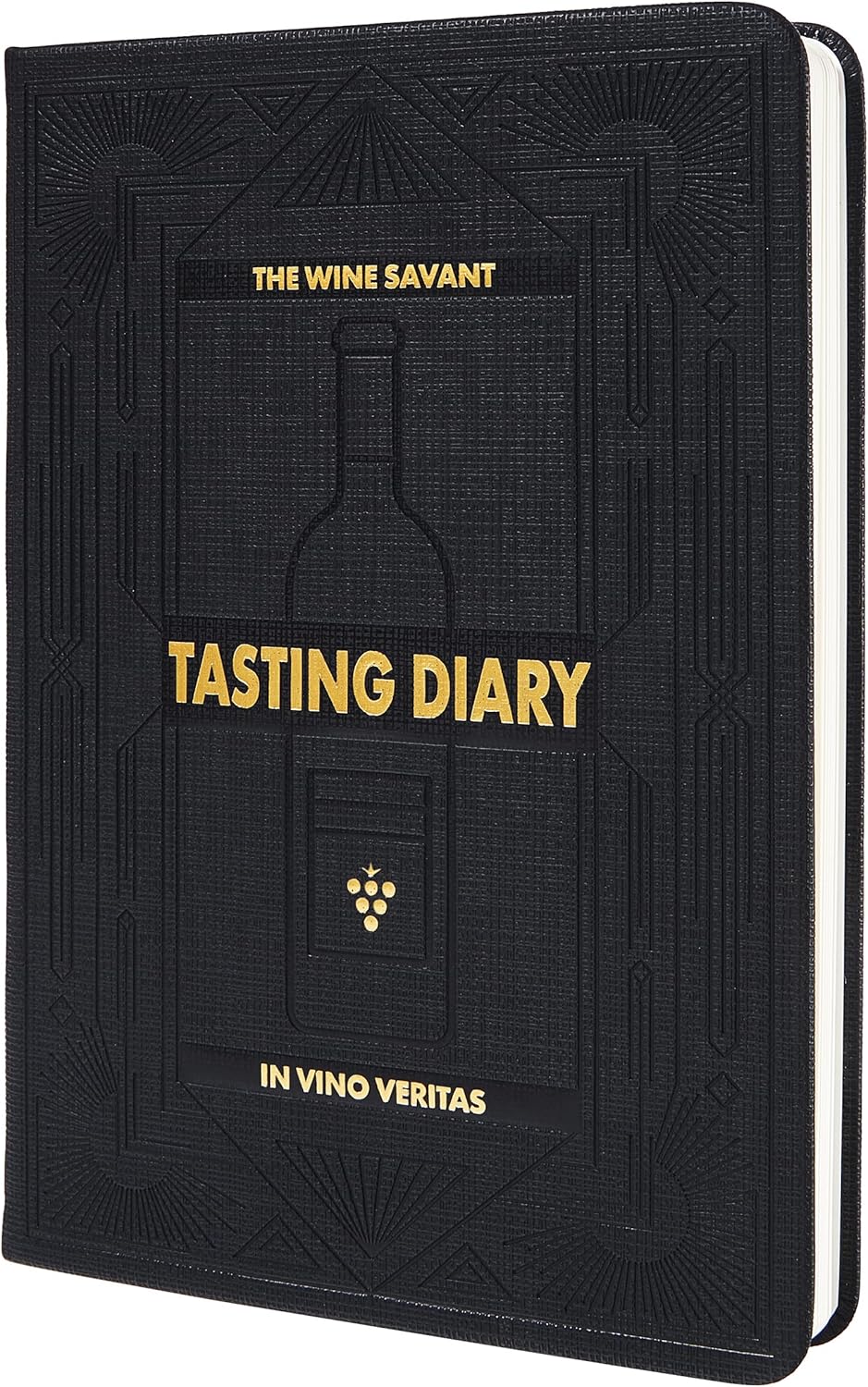 Essential Learning Tool
Wine Tasting Journal
The single best way to build vocabulary is to write it down. This beautifully designed journal provides prompts for aroma, taste, finish, and more, helping you build a personal library of tasting experiences and discover the patterns in your own palate. Indispensable for anyone serious about learning.
Check Price on Amazon Train Your Nose
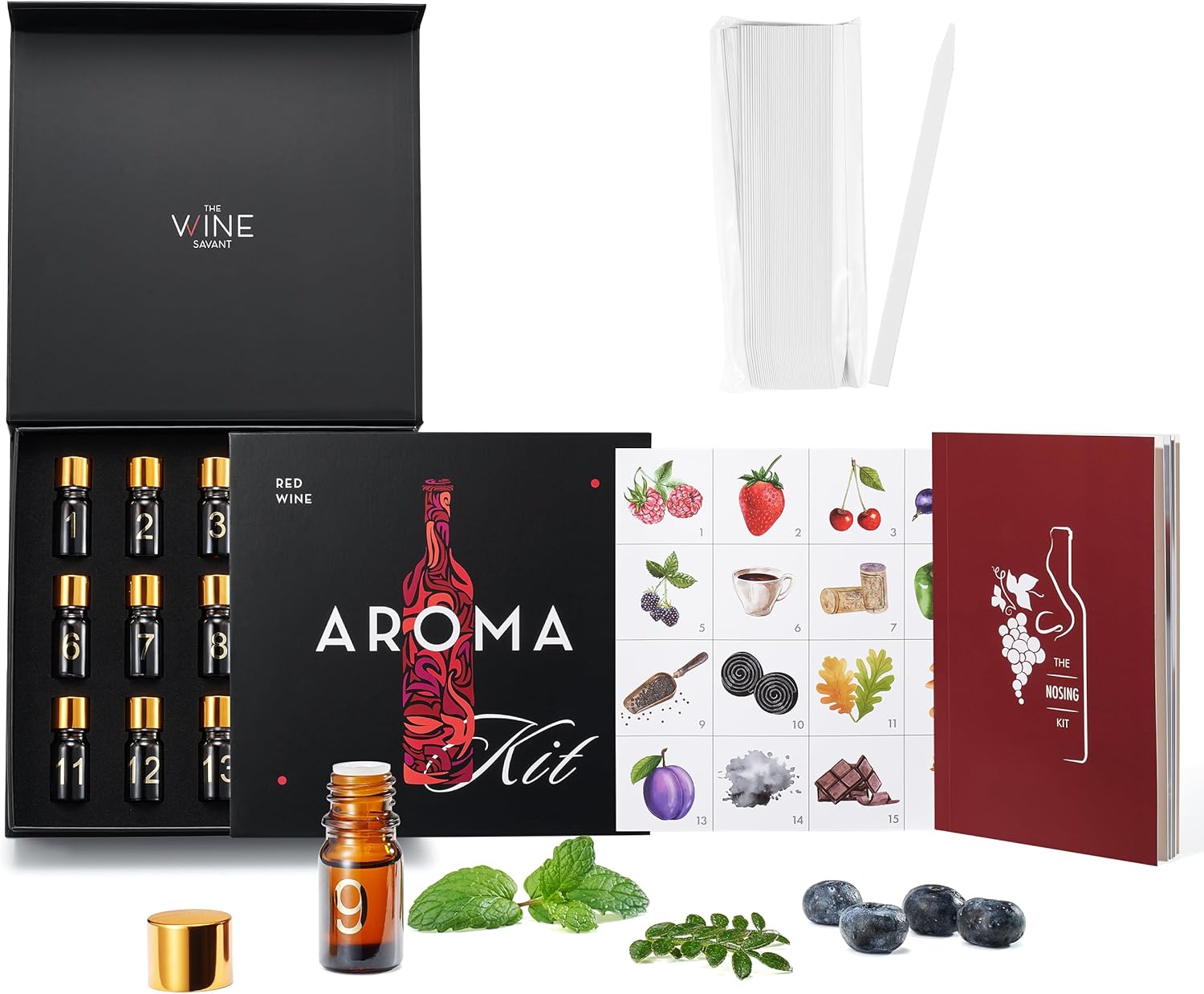
Master Wine Aroma Kit
Having trouble identifying “cassis” or “licorice” in your wine? This kit is flashcards for your nose. It contains vials of common wine aromas, allowing you to train your sense of smell to identify specific notes in the glass—the fastest way to move from “it smells like wine” to genuine aromatic vocabulary.
Check Price on AmazonFrequently Asked Questions
What’s the difference between “fruity” and “sweet”?
A very common point of confusion. “Fruity” refers to the aromas and flavors of fruit in the wine—cherry, blackberry, lemon, peach. “Sweet” refers to the actual presence of residual sugar on your palate. A wine can be bursting with fruit aromas while being technically completely dry. Many New World wines are very fruity but entirely dry. The test: if your mouth is watering from acidity and the “sweetness” you perceive is in the nose rather than a coating sensation on your palate, the wine is probably dry.
Why do people spit out wine at tastings?
Professional tasters spit so they can taste many wines in a single session without becoming intoxicated. Alcohol dulls the senses and impairs critical evaluation, so spitting maintains a clear, sensitive palate through dozens of wines. Many serious amateurs spit at formal tastings too, for the same reason. At a casual tasting with friends, spitting is entirely optional—but know that the professionals always do it when their job requires critical assessment.
What’s the best way to start learning these terms?
The most effective method is comparative tasting. Buy two bottles of the same grape from two different regions—for example, a Sauvignon Blanc from New Zealand and one from France’s Loire Valley. Taste them side by side and actively try to identify differences in acidity, body, aroma, finish, and minerality. Write everything down in a tasting journal. Connecting abstract vocabulary to concrete sensory experiences is how the terms go from definitions to instincts. Do this once a week and your palate will develop faster than years of passive drinking.
Is “old world” vs. “new world” wine an important distinction?
Yes, and understanding it helps you predict what’s in the glass. Old World wines (France, Italy, Spain, Germany, etc.) tend to be named by region, lean toward earthy and savory flavors, show higher acidity, and are made in a terroir-driven style. New World wines (USA, Australia, New Zealand, Chile, Argentina) tend to be named by grape variety, show riper fruit flavors, have higher alcohol, and are often made in a more fruit-forward, approachable style. These are broad generalizations with many exceptions on both sides, but as a starting framework, they are useful.
Why does the same grape taste different in different countries?
This is the answer to one of wine’s greatest questions, and that answer is terroir. The same Pinot Noir grape planted in Burgundy’s cool limestone soils produces a wine of earthy delicacy and mineral tension. Planted in warm, rich Napa Valley soils, it produces a wine of ripe dark cherry and plush velvet. The difference is climate (cooler vs. warmer), soil type, drainage, vine age, and every other environmental factor that shapes how the grape ripens. Terroir is why geography matters in wine and why the same grape tells a different story in every place it grows.
Do I need to spend a lot of money to learn about wine?
Absolutely not. The best wine education happens one glass at a time, with a journal in hand. Many of the best affordable wines are genuinely excellent and teach you just as much as expensive bottles—sometimes more, because they’re less intimidating to analyze critically. Comparative tastings (buying two similar wines side by side) are more educational than a single expensive bottle. A good wine journal, a quality set of glasses, and a curious mind are the only non-negotiable investments.
Conclusion: Wine Is a Conversation
Learning wine terminology isn’t about memorizing a dictionary so you can show off at dinner parties. It’s about giving yourself the tools to understand and appreciate the extraordinary complexity, history, and craftsmanship that goes into every bottle. These words allow you to have a conversation—with the wine, with the winemaker, and with the landscape where the grapes grew.
This language transforms a simple beverage into a story: of place (terroir), of a specific moment in time (vintage), and of a specific plant (varietal). When you taste a wine and recognize the cassis and cigar box of a warm Cabernet vintage, the flinty mineral quality of a Chablis, or the lactic creaminess of a sur lie white Burgundy, you’re not just naming flavors—you’re reading the biography of a wine and the landscape that made it.
Don’t be intimidated. Be curious. Use this glossary as a living reference—return to it whenever a term appears on a label, in a review, or at a tasting. With every bottle you open, your vocabulary will deepen, your palate will sharpen, and your enjoyment will grow. The journey from “it tastes like grapes” to genuine fluency is one of the most rewarding paths in gastronomy, and your first step is already behind you. Cheers!