Wine Enthusiast Wine Cooler Review: A Deep Dive into Premium Storage
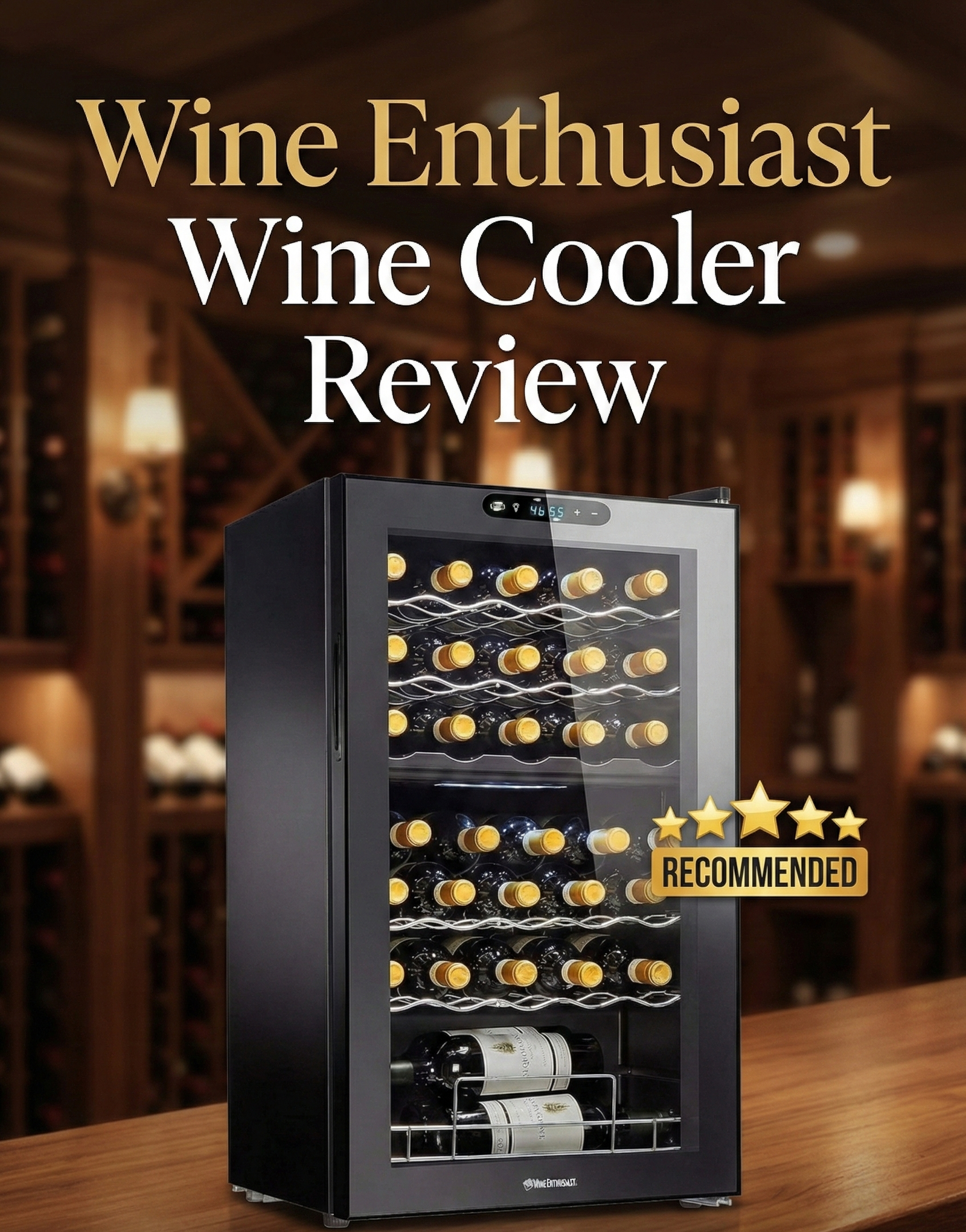
Wine Enthusiast’s cooler lineup spans 18-bottle slimlines to 155-bottle cellar-replacement units — each designed with the VinoView display-forward shelving philosophy.
“A great wine cooler is an act of respect toward every bottle inside it — a promise that what the winemaker spent years creating will not be undone by temperature swings, vibration, or poor humidity.”
For decades, the name “Wine Enthusiast” has been synonymous with the culture of viticulture. It started as a magazine but quickly evolved into a leading authority on wine lifestyle, eventually manufacturing its own line of storage solutions. But does a media brand know how to build hardware? In this comprehensive Wine Enthusiast wine cooler review, we are putting their most popular models to the test.
If you have graduated from buying best affordable wines to collecting age-worthy vintages, you already know that the kitchen refrigerator is a graveyard for fine wine. It is too cold, too dry, and vibrates too much. Serious collectors need a dedicated environment.
Whether you are looking for a sleek under-counter unit or a freestanding showpiece to complement your wine cellar essentials, Wine Enthusiast promises silent cooling, compressor technology, and aesthetic brilliance. But with premium pricing comes high expectations. Let’s analyze whether these coolers justify every dollar.
Who Are Wine Enthusiast Coolers For?
Wine Enthusiast coolers occupy a specific niche: the “Prosumer” market. They bridge the gap between entry-level thermoelectric coolers found at big-box stores and the ultra-luxury, custom-built units like EuroCave — a brand Wine Enthusiast actually distributes in North America, giving them direct access to the engineering philosophy of the world’s most respected wine storage manufacturer.
They are ideal for three distinct buyer profiles:
- The Urban Collector: Space-saving designs like the 18-bottle slimline fit perfectly in apartments where a full cellar is not an option.
- The Varietal Explorer: Their dual-zone technology allows you to keep Chardonnays crisp while maintaining reds at cellar temperature — perfect for those learning how to pair wine with food and needing different serving temperatures at hand.
- The Display Lover: The VinoView shelving system is a patented design that displays labels forward rather than corks forward, turning your collection into a piece of visual art and making selection effortless.
However, if you are looking for a simple portable solution for picnics or outdoor entertaining, you might be better served by a portable wine cooler. These stationary units are purpose-built for the home environment.
It is also worth understanding Wine Enthusiast’s positioning within the wider market ecosystem. As both a retailer and a manufacturer, they design with their editorial wine knowledge embedded into the product. Features like the charcoal filtration system (which we explore in detail later) and the humidity recycling architecture were not conceived by an appliance engineering team working from a brief — they came from years of editorial exposure to what actually goes wrong with wine in imperfect storage environments. That context produces thoughtful products.
Compressor vs. Thermoelectric: The Technology Explained
One of the most consequential decisions in selecting a Wine Enthusiast cooler — or any wine cooler — is understanding the fundamental cooling technology. Wine Enthusiast offers both systems across their lineup, and picking the wrong type for your environment can negate everything else the unit does well.
🔇 Thermoelectric Cooling
Operates on the Peltier effect — electrical current through semiconductor junctions creates a temperature differential. No moving mechanical parts means near-absolute silence and zero vibration.
- Noise output: Virtually silent (0–18 dB)
- Max cooling: ~20°F below ambient room temperature
- Best environment: Conditioned rooms, 65–75°F
- Vibration: None — ideal for sediment-bearing wines
- Running cost: Higher (runs continuously at full draw)
❄️ Compressor Cooling
Refrigerant-cycle technology — the same principle as a household refrigerator, engineered with dampeners specific to wine storage. Cools regardless of ambient temperature.
- Noise output: 38–40 dB (low background hum)
- Max cooling: Reaches down to 38°F
- Best environment: Kitchens, garages, any ambient condition
- Vibration: Low (Wine Enthusiast uses anti-vibration mounts)
- Running cost: Lower (duty-cycle operation)
Critical Consideration: If your home reaches temperatures above 77°F in summer — common in most non-air-conditioned spaces across the US South, Southwest, or any sun-facing apartment — a thermoelectric unit cannot maintain safe wine storage temperatures. The compressor models are the only reliable choice for variable or warm ambient environments.
How Wine Enthusiast Manages Vibration in Compressor Models
The historic criticism of compressor wine coolers — vibration — has been substantially addressed in Wine Enthusiast’s engineering. Their compressor units mount the mechanism on rubber-isolated pads that absorb the majority of mechanical vibration before it reaches the cabinet walls. This matters enormously for long-term aging. Chronic micro-vibration accelerates chemical reactions in wine, ages bottles unevenly, and disturbs sediment in older reds — effectively undoing years of patient cellaring.
In practice, Wine Enthusiast compressor models produce vibration levels competitive with the mid-tier of the market. They are not as isolated as EuroCave’s top models, but they are materially better than budget brands and acceptable for collections including wines intended for mid-term aging of five to ten years.
How Many Bottles Do You Actually Need?
One of the most common mistakes first-time wine cooler buyers make is purchasing based on their current collection size rather than their anticipated collection size. Wine buying has a well-documented ratchet effect: the right cooler encourages more purchasing, more purchasing fills the cooler, and suddenly a 32-bottle unit feels cramped. The following guide helps you right-size your investment from the start.
A practical rule of thumb used by many sommeliers: purchase a cooler with 50% more capacity than your current collection. If you have 20 bottles today and buy regularly, a 32-bottle unit will feel right-sized for approximately one year before you are rearranging shelves to make it work. Buy the 48-bottle unit and you have breathing room.
Also factor in bottle formats. Standard capacity ratings assume Bordeaux-shaped 750ml bottles — approximately 3 inches in diameter. If your collection includes wide-bodied Burgundy shapes, Champagne bottles, or magnums, subtract 15–25% from the advertised number for a realistic real-world estimate.
Deep Dive: The Three Main Series Reviewed
Wine Enthusiast separates their cooler lines by cooling technology and capacity. We tested the performance of their three most widely purchased configurations under real-world home conditions.
1. The Wine Enthusiast 32-Bottle Dual Zone MAX
This is their flagship mid-sized model and the unit most buyers encounter first. It uses compressor cooling, superior to thermoelectric for maintaining stable temperatures in fluctuating ambient environments. If you are learning how to store wine at home properly, a compressor unit is the recommended foundation.
Performance in Testing: The dual-zone separation is genuinely impressive for its class. The upper zone held steady at 50°F (ideal for full-bodied whites like oaked Chardonnay), while the lower zone maintained 55–58°F for reds. This is critical because serving temperature affects flavor profoundly — a Cabernet Sauvignon served at 45°F will present as tight, tannic, and closed, whereas the same bottle at 60°F opens into the plush, fruit-forward profile the winemaker intended. (Read our full explainer on what is tannin in wine).

Wine Enthusiast 32-Bottle Dual Zone MAX
Perfect for medium collections requiring different temperature zones for reds and whites simultaneously.
Check Price on Amazon2. The VinoView 155-Bottle Cellar
For serious collectors, the 32-bottle ceiling is hit quickly. The VinoView 155-bottle unit is where Wine Enthusiast’s engineering ambition is fully expressed. Its defining characteristic is the shelving system — but the climate architecture is equally compelling. This unit operates with fan-assisted compressor cooling, actively circulating air throughout the cabinet to maintain a temperature variance of under three degrees from top to bottom of the interior.
The unit rivals dedicated modular wine rack systems in capacity but adds the climate control that passive rack storage cannot provide. It features an activated charcoal filter to eliminate ambient odors — a feature we explore fully in the UV and filtration section below. For those collecting sensitive organic and natural wines, which often lack sulfite protection and are more vulnerable to environmental compromise, this level of active protection is not optional — it is essential.
3. The 18-Bottle Slimline (Thermoelectric)
Not every household has space for a full-width appliance. The 18-bottle Slimline is engineered for exactly this constraint. At roughly 10.5 inches wide, it fits between existing kitchen appliances, on shelving, or in a bar nook where larger units cannot go. Unlike the larger units, this typically uses thermoelectric cooling — silent, vibration-free, and well-suited to its purpose as an entry point for buyers transitioning from improvised storage such as a pantry shelf or wine bags.
The thermoelectric Slimline excels in climate-controlled environments. It is the unit we recommend to apartment dwellers and office buyers where ambient temperature is consistently managed. Its limitation is its ~20°F cooling differential — in any space where summer temperatures exceed 78°F, its internal temperature will climb above the safe storage range for white wines.
The VinoView Shelving System: A Genuine Innovation
Most wine cooler shelves are designed around a straightforward principle: horizontal bottle storage with the cork pointing inward. To identify a bottle, you pull it out, check the label, and replace it. For a collection of 20 bottles, this is mildly inconvenient. For a collection of 80 or 155 bottles organized by producer, vintage, and region, it is a significant friction point that leads to accidental label damage, sediment disturbance, and the general chaos that makes a large collection harder to use than it should be.
VinoView shelves angle the bottle slightly downward while positioning it label-forward. The effect is that you see labels rather than capsules when you open the door — the same presentation logic as a professional wine cellar or a retail wine shop floor. Identification is immediate and requires no physical handling of bottles that are not being selected. For anyone who has applied the principles in our wine label reading guide to organize their collection by producer and appellation, VinoView is the hardware expression of that organizational logic.
🔎 The Ergonomics of Label-Forward Storage
Beyond aesthetics, label-forward presentation has a practical benefit for label preservation. Traditional sliding shelves, with their metal-on-bottle contact during insertion and removal, scuff labels — particularly those with embossed designs or heavy paper stocks. VinoView’s pull-forward mechanism reduces lateral friction during access, keeping labels in display-quality condition. For collectors who track valuations or intend to resell bottles, label condition matters in a tangible monetary sense.
The shelves themselves are constructed from a combination of metal rails and beechwood cradle surfaces. The wood contact reduces the risk of label tearing that all-metal wire racks produce. The weight rating per shelf accommodates six standard Bordeaux bottles with comfortable margin. For the 155-bottle VinoView, each sliding shelf pulls out smoothly on stainless runners — a quality of mechanism that feels deliberately engineered rather than an afterthought, which is often exactly what budget cooler shelving feels like.
Key Features & Technology Analysis
Cooling Technology: A Practical Recap
Wine Enthusiast offers both cooling systems across their lineup. Their compressor models function like a specialized refrigerator with vibration dampeners built into the compressor mount. These are powerful and consistent across any ambient temperature condition. Their thermoelectric models are quieter and produce zero vibration — ideal for sediment-bearing reds and silent rooms — but are limited to environments where ambient temperatures remain below 77°F year-round.
Shelving Quality and Ergonomics
Shelf quality varies meaningfully by model tier. The premium VinoView lines feature pull-out beechwood shelves with metal-channel fronts. These are structurally solid and protect labels from tearing — an annoyance every collector who has dealt with wire racks will recognize. If you have ever struggled to read a label damaged by a cheap rack, you will appreciate the wood surface on first use. The entry-tier models use wire shelving with wood-strip fronts, which is adequate but not the full VinoView experience.
Digital Temperature Control
All current Wine Enthusiast models include digital thermostat controls with LED temperature displays. The 32-bottle and 155-bottle dual-zone units display both zones simultaneously and allow independent adjustment via front-panel touch controls without opening the door. This is a meaningful operational advantage — every time you open the door to check the temperature, the internal temperature drops and the compressor cycles to recover. Front-panel control eliminates this entirely.
Wine Storage Temperature Guide by Varietal
Understanding temperature requirements by wine type transforms how you configure your Wine Enthusiast dual-zone unit. The following table represents the consensus of professional sommeliers and enologists on storage versus service temperature ranges.
| Wine Type | Long-Term Storage | Serving Temperature | Notes |
|---|---|---|---|
| Cabernet Sauvignon | 54–57°F | 60–65°F | High tannin; warmer serving unlocks aromatics |
| Pinot Noir | 52–55°F | 55–60°F | Most temp-sensitive red varietal; avoid all fluctuation |
| Syrah / Shiraz | 54–58°F | 60–65°F | Tolerates slightly warmer long-term storage |
| Chardonnay | 50–54°F | 48–55°F | Oaked styles benefit from slightly warmer storage |
| Sauvignon Blanc | 46–50°F | 44–50°F | Aromatics degrade rapidly above 55°F storage |
| Champagne / Sparkling | 50–55°F | 42–48°F | Pre-chill 2–3 hours before serving |
| Dessert / Port | 55–60°F | 58–65°F | High sugar provides thermal buffer; somewhat forgiving |
| Rosé | 46–52°F | 44–50°F | Consume young; best stored near serving temperature |
Dual-Zone Configuration Tip: For the Wine Enthusiast 32-bottle MAX, set your upper zone at 48–50°F for whites and sparkling, and the lower zone at 55–57°F as your universal red storage temperature. This covers the entire range of common varietals without compromise and gives you serving-ready whites the moment guests arrive.
The Cost of Temperature Fluctuation
Beyond the absolute storage temperature, the consistency of that temperature is what separates adequate storage from excellent storage. When a wine cooler cycles between 50°F and 68°F due to a loose gasket, improper installation, or an underpowered compressor in a warm room, the wine inside undergoes repeated expansion and contraction. Over months, this stresses the cork seal, can cause seepage from under the capsule, and accelerates premature aging. A Wine Enthusiast unit with a well-sealed door and correctly installed compressor maintains temperatures within ±2°F of the set point — a specification that protects even sensitive bottles over multi-year storage horizons.
Installation Guide: Built-In vs. Freestanding
Correct installation is as important as selecting the right model. The majority of premature cooler failures can be traced to ventilation errors — a problem entirely preventable with careful pre-installation planning.
Freestanding Installation
Freestanding Wine Enthusiast models exhaust heat from the rear. This requires a minimum of six inches of clearance behind the unit and two inches on each side. Placing a rear-venting unit in a closed cabinet opening without this clearance creates a heat trap — the compressor runs continuously trying to overcome the ambient heat it is generating, drawing excessive current and wearing out in a fraction of its expected service life.
- Choose LocationSelect a level surface in a conditioned room, away from direct sunlight, heat appliances, and exterior walls in climates with temperature extremes.
- Confirm ClearancesMark six inches behind the intended rear position and two inches on each side. These minimums are non-negotiable for rear-venting models.
- Check LevelUse a spirit level. An unlevel unit allows the door to hang slightly open, progressively compromising the gasket seal and forcing the compressor to work harder.
- Electrical ConnectionConnect to a dedicated 15-amp grounded outlet. Sharing a circuit with high-draw appliances (dishwasher, microwave) causes voltage fluctuations that stress the compressor motor.
- Run Empty FirstAllow the unit to run empty at your target temperature for 24 hours before loading your collection. Verify both zones reach and hold set point temperatures before committing bottles to the interior.
Built-In / Undercounter Installation
Built-in Wine Enthusiast models are designed with front-exhaust ventilation through the toe-kick area at the base of the unit. This allows completely flush installation within existing cabinetry without any rear or side clearance requirements. However, the installation procedure requires attention to several details that directly affect long-term performance.
Measure Twice: Standard kitchen undercounter openings are 24 inches wide and 34.5 inches tall. Confirm your model’s exact dimensions against your opening, including handle projection. Many buyers discover a 0.5–1 inch discrepancy after delivery that requires cabinet modification. The time to discover this is before purchase, not on delivery day.
After flush installation, verify that no kick plate, trim piece, or flooring material obstructs the front toe-kick exhaust panel. An obstructed front vent on a built-in unit creates the same heat-trap problem as incorrect rear clearance on a freestanding unit. Additionally, secure the unit to the cabinet walls using the anti-tip bracket included in the installation package — particularly important in households with children.
A Note on Door Reversibility
Not all Wine Enthusiast models offer reversible door swing, and this is worth confirming before purchase if your installation geometry requires a specific hinge side. A unit installed with the door hinging into a wall or adjacent appliance requires the door to be pulled at an angle to open fully — inconvenient at best, a long-term hinge stress issue at worst. Review the product specifications carefully and confirm with the retailer if reversibility is a requirement for your space.
Humidity & Vibration Control
The Humidity Requirement
Wine Enthusiast coolers often feature what the brand describes as a “humidity recycling” architecture — a term that encompasses the sealed cabinet design, the minimal air exchange between internal and external environments, and in select models, an active moisture management system. The target is the same range every serious wine storage system aims for: 50–70% relative humidity.
Below 50% RH, natural corks desiccate. The elasticity that makes a cork an effective bottle seal diminishes as it dries, and micro-fractures develop that allow oxygen ingress. Over months, this can turn a carefully aged bottle into one with premature oxidation — flat color, reduced aromatics, and the telltale orange-brown tinge at the rim in reds. Above 70% RH, the risk shifts to mold growth on labels and potentially on cork surfaces. Neither extreme is catastrophic in the short term, but both compound over a multi-year storage horizon.
In practice, a well-sealed Wine Enthusiast cabinet naturally maintains acceptable humidity because the wine itself contributes moisture to the enclosed air. In very dry climates or heated interiors in winter, placing a small open container of distilled water on a low shelf supplements moisture. A silica gel desiccant absorbs excess moisture in persistently humid environments.
Vibration Management in Practice
Vibration is the most underappreciated variable in home wine storage. The mechanism of damage operates at two scales. At the macro scale, agitation of sediment-bearing bottles physically stirs settled particles back into solution. Opening a well-aged Vintage Port or a mature Barolo after months in a vibrating unit produces a cloudy, astringent glass rather than the clear, complex pour that careful cellaring should yield. At the molecular scale, chronic vibration accelerates oxidation reactions and disrupts the slow, reductive chemical processes responsible for tertiary complexity in aged wines.
Wine Enthusiast’s compressor models mount the compressor on rubber isolation pads and use a cabinet construction that dampens residual vibration before it reaches the bottle racking. Their thermoelectric models, of course, produce no vibration whatsoever — the Peltier effect involves no moving mechanical parts. For a collection that includes bottles you plan to age for more than five years, this specification is worth paying careful attention to when comparing specific models.
UV Protection & Charcoal Filtration: The Chemistry Explained
Light Strike: More Serious Than Most Buyers Realize
The phenomenon known as light strike — or in French, gout de lumière — is a photochemical reaction in which certain wavelengths of light, particularly UV and near-UV, catalyze reactions between riboflavin (vitamin B2) and sulfur-containing amino acids in wine. The products of this reaction include dimethyldisulfide and hydrogen sulfide — compounds that produce the characteristic cooked-vegetable and struck-match off-aromas associated with light-damaged wine. Crucially, this reaction can occur within hours of intense light exposure in white wines in clear glass bottles. For Champagne, Riesling, and unoaked Chardonnay — wines prized precisely for their delicate aromatic profiles — light damage is not a minor quality issue. It is a potentially irreversible one.
Wine Enthusiast addresses this through thermopane glass doors with UV-filtering tinting applied to the outer pane. The thermopane construction creates an insulating air gap between the panes that simultaneously blocks the majority of UV transmission and reduces thermal exchange with the room. The resulting light that enters the cabinet is shifted toward the warmer, redder part of the visible spectrum — the range that has not been shown to catalyze light strike reactions at the intensities typical of domestic ambient lighting.
☀️ What “UV-Filtered” Actually Means
The UV tinting on Wine Enthusiast glass filters approximately 90–95% of UV wavelengths below 380nm — the range most responsible for light strike. This does not mean UV-immune, but it means the rate of photodegradation is reduced to levels negligible under normal home ambient light exposure. Direct sunlight through the glass door would still cause damage; indirect or artificial lighting will not.
Activated Charcoal Filtration
The 155-bottle VinoView unit and select larger models include an activated charcoal filter mounted near the air circulation system. This is a feature rarely found outside commercial cellar installations, and its presence reflects Wine Enthusiast’s editorial-informed product philosophy.
Corks are porous. Over time, they equilibrate with the atmosphere inside the storage cabinet — absorbing volatile compounds present in the air. In a sealed wine cooler this process is minimal, but it is not zero. Strong ambient odors from other foods, cleaning products, or even new-appliance off-gassing can theoretically influence cork-sealed wines over years of storage. Activated charcoal is one of the most effective adsorbents for organic volatile compounds. Its presence in the cabinet creates a continuous passive filtration loop that keeps the internal atmosphere as neutral as possible. For natural wine collectors whose bottles often feature less protective closures or unfiltered wine with greater aromatic sensitivity, this feature provides a meaningful layer of protection.
Cleaning & Long-Term Maintenance
A wine cooler that receives proper maintenance will outlast one that is ignored by a decade or more. The following schedule covers everything from routine interior cleaning to the annual mechanical checks that prevent premature failure.
Quarterly Cleaning Routine
- Interior Wipe-Down: Use a solution of baking soda and warm water (1 tablespoon per quart of water). This neutralizes any trace odors without leaving chemical residues that could influence cork-sealed wine aromas. Never use bleach, solvent-based cleaners, or abrasive compounds inside the cabinet.
- Beechwood Shelf Cleaning: Remove shelves and wipe with a barely damp cloth. Dry thoroughly before reinstallation. Damp wood can harbor mold in the slightly elevated humidity environment of a wine cooler.
- Door Gasket Inspection: Run your fingers along the entire perimeter gasket checking for cracks, tears, or sections that have lost their magnetic hold. A failing gasket is the most common cause of elevated electricity bills and temperature instability. Clean with mild soap solution, rinse, and dry. If the gasket fails the folded-paper test (paper should resist pulling when caught in the closed door), the gasket needs replacement.
- Glass Door Cleaning: Use a streak-free glass cleaner on the exterior pane. Never attempt to clean between the thermopane panes — condensation or fogging between the panes indicates that the door’s edge seal has failed and requires professional attention.
Annual Maintenance
- Condenser Coil Cleaning (Freestanding Models): Slide the unit forward and use a soft brush vacuum attachment on the rear condenser coil grid. Dust and pet hair coating the coils reduce heat dissipation efficiency significantly, forcing the compressor to run longer and harder. This single maintenance action has the largest impact on both unit longevity and electricity consumption.
- Charcoal Filter Replacement: If your model includes an activated charcoal filter, replace it according to the manufacturer’s schedule — typically annually. A saturated charcoal filter loses its adsorptive capacity and provides no ongoing benefit. Replacement filters are available directly from Wine Enthusiast.
- Temperature Verification: Place a calibrated thermometer in a glass of water inside each zone overnight and compare the reading to the digital display. A discrepancy greater than 2°F suggests thermostat drift and warrants a call to Wine Enthusiast support.
- Leveling Check: Reconfirm the unit is perfectly level. Building settlement in older homes can shift floors by fractions of an inch over a year — enough to cause the door to hang slightly open on the non-hinge side.
Extension Cord Warning: Wine Enthusiast, in common with all reputable wine cooler manufacturers, advises strongly against the use of extension cords. If your outlet placement makes a direct connection impractical, hire an electrician to install a properly rated outlet rather than relying on a cord rated below the unit’s draw. An undersized extension cord creates a voltage drop that stresses the compressor motor and voids the warranty.
Energy Consumption & Annual Running Costs
A wine cooler runs continuously, 24 hours a day, every day of the year. It is easy to underestimate the cumulative electricity cost of an appliance that never turns off. The following estimates are based on typical duty-cycle behavior — a compressor runs approximately 30–40% of the time in a well-installed, properly sealed unit at standard ambient temperatures.
| Model | Avg. Wattage | Daily kWh (Est.) | Annual Cost* | Energy Star |
|---|---|---|---|---|
| 18-Bottle Slimline (Thermoelectric) | 50–65W | 0.7–0.9 kWh | $28–38/yr | Not rated |
| 32-Bottle Dual Zone MAX | 80–105W | 0.55–0.85 kWh | $26–40/yr | Select models |
| 48-Bottle Series | 90–120W | 0.65–0.95 kWh | $29–43/yr | Select models |
| VinoView 155-Bottle | 130–185W | 0.95–1.45 kWh | $42–62/yr | Select models |
*Estimates based on U.S. average electricity rate of approximately $0.13/kWh. Actual costs vary by region, installation quality, and ambient temperature.
The thermoelectric 18-bottle Slimline is counterintuitively less energy-efficient per bottle than the compressor 32-bottle MAX. Thermoelectric modules run at continuous full draw rather than cycling, which means their per-hour wattage is lower but their duty cycle is 100% compared to the compressor’s 30–40%. Over a full year, the actual energy consumption often ends up comparable between the two technologies despite the thermoelectric’s lower peak wattage.
For energy efficiency as a primary selection criterion, look for the Energy Star certification label. Wine Enthusiast’s Energy Star-rated models feature enhanced door insulation and more efficient compressor specifications that reduce annual consumption by 15–20% compared to non-rated units of equivalent capacity.
Wine Enthusiast vs. The Competition
How does Wine Enthusiast stack up against the other significant players in the premium wine cooler market? The 32-bottle category — the segment where most buyers begin serious collecting — is the most competitive. Here is a full cross-brand analysis.
| Brand | Price Tier | Cooling Tech | Shelving | Vibration Isolation | Warranty | Verdict |
|---|---|---|---|---|---|---|
| Wine Enthusiast Our Pick | Mid–Premium | Compressor / Thermoelectric | Beechwood + VinoView | Good | 1yr / 3yr parts | Best aesthetics + display |
| EuroCave Luxury | Luxury | Compressor | Solid beech — exceptional | Excellent | 3 Year | Best overall, 2–3× price |
| Vinotemp | Mid–Premium | Compressor / Thermoelectric | Metal + wood fronts | Very Good | 2 Year | Better durability, less display focus |
| NewAir | Budget–Mid | Compressor | Full beechwood (select) | Average | 1 Year | Good value for casual collectors |
| Kalamera | Budget–Mid | Compressor | Wire — below average | Below Average | 1 Year | Entry-level budget option |
While often slightly more expensive, the Wine Enthusiast warranty structure — with three-year parts coverage on select models beyond the standard one-year labor warranty — combined with the VinoView display system gives it a clear edge for aesthetic-focused buyers. For buyers prioritizing structural durability and vibration isolation above display elegance, Vinotemp’s two-year full warranty and commercial-heritage racking represents a compelling alternative at similar price points.
Where to Install: Placement Guide
Ideal Installation Locations
- Kitchen (Built-In Models): The most common and practical placement for 18 to 48-bottle units. Keep away from oven and dishwasher heat exhaust zones.
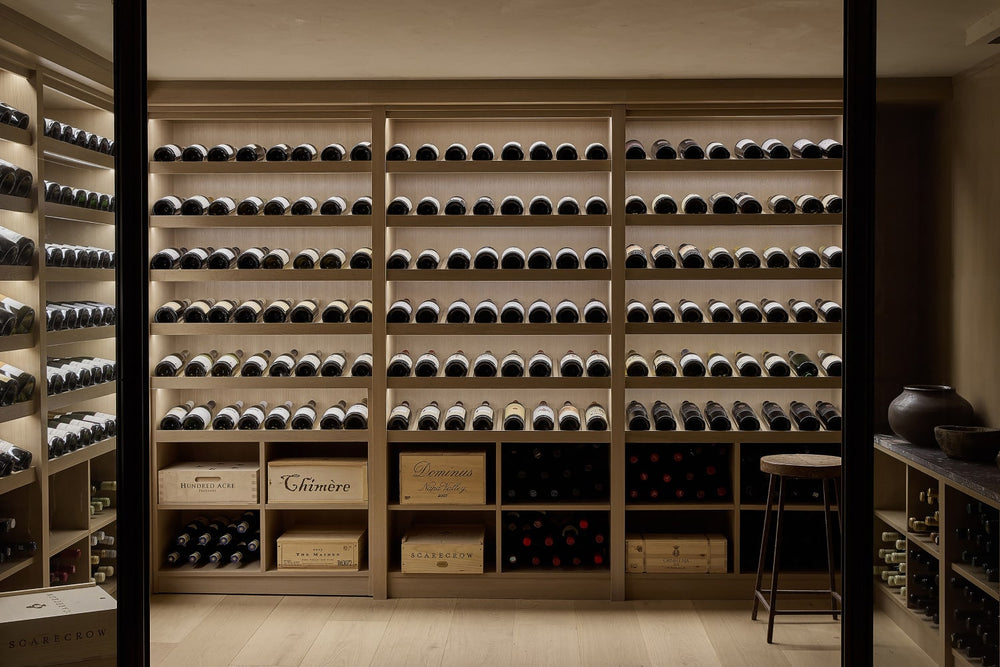
- Butler’s Pantry or Wine Room: Optimal for the 155-bottle VinoView. Stable ambient temperature reduces compressor duty cycle and extends unit longevity.
- Dining Room or Living Room: Excellent for display-focused models. The VinoView label-forward shelving was designed exactly for this visibility context. Avoid direct sunlight.
- Home Bar: Well-suited for 18 and 32-bottle units. Ensure the bar area is climate-controlled; home bar spaces are frequently warmer than adjacent rooms due to incandescent lighting and crowding during entertaining.
- Insulated Basement: Naturally stable temperatures make basements among the best environments for wine cooler performance, as the compressor rarely needs to work hard against ambient heat.
Locations to Avoid
- Direct Sunlight: The UV-filtered glass significantly reduces risk but does not eliminate it entirely. Solar heat loading will force the compressor to run continuously.
- Uninsulated Garages in Climate Extremes: Temperature swings below 40°F (winter) or above 85°F (summer) stress compressors and compromise wine quality.
- Adjacent to Heat-Generating Appliances: Ovens, boilers, tumble dryers, and HVAC condenser units all create localized heat that makes the cooler’s compressor work harder.
- Outdoor or Semi-Outdoor Spaces: Wine Enthusiast units are not rated for outdoor use. Moisture ingress in outdoor environments will corrode electrical components and void the warranty.
Never Do This: Do not place a freestanding (rear-venting) Wine Enthusiast model in a fully enclosed cabinet space without proper rear clearance. This is the single most common cause of premature compressor failure and is explicitly excluded from warranty coverage. If you need a fully flush installation, you must purchase a model specifically designated as “Built-In” with front exhaust ventilation.
Large Format & Champagne Bottle Compatibility
Standard Wine Enthusiast capacity ratings are calculated using the Bordeaux bottle format: approximately 3 inches in diameter and 12 inches tall. The reality of a diverse collection is that bottle shapes vary considerably, and each deviation from standard Bordeaux sizing reduces effective capacity.
Champagne & Sparkling Wine
Champagne bottles feature a wider punt (base) and a more pronounced shoulder than Bordeaux bottles, with a typical diameter of 3.5 inches. Standard Wine Enthusiast shelves have spacing calibrated for Bordeaux width. Champagne bottles can be stored in most models but require shelf adjustment — typically removing one shelf to create a double-height bay — which reduces the standard capacity by four to six bottles per modified shelf row.
If Champagne represents a significant portion of your collection, the 32-bottle dual-zone MAX’s upper zone serves particularly well with shelves reconfigured for the wider format. The upper zone’s proximity to the door and cooler temperatures (set at 48–50°F) is ideal for sparkling wines that move from storage to serving without an additional chilling step.
Magnum and Large Format Bottles
Magnums (1.5L) and Jeroboams (3L) cannot be accommodated in standard shelf configurations in smaller Wine Enthusiast models. The 155-bottle VinoView includes a bulk storage section at the base — a floor-level bay with sufficient height for magnum storage in a horizontal position. For the 32-bottle and smaller units, magnums require full shelf removal to create a dedicated bay, which may accommodate only one or two large-format bottles.
If large-format bottles are central to your collection, clarify with the retailer whether the specific model includes a bulk storage accommodation before purchasing. This specification is not always prominently highlighted in product listings but can be confirmed in the detailed specification sheet.
Pros and Cons: The Complete Picture
✅ The Pros
- Brand Heritage: Built by people with decades of editorial wine knowledge embedded into product design decisions.
- VinoView Shelving: Genuine label-forward innovation that improves usability and label preservation simultaneously.
- Aesthetics: Blue LED interior lighting, stainless steel trim, and clean glass door design elevate any kitchen or bar environment.
- Vibration Dampening: Critical for long-term aging — rubber-isolated compressor mounts protect sediment-bearing wines.
- UV-Filtered Thermopane Glass: Genuine protection against light-strike photodegradation.
- Charcoal Filtration (Select Models): Active air purification keeps the cabinet atmosphere neutral for sensitive natural wines.
- Warranty Structure: Three-year parts coverage on select models exceeds most competitors in the segment.
❌ The Cons
- Capacity Reality: “32 Bottles” refers to standard Bordeaux bottles. Wide-bottomed Pinot Noir or Chardonnay shapes reduce capacity by 15–20%.
- Price Premium: You pay more per bottle of storage capacity than Kalamera or NewAir equivalents — the brand name and design quality carry a cost.
- Door Reversibility: Not universally available across all models — confirm for your specific kitchen layout before purchasing.
- Thermoelectric Limitation: Slimline units struggle in warm environments; buyers in hot climates must select compressor models.
- Vibration vs. EuroCave: Compressor vibration isolation, while good, does not match the benchmark set by EuroCave’s top-tier units.
Living With the Cooler: Practical Insights
After unboxing, there is a distinct new-appliance smell. Wipe the interior with a damp cloth using a mild baking soda solution and allow the unit to run empty for 24 hours before loading your wine subscription box delivery or existing collection. This settling period allows the temperature to stabilize and any residual manufacturing odors to dissipate through the toe-kick vent.
Noise Level in Practice: The compressor models produce approximately 38–40 dB during the compressor’s active cycle. For context, this is roughly equivalent to a quiet library or a very low HVAC background hum — audible in a completely silent room but effectively masked by normal household noise. If you plan to install a unit in a bedroom or dedicated media room where silence is important, the thermoelectric Slimline is genuinely silent, though you sacrifice cooling range and consistency.
Kitchen Integration: Many Wine Enthusiast models are front-venting and can be built into cabinetry. Always verify the specific model’s ventilation type before assuming flush installation is possible. A rear-venting unit placed under a counter is not simply an inconvenience — it is a mechanical failure waiting to happen. If you cannot accommodate a built-in unit, consider a countertop electric wine chiller for serving purposes, though these are not substitutes for proper temperature-controlled storage.
Loading Your Collection: When loading the unit for the first time, place bottles in the lower zone first (the larger, cooler section for reds) before filling the upper zone. Allow the unit to restabilize for four to six hours after loading before checking temperatures. The thermal mass of cold bottles actually stabilizes the internal temperature and reduces compressor cycling frequency — a fully loaded cooler runs more efficiently than an empty one, which surprises many new owners.
Commercial & Restaurant Use Cases
Wine Enthusiast units are primarily designed for residential use, but their quality specifications and dual-zone control make them practical tools in small commercial settings — boutique wine bars, private dining rooms, chef’s tables, and tasting room retail environments.
What Makes These Suitable for Semi-Commercial Use
The 32-bottle dual-zone and 155-bottle VinoView are the two models most commonly encountered in commercial settings. Their digital temperature control panels, locking doors, and UV-filtered glass make them appropriate for customer-facing environments. The by-the-glass program use case is particularly natural: whites and sparkling wines maintained at serving temperature in the upper zone are pourable without any waiting period, while reds in the lower zone require only minimal warming from the hand after pouring.
A wine bar managing a curated 40-bottle by-the-glass program can operate effectively from a pair of Wine Enthusiast 32-bottle units, organized by category — one unit for whites, rosé, and sparkling; one for reds. This configuration costs a fraction of a commercial undercounter refrigeration installation and provides comparable service-readiness for lower-volume operations.
Limitations in Commercial Environments
Wine Enthusiast residential models do not carry NSF (National Sanitation Foundation) certification. This certification is required by health codes in many US jurisdictions for food and beverage storage equipment in licensed establishments. Before using these units in a commercially licensed space, confirm local health department requirements. Additionally, the residential warranty does not extend to commercial-use applications. For high-volume commercial environments — restaurants turning 200-plus covers per service — purpose-built commercial undercounter refrigeration is the appropriate specification.
Warranty & Customer Support
Wine Enthusiast’s warranty structure is among the more nuanced in the category and rewards careful reading before purchase. Understanding exactly what is covered — and for how long — removes uncertainty from a purchase that may reveal performance issues only months after delivery.
The Two-Tier Warranty Structure
Most Wine Enthusiast wine coolers carry a one-year full warranty covering parts and labor for manufacturing defects. Select models — primarily in the VinoView and higher-capacity series — extend the parts warranty to three years, while labor coverage remains at one year. This means that a compressor failure in month 18 would have the replacement compressor covered under warranty but the service technician’s labor would be at the buyer’s expense. Confirming which warranty tier applies to your specific model at the time of purchase is worthwhile — it influences the actual cost exposure during the years two and three of ownership.
What Is and Is Not Covered
Covered: manufacturing defects in the compressor, thermostat, electronic control boards, LED lighting, and structural components. Not covered: damage from improper installation (including incorrect ventilation clearances), damage from extension cord use, cosmetic damage present upon delivery that was not reported within 48 hours, commercial use on residential-grade units, and damage from power surges or unstable electrical supply.
Customer Support Experience
Wine Enthusiast’s customer support is accessible through their website chat, email, and phone. Response times and resolution rates are generally regarded positively in community reviews, with replacement parts for gaskets, shelves, and thermostats available directly through the company’s parts department. The ability to order specific replacement components rather than having to replace an entire unit is a meaningful long-term ownership advantage — the failure mode most likely to occur in a wine cooler’s second decade of life (a worn gasket or a thermostat sensor) should not require a full appliance replacement.
Buying Guide: New, Refurbished & Timing Your Purchase
Where to Buy
Wine Enthusiast products are available through their own direct website, Amazon, Williams-Sonoma, and specialty kitchen and wine retailers. Purchasing directly from Wine Enthusiast.com provides access to the full model range and current promotional pricing, and direct purchases benefit from their own customer service team rather than a third-party retailer’s support structure. Amazon’s marketplace offers competitive pricing and familiar logistics, but verify that you are purchasing from Wine Enthusiast directly rather than a third-party reseller to ensure warranty validity.
Williams-Sonoma is worth checking for in-store availability if you prefer to see the display quality in person before committing — the VinoView shelving and LED interior lighting are significantly more compelling in person than in product photography.
Refurbished Units: The Risk Assessment
Certified refurbished Wine Enthusiast units occasionally appear through manufacturer-certified channels and liquidation platforms. The risk profile differs from buying new in specific ways. Compressor wear, gasket degradation, and thermostat drift are all age-related failure modes that may not be visible during a basic functional test. A unit that passes a 24-hour temperature stability test during refurbishment may still have a gasket that fails in month six. For a device that protects a potentially valuable wine collection, the risk-adjusted value of a refurbished unit without warranty coverage is typically lower than the headline savings suggest. If purchasing refurbished, insist on at minimum a 90-day warranty from the seller and verify that the door gasket has been replaced as part of the refurbishment process.
Seasonal Pricing Patterns
Wine Enthusiast participates in the standard major retail sale calendar: Black Friday and Cyber Monday typically produce the deepest discounts, ranging from 15–30% off regular pricing. Post-holiday January clearance represents a secondary opportunity, particularly for prior-season models being cleared to make room for updated SKUs. If your collection can wait, purchasing during these windows at any capacity tier is the highest-value timing strategy available to patient buyers.
Recommended Accessories
To get the most from your new cooler, consider these proven additions:
- Hygrometer: A standalone digital hygrometer placed inside the cabinet confirms humidity is tracking within the 50–70% range. Wine Enthusiast units do not include a built-in humidity display.
- Wine Preservation: If you open a bottle from your collection but do not finish it, the economics of proper storage demand proper short-term preservation. Read our full breakdown of Coravin vs Vacu Vin to choose the right approach for your drinking habits.
- Proper Glassware: Storing wine at its ideal temperature only to serve it in an inappropriate glass is a false economy. Review the best wine glasses for red wine to complete the chain from storage to experience.
- Wine Stoppers: For casual bottle finishing, quality wine stoppers protect open bottles stored back in the cooler for up to 48 hours without significant quality loss.
Frequently Asked Questions
Yes, for serious collectors. Their compressor technology, vibration dampening, VinoView shelving, UV-filtered glass, and charcoal filtration offer substantially better protection for valuable vintages compared to budget brands. The premium reflects genuine engineering investment, not just brand positioning.
With proper maintenance — annual condenser coil cleaning, regular gasket inspection, and charcoal filter replacement — a compressor-based Wine Enthusiast cooler should provide 12–15 years of reliable service. The commonly cited 7–10 year figure reflects units that received minimal maintenance. Routine care is the most significant longevity variable under your control.
Only if it is explicitly designated as “Built-In” or “Front-Venting.” Placing a rear-venting freestanding model in an enclosed under-counter space traps the compressor’s exhaust heat, forcing continuous operation, dramatically shortening unit life, and creating a potential fire hazard. This configuration also voids the warranty. Refer to our wine storage without a fridge guide if a built-in model does not fit your space.
Single zone maintains one temperature throughout the entire cabinet — appropriate for long-term storage where all bottles rest at a universal 55°F. Dual zone provides two independently controlled compartments, allowing white wines at 45–50°F and reds at 55–60°F simultaneously. Learn the full vocabulary in our wine terminology guide.
Critically, yes. Below 50% relative humidity, natural corks desiccate and develop micro-fractures that allow oxygen ingress — progressively oxidizing the wine from the outside in. Above 70%, mold growth on labels and cork surfaces becomes a risk. Wine Enthusiast’s sealed cabinet design and humidity recycling architecture maintains the 50–70% target range under most home conditions without active intervention.
VinoView is Wine Enthusiast’s patented label-forward shelving system. Instead of storing bottles cork-end first (which requires removing the bottle to read the label), VinoView positions bottles at a slight downward angle with the label facing the glass door. The result is a display-quality visual experience and instant label identification without physically handling any bottle in the collection — preserving sediment and label condition simultaneously.
Yes, though the standard shelf configuration is sized for Bordeaux-format bottles. Champagne’s wider punt and shoulder require shelf adjustment — typically removing one standard shelf to create a double-height bay — which reduces the effective capacity of that section. If Champagne is a major part of your collection, confirm the model’s accommodation for wider bottle formats before purchasing.
They are closely matched but prioritize differently. Wine Enthusiast excels in display aesthetics, VinoView shelving ergonomics, charcoal filtration on larger models, and the brand’s editorial wine knowledge embedded in product decisions. Vinotemp offers stronger structural build quality, a two-year full warranty versus Wine Enthusiast’s one-year labor coverage, and vibration isolation specifications closer to commercial standards. Display-focused collectors lean toward Wine Enthusiast; durability-focused collectors lean toward Vinotemp.
The most common causes are a failing door gasket, blocked exhaust ventilation, dirty condenser coils reducing heat exchange efficiency, or placement in an ambient environment exceeding 85°F (which overtaxes the compressor). Check the door gasket seal first using the folded-paper resistance test. A gasket that allows paper to slide freely has lost its seal and needs replacement. Contact Wine Enthusiast customer support if the issue persists after checking ventilation and gasket condition.
For a general mixed collection: upper zone at 48–50°F for whites and sparkling wines ready to serve immediately; lower zone at 55–57°F as a universal storage and near-serving temperature for reds. This configuration covers the practical range of the most common varietals without compromise and means white wines are always service-ready when guests arrive.
Final Verdict: Should You Buy One?
Wine Enthusiast wine coolers represent the sweet spot in the prosumer market. They are materially superior to the cheap appliances found in department stores, offering quiet operation, stable temperatures, and the VinoView shelving system that no competitor at the price point matches. They are not the astronomical-cost custom cellar builds, but for the overwhelming majority of home collectors, they do not need to be.
For most homes and most collections, the Wine Enthusiast Dual Zone MAX series is our top recommendation. It balances capacity, display quality, temperature precision, and price in a package that will serve a growing collection for well over a decade with proper care. The 155-bottle VinoView is the definitive choice for serious collectors who want cellar-quality storage with show-quality presentation.
Confirm ventilation type for your installation, measure your cabinet opening against the unit’s dimensions, and order during a major sale event for the best value. Do not let another bottle spoil on the kitchen counter.
Check Current Prices & Availability on Amazon