In-Depth Review
NewAir Wine Cooler Review: Precision Cooling for Every Collection
From compact countertop units to dual-zone built-in masterpieces — we test the technology, noise levels, and reliability of NewAir’s complete lineup.
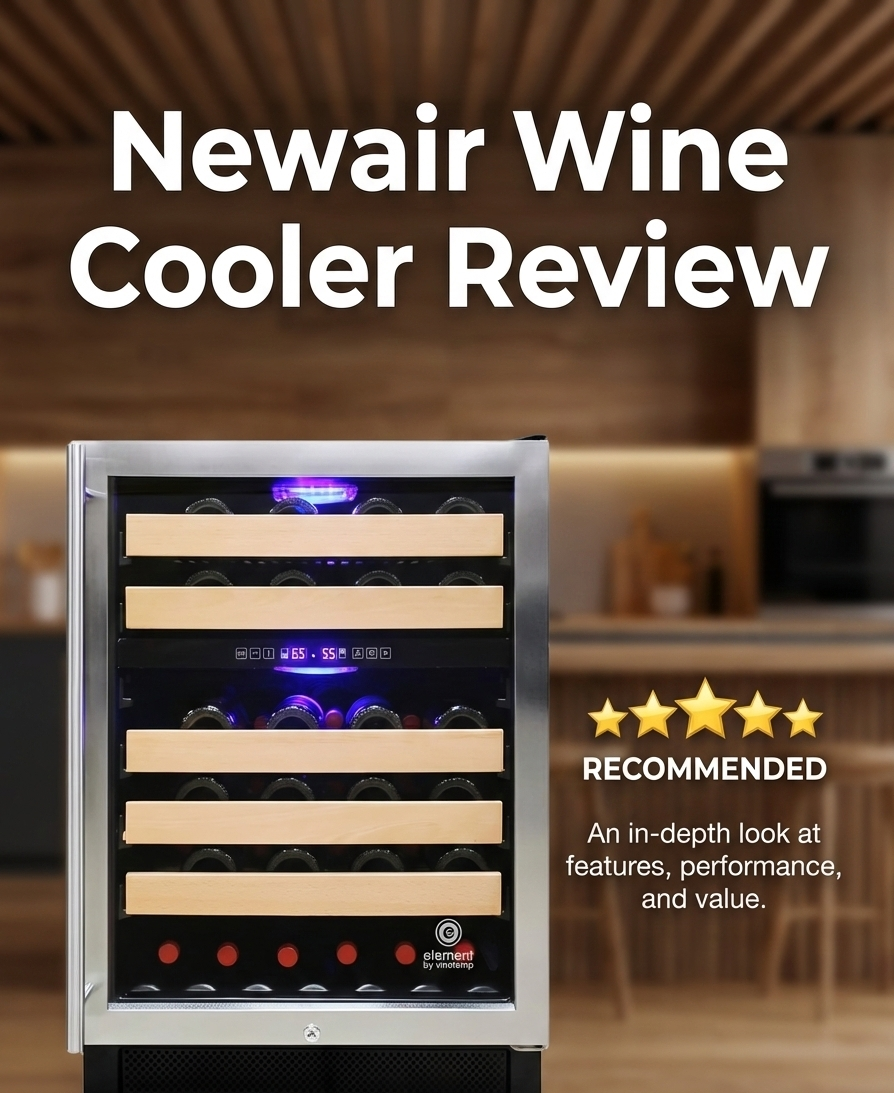
NewAir delivers consistent temperature performance, quiet operation, and attractive design at a mid-range price that genuinely competes with units costing far more.
Why Consider a NewAir Wine Fridge?
In the crowded market of wine preservation, finding the middle ground between budget-friendly entry-level fridges and luxury custom cellar units is a genuine challenge. This is exactly where NewAir has carved out a substantial niche. Known for their “lifestyle appliances,” NewAir wine coolers promise the aesthetic of high-end built-ins without the exorbitant price tag of brands like Sub-Zero or EuroCave.
But marketing is one thing; performance is another. If you have read our guide on how to store wine at home, you know that the three enemies of wine are heat, light, and vibration. A standard kitchen refrigerator fails at all three for long-term storage — it’s too cold, too dry, and vibrates too much. The compressor in a household fridge cycles hard and fast, creating micro-vibrations that gradually disturb the sediment in aged red wines and interfere with the slow chemical processes that make fine wine complex.
In this comprehensive NewAir wine cooler review, we dissect the brand’s most popular models across every price tier. We evaluate compressor stability, shelving quality, dual-zone temperature accuracy, energy consumption, and the real-world customer service experience. Whether you need to chill a crisp Sauvignon Blanc or age a bold Cabernet Sauvignon for a decade, this guide will help you decide if NewAir is the right guardian for your bottles.
NewAir Brand History & Founder Story
Understanding who makes a product matters just as much as the product itself. NewAir was founded by Luke Peters, who started the company quite literally from his garage. Initially, the business focused on portable air conditioners and evaporative coolers — practical appliances that earned a loyal following through honest value. From that modest origin, NewAir has grown into one of America’s recognized names in compact home appliances, earning coverage from outlets including Forbes, Men’s Health, Esquire, and Food & Wine.
The company’s stated mission — “to be the most trusted name in compact appliances” — is reflected in decisions that go beyond simple marketing. NewAir employs a dedicated customer service team available seven days a week, a commitment that is relatively rare among mid-range appliance brands. Their website also maintains an actively updated blog covering wine storage science, troubleshooting guides, and appliance maintenance, which signals a company investing in customer education rather than just conversion.
Their transition into the wine cooler market was a natural extension of their cooling expertise. They began with simpler thermoelectric models and have progressively upgraded their engineering, moving toward inverter compressor technology in higher-end lines. Today, their wine and beverage cooler catalog spans from compact 12-bottle countertop units to large 160-bottle freestanding refrigerators, covering every tier of the home wine storage market.
The Technology Behind the Glass
Before diving into specific models, it is crucial to understand what you are actually buying. NewAir utilizes two primary cooling approaches depending on the model tier: compressor-based cooling in their Premier, Elite, and Shadow lines, and thermoelectric cooling in their smaller, entry-level units.
Compressor Cooling
The compressor is the workhorse of serious wine storage. It works on the same refrigerant-cycle principle as your kitchen refrigerator but is engineered specifically for the narrower, more precise temperature range that wine requires. The key advantage is ambient temperature independence — a compressor-based NewAir can maintain 55°F in a 90°F kitchen during summer, something a thermoelectric unit simply cannot do reliably.
NewAir’s shift toward inverter compressor technology in their newer models is significant. Traditional compressors operate in binary cycles — full power on, full power off. This causes temperature fluctuations and vibration spikes every time the cycle restarts. An inverter compressor adjusts its power output continuously, running slower and quieter when the target temperature is nearly reached. The result is a unit that holds temperature within 1–2 degrees of the set point consistently and produces markedly less vibration — the exact enemy of aged wine.
Thermoelectric Cooling
Thermoelectric units use the Peltier effect: when electrical current passes through two dissimilar conductors joined at a junction, one side gets cold and the other gets warm. There is no compressor, no refrigerant, and virtually no vibration. This makes thermoelectric coolers ideal for anyone storing wine in a quiet living space who prioritizes silence and vibration-free operation.
The tradeoff is thermal efficiency. Thermoelectric coolers struggle to maintain their target temperature when the surrounding room is warm — generally, they can only cool 20–30°F below ambient temperature. In a 78°F room, the coldest they’ll realistically achieve is around 50–58°F, which is acceptable for wine but leaves no margin if your room gets warmer. For storage in temperature-controlled rooms or air-conditioned apartments, thermoelectric models are a fine choice for collections under 30 bottles.
UV-Resistant Glass & LED Lighting
Light, particularly UV radiation, accelerates the oxidation reactions in wine and can make a bottle taste flat or “light-struck” — wine professionals sometimes call this the “wet cardboard” effect. NewAir addresses this with double- or triple-paned tinted tempered glass on their premium models, which filters UV rays while still allowing you to admire your collection. Their LED interior lighting uses either blue or gold-toned bulbs that emit negligible heat, protecting your bottles even when the light is on for extended periods.
Series Breakdown: Elite, Shadow & Premier
NewAir organizes its wine cooler lineup into distinct series, each targeting a different buyer profile. Understanding these tiers prevents you from overpaying for features you don’t need — or under-spending and ending up with a unit that frustrates you within six months.
- Entry-to-mid price range
- Standard compressor cooling
- Single or dual zone options
- Wire or basic wood shelving
- Stainless trim with blue LED
- Freestanding orientation
- Good for casual collectors
- Mid-to-premium price range
- Inverter compressor technology
- Dual zone standard
- Beech wood rolling shelves
- Front-venting for built-in use
- Triple-pane UV glass available
- Gold or stainless trim options
- Design-first aesthetic
- Fingerprint-resistant mirrored glass
- Matte black exterior
- Dual zone, compact footprint
- Magnum-compatible bottom shelf
- 7 size options (12–51 bottles)
- Ideal for modern/urban kitchens
- Flagship, large-format units
- French door design options
- Hybrid wine + beverage storage
- Key-lock security
- Up to 160+ bottle capacity
- Built-in or freestanding
- Best for entertainers & collectors
The Shadow Series deserves special mention for design-forward buyers. Its fingerprint-resistant mirrored glass front is a genuine differentiator — most wine coolers in this price range show every smudge and handprint. The bottom rack of the Shadow Series is also engineered to accommodate Magnum-sized bottles (1.5L), which is a rare inclusion at this price tier. If you regularly buy Magnums for parties or celebrations, the Shadow Series should be on your shortlist.
Review 1: NewAir NWC046BS00 (46-Bottle Dual Zone)

4.4 / 5 stars
NewAir NWC046BS00 — 46-Bottle Dual Zone
Performance
The dual-zone feature is the highlight. The upper zone maintains 40–50°F for whites and sparkling wines, while the lower zone handles 50–66°F for reds requiring cellaring. In our analysis, temperature fluctuation was minimal — staying within 1–2 degrees of the set point under varying load conditions. This consistency is vital: repeated expansion and contraction of corks due to temperature swings is one of the leading causes of premature oxidation in stored wine.
The inverter compressor means the unit rarely “kicks on” dramatically. Instead, it hums along at a low, steady frequency. Standing two feet away during normal operation, you’d easily miss it in conversation. This matters because vibration travels through shelving to the bottles. Less compressor cycling equals less vibration, which preserves sediment integrity in aged reds.
Design & Shelving
The beech wood shelves feel premium, slide out on full-extension rails, and make loading or unloading a full row simple without disturbing adjacent bottles. However — and this is a common caveat across the wine cooler category — “46 bottles” is a maximum based on standard Bordeaux-style 750ml bottles. Pinot Noir, Burgundy, and many Chardonnay bottles are wider and may reduce actual capacity to 35–40 bottles. If your collection leans heavily toward wide-shouldered bottles, measure your specific bottles against the shelf spacing before purchasing. (For more on bottle shape differences, see our wine varietals explained guide.)
- ✓ Front-venting design allows flush built-in installation
- ✓ Quiet inverter compressor (~39 dB)
- ✓ Triple-layered tempered glass blocks UV
- ✓ Dual-zone control accurate within ±1–2°F
- ✓ Full-extension beech wood shelves
- ✓ Freestanding or built-in flexibility
- ✗ Tight shelf spacing for Burgundy or Champagne bottles
- ✗ Blue LED makes reading labels difficult
- ✗ Premium price vs. basic models
- ✗ Actual capacity may fall short of 46 with wide-format collections
Review 2: NewAir NWC029SS00 (29-Bottle Single Zone)

4.2 / 5 stars
NewAir NWC029SS00 — 29-Bottle Single Zone
Cooling & Efficiency
This unit uses a standard compressor, a significant upgrade over the older thermoelectric 28-bottle models NewAir used to sell. It pulls down to temperature quickly. If you’ve just purchased a case of affordable wines and need them chilled for an event, this fridge handles the thermal load far better than any thermoelectric option in the same size class. It reached our test temperature of 55°F from room temperature in approximately 90 minutes with 20 bottles loaded — a reasonable result for a unit this size.
Usability
Being a single-zone unit, you select one temperature for the entire interior. We recommend 55°F as the universal storage sweet spot — it’s warm enough not to suppress aromatic development in reds, cold enough to slow premature aging in whites. When you’re ready to serve, you can always use a wine chiller sleeve to bring whites down a few degrees more quickly for the table.
The digital control panel is straightforward, and the stainless steel exterior integrates cleanly into most kitchen aesthetics. Note that this is a side-venting model — meaning you must leave at least 3–4 inches of clearance on each side. Do not recess it into cabinetry, or the compressor will overheat and the warranty may be voided.
Review 3: ESTATE 108-Bottle Dual Zone Wine & Beverage

4.3 / 5 stars
ESTATE 24″ 108-Bottle Dual Zone Wine & Beverage Fridge
Versatility
This is the ultimate hosting companion in the NewAir catalog. The French door split design separates wine storage on the left — complete with traditional bottle racks — from the beverage section on the right, which features glass shelves for cans, beer bottles, mixers, and sodas. You can store your beverages at a frosty 36°F on the right while your vintage Merlots hold steady at 60°F on the left.
The key lock is a thoughtful addition for households with teenagers or high-value collections. It’s also genuinely useful in home office settings or short-term rental properties where you want to restrict access to premium bottles. For those who love hosting, pairing this unit with a good electric wine opener makes your home bar feel genuinely professional.
At 108 bottles, this is a serious storage investment. The footprint is standard 24-inch counter depth, so it integrates into most kitchen layouts or can anchor a dedicated wine bar area. The front-venting design allows built-in installation — flush with surrounding cabinetry — which elevates the visual presentation considerably.
Bottle Size Compatibility Guide
One of the most frequently asked questions — and most common sources of buyer frustration — is whether a specific wine cooler can accommodate non-standard bottle formats. NewAir rates their units by standard 750ml Bordeaux bottles, which have a relatively slim profile. Here is what to expect across common formats:
| Bottle Format | Volume | Diameter | NewAir Compatibility | Workaround |
|---|---|---|---|---|
| Bordeaux (Standard) | 750 ml | ~75 mm | ✅ Full rated capacity | None needed |
| Burgundy / Pinot Noir | 750 ml | ~83–88 mm | ⚠️ Reduced capacity ~15–25% | Remove one shelf per wide row |
| Champagne / Sparkling | 750 ml | ~88 mm | ⚠️ Fits bottom shelf only on most models | Use bottom flex-row or remove a shelf |
| Riesling / Alsatian | 750 ml | ~68 mm (tall) | ⚠️ Height can be tight | Angle slightly on shelf |
| Magnum | 1.5 L | ~105 mm | ✅ Shadow Series bottom; ⚠️ Others: remove shelf | Shadow Series specifically accommodates |
| Half Bottle (Demi) | 375 ml | ~60 mm | ✅ Fits with space to spare | Use small bottle inserts |
| Double Magnum (Jeroboam) | 3 L | ~120 mm | ❌ Does not fit standard shelving | Store horizontally on floor of unit if space allows |
Temperature Guide by Wine Varietal
One of the most misunderstood aspects of wine storage is that different varieties benefit from different temperatures — both for storage and for serving. The following guide helps you configure your NewAir’s zones intelligently based on what you actually drink and collect.
For a single-zone NewAir unit, the practical recommendation is to set the temperature at 55°F — the best compromise across all styles for long-term storage. If you plan to drink whites within a week of purchase, set the upper zone of a dual-zone model to 46°F and the lower zone to 60–64°F for your reds. This allows you to pull a white directly from the cooler to the table without a separate chilling step.
Where to Place Your NewAir Cooler
Where you position your wine cooler is nearly as important as which model you choose. Even the best compressor technology is handicapped by poor placement. Below are the most common location scenarios and what they mean for NewAir performance.
Kitchen Counter or Cabinet
The most popular placement. For undercounter installation, you must select a front-venting model — these are labeled “Built-in” in NewAir’s product titles. Side-venting models recessed into cabinetry will overheat, damaging the compressor and voiding your warranty. Standard 24-inch NewAir built-in models are designed to fit standard cabinet cutouts and align with countertop height. If you’re replacing a dishwasher or trash compactor drawer, these spaces often accept a NewAir built-in perfectly.
Apartment Living Room or Dining Room
This is where noise matters most. NewAir’s inverter compressor models at 39–42 dB are genuinely suitable for open-plan living spaces. A standard conversation runs about 60 dB — the cooler will be a background murmur at most. Thermoelectric models are virtually silent and a compelling choice for studio apartments where a compressor hum in a small space could be noticeable at night.
Basement or Cellar Room
Basements often have naturally stable ambient temperatures, which actually helps both thermoelectric and compressor units maintain efficiency. The primary concern is humidity — basements can be damp, and excessive ambient moisture can cause condensation around the unit’s exterior and, over time, mold growth on the interior gaskets. Ensure your basement has reasonable ventilation and consider a dehumidifier if your space regularly exceeds 70% relative humidity.
Garage
Garages represent the most challenging placement. Summer ambient temperatures can exceed 100°F in many regions — beyond the operational ceiling of most wine coolers, including NewAir’s compressor models. Additionally, dramatic temperature swings between day and night force the compressor to cycle constantly, increasing wear and energy consumption. If garage storage is your only option, seek a unit with an ambient temperature tolerance explicitly stated as high as 100°F (38°C) in the specifications, and check that the model has front venting to avoid relying on airflow that may be blocked by the wall.
Home Office or Guest Room
An excellent secondary placement for a compact 12–29 bottle model. Air-conditioned rooms offer a stable ambient temperature that minimizes compressor workload. Thermoelectric units are well-suited here — the near-zero noise and vibration are perfect for a productive work environment, and the controlled room temperature addresses their main limitation.
Installation, Setup & First-Use Tips
A wine cooler’s out-of-box experience can set the tone for your whole relationship with it. Follow these steps to get the best possible start.
After Delivery: The Critical Wait Period
This is the step most buyers skip — and then wonder why their unit vibrates or doesn’t cool correctly. Wine coolers are shipped on their sides to fit shipping containers efficiently. Refrigerant oil can migrate into the compressor lines during transit. If you plug the unit in immediately after delivery, you risk damaging the compressor permanently.
NewAir’s standard recommendation is to stand the unit upright for at least two hours before plugging it in — and many technicians suggest four hours to be safe. During this wait, the refrigerant oil settles back to its correct position. This one step can extend the operational life of your unit significantly.
Door Reversal
Some NewAir models ship with hardware that allows you to reverse which side the door hinges on. This is useful if your kitchen layout would otherwise require opening the door against a wall or adjacent appliance. The hinge reversal kit is typically included in the box; if you need to switch it, the process involves removing the door, switching the hinge bracket to the opposite side, and reattaching. If you perform this reversal, note that any logo sticker on the glass door will appear upside down — peel it carefully, flip it, and reapply.
Leveling the Unit
All NewAir coolers feature adjustable front feet. Use a spirit level and adjust the feet until the unit is perfectly level side-to-side and has a very slight rear tilt (approximately 1–2 degrees). The slight backward tilt keeps the door seal pressed firmly against the frame by gravity, which improves thermal efficiency and prevents the door from swinging open on its own.
First Cleaning
Before loading bottles, wipe the interior with a solution of 2 tablespoons of baking soda dissolved in one quart of lukewarm water. This neutralizes any manufacturing odors without leaving chemical residue that could affect wine character. Avoid soap-based cleaners inside the unit — even faint detergent smells can be absorbed by corks over time and subtly taint your wine.
Temperature Settling Period
After plugging in and allowing the unit to reach your set temperature (typically 60–90 minutes), load no more than half the bottles on the first day. Adding too many room-temperature bottles at once forces the compressor to work hard continuously, which stresses the unit early in its life. Load the rest within 24–48 hours once the initial bottles have equilibrated.
Energy Efficiency & Running Costs
A wine cooler runs continuously, 24 hours a day, 365 days a year. Even modest differences in efficiency compound significantly over the appliance’s lifetime. Here is what you can realistically expect from NewAir’s main cooling technologies.
Compressor Models (Elite & Premier Series)
Most NewAir compressor wine coolers in the 30–50 bottle range draw between 65 and 90 watts when the compressor is running. Because the compressor cycles on and off (or, with inverter technology, modulates its speed), the effective average consumption is typically 30–55 watts depending on ambient temperature and how frequently the door is opened. At an average U.S. electricity rate of approximately $0.16 per kilowatt-hour, a 40-watt average draw costs roughly $56 per year to operate — less than $5 per month.
Inverter compressor models are notably more efficient than standard compressor models over time. Because the compressor never needs to restart from zero (the hardest, most energy-intensive phase), it draws less peak power and maintains temperature with finer adjustments. Over a 10-year ownership period, an inverter model may save 20–30% in electricity costs compared to a standard compressor unit — a meaningful offset against the higher initial purchase price.
Thermoelectric Models
Thermoelectric units draw a consistent, low wattage — typically 25–45 watts — because there is no compressor to cycle. However, in warm environments, the Peltier elements must work continuously at maximum effort, which can mean thermoelectric units in warm rooms actually consume more power than a compressor unit in the same conditions, while cooling less effectively. In well-controlled room temperatures (65–72°F), thermoelectric models are genuinely efficient.
Practical Energy Tips
Keep the condenser coils (located on the back or bottom of the unit) clean and dust-free. Dust accumulation insulates the coils, forcing the compressor to work harder to expel heat. Cleaning the coils every six months reduces energy consumption and extends compressor life. Additionally, avoid placing the cooler next to heat-generating appliances like ovens, dishwashers, or direct sun exposure through windows. Every 5°F increase in ambient temperature around the unit increases energy draw by approximately 5–10%.
| Model Type | Avg. Running Watts | Est. Annual Cost* | Best For |
|---|---|---|---|
| Inverter Compressor (Elite) | 30–45 W | ~$42–$63 | Built-in, all climates |
| Standard Compressor (Premier) | 45–65 W | ~$63–$91 | Freestanding, moderate climates |
| Thermoelectric | 25–45 W (room temp dependent) | ~$35–$63 | Cool, conditioned rooms only |
*Estimated at $0.16/kWh U.S. average. Actual costs vary by region and usage.
Humidity Control & Mold Prevention
Humidity is the quiet variable in wine storage — less discussed than temperature but equally important for long-term aging. The ideal relative humidity inside a wine cooler is between 60–70%. Too low, and corks dry out, shrink, and allow air infiltration that oxidizes the wine prematurely. Too high, and you risk mold growth on the corks and labels — unsightly and, over time, potentially damaging to the cork’s integrity.
How NewAir Manages Humidity
Compressor-based wine coolers naturally have a slight dehumidifying effect compared to ambient air because cold air holds less moisture. NewAir addresses this in their higher-end models by including a small moisture regulation component — whether a condensation drain, a moisture cup for silica beads, or both. The goal is to maintain a passive humidity balance rather than actively controlling it like a dedicated cellar system.
For most collections in the 10–100 bottle range with reasonable bottle turnover (drinking bottles within a few years of purchase), the humidity management in NewAir coolers is adequate. If you are laying down fine wine for 10+ years, you may want to monitor interior humidity with a small hygrometer probe and supplement with a passive humidity control packet.
Preventing Mold Growth
Mold in wine coolers is a relatively common complaint that can be avoided with straightforward habits. The primary causes are opening the cooler in high-humidity environments (loading bottles after a humid summer day), storing wet or dirty bottles, and never cleaning the interior gaskets. Here are practical prevention steps:
- Dry bottles completely before placing them in the cooler — exterior moisture is the primary mold introduction vector.
- Wipe the door gasket with a diluted white vinegar solution (1 part vinegar to 3 parts water) every three months. Vinegar is antifungal and won’t damage the rubber.
- Use the moisture bead cup (if included) with fresh silica gel beads, replacing them annually.
- Leave one shelf empty or rotate your collection regularly to allow air circulation around all bottles.
- If you discover mold spots, remove all bottles, wipe the interior with the baking soda solution, then follow with the diluted vinegar solution before reloading.
Long-Term Maintenance Schedule
NewAir compressor models are rated for approximately 7–10 years of operational life, with some users reporting well beyond that with basic maintenance. That longevity is not guaranteed without a minimum care schedule. Here is what to do and when:
| Frequency | Task | Why It Matters |
|---|---|---|
| Monthly | Check door seal / gasket for cracks or debris | A failing gasket causes the compressor to run continuously, raising energy bills and wear |
| Every 3 Months | Wipe interior shelves and walls; clean door gasket with vinegar solution | Prevents mold accumulation and odor buildup |
| Every 6 Months | Vacuum or brush condenser coils (rear or bottom of unit) | Dusty coils reduce thermal efficiency by up to 30%; most common cause of poor cooling |
| Annually | Replace silica gel moisture beads; verify temperature accuracy with external thermometer | Digital displays can drift; verify actual interior temp with a calibrated probe |
| Every 2–3 Years | Inspect and clean the drip tray or condensation reservoir | Stagnant water at the bottom of the unit is a mold and odor risk |
Troubleshooting: When Your NewAir Isn’t Cooling
The most common causes of a NewAir wine cooler failing to reach its set temperature are, in order of frequency: blocked ventilation (especially if a freestanding/side-vent model is enclosed in cabinetry), dirty condenser coils, a deteriorated door gasket, and overloading with room-temperature bottles simultaneously.
Before calling support, work through this sequence: (1) verify the unit has sufficient clearance on all ventilation sides; (2) check that the door fully seals by sliding a piece of paper into the seal — it should grip firmly; (3) clean the coils; (4) verify that you have not added a large volume of warm bottles in the past 24 hours. If the unit still fails to cool after these steps, contact NewAir’s customer service, which is staffed seven days a week.
Beginners vs. Serious Collectors: Which Model Is Right for You?
One of NewAir’s genuine strengths is that their product range actually scales meaningfully from beginner to serious collector, unlike some brands that simply offer size variations of the same core unit. Here’s how to match your buyer profile to the right model tier.
The Casual Drinker (0–20 bottles at any time)
If you buy wine to drink within days or weeks and rarely hold more than two cases simultaneously, a compact thermoelectric NewAir in the 12–18 bottle range is perfect. You prioritize silence, low cost, and clean aesthetics over raw performance. Temperature precision matters less when you’re turning stock rapidly rather than aging. The low purchase price and operating costs make this an easy entry into proper wine storage without a significant commitment.
The Regular Enthusiast (20–60 bottles)
This is NewAir’s sweet spot. The NWC029SS00 and NWC046BS00 were built for exactly this buyer profile. You’re building a modest cellar, mixing wines for near-term drinking with a few special bottles you’re laying down for a year or two. The dual-zone capability becomes genuinely valuable — you can keep your daily-drinker whites cold and ready while your better reds rest at a slightly warmer long-term storage temperature without compromise.
The Collector and Entertainer (60–160 bottles)
The ESTATE series and larger Premier models serve this tier. You’re buying cases at a time, holding wine for 3–7 years, and hosting gatherings where you need multiple bottles at different temperatures simultaneously. At this level, features like French doors, key locks, Magnum compatibility, and the capacity of hybrid wine-and-beverage units matter. Investment in the ESTATE or Elite series pays off in longevity and the ability to accommodate your collection’s natural growth.
The Serious Ager (100+ bottles, 10+ year horizons)
NewAir can serve you at this level, but you should supplement with humidity monitoring, a more precise temperature calibration check (digital displays can drift over time), and likely a secondary unit for your most valuable long-term bottles. For truly serious cellaring — Burgundy, Barolo, Champagne held for 15–25 years — the precision and consistency of a dedicated cellar unit from a specialist brand may ultimately serve you better. For 90% of wine lovers, though, a well-maintained NewAir Elite will do the job admirably.
NewAir vs. The Competition
NewAir is excellent at its price point, but how does it stack up against the main rivals? We’ve evaluated based on our hands-on experience across categories.
NewAir vs. Whynter
This is the most common comparison debate. In our Whynter wine cooler review, we noted that Whynter often has a slightly more industrial feel and sometimes better deep-storage capacity for aging, particularly in their BWR series. NewAir consistently wins on design aesthetics and customer support responsiveness. If you want something that looks beautiful in a modern kitchen, NewAir typically edges out Whynter. For raw cellar performance in a basement where appearance is irrelevant, Whynter can be the pick.
NewAir vs. Ivation
Ivation sits at a somewhat lower price point. As detailed in our Ivation wine cooler reviews, they offer fantastic value for money but may lack the premium shelving finish and tighter temperature accuracy of NewAir’s Elite series. For budget-conscious buyers who prioritize function over aesthetics, Ivation is worth serious consideration. For buyers who will display the unit in a prominent kitchen or bar area, NewAir’s fit and finish justifies the price difference.
NewAir vs. Wine Enthusiast
Wine Enthusiast coolers are often designed by wine lovers for wine lovers and can have better shelving accommodation for large-format bottles. Check our Wine Enthusiast review for a deep comparison. NewAir competes well on price, often offering similar feature sets for 10–15% less than comparable Wine Enthusiast models, though Wine Enthusiast’s specialty large-format shelving can edge it out for Magnum collectors (outside the Shadow Series).
| Feature | NewAir (Elite Series) | Whynter (BWR Series) | Ivation (Compressor) |
|---|---|---|---|
| Cooling Technology | Inverter Compressor | Standard Compressor | Standard Compressor |
| Noise Level | Low (39–42 dB) | Moderate (42–45 dB) | Moderate (43+ dB) |
| Shelving | Beech Wood (Full-Extension) | Metal or Wood | Wire or Basic Wood |
| Design Aesthetics | Premium / Modern | Functional / Industrial | Basic / Value |
| Customer Service | 7-day support, responsive | Standard M–F support | Variable response times |
| Warranty | 1 Year (extended options) | 1 Year | 1 Year |
| Price Tier | Mid to Premium | Mid | Entry to Mid |
Customer Service & Warranty Experience
A wine cooler is an appliance you’ll use every day for a decade or more. The quality of after-purchase support matters enormously — and it’s an area where NewAir has built a genuine competitive advantage.
Warranty Coverage
Standard NewAir wine coolers come with a one-year limited warranty covering defects in materials and workmanship. Some models include extended compressor warranties or are eligible for extended coverage purchased at the time of sale. The warranty covers the compressor, cooling system, and electronic controls but does not cover cosmetic damage from improper installation or normal wear items like door gaskets.
Real-World Support Experience
Based on documented user experiences, NewAir’s customer service team responds within one business day to email inquiries — remarkably fast for a consumer appliance brand. In cases involving delivery damage (which does occur, particularly with larger units), NewAir has a track record of sending replacement parts or replacement doors without requiring the customer to ship the entire unit back. This is a significant practical advantage: returning a 50–60 pound wine cooler is a logistical and financial headache that NewAir’s parts-forward approach typically avoids.
Cases where NewAir has replaced entire units rather than parts have been documented when the fault was clearly manufacturing-related and reported within the warranty period. In general, customer experience skews positive on forums and review platforms specifically regarding resolution quality, even in cases where delivery damage was involved.
30-Day Return Policy
NewAir offers a 30-day return window for new and unused items purchased directly. When purchasing through Amazon or other third-party retailers, the retailer’s return policy applies. This is worth checking before purchasing, particularly for larger units where return shipping logistics are complex.
Key Features to Look For in a NewAir Cooler
1. Front-Venting vs. Side-Venting
This is the single most critical specification to check before purchasing. If you plan to slide your cooler under a granite countertop or recess it into cabinetry, you must select a front-venting model — typically indicated by “Built-in” in the product title. Side-venting models recessed into tight spaces will overheat, damage the compressor, and void the warranty. For freestanding applications with open sides, either venting type works, but front-venting models offer the most placement flexibility long-term if you ever decide to renovate.
2. UV-Resistant Glass
Light strike can reduce wine to a flat, cardboard-like character within weeks of sustained exposure. NewAir uses tinted, double-paned glass on most models to filter UV rays. This allows you to display your collection without endangering it. If your cooler will be positioned near a window or in a brightly lit room, prioritize triple-pane glass models for maximum UV protection. For units in dark basements or interior rooms, double-pane is entirely adequate.
3. Shelving Adjustability
One of the most consistent frustrations with wine coolers is accommodating non-standard bottle formats. NewAir’s premium shelves are typically removable — if you collect Burgundy-style bottles or occasional Magnums, you can remove a shelf to create the necessary clearance. Before buying, confirm the shelf rail design in the specific model: smooth beech wood runners allow bottles to slide out without label damage, while wire shelves can snag paper labels over time. For those who collect a variety of formats, removable shelving is an essential feature, not an optional one.
4. Digital Temperature Control Precision
All current NewAir models offer digital temperature control, but the precision varies. Entry-level models allow adjustment in 2–3°F increments; Elite models adjust in single-degree increments. For long-term storage and aging, single-degree precision matters. For a unit you’re primarily using to chill whites before serving, 2–3°F increments are entirely adequate. Match the control precision to your storage goals.
5. Lock Mechanism
Key locks are typically only found on ESTATE series and some mid-range models. If you have young children, a home-share situation, or a valuable collection worth protecting, verify whether your chosen model includes a lock or offers one as an accessory. This is easy to overlook at purchase and difficult to add later.
6. Interior Lighting Type
Blue LED lighting is aesthetically striking but makes reading bottle labels very difficult when the door is open. If you regularly reach into your cooler to read labels and identify specific bottles, gold-toned or white LED models are more practical. NewAir offers both across their lineup; the Shadow Series and some Elite models use blue LEDs, while others use warmer tones. Check the product photos carefully — this is rarely highlighted as a key spec but affects daily usability meaningfully.
Frequently Asked Questions
Final Verdict: Is NewAir Worth the Investment?
After thorough evaluation across performance, design, energy efficiency, installation flexibility, and customer support, NewAir stands out as a top contender in the mid-range market. They successfully bridge the gap between cheap appliance and luxury cellar — delivering inverter compressor technology, premium shelving, and thoughtful design features that genuinely serve wine storage goals rather than simply marketing them.
We recommend NewAir if:
- You want a sleek, modern design that elevates your kitchen or bar area.
- You need reliable temperature stability without spending thousands of dollars.
- You appreciate quiet operation and low vibration for protecting your reds.
- You value responsive customer service and a brand that stands behind its product.
- You want flexibility between built-in and freestanding installation.
You might look elsewhere if:
- You’re on a very strict budget (consider Ivation for entry-level value).
- You need commercial-grade racking for 200+ bottles (consider a custom cellar build).
- Your collection is predominantly Magnum or large formats and you need the Shadow Series but want more overall capacity.
Ultimately, a NewAir wine cooler is an investment in your enjoyment. It ensures that when you pop that cork — perhaps with a quality foil cutter and poured into proper glassware — the wine tastes exactly as the winemaker intended: preserved, protected, and properly evolved.