Ivation Wine Cooler Reviews: Are They the Best Budget Option?
We test every tier — thermoelectric, compressor, and dual-zone — to answer whether Ivation truly delivers on its value-for-money promise.
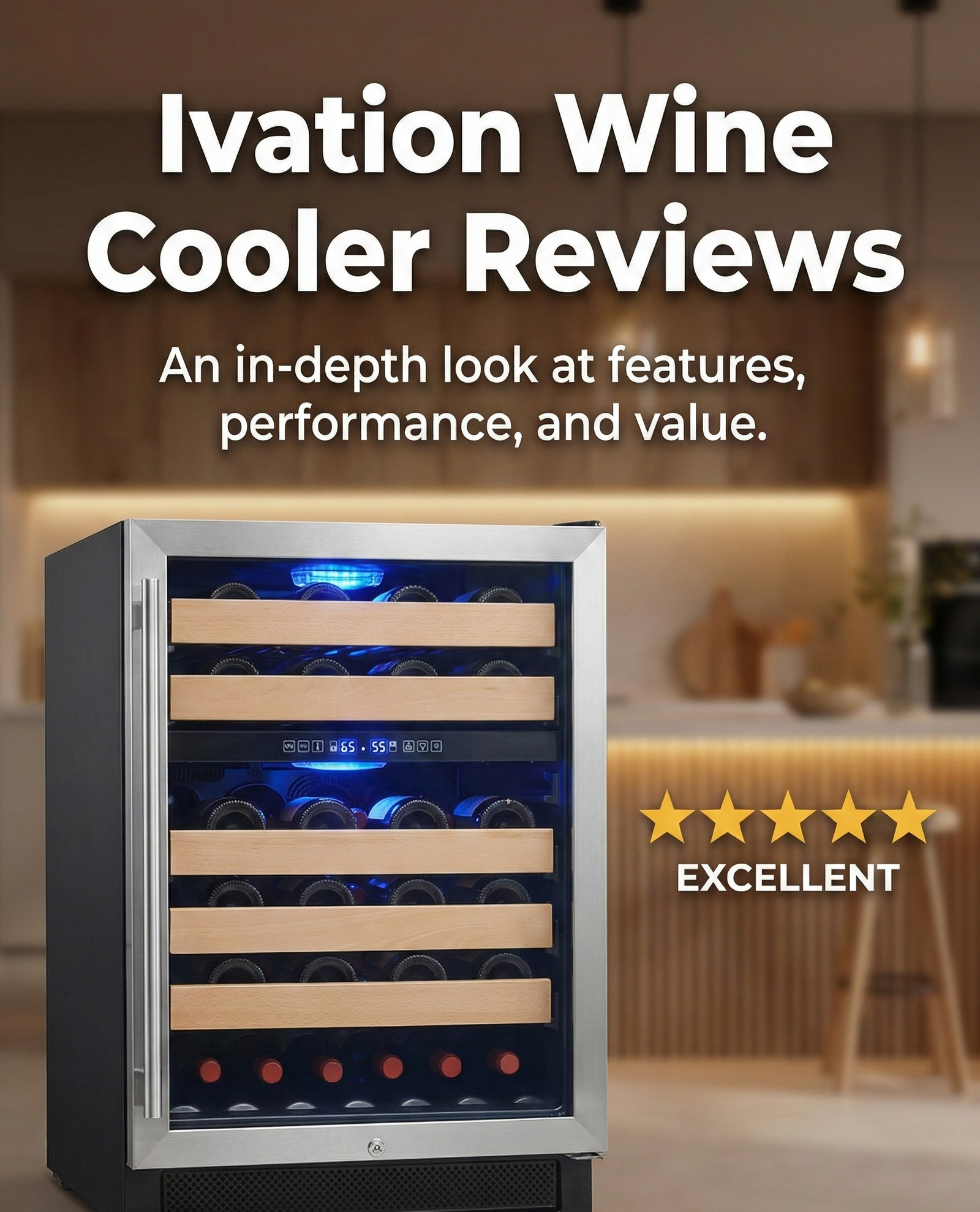
Ivation delivers honest, functional wine storage at the industry’s most accessible price point — thermoelectric silence, clean aesthetics, and reliable compressor models — with well-understood limitations that informed buyers can plan around.
Introduction: Can Budget Storage Protect Fine Wine?
If you have recently graduated from storing bottles in a kitchen cabinet to looking for a dedicated wine appliance, you have almost certainly encountered Ivation. Dominating the online marketplace with sleek designs and aggressive price points, Ivation promises to democratize wine storage — making proper cellar-quality conditions accessible to everyday buyers without a luxury budget.
But for the serious enthusiast, the question remains: can a budget-friendly cooler truly protect your vintage investments? Proper storage is not simply about keeping beverages cold — it is about stability. As we have detailed in our guide on how to store wine at home, humidity, vibration, and UV light are the primary enemies of fine wine over time. Temperature spikes in either direction accelerate aging unpredictably. Vibration disturbs sediment and interferes with slow chemical maturation. UV radiation degrades tannins and anthocyanins within weeks of exposure.
In this comprehensive Ivation wine cooler review, we test their most popular thermoelectric and compressor models across all the variables that matter for wine quality. Whether you are looking for a compact 12-bottle countertop unit or a dual-zone fridge to separate your Pinot Noirs from your Chardonnays, this guide will help you determine if Ivation is the right guardian for your collection — and exactly where its limitations begin.
Who Is Ivation? Brand History & Philosophy
Ivation is a consumer electronics brand with a notably broad product catalog. Unlike specialized manufacturers such as EuroCave or Whynter — whose engineering resources are focused almost entirely on precision refrigeration — Ivation produces a wide array of home appliances including dehumidifiers, ozone generators, blood pressure monitors, foot spas, and home weather stations. This breadth is worth understanding before making a purchase decision, because it shapes both the product’s strengths and its limitations.
On the strength side, Ivation’s wide distribution network and high-volume manufacturing approach allow them to offer hardware at price points that specialized wine appliance brands cannot match. Their wine cooler lineup benefits from the same sourcing efficiency as their broader catalog, translating directly into the most accessible entry prices in the category. For a buyer who wants functional wine storage without spending more than the wine inside the unit, Ivation is genuinely difficult to beat at the entry tier.
The limitation, conversely, is that wine cooling is not the company’s singular engineering focus. You will not find Ivation innovating on refrigerant chemistry, vibration isolation mount design, or activated carbon filtration in the way that dedicated brands have. Their value proposition is honest and consistent: take proven thermoelectric and standard compressor technology, package it in clean stainless-and-glass aesthetics, and deliver it at an aggressive price. For the majority of home wine enthusiasts who need reliable storage rather than precision cellar engineering, this is a completely valid proposition.
Ivation products are available through Amazon, Walmart, and other major online retailers, with customer service operated through their website and the respective platform’s support channels. They have maintained a consistent presence in the market for over a decade, which is itself a meaningful quality signal in a category where many budget brands launch and disappear within a few product cycles.
Technology Deep-Dive: Thermoelectric vs. Compressor
The Thermoelectric (Peltier) Cooling System
Ivation’s most popular and widely reviewed products use thermoelectric cooling — a technology based on the Peltier effect. When electrical current passes through a junction of two dissimilar semiconductor materials, one side of the junction becomes cold and the other becomes warm. This creates a heat-transfer mechanism without any moving parts other than a small exhaust fan. The cold side faces the interior of the wine cooler; the warm side dissipates heat through the rear panel to the surrounding room.
The implications for wine storage are significant and cut both ways. The absence of a compressor means zero mechanical vibration is transmitted through the shelving and into the bottles — theoretically ideal for sediment-bearing aged wines. It also means near-absolute silence: thermoelectric units produce only the gentle hum of their cooling fan, typically 25–30 dB, well below the threshold of conscious awareness in a normal living space. These characteristics make thermoelectric Ivation models genuinely excellent choices for apartments, open-plan living areas, home offices, and any space where ambient noise is a priority.
The critical limitation is ambient temperature dependency. Thermoelectric coolers can only cool approximately 20–30°F below the surrounding room temperature. In a climate-controlled room held at 70°F, reaching and maintaining a 50–55°F storage temperature is entirely achievable. In a room that climbs to 82–85°F during summer — a warm kitchen without air conditioning, a sunroom, or an unconditioned garage — the unit will struggle to reach proper wine storage temperatures and may plateau at 60–65°F. At that temperature, whites begin to degrade over weeks and reds age faster than intended. The ambient temperature limitation is not a flaw — it is an inherent physical constraint of Peltier cooling — but it is one buyers must assess honestly against their specific environment before choosing thermoelectric over compressor.
The Compressor Cooling System
Ivation also offers compressor-based models for buyers who need performance independent of ambient temperature. A compressor system uses a refrigerant gas cycle — the same fundamental physics as your household refrigerator — to actively pump heat from the interior to the exterior regardless of how warm the surrounding room is. This makes compressor models suitable for kitchens, garages, sunrooms, and any space where ambient temperature can climb significantly above wine storage range in summer.
Compressor units cool faster, achieve lower minimum temperatures (down to 41°F, enabling Champagne and sparkling wine storage), and handle a full load of room-temperature bottles without the performance degradation that thermoelectric units experience under the same thermal demand. The tradeoffs are noise (approximately 40 dB during compressor cycling), some vibration transmitted through the chassis (less than a household refrigerator but more than zero), and slightly higher energy consumption in temperate conditions where a thermoelectric unit would suffice.
Ivation’s compressor models do not feature the rubber-mount vibration dampening or R600a eco-refrigerant found in Whynter’s BWR series — these are areas where the premium price delta between brands reflects genuinely different engineering investments. For most buyers storing wine for a few years rather than a decade of fine aging, this is an acceptable tradeoff. As we explain in our wine cellar essentials guide, the primary enemies of wine are temperature spikes, UV light, and significant sustained vibration — all of which Ivation’s compressor models address adequately at their price point.
When to Choose Compressor Over Thermoelectric
If your cooler will be placed in any room that exceeds 78°F for more than a few weeks per year — a kitchen without air conditioning, a sunroom, an unconditioned basement in summer, or a garage — you must choose Ivation’s compressor model. Thermoelectric units in hot environments do not fail dramatically; they simply stop cooling adequately, leaving your organic and natural wines vulnerable to heat damage over time.
Ivation Model Series Overview
Ivation’s wine cooler catalog is organized into three practical tiers. Unlike brands with formal series names (Whynter’s BWR, NewAir’s Elite/Shadow), Ivation typically identifies models by bottle count and cooling technology type. Understanding these tiers helps match the right model to your specific storage needs and environment.
- 12–18 bottle capacity range
- Peltier thermoelectric cooling
- Zero mechanical vibration
- Near-silent (25–30 dB)
- Rear-venting (freestanding only)
- Wire or basic wood shelving
- Best for cool, conditioned rooms
- Entry-level price point
- 18–28 bottle capacity range
- Standard compressor cooling
- Ambient-temperature independent
- Cools to 41°F (Champagne capable)
- Front or rear venting (model specific)
- Faster thermal recovery
- Suitable for warm rooms & garages
- Mid-range price point
- 18+ bottle capacity
- Independent temperature zones
- Whites & reds simultaneously
- Thermoelectric or compressor options
- Removable shelves (standard)
- Digital zone controls
- Best for mixed red/white collections
- Mid-range price point
Review 1: Ivation 12-Bottle Thermoelectric Cooler
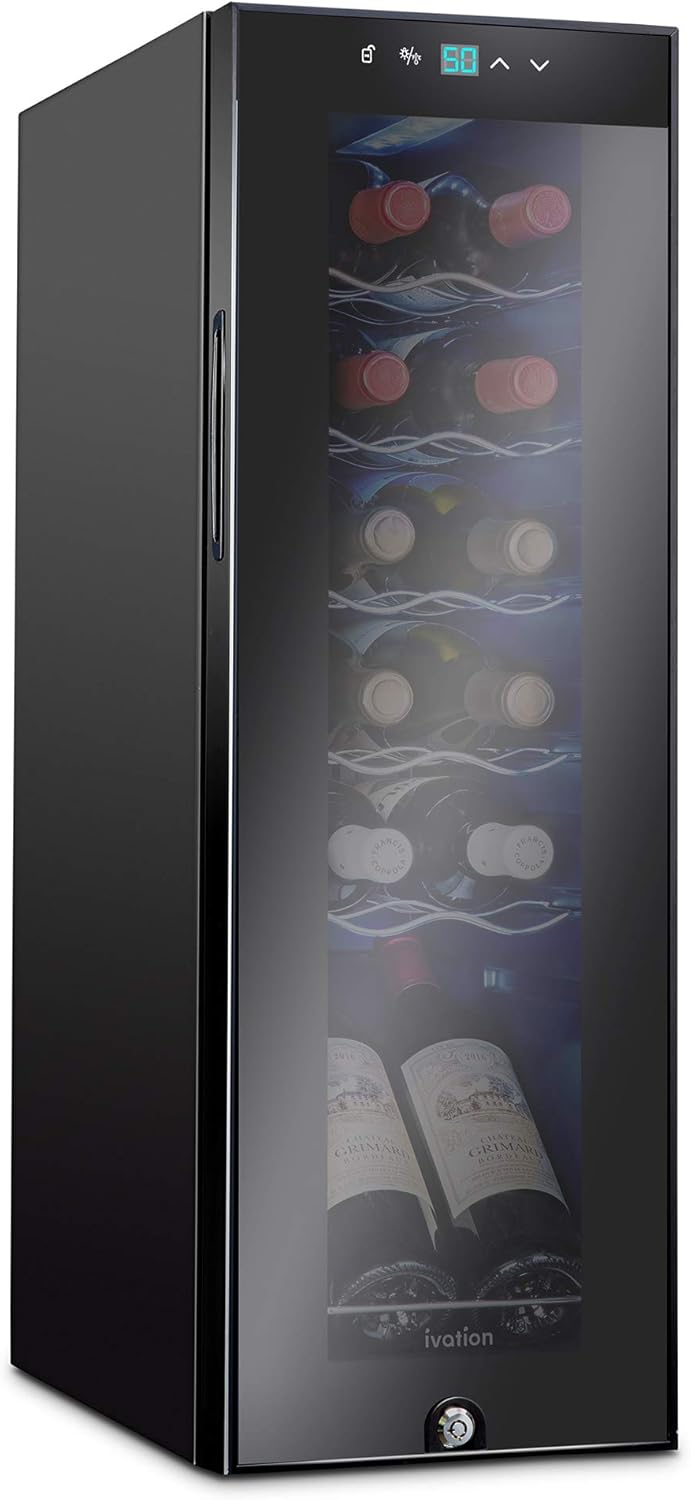
Who This Is For
This is the gateway unit for wine lovers stepping up from casual storage. It is small, stylish, and virtually silent — designed for the casual drinker who keeps a rotation of bottles ready for dinner parties or weeknight enjoyment. The countertop footprint fits most kitchens without rearranging existing appliances, and the clean stainless-and-smoked-glass aesthetic integrates well into both modern and traditional decors.
Performance Analysis
Because this unit uses thermoelectric cooling, its performance is directly tied to your room’s ambient temperature. In an air-conditioned room at 70–72°F, the unit comfortably reaches and holds 50–55°F — perfect for universal wine storage. In a kitchen that routinely reaches 78–80°F in summer, the unit will plateau around 58–62°F, which is still acceptable for red wine storage but too warm for maintaining whites at their best over extended periods. Honesty about your room’s peak summer temperature is essential before choosing this unit.
The zero-vibration characteristic of thermoelectric cooling is a genuine benefit for wines with sediment — mature Bordeaux, aged Burgundy, or any bottle you are holding for special occasions. Without a compressor cycling on and off, there are no mechanical oscillation events to disturb settling particles. For the casual collector keeping bottles for months rather than years, this is more reassuring than practically decisive — but it is a real technical advantage.
Design & Usability
The smoked double-paned glass door blocks UV light and provides enough visibility to identify bottles without opening the door. The digital touch controls are responsive and precise, adjusting in single-degree increments. The wire shelving, while functional, is the most common complaint in user reviews — it can mark paper labels over repeated bottle insertions and removals. If label preservation matters to you, a thin adhesive felt strip on each wire row is an inexpensive fix.
- ✓ Near-silent operation (25–30 dB)
- ✓ Zero vibration — ideal for aged wines with sediment
- ✓ Compact countertop footprint
- ✓ UV-resistant smoked glass
- ✓ Most affordable entry point in the category
- ✗ Cooling limited by ambient room temperature
- ✗ Wire shelves can abrade bottle labels
- ✗ Rear-venting — cannot be built into cabinetry
- ✗ 12-bottle capacity fills quickly for growing collections
Review 2: Ivation 18-Bottle Dual Zone
For buyers who need to simultaneously maintain different temperatures for whites and reds — the most common real-world use case for home collectors — the 18-bottle dual-zone model is Ivation’s most practical everyday solution. It allows you to keep the top zone cooler for serving whites (44–52°F) while the bottom zone maintains a warmer environment for reds at service-ready temperature (58–65°F). This is particularly useful if you are learning how to pair wine with food and want both your white and red selections ready to pour without any additional chilling or warming time.
The Practical Value of Dual Zones
Many buyers set their dual-zone unit to long-term storage temperatures in both zones (55°F upper, 60°F lower) and accept that they’ll need to chill whites a few degrees further before serving. A more practical approach for casual drinkers is to set the upper zone closer to serving temperature (46–48°F) so whites come directly from the cooler to the table. Neither approach is wrong — it depends on whether you prioritize optimal storage preservation or serving convenience for your drinking habits.
Shelving & Bottle Versatility
The removable shelving in the 18-bottle model is a meaningful practical advantage over fixed-shelf units. Standard configurations accommodate Bordeaux-style 750ml bottles throughout. By removing one shelf, you can create the necessary vertical clearance for wider Burgundy or Champagne bottles, though at the cost of capacity in that zone. For buyers who occasionally need to fit a Champagne bottle for an event, this removable-shelf design solves the problem cleanly without requiring a separate appliance. For buyers whose collection is primarily wide-format bottles, the 28-bottle compressor model with its more generous interior dimensions is a better fit.
Temperature Stability in Dual-Zone Operation
A common concern with dual-zone thermoelectric units is whether the zone barrier effectively maintains temperature separation. In Ivation’s 18-bottle model, the separation between zones achieves approximately 8–12°F differential under normal operating conditions in a temperate room. This is sufficient for the practical white-versus-red storage scenario. However, if you need a very wide differential — say, 40°F in the upper zone and 65°F in the lower zone simultaneously — a compressor-based dual-zone unit will hold that spread more reliably than a thermoelectric system, which struggles to achieve large differentials efficiently.
Review 3: Ivation 28-Bottle Compressor Cooler
Recognizing the thermal limitations of thermoelectric cooling, Ivation’s 28-bottle compressor model addresses the primary weakness of their lineup directly. This unit functions on the same refrigeration cycle as a standard household appliance, making it immune to ambient temperature spikes and capable of reaching temperatures as low as 41°F — which enables proper storage of sparkling wines, Champagne, and dessert wines that require cold-end storage below what thermoelectric units reliably achieve.
Cooling Performance
Thermal recovery time — the speed at which the unit returns to set temperature after the door has been opened or bottles have been loaded — is dramatically better than thermoelectric alternatives. Loading a full 28 bottles at room temperature, the compressor model returns to 55°F in approximately 2–3 hours. The equivalent thermoelectric unit would take significantly longer under the same load, and in a warm room might not achieve the target temperature at all. For buyers who buy wine by the case and load it in a single session, the compressor’s recovery performance is a practical daily consideration, not just a technical footnote.
Noise & Vibration Profile
The compressor model operates at approximately 40 dB during active cycles — audible in a quiet room, though comparable to a standard household refrigerator running at low. Unlike the premium brands that rubber-mount their compressors to isolate vibration, Ivation’s compressor models use standard direct-mount configurations. This means some low-frequency vibration is transmitted through the unit’s body and shelving during compressor cycles. For wine held for 1–3 years, this is not a meaningful concern. For wines held for 5–10 years with deliberate sediment development, a unit with dedicated vibration isolation (such as Whynter’s BWR series) would serve those specific bottles better.
Bottle Size Compatibility Guide
Like most wine coolers rated by standard Bordeaux bottle count, Ivation’s capacity figures assume the slimmest common bottle profile. Here is how different formats perform across their lineup:
| Format | Volume | Diameter | Ivation Compatibility | Practical Solution |
|---|---|---|---|---|
| Bordeaux (Standard) | 750 ml | ~75 mm | ✅ Full rated capacity | None needed |
| Burgundy / Pinot Noir | 750 ml | ~83–88 mm | ⚠️ Reduces capacity ~15–20% | Remove adjacent shelf to create clearance per wide row |
| Champagne / Sparkling | 750 ml | ~88 mm | ⚠️ Requires shelf removal | Remove one shelf per Champagne row; store base-down in lower zone |
| Riesling / Alsatian | 750 ml | ~68 mm (tall) | ⚠️ Height can be restrictive | Angle slightly; works better in larger compressor models |
| Magnum | 1.5 L | ~105 mm | ❌ Does not fit standard Ivation shelving | Remove two adjacent shelves and store horizontally if space permits |
| Half Bottle (Demi) | 375 ml | ~60 mm | ✅ Fits with room to spare | Use bottle inserts to prevent rolling |
| Jeroboam / Double Magnum | 3 L | ~120 mm | ❌ Not compatible | Use a modular wine rack for large formats |
Temperature Guide by Wine Varietal
Understanding what temperature to set your Ivation cooler is as important as choosing the right model. The following guide covers optimal storage temperatures — what keeps wine developing well over time — and notes on serving, since these are different requirements.
For single-zone Ivation models: set to 55°F. This is the universally accepted long-term storage compromise — it maintains both reds and whites in a safe development range without any style being actively harmed. Whites will need 5 minutes in an ice bucket to reach ideal serving temperature; reds can be poured directly at 55°F as they will warm quickly in the glass.
For dual-zone models: set the upper zone to 46–48°F for whites ready to serve, and the lower zone to 60–62°F for reds. This allows you to pull either style directly to the table without any additional temperature adjustment step.
Where to Place Your Ivation Cooler
Placement affects performance, energy consumption, compressor or element lifespan, and in some cases warranty validity. Each environment has specific considerations unique to Ivation’s thermoelectric and compressor technologies.
Kitchen Counter or Undercounter
The most common placement. For thermoelectric units, counter placement is ideal — the room is climate-controlled, ambient temperature is relatively stable, and the rear-venting clearance (4–5 inches minimum behind the unit) is easy to maintain on an open counter or within a standard cabinet with ventilation. Do not attempt to recess a thermoelectric or rear-venting compressor model into sealed cabinetry — trapped heat compromises both performance and unit longevity. If undercounter installation is your goal, check whether the specific Ivation model is designated front-venting before purchasing.
Living Room or Dining Room
Thermoelectric Ivation models are ideal here. Their noise profile (25–30 dB) is genuinely inaudible against normal living room ambient sound, and the stainless glass aesthetic integrates cleanly with most furniture styles. Position away from south-facing windows that receive direct afternoon sun — sustained radiant heat on the exterior of the unit adds to the ambient temperature the cooling system must overcome. A shaded corner or interior wall position is always preferable.
Home Office
An excellent secondary placement for a compact 12-bottle Ivation unit. The air conditioning typical of home offices keeps ambient temperature well within the thermoelectric system’s operating range, and the near-silent operation is genuinely compatible with concentrated work. A small countertop unit in a home office functions almost as a personal beverage center — within reach for an evening glass without a trip to the kitchen.
Basement
Basements offer naturally stable, cool ambient temperatures that are close to the wine storage target range — the optimal scenario for a thermoelectric unit, which barely needs to work in a 60–65°F basement environment. Energy consumption drops to minimal levels, and the element lifespan extends accordingly. The primary basement consideration is humidity: Ivation units are not sealed against high-humidity environments, and if your basement regularly exceeds 70–75% relative humidity, check the exterior of the unit periodically for surface condensation at the base and hinge hardware. A basic dehumidifier in the space addresses this cleanly.
Garage
Garages represent the highest-risk placement. For thermoelectric Ivation units, garage placement in a warm climate is effectively disqualifying — the ambient temperature regularly exceeds the system’s cooling differential, making adequate wine storage impossible during summer months. Even Ivation’s compressor models should be evaluated against their maximum rated ambient operating temperature (typically 86–95°F depending on model) before garage placement. Garages in mild climates where summer temperatures rarely exceed 85°F can accommodate the compressor model. Garages in hot climates should not be used for any Ivation wine cooler without air conditioning assistance.
Installation, Setup & First-Use Tips
Wait Before Powering On
For Ivation’s compressor models, the same critical rule applies as for all compressor appliances: stand the unit upright for at least two hours — preferably four — before plugging it in. Appliances are shipped horizontally for packaging efficiency, which allows refrigerant oil to migrate from the compressor reservoir into the refrigerant lines. Powering on a compressor before this oil settles back risks permanent damage within the first hour of operation. For thermoelectric models, there is no compressor oil concern — these can be plugged in immediately after unboxing.
Rear Clearance for Thermoelectric Models
All Ivation thermoelectric units vent heat through the rear panel. Maintain a minimum of 4–5 inches of clearance between the rear of the unit and any wall or surface. Restricted rear airflow is the most common reason thermoelectric units underperform — the warm air expelled by the cooling system recirculates back into the intake if there is insufficient clearance, progressively reducing cooling efficiency. This is the one installation step most users skip, and it is the most impactful one for thermoelectric performance.
Leveling the Unit
Most Ivation models include adjustable front feet. Use a small spirit level on an interior shelf and adjust until the unit reads level side-to-side. Add a slight backward tilt of 1–2 degrees by raising the front feet slightly above perfectly level. This tilt uses gravity to keep the door gasket in constant contact with the frame, improving the thermal seal and preventing the door from spontaneously swinging open. Any condensate inside the unit also drains toward the rear rather than pooling near the door.
Interior Cleaning Before First Use
Wipe the interior with a mild baking soda solution (2 tablespoons dissolved in 1 quart of warm water) before loading any bottles. This neutralizes manufacturing odors without leaving chemical residue that could be absorbed by corks over time. Avoid any scented cleaning products inside the cooler. Allow the interior to air dry with the door open for 20–30 minutes before closing and powering on.
Gradual Loading on Day One
Allow the empty unit to reach its set temperature (45–75 minutes for thermoelectric; 30–60 minutes for compressor) before loading bottles. On the first day, load no more than half the total capacity. Thermoelectric units particularly benefit from gradual loading — a full load of room-temperature bottles on day one pushes the Peltier system to maximum effort continuously, which is hard on the elements early in their lifespan. Loading the remainder over the following 24 hours gives the system appropriate operating conditions from the start.
Energy Efficiency & Running Costs
A wine cooler operates every hour of every day. Even small differences in consumption accumulate meaningfully over years of ownership. Here is what to expect from Ivation’s two cooling technologies.
Thermoelectric Efficiency
In a well-controlled room at 68–72°F, Ivation thermoelectric models draw a consistent 25–40 watts — among the lowest energy footprints of any active wine storage solution. There is no compressor startup surge, no cycling, just steady low-level current maintaining the Peltier junction. At an average U.S. electricity rate of approximately $0.16 per kilowatt-hour, a 30-watt average draw costs roughly $42 per year to operate. In a warm room, this figure rises as the element works harder — potentially doubling — while achieving less effective cooling. This is the hidden energy cost of placing a thermoelectric unit outside its optimal ambient range.
Compressor Efficiency
Ivation’s compressor models draw approximately 65–85 watts when the compressor is actively cycling. Because the compressor is on–off rather than modulating (unlike inverter compressor technology in premium brands), average consumption depends on how frequently it cycles. In a temperate room, average draw typically lands at 40–55 watts, costing approximately $56–$77 per year. In a hot room, the compressor runs more continuously, pushing consumption and cost higher.
| Model Type | Approx. Running Watts | Est. Annual Cost* | Ideal Placement |
|---|---|---|---|
| 12-Bottle Thermoelectric | 25–35 W (steady) | ~$35–$49 | Conditioned rooms ≤72°F only |
| 18-Bottle Dual Zone TE | 30–45 W (steady) | ~$42–$63 | Conditioned rooms ≤72°F only |
| 28-Bottle Compressor | 45–65 W (cycling avg.) | ~$63–$91 | Any room up to rated ambient max |
*Estimated at $0.16/kWh U.S. average. Actual costs vary by region and ambient temperature.
Humidity Control & Mold Prevention
Ivation coolers manage interior humidity passively through condensation recirculation rather than active humidification systems. Under normal operating conditions in a temperate environment, this maintains relative humidity in the 55–70% range — adequate for preventing cork desiccation in collections with reasonable bottle turnover (drinking bottles within a few years of purchase). The ideal humidity range for wine storage is 60–70%: above 50% to keep corks supple, and below 75% to prevent mold growth on corks and labels.
When Passive Humidity Management Is Insufficient
In very dry climates where indoor humidity falls below 40–45% for extended periods, passive recirculation may not maintain adequate cork moisture. Corks that dry out shrink, creating microscopic air pathways that allow slow oxygen infiltration — the precursor to premature oxidation. If you live in an arid region and store wine for more than 12–18 months, supplement with a passive humidity control packet (the kind used in guitar cases and cigar humidors) placed on a shelf inside the unit. These are inexpensive, require no power, and simply exchange moisture with the interior air to maintain a target humidity range.
A small wireless digital hygrometer placed on a shelf inside your Ivation cooler takes the guesswork out of humidity monitoring. Many compact Bluetooth-enabled models cost under $15 and report temperature and humidity to your phone — far more reliable than assuming the unit is maintaining target conditions without any verification.
Mold Prevention Best Practices
- Dry bottles completely before placing them in the cooler — moisture on bottle exteriors is the primary mold introduction vector.
- Wipe the door gasket with diluted white vinegar (1 part vinegar, 3 parts water) every three months. Vinegar is antifungal and safe for rubber gasket materials.
- Leave at least one shelf position empty per zone to allow airflow around bottles rather than packing every available space.
- Inspect the base of the unit annually for any water pooling from condensate — clean with baking soda solution and ensure the drain path is clear.
- If mold spots appear on corks, wipe with a clean dry cloth before opening. Surface mold on an intact natural cork does not indicate a wine fault; the seal remains intact provided the cork has not structurally deteriorated.
Long-Term Maintenance Schedule
Ivation thermoelectric units have a simpler mechanical profile than compressor coolers — no refrigerant, no compressor, fewer failure modes — but they still require basic maintenance to perform well over time. The primary wear component is the exhaust fan. Compressor models add the coils and compressor cycle to the maintenance checklist.
| Frequency | Task | Why It Matters |
|---|---|---|
| Monthly | Check door gasket condition; verify rear clearance is unobstructed | A degraded gasket allows warm air infiltration; blocked vents reduce efficiency in both cooling types |
| Every 3 Months | Wipe interior walls and shelves; clean door gasket with diluted vinegar; clean rear vent area | Prevents mold and odor buildup; maintains rear vent heat dissipation efficiency for thermoelectric models |
| Every 6 Months | Vacuum or brush rear panel and fan intake; for compressor models, clean condenser coils | Dust on fans reduces airflow; dust on coils reduces heat exchange — both degrade cooling performance progressively |
| Annually | Verify temperature accuracy with an independent thermometer; inspect drip tray if present | Digital displays can drift; stagnant water in drip tray is a mold risk |
| Every 3–5 Years | Inspect fan bearing for noise; replace fan if audible grinding or rattling develops | Fan bearings are the most common failure point in thermoelectric units; replacement fans are inexpensive and typically DIY-accessible |
Troubleshooting Common Problems
Thermoelectric Unit Not Reaching Target Temperature
Work through this sequence before assuming the unit is defective. First, check the room temperature — if the ambient is above 78°F, the unit physically cannot reach 55°F regardless of its operational status. Second, verify the rear clearance is at least 4–5 inches and unobstructed. Third, clean the rear vent area of any dust or lint accumulation. Fourth, check the door gasket by sliding a piece of paper into the seal — it should grip firmly all the way around. A loose gasket allows warm air infiltration that continuously counteracts the cooling. If all four checks pass and the unit still underperforms significantly in a temperate room, the Peltier element or fan may have degraded and a replacement fan is worth trying before discarding the unit.
Fan Noise in Thermoelectric Models
Thermoelectric units are near-silent when new. If yours develops a rattling, grinding, or high-pitched whine, the fan bearing is almost certainly the cause. This is the most common mechanical failure in thermoelectric coolers. Replacement fans for most Ivation models are available through Amazon and appliance parts suppliers for $10–$20. The fan assembly is typically accessible by removing the rear panel with a standard screwdriver — a repair well within the capability of any moderately handy person. Ignoring the noise eventually results in fan failure and total loss of cooling.
Compressor Unit Not Cooling — Diagnostic Steps
For Ivation compressor models that are not cooling adequately: first, confirm clearance around all venting points. Second, check the door gasket seal. Third, if the unit was recently delivered, verify you waited at least two hours before powering on — if not, unplug it for four hours to allow refrigerant oil to settle. Fourth, check whether the compressor is starting and running (a faint hum or subtle vibration when the unit is operating is normal). If the compressor does not appear to start at all and the display is active, contact Ivation customer service — compressor failures within the warranty period are typically covered for unit replacement.
Condensation on Exterior
Light surface condensation on the exterior of thermoelectric and compressor models is normal in high-humidity environments, particularly in humid summers. It does not indicate a fault. If condensation is heavy and persistent, ensure the door seals properly and consider running a dehumidifier in the room to reduce ambient moisture. Persistent condensation pooling at the base can eventually cause corrosion on the cabinet bottom — placing a small rubber anti-vibration mat under the unit elevates the base slightly and allows any pooled moisture to evaporate rather than sitting in direct contact with the cabinet material.
Beginners vs. Collectors: Which Ivation Model?
Ivation’s lineup genuinely serves three distinct buyer profiles. Matching your profile to the right model prevents both the frustration of outgrowing a unit in six months and the expense of paying for features you will never use.
The Casual Drinker (Under 15 Bottles at Any Time)
The 12-bottle thermoelectric unit is purpose-built for this buyer. You are not building a cellar — you are keeping a rotation of enjoyable bottles ready for weeknight dinners and weekend gatherings. The near-silent operation, minimal footprint, and entry-level price make this an easy quality-of-life upgrade from storing bottles in a kitchen cabinet or standard refrigerator. The single essential pre-purchase check is your room’s peak summer temperature. If it stays below 76°F, the thermoelectric system will serve you very well.
The Regular Enthusiast (15–30 Bottles)
The 18-bottle dual-zone or 28-bottle compressor model serves this buyer depending on their environment. If your living space is consistently air-conditioned and you want the convenience of dual-zone temperature management, the 18-bottle dual-zone thermoelectric is the practical choice — the best affordable wines you discover through experimentation can be kept at serving-ready temperatures simultaneously. If your space gets warm in summer or you want faster thermal recovery for case purchases, the 28-bottle compressor is the right call. This tier represents most buyers reading this review.
The Growing Collector (30+ Bottles, Aging Intent)
At this point, Ivation’s lineup reaches its natural ceiling. The 28-bottle compressor serves well for collections up to 2–3 years of aging intent. For buyers holding fine wine for 5+ years, investing in a brand with dedicated vibration isolation, R600a refrigerant, and activated carbon filtration — such as Whynter’s BWR series — pays off over the aging horizon. Read our full Whynter wine cooler review for a direct comparison at that tier.
Ivation vs. The Competition
Ivation vs. Wine Enthusiast
Wine Enthusiast targets a buyer who wants design-forward aesthetics and feature completeness. In our Wine Enthusiast wine cooler review, we found their wood-front shelving and digital controls polished and premium-feeling. Ivation typically saves you 20–35% versus a comparable Wine Enthusiast model, with the tradeoff being simpler wire shelving and less refined finish on the unit’s exterior. For buyers where function matters more than aesthetics, Ivation wins clearly. For a unit that will be prominently displayed in a show kitchen, Wine Enthusiast’s finish quality may justify the price premium.
Ivation vs. Vinotemp
Vinotemp occupies a mid-to-premium tier with distinctive design and strong built-in capability. Our Vinotemp reviews show they are competitive for custom cabinetry installations and collectors who want unique aesthetic differentiation. Ivation is not competing in this space — they are the value-tier choice, and buyers comparing Ivation to Vinotemp are likely evaluating whether the premium is warranted for their specific use case.
Ivation vs. Whynter
This is the most instructive comparison for buyers considering a step up from entry level. Whynter’s BWR series adds R600a refrigerant, rubber-mount vibration dampening, activated carbon filtration, and full-extension beech wood shelving at a higher price point. For casual wine enjoyment and collections stored for 1–3 years, these features are difficult to justify over Ivation’s price advantage. For long-term aging of fine wine over 5–10 years, Whynter’s engineering depth is genuinely meaningful and worth the investment. The decision comes down to aging horizon and how seriously wine storage is taken as a practice. Read our full Whynter review for the technical breakdown.
Ivation vs. NewAir
NewAir competes in the same mid-range tier as Whynter with a stronger design emphasis. As detailed in our NewAir wine cooler review, their Elite Series features inverter compressor technology and premium beech wood shelving with a design-first sensibility. Ivation undercuts NewAir significantly on price for comparable bottle counts, but NewAir’s more refined finish and front-venting built-in capability make it the stronger choice for kitchen-integrated installations. Ivation wins the value calculation for buyers who will display their cooler in a secondary location or simply prioritize cost over aesthetics.
| Feature | Ivation | Wine Enthusiast | Vinotemp (Comp.) |
|---|---|---|---|
| Cooling Tech | Thermoelectric & Compressor | Thermoelectric | Compressor available |
| Shelving | Wire (most models) | Wood-front wire | Black metal / wood |
| Noise Level | Very Low (TE) / Moderate (comp.) | Low | Moderate |
| Price Point | $ (Entry to Budget-Mid) | $$ (Mid-Range) | $$$ (Premium) |
| Warranty | 1 Year Limited | 1 Year + Support | 1 Year |
| Built-In Capable | Compressor (select models) | Select models | Yes (key strength) |
Customer Service & Warranty Experience
Ivation offers a standard one-year limited warranty on their wine coolers, covering defects in materials and workmanship. This covers the cooling element (thermoelectric) or compressor and the electronic control system, but does not cover cosmetic damage from improper installation, wear items such as door gaskets, or damage resulting from operating the unit outside its rated ambient temperature range — the most common cause of premature thermoelectric unit failure.
Support Channels
Ivation customer service is accessible via their website contact form and phone line during business hours. The quality of support experience varies across user reports — it is generally considered competent for straightforward issues like missing accessories or clear unit defects within the warranty period, but some users report slower response times and less technical depth compared to specialized brands like Whynter whose support team focuses exclusively on cooling appliances. For buyers purchasing through Amazon, the retailer’s own A-to-Z Guarantee provides an additional resolution pathway for delivery damage or out-of-box defects that can be faster to navigate than direct manufacturer support.
Managing Expectations on Longevity
Thermoelectric Ivation units are typically rated for a shorter operational lifespan than premium compressor units — approximately 3–6 years under normal conditions, compared to 7–10 years for quality compressor models. This reflects the price tier honestly: for the cost difference between an Ivation thermoelectric and a Whynter BWR, you could replace the Ivation twice over the Whynter’s expected lifespan and still come out near-even financially. The value proposition is sound at its tier, provided buyers enter with accurate expectations about longevity.
Recommended Accessories
Getting the most from your Ivation cooler extends well beyond the purchase itself. The right accessories amplify your storage investment into a complete home wine experience.
- Wine Preservation System: Once a bottle is opened, how you store the remainder determines the quality of your next glass. The debate between Coravin vs. Vacu Vin is worth reading — they represent two philosophies (argon gas injection vs. vacuum pump) at very different price points, both meaningfully extending open bottle life beyond a simple cork replacement.
- Quality Glassware: Wine stored at the right temperature still deserves the right vessel. Serving your perfectly preserved bottle in the best wine glasses for red wine is the final step in the chain from vineyard to palate.
- Digital Hygrometer: A small wireless hygrometer placed on a shelf inside the cooler monitors both temperature and humidity independently from the unit’s own display, providing confirmation that your wine is experiencing the conditions you’ve set — not just what the display reads.
- Wine Stoppers: For casual bottles opened and not immediately finished, a quality wine stopper creates a tighter seal than re-inserting the original cork and meaningfully extends the next-day drinking experience.
- Portable Wine Chiller: For bottles pulled from long-term storage at 55°F that need to reach white wine serving temperature (46–48°F) quickly, a portable wine chiller or chiller sleeve handles the final few degrees without needing to reconfigure your cooler’s set point.
Frequently Asked Questions
Final Verdict: Should You Buy an Ivation Wine Cooler?
After reviewing specifications, performance characteristics, placement requirements, and real-world ownership experience, our verdict is clear: Ivation is the most honest value proposition in entry-level wine storage.
They do not claim to be EuroCave or Whynter. They are a broad-scope consumer electronics brand that has applied proven cooling technology to genuinely functional wine storage products at prices that make proper wine storage accessible to casual and early-stage enthusiasts who are not yet ready to invest in a premium cellar unit. Within that positioning, they deliver consistently.
The 18-bottle dual-zone model, in particular, offers features — dual-zone temperature control, UV-resistant glass, digital touch controls — that were reserved for much more expensive units a decade ago. For a buyer who wants to properly store a modest collection without overthinking the investment, it delivers exactly what it promises.
We recommend Ivation if:
- You are entering wine storage for the first time and want to understand your habits before committing to a premium unit.
- Your room is well temperature-controlled and you prioritize silent, vibration-free storage (thermoelectric line).
- You need a compact, affordable second unit for a home office, dining room, or overflow storage.
- Your collection turns over regularly (drinking within 1–3 years) rather than long-term aging.
Consider alternatives if:
- Your room gets hot in summer and you want thermoelectric cooling — choose Ivation’s own compressor model or consider Whynter’s BWR series instead.
- You are storing fine wine for 5+ years with serious aging intent — premium vibration isolation and refrigerant engineering from Whynter or a specialist brand will serve those bottles better.
- You need flush undercounter built-in installation — confirm front-venting availability in your specific Ivation model, or consider NewAir or Whynter whose built-in lines are more comprehensive.
Protect your investment, clear up your refrigerator space, and enjoy your wine as the winemaker intended — at the right temperature, with the right stability, from the right vessel.