How to Open a Wine Bottle Without a Corkscrew (and How to Never Do It Again)
It’s a scene played out in homes, college dorms, and picnic blankets across America every single weekend. The sound is silence. It’s the moment you realize the only thing standing between you and that beautiful bottle of Cabernet is a tiny, stubborn cylinder of cork. You have the wine. You have the friends. You do not have a corkscrew. This is the moment “Wine O’Clock” turns into “Wine O’Crap.”
We’ve all been there. That dawning, comedic horror. You search the junk drawer for the tenth time, willing an opener to materialize. You look at the bottle, then at your toolbox, and a series of very bad, very MacGyver ideas start to form.
Here at Cooking Authority, we are dedicated to enhancing your wine experience. And while this situation is the opposite of an enhanced experience, getting through it is a rite of passage. So, we’re going to do two things. First, we’re going to give you the real, no-nonsense guide to the “desperation methods.” Second, we’re going to show you how to buy a $10 tool that ensures this never, ever happens to you again. This is your ultimate guide to conquering the cork—with or without the proper tools.
STOP! Read This First!
Before you grab a hammer or a shoe, you must accept the risks. We are not joking. Every single method listed below (except the “push-in”) comes with a serious risk of injury.
- You can shatter the bottle, sending glass shards everywhere.
- You can slip with a tool and badly cut your hand.
- You can ruin the wine with cork fragments.
These are last-ditch, at-your-own-risk solutions. The bottle is under pressure. The glass is fragile. Please be careful, be sober (for now), and if at any point it feels like it’s going wrong, STOP. A $20 bottle of wine is not worth a trip to the ER.
What’s In This Guide
- The Science of the Cork: Why It’s So Hard to Get Out
- Part 1: The Desperation Methods (The MacGyver Guide)
- Emergency Damage Control: What to Do When It Goes Wrong
- Part 2: You Survived. Now Let’s Never Do That Again.
- Understanding Cork Types: Why Your Opener Choice Matters
- Part 3: The $10 “Never-Again” Kit: Your Opener Arsenal
- At-a-Glance: The 5 Openers You Should Own
- 1. The Pro’s Pick: Pulltap’s Waiter’s Corkscrew
- 2. The Easy-Mode: OXO SteeL Winged Corkscrew
- 3. The Effortless: Oster Cordless Electric Opener
- 4. The Old Bottle Savior: The Ah-So Opener
- 5. The High-Tech: Coravin Timeless
- The Perfect Technique: How to Use Each Opener Correctly
- Part 4: You Opened It. What’s Next?
- Part 5: Storing, Saving, and Savoring Your Wine
- Frequently Asked Questions (FAQ)
The Science of the Cork: Why It’s So Hard to Get Out
Before you wage war on the cork, it helps to understand what you’re dealing with. A wine cork is a remarkable piece of natural engineering, and its resistance to removal is not a design flaw—it’s the entire point.
What a Cork Actually Is
Natural wine corks are harvested from the bark of the cork oak tree (Quercus suber), found primarily in Portugal and Spain, which together supply more than 80% of the world’s wine cork. The bark is harvested roughly every nine years from mature trees without cutting the tree down—cork production is genuinely sustainable and renewable. The cork material itself is made up of millions of tiny air-filled cells with walls of suberin and lignin, arranged in a honeycomb structure. This structure gives cork its extraordinary combination of compressibility (it can be squeezed to fit a bottle neck), elasticity (it springs back to create a seal), and impermeability (the suberin walls resist liquid and gas transmission). It is, by any engineering standard, a nearly perfect sealing material for wine storage.
Why It Grips the Bottle So Firmly
When a cork is inserted into a bottle neck, it is compressed to approximately 30% below its natural diameter. The cellular structure of the cork generates enormous radial pressure outward against the glass—this is what creates the seal. Over time, as wine is stored, the cork also absorbs a small amount of liquid and swells very slightly, increasing this outward pressure and improving the seal. The combined effect is a cork that, after even a few months of storage, is gripping the glass with tremendous force. When you pull a cork, you must overcome all of that radial friction along the entire length of the cork simultaneously. A standard cork is 44–54mm long. A corkscrew with a proper “worm” provides the vertical mechanical advantage to overcome this friction efficiently and in a straight line. Without it, you’re fighting the cork’s full grip force with no leverage advantage—which is why every “improvised” method is inefficient, unreliable, and risky.
Cork oak bark, harvested every 9 years without harming the tree
Millions of air-filled cells; compresses to 30% below natural size to seal
Radial pressure against glass + moisture swelling = enormous friction
Vertical mechanical advantage along the full cork length = a worm and lever
Natural Cork vs. Synthetic: Does It Change Your Approach?
Not all bottles use natural cork. Synthetic corks—made from molded polyethylene or composite materials—are common in everyday wines and have a different physical character that affects how they respond to improvised opening. Synthetic corks are often firmer and more uniform than natural cork. They resist the “screw” method better because their smooth, dense surface doesn’t grip a coarse-threaded screw as well as the porous surface of natural cork. The push-in method works relatively well on synthetic corks because they compress and deform uniformly. The “shoe” method may be somewhat more effective on synthetic corks as well, as they don’t crumble under pressure the way a brittle old natural cork might. When using any improvised method, knowing whether you have a natural or synthetic cork helps you choose the right approach.
Part 1: The Desperation Methods (The MacGyver Guide)
Okay. You’ve accepted the risks. You’re doing this. First, take a deep breath. Second, you must remove the foil capsule completely before attempting any of these methods. A proper wine foil cutter is ideal, but in crisis mode, use a small knife or your thumbnail to score and peel the foil off. Work cleanly—you don’t want a ragged metal edge near your tools or your hands.
Method 1: The Screw & Pliers — The Most Reliable “Bad” Method
Risk Level: MediumThis is, by far, the most effective and least dangerous of the improvised methods. It most closely mimics the actual mechanics of a real corkscrew and, if done carefully, has a reasonable success rate.
Tools needed: One long, coarse-threaded screw (a drywall or wood screw works best), a screwdriver or drill, and a pair of pliers or a claw hammer.
- Place the tip of the screw at the exact center of the cork. Center placement is critical—off-center and the screw will angle toward the glass, increasing the risk of shatter.
- Drive the screw straight down into the cork, turning clockwise. Go deep—you want the full threaded length in the cork with approximately half an inch of the screw head still exposed above the cork surface. The coarse thread is what provides grip; a fine-threaded bolt will not hold.
- Grip the screw head firmly with your pliers. If using a claw hammer, slide the claw under the screw head, just as you would to pull a nail.
- Pull straight up, steadily and firmly. You can gently rock the screw side-to-side a millimeter or two while pulling to break the initial friction seal, but do not wobble—lateral force increases the risk of shatter. The cork should begin to ease upward.
Why it works: You’ve created a functional analog of a corkscrew’s worm (the screw) and fulcrum (the pliers or hammer head). The coarse thread bites into the cork’s cellular structure and holds under vertical tension.
Risk factors: The risk is primarily in the “pull” phase. Applying lateral force or pulling at an angle can shift the stress point to the glass neck, which can shatter. Always pull straight up.
Method 2: The Shoe & The Wall — The Classic
Risk Level: HighYou’ve seen this in a French film or on YouTube. It looks ridiculous. It is ridiculous. But it is based on real physics—and it occasionally works. This method uses the hydraulic pressure of the wine sloshing inside the bottle to gradually push the cork outward.
Tools needed: One sturdy, flat-soled shoe (a sneaker with a firm heel, not a stiletto or a flip-flop) and one very solid, unyielding wall (brick, concrete, or stone only—not drywall).
- Place the bottom of the wine bottle into the heel section of the shoe. The sole acts as a padded buffer to distribute the impact across the bottle base rather than concentrating it at one point.
- Hold the bottle and shoe together as a single unit, gripping firmly with both hands.
- Stand facing the wall. Strike the sole of the shoe flat against the wall with firm, consistent, even impacts. Do not swing hard—you are not trying to shatter anything. You want a repeating “thud” that sends a shock wave through the wine. The key word is “flat”—any angled strike transfers force unevenly to the bottle.
- After every 3–4 strikes, stop and inspect the cork. You should see it very gradually extruding outward from the neck. This process requires patience; expect 20–40 strikes before meaningful movement.
- When the cork is halfway out, stop striking immediately. The remaining half of the cork can be pulled out by hand. If you continue striking past this point, the cork will fly out, followed by a significant loss of wine.
The physics: Each impact sends a pressure wave through the incompressible liquid inside the bottle (this is Pascal’s Law—pressure applied to a contained fluid is transmitted equally in all directions). This pressure acts on the inner face of the cork, pushing it outward with each pulse.
Why it’s dangerous: An angled strike, a weak wall that flexes, or hitting too hard can shatter the bottle. Glass shattering at hand level, with force, is a serious injury risk. This method has a higher failure rate than the screw method and produces a better story whether it works or not.
Method 3: The Push-In — The Last Resort
Risk Level: Low (for the person), High (for the wine)This isn’t opening. This is surrender. You are admitting defeat and pushing the cork into the wine. The wine wins this round. But at least you get to drink it.
Tools needed: A blunt, narrow object: the handle of a wooden spoon, the cap of a thick marker, or a clean, rounded pen.
- Place the bottle on a completely stable, non-slip surface. The bottle must not move during this process—any lateral movement while you’re pushing down transfers force to the glass.
- Center your tool on the cork’s top surface.
- Push downward firmly and steadily. It will take a surprisingly large amount of force to break the cork’s initial friction hold—more than most people expect. Lean into it with your body weight rather than just pushing with your arms.
- The cork will give way with a definitive “pop” and fall into the wine. Be aware of backsplash.
Consequences: Your wine now contains floating cork pieces. You will need to strain it through a fine-mesh sieve or coffee filter before drinking. The cork is now inside the bottle and will obstruct the last glass. This method is a poor choice for older natural wines whose corks may be brittle and will disintegrate into fine particles that are difficult to strain out completely.
Method 4: The Key or Serrated Knife — The Twister
Risk Level: HighThis is a variation of the screw method, substituting a house key or small serrated knife for the actual screw. The mechanics are similar but the grip is far inferior, significantly increasing the risk of the tool slipping.
- Insert your key (or the tip of the knife) into the cork at a 45-degree angle, pushing and wiggling until it is embedded as deeply as possible.
- Apply simultaneous twisting (to use the key’s ridges as thread) and upward pulling force.
- Rotate the cork slowly upward in a continuous motion, maintaining even tension.
Why we don’t recommend this: A key or knife tip has very little meaningful grip on the cork compared to a coarse-threaded screw. The odds of the tool slipping out mid-pull are high. When a key slips outward from the cork under tension, your hand—which was providing the pulling force—follows through and impacts either the glass bottle or a hard surface. Hand injuries from this method are common. Use the screw method instead whenever possible.
Method 5: The Heat Method — DO NOT DO THIS
Risk Level: EXTREME — Do Not AttemptYou will see videos online of someone applying a blowtorch or butane lighter to the neck of a wine bottle, and the cork “magically” popping out. Do not attempt this under any circumstances.
What you are watching is either staged, edited, or about to go very wrong off-camera. Applying intense, localized heat to glass creates “thermal shock”—differential expansion between the heated zone and the cooler surrounding glass generates internal stress that can cause sudden, explosive fracture. The bottle does not “pop the cork.” The bottle shatters, often violently, in your hands. The “method” is a myth propagated by people who have never actually tried it and survived to tell the story honestly.
The only heat you should ever bring anywhere near a wine bottle is the gentle warmth of your hands around a glass of red wine that came out of the fridge slightly too cold.
Emergency Damage Control: What to Do When It Goes Wrong
The improvised methods fail in predictable ways. Here’s how to salvage your evening when they do.
The Cork Crumbled
This is the most common failure mode—the cork was dry, brittle, or old, and the screw or key tore it apart instead of pulling it out cleanly. If significant cork pieces have fallen into the wine, do not panic. Pour the wine through a fine-mesh kitchen sieve directly into a decanter or pitcher. If you don’t have a sieve, a folded piece of cheesecloth or a clean paper coffee filter laid in a regular strainer works. Pour slowly. The process is tedious but effective. The wine inside is perfectly fine—cork itself is inert and harmless. It just tastes like wet cardboard, which is not what you paid for.
The Cork Fell In
If you used the push-in method or the cork broke and fell inside the bottle, you now have the “ship in a bottle” problem. The cork cannot practically be retrieved without a purpose-built tool. Accept it, pour carefully by tilting the bottle slowly so the cork floats away from the neck, and strain the last pour through a fine mesh. The more important note is this: a submerged cork almost never taint the wine. It’s an aesthetic inconvenience, not a flavor disaster.
There Are Glass Fragments in the Wine
If your improvised method caused any cracking or chipping near the bottle neck, do not drink the wine. Even microscopic glass particles are dangerous to swallow. There is no safe way to strain glass out of a liquid. This is the one scenario where the wine must be discarded entirely. This outcome is rare but possible with high-force methods applied to a cold bottle (cold glass is significantly more brittle than room-temperature glass). This is a core reason why we recommend the screw-and-pliers method over the shoe method—it applies controlled vertical force rather than repeated shock.
💡 The Cork Fragment Decant: Make It Look Intentional
If your cork crumbled and you’re entertaining, the decant into a beautiful glass vessel can transform a failure into a feature. Pour the wine through a fine sieve into your most elegant decanter, set it on your serving tray, and present it as a deliberately decanted wine. Most guests will never know. And if they ask why you decanted it, “to open it up and let it breathe” is a perfect, entirely correct answer.
Part 2: You Survived. Now Let’s Never Do That Again.
Okay. You did it. The bottle is open. Your living room looks like a scene from a disaster film, you have a small cut on your thumb, and your wine has cork crunchies in it. But it’s open.
You pour a glass into your best red wine glasses, and you take a sip. You earned this.
Now, let’s talk about the real solution. The “how to open a wine bottle without a corkscrew” problem is not a knowledge problem. It’s a tool problem. The solution is to spend ten dollars on Amazon and acquire a tool that makes this a ten-second, elegant process. You need to add a proper opener to your wine cellar essentials. Even if your “cellar” is just a modular wine rack in your kitchen, you are now a person who respects wine—and yourself—too much to go through that again.
Understanding Cork Types: Why Your Opener Choice Matters
The right opener depends not just on your personal preference but on what is actually sealing the bottle. Not all wine bottles use the same closure, and using the wrong opener for the wrong cork is the most common source of opener frustration. Here’s what you need to know.
Natural Cork
Stamped from solid cork bark. Recognizable by its natural tan color, slight variations in surface texture, and the gentle “pop” when pulled. Used for most quality wines intended for aging. Natural cork is compressible, elastic, and grips the bottle firmly. Any good corkscrew handles natural cork beautifully when technique is sound. Old natural corks (10+ years) can become brittle and crumble—this is the Ah-So opener’s primary use case.
Technical / Colmated Cork
Natural cork pieces bonded with cork dust and food-safe adhesive. Firmer and more uniform than natural cork, less expensive, and used in everyday wines. Handles all standard openers well. Less prone to crumbling than old natural corks. Slightly less elegant appearance—often a denser, more uniform tan color without the natural surface variation of solid cork.
Synthetic Cork
Molded from polyethylene or similar polymer. Bright white or colored, very consistent diameter, noticeably firmer than natural cork. Common in everyday wines. Can be slightly harder to remove than natural cork with a waiter’s corkscrew because the smooth polymer surface generates more friction against the glass than natural cork does. Electric openers handle synthetic corks particularly well. The “pop” when removed is louder and more abrupt than natural cork.
Screw Cap (Stelvin)
The aluminum screw cap closure. No opener needed—but the Coravin system requires an adapter to work with screw cap bottles. Screw caps have no negative impact on wine quality and are preferred by many winemakers for wines intended to be drunk young. They eliminate the possibility of “cork taint” (TCA contamination), which affects roughly 1–3% of natural-corked bottles and produces a musty, wet-cardboard off-flavor.
The Sommelier’s Cork Inspection: What to Look For Before You Pull
Professional sommeliers routinely inspect the cork after removal as part of the service ritual. They’re looking for several things. A cork that is intact and slightly damp on its lower end (the wine-contact end) is a good sign—it means the bottle was stored horizontally, as it should have been, and the cork remained moist and sealed throughout its storage. A cork that is completely dry, crumbly, or that shows wine “weeping” above the wine contact area (staining higher up on the cork than expected) can indicate that the bottle was stored upright (cork dried out) or that it experienced temperature fluctuations (wine pushed past the cork seal). These are not guarantees of a flawed wine, but they warrant a careful initial sniff and taste before serving guests.
Part 3: The $10 “Never-Again” Kit: Your Opener Arsenal
The world of wine openers is vast, but you only need one or two good ones. We’ve selected the 5 best types of openers—all available on Amazon—that will solve the corkscrew problem permanently. These are the real wine accessories every host needs.
| Opener Type | Best For | Ease of Use | Price | Cork Types |
|---|---|---|---|---|
| Waiter’s Corkscrew (Pulltap’s) | Everyone — the all-star | Medium (2–3 bottles to learn) | $ | Natural, Synthetic, Technical |
| Winged Corkscrew (OXO) | Beginners / Home use | Easy — intuitive | $$ | Natural, Synthetic, Technical |
| Electric Opener (Oster) | Effortless / High-volume parties | Easiest — one button | $$$ | Natural, Synthetic (firm corks caution) |
| Ah-So Two-Prong | Old, brittle, fragile corks | Hard — requires practice | $$ | Old Natural cork only |
| Coravin System | Tasting rare wines by the glass | Easy once understood | $$$$$ | Natural cork only (adapter for screw caps) |
1. The Pro’s Pick: Pulltap’s Double-Hinged Waiter’s Corkscrew
Pulltap’s Double-Hinged Waiter’s Corkscrew

This is it. The single most important tool every wine drinker should own. It’s what every sommelier in every restaurant uses. It’s cheap, it’s essentially indestructible, it fits in a pocket, and it handles every opening situation elegantly. It’s called a “waiter’s friend” for a reason that has been validated by millions of service professionals over decades: it simply works, every time, with minimal effort.
The anatomy of the Pulltap’s is worth understanding. The serrated blade at the top folds out to cut foil capsules cleanly—a built-in foil cutter that eliminates the need for a separate tool. The “worm” (the spiral) is Teflon-coated on quality models, which reduces friction as it threads into the cork and pulls it out more smoothly. The “double-hinge” lever mechanism is what separates a professional waiter’s key from a cheap imitation—the two-step lever gives you two sequential mechanical advantages, allowing you to remove even a long, tight cork with almost no effort, in complete silence, without the dramatic “pop” that amateurs produce.
(+) Pros
- All-in-one: built-in foil cutter, worm, and double-hinge lever
- Double-hinge makes removal virtually effortless once technique is learned
- Extremely durable—quality models last decades
- The industry-standard professional choice worldwide
- Pocket-sized and completely portable
- Remarkably affordable
(−) Cons
- Takes 2–3 bottles to learn the correct technique comfortably
Our Verdict
Buy three. One in the kitchen, one in your car’s glove box, one in your wine bag. This is the definitive solution to never being without an opener again.
2. The Easy-Mode: OXO SteeL Winged Corkscrew
OXO SteeL Winged Corkscrew

You know this one—it’s the “arms-up, arms-down” opener that lives in most American kitchen drawers. And there’s a reason it’s ubiquitous: the geared lever mechanism is deeply intuitive, requiring no technique, no practice, and minimal strength. Place it on the bottle, turn the top knob clockwise to drive the worm in (the “wings” rise as you turn), then simply press the wings down—the gears extract the cork in a clean, controlled motion. First-time users succeed on the first try, every time.
The OXO model specifically earns its position here because OXO’s engineering focus—non-slip grip materials, larger surface contacts, higher-quality zinc alloy construction—addresses the failure modes of cheaper wing corkscrews, which tend to bend or strip after modest use. The heavier, more stable base of the OXO also makes it easier to maintain vertical alignment during extraction, which reduces the risk of cork breakage.
(+) Pros
- Completely intuitive—no learning curve whatsoever
- Geared extraction requires minimal physical strength
- Sturdy, stable platform ideal for home bar use
- Non-slip ergonomic grips from OXO’s specialty design
(−) Cons
- Bulky—cannot be pocketed or carried in a bag conveniently
- No built-in foil cutter requires a separate tool
- Cheap imitation models fail quickly—buy this specific model
Our Verdict
The best “first opener” for anyone who finds the waiter’s key intimidating. Stays home; lets the Pulltap’s travel.
3. The Effortless: Oster Cordless Electric Wine Opener
Oster Cordless Electric Wine Opener
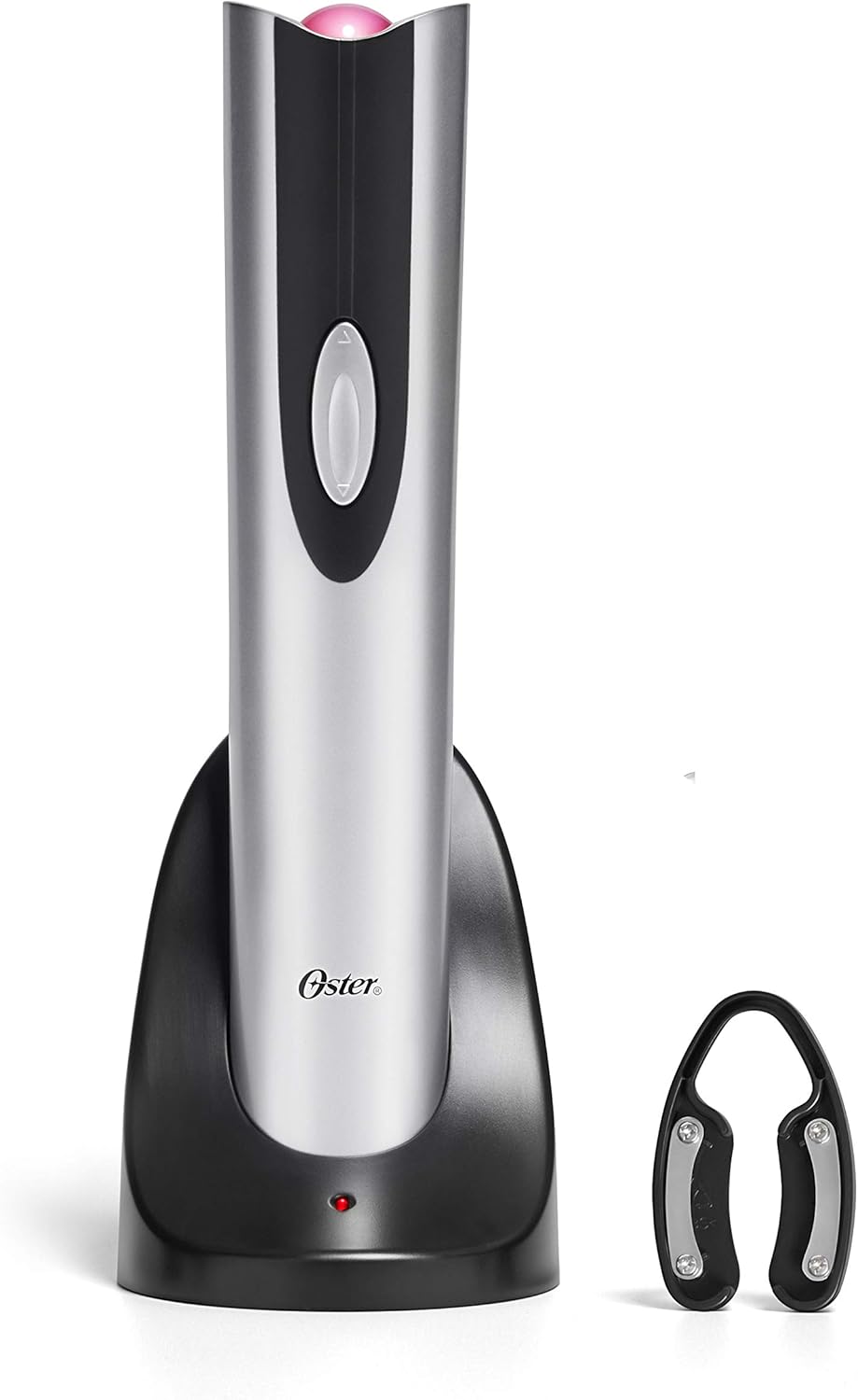
This is the best electric wine opener for the consumer who values convenience above all. Place it on top of the bottle, press the down button. Wait five seconds while the motor drives the worm into the cork and extracts it automatically. Press the up button to eject the cork from the device. The bottle is open. No technique, no strength, no physical contact with the cork whatsoever. It is genuinely magical the first time you watch it work.
For a party where you’re opening six or more bottles in succession, the Oster is the only rational choice—it eliminates the repetitive arm fatigue of manual openers and handles every bottle at the same speed and with the same zero-effort experience. It also makes an outstanding gift: it’s visually impressive, obviously high-quality, and demonstrates genuine thoughtfulness about the recipient’s wine experience.
Who Benefits Most from an Electric Opener
Beyond convenience, the electric opener addresses a genuine accessibility need. Grip strength limitations from arthritis, hand injuries, or age make even the easiest manual openers challenging. The Oster’s fully automatic mechanism requires only the ability to press a single button—no grip, no torque, no arm strength whatsoever. For the wine lover managing rheumatoid arthritis or recovering from hand surgery, an electric opener isn’t a luxury—it’s the difference between opening a bottle independently or not. This is the opener we recommend for older wine enthusiasts, anyone with hand or grip limitations, and any household where wine is a regular but not every-night experience.
(+) Pros
- Zero physical effort—one button, five seconds, done
- Ideal for high-volume party use (6+ bottles)
- Accessible for users with grip strength limitations
- Sleek countertop presence; looks impressive to guests
- Rechargeable base—no disposable batteries
(−) Cons
- Must be charged—can fail mid-party if neglected
- Bulky countertop footprint, not portable
- Can struggle with very old, brittle, or extra-long corks
Our Verdict
The most impressive wine tool to have on your kitchen counter. Buy the Pulltap’s for portability, and the Oster for everything at home.
4. The Old Bottle Savior: The Ah-So Two-Prong Opener
Ah-So Two-Prong Wine Opener

This is the “Butler’s Friend,” and it earns its nickname by doing quietly what no other opener can: removing an old, fragile, or partially disintegrated cork from a valuable bottle completely intact, without piercing it at all. Every other opener on this list attacks the cork from the center with a spiral. The Ah-So bypasses the cork entirely and extracts it by the sides.
The mechanism is elegantly simple: two thin, flexible metal prongs of slightly different lengths (the length difference allows insertion without needing to force both simultaneously) are “rocked” gently down between the cork’s outer surface and the interior of the bottle neck. Once both prongs are fully seated alongside the cork—below the cork’s bottom edge—a slow, gentle twisting motion combined with steady upward pressure causes the cork to grip the prongs and extract as a complete unit, fully intact. No spiral, no puncture, no crumbling. For a 20-year-old Burgundy whose cork has dried to near-powder consistency, the Ah-So is not an alternative opener—it is the only opener.
The Ah-So’s Second Life: Reinsertion
An underappreciated feature of the Ah-So is its ability to reinsert corks—including synthetic corks that have been pulled by a conventional opener and expanded slightly. After decanting a bottle or removing a natural cork you want to preserve intact, the Ah-So can slide back alongside it and push it cleanly back into the bottle neck. This is useful for storing a partially consumed bottle under a natural cork seal rather than a stopper, and it’s the technique professional auction-house recorkers use when assessing a cellar. Combined with a quality wine stopper for most everyday use, the Ah-So covers the “special bottle” scenario that the stoppers cannot.
(+) Pros
- The only reliable tool for old, fragile, or crumbling natural corks
- Extracts the cork completely intact—no fragments in the wine
- Can also reinsert corks—a unique, valuable secondary function
- Affordable and very compact
(−) Cons
- Requires significant practice—first-time users often push cork in accidentally
- Not suitable for everyday use on young bottles
- Does not work on synthetic corks
Our Verdict
Buy one, practice on two young bottles until you have the technique, then store it for the day you open something truly special. You’ll be glad it’s there.
5. The High-Tech: Coravin Timeless Preservation System
Coravin Timeless Six+ Wine Preservation System

The Coravin is not an opener. It is a preservation system that renders the question of “opening” largely obsolete for natural-cork bottles. Instead of removing the cork, a medical-grade hollow needle is inserted through it. Argon gas—inert, tasteless, and heavier than air—is then injected into the bottle to replace the wine as it pours through the needle. When you remove the Coravin, the needle withdraws and the cork’s natural elasticity seals the puncture. The wine inside has never been exposed to oxygen. It can be returned to your wine storage and will continue aging as if it had never been touched, for months or years.
For the serious collector, the implications are profound. You can pour a single glass from a $300 bottle of aged Burgundy, evaluate it, and decide it needs two more years. You can taste through your cellar without committing to consuming each bottle. You can offer guests a glass of something extraordinary without sacrificing the remaining five glasses. It’s the technology that makes owning a serious wine collection genuinely practical rather than financially stressful. The Coravin vs. Vacu Vin comparison isn’t really fair—they solve different problems, but for the collector with bottles worth preserving, the Coravin is in a category of its own.
(+) Pros
- Allows you to pour single glasses without “opening” the bottle
- Preserves wine for months or years after use
- The definitive tool for serious wine collectors
- Makes owning expensive bottles financially practical
- Impressive conversation piece for any wine-savvy dinner guest
(−) Cons
- Significant upfront cost plus ongoing argon capsule cost
- Does not work on synthetic corks (without the Coravin Pivot adapter)
- Not practical for a party—this is a one-or-two-glass tool
Our Verdict
If you own even one bottle worth more than $75 that you’re “saving,” the Coravin pays for itself the first time you use it. If you own many such bottles, it’s mandatory.
The Perfect Technique: How to Use Each Opener Correctly
Owning the right opener is only half the battle. Technique failures are responsible for almost all the cork breakage, cork crumbling, and general opener frustration that wine drinkers experience even with quality tools. Here is the correct technique for each opener on this list.
Mastering the Waiter’s Corkscrew in 5 Minutes
The waiter’s corkscrew feels awkward the first time and effortless by the third bottle. Here is the complete technique. After cutting the foil with the serrated blade (score all the way around just below the top ring of the bottle’s lip, not at the base of the foil capsule), fold the blade away and extend the worm. Place the tip of the worm at the exact center of the cork. Apply light downward pressure and rotate the handle clockwise, keeping the worm vertical—if it tilts, correct it immediately, as an angled worm will angle the cork and cause breakage. Drive the worm in until one full loop is still visible above the cork surface—going all the way through risks puncturing the cork and pushing fragments into the wine.
Now engage the first hinge of the lever. Fold it down so the notch rests on the lip of the bottle. With your finger on the lever as a fulcrum, pull the handle straight up—this will extract the cork partway with almost no effort. Pause. Engage the second (lower) hinge notch on the bottle lip. Pull the handle straight up again. The cork releases cleanly. Twist and pull the final centimeter by hand. The whole process, done correctly, is completely silent. The dramatic “pop” is a sign that someone yanked the cork instead of extracting it.
Mastering the Ah-So: The Hardest Technique on This List
The Ah-So requires patience and a specific feel that develops over several practice bottles. Begin with the two prongs aligned so the longer one will go in first. Rock the longer prong gently into the gap between the cork and the glass on one side, using small down-and-back movements rather than direct downward pressure. When the longer prong is partially inserted, begin working the shorter one in on the opposite side of the cork using the same rocking motion. Alternate between prongs, working both deeper simultaneously. The temptation is to push directly down—resist this. Direct downward pressure on a brittle old cork will push it into the bottle. The motion is always “rock, not push.” Once both prongs are fully alongside the cork, grip the handle firmly with both hands, apply light upward pressure, and rotate the entire device slowly in a continuous circular motion. The cork will begin to release. Keep rotating and pulling gently until it clears the bottle.
The Complete Pre-Opening Checklist
- Remove all foil from the bottle neck cleanly before inserting any opener
- Inspect the cork surface for signs of weeping, mold, or unusual discoloration
- Check the bottle’s fill level through the glass—excessive ullage (air space below the cork) can indicate past oxidation
- For old bottles, stand the bottle upright for 24–48 hours before opening to allow any sediment to settle to the bottom
- Have a decanter or glass ready before you start—once the bottle is open, you want to act quickly if there are issues
- Insert the worm at the exact center of the cork, not off-center
- Pull straight up, never at an angle
- Smell the cork after removal—a musty, wet cardboard smell indicates possible TCA cork taint in the wine
Part 4: You Opened It. What’s Next? (The Full Experience)
Opening the bottle is just the first act. Now that you’ve safely breached the cork, the real wine experience begins.
The Perfect Pour Ritual
- Let it breathe: A red wine that’s been sealed for months or years needs air to open up. This is the great wine aerator vs. decanter debate. For a young, tannic red, decanting in a crystal decanter for 30–60 minutes makes a dramatic difference. In a hurry, a pour-through electric aerator delivers the same result in seconds.
- Check the temperature: Was the white sitting out? Was the red too warm? A lukewarm white is a minor tragedy. A wine chiller sleeve from the freezer brings a white to 45°F in 10 minutes. A countertop electric wine chiller can hold it there all evening.
- Serve with proper glasses: Please don’t drink that wine from a coffee mug or a tumbler. A proper red wine glass with a large bowl concentrates aromas in a way that is not subtle—it genuinely changes what the wine tastes like. This is science, not snobbery.
- Present it properly: A wine serving tray with glasses and a decanter turns a pour into a moment. It’s one of the simplest upgrades in the entire wine experience.
- Pair it with food: Wine is designed to be consumed with food. The basics of how to pair wine with food are simple to learn and dramatically elevate every meal.
Part 5: Storing, Saving, and Savoring Your Wine
Your wine journey has officially begun. You’ve got proper openers, proper glasses, and a proper pour. But what about the next bottle? And what about the rest of this one?
Saving the leftovers: Shoving the cork back in creates a poor seal—the cork expands after removal and no longer fits the neck precisely. A set of quality wine stoppers creates a genuine airtight seal that keeps an opened bottle fresh for 2–3 days. The Vacu Vin vacuum pump stopper extends this to 4–5 days by removing oxygen from the bottle. For a side-by-side comparison of your preservation options, our Coravin vs. Vacu Vin guide covers every scenario.
Building your collection: If you’re getting into a wine subscription box and discovering new wine varietals—from everyday affordable bottles to interesting organic and natural wines—you need somewhere to put them. The fundamental rules of how to store wine at home are simple: cool, dark, horizontal, and stable. You don’t need a custom cellar; our guide on storing wine without a wine fridge covers practical solutions for every space. A modular wine rack is an eco-friendly, scalable solution that grows with your collection. And when you’re ready to commit to proper temperature-controlled storage, our guide to the best wine coolers has everything you need.
Frequently Asked Questions (FAQ)
Q: I pushed the cork in. How do I get it out?
A: You don’t, practically speaking. The cork is now inside the bottle, and retrieving it requires either a purpose-built cork retrieval tool (which exists, but is specialized) or simply accepting that the cork lives there now. Pour carefully—tilt the bottle slowly as you near the end so the cork floats away from the neck. Strain the last pour through a fine-mesh sieve if needed. The wine is completely unaffected by a whole, intact cork floating in it. Cork is inert.
Q: I used the screw method, but my cork just crumbled. What did I do wrong?
A: Nothing wrong—this is a material failure, not a technique failure. The cork was old, dry, or brittle, typically from a bottle stored upright for too long (dry air desiccates the cork—see our guide on proper wine storage). The screw’s thread tore through the dried cork cells rather than gripping them. The only tool that could have saved this cork was an Ah-So two-prong opener. Your solution now: strain the wine through a fine-mesh sieve into a decanter. The wine is fine.
Q: Is the shoe method real? It looks like a prank.
A: It is physically real—it works on Pascal’s Law, which is solid physics. But it is also genuinely dangerous. The risk of bottle shattering from an angled strike or an inadequate wall is significant and real, and broken glass at force near your hands is serious. It produces a good story in success. It produces a very bad story in failure. A Pulltap’s waiter’s corkscrew costs $10. It is a far better party trick.
Q: I’m buying my first opener. Which one?
A: Get the Pulltap’s Double-Hinged Waiter’s Corkscrew. It’s inexpensive, has a built-in foil cutter, fits in a pocket, and will handle every bottle you encounter for the rest of your wine life. After your third bottle with it, you’ll wonder why you ever found it intimidating.
Q: What is “cork taint” and how do I know if my wine has it?
A: Cork taint is caused by a chemical compound called TCA (2,4,6-trichloroanisole), which can form when naturally occurring fungi in cork react with environmental chlorine compounds. It affects roughly 1–3% of natural-corked wine bottles. A wine that is “corked” smells unmistakably musty—like wet cardboard, damp newspaper, or a moldy basement. The smell is distinctive and unpleasant, and it completely masks the wine’s fruit and varietal character. The wine is not dangerous to drink, but it is genuinely ruined for pleasure. If you suspect a wine is corked, compare your glass to a second glass poured and left open for 5 minutes—TCA aromas intensify with air exposure, so a truly corked wine gets worse. Synthetic corks and screw caps eliminate the possibility of TCA contamination entirely, which is a genuine advantage for everyday wines.
Q: Can I use any corkscrew on every type of wine bottle?
A: Most standard corkscrews work on most standard bottles. The exception is the Ah-So, which requires a natural cork with a consistent width. The Coravin cannot be used on synthetic corks without a separate adapter. The electric opener may struggle with very long corks (some French bottles use 55–60mm corks designed for extended aging) if the worm is not long enough to penetrate the full length. When in doubt, the waiter’s corkscrew handles the widest range of bottle and cork types correctly.
Q: How do I store my corkscrew so I always know where it is?
A: Buy three Pulltap’s waiter’s corkscrews, which cost roughly $10–$15 each. Keep one in your kitchen utensil drawer. Keep one in your car’s glove box. Keep one in your portable wine bag. Problem permanently solved. The “where’s the corkscrew” question should be a relic of your past, not a recurring element of your wine life.
The Final Word: The $10 Solution
The best way to open a wine bottle without a corkscrew is to never have to. The panic, the danger, the cork crumbles, the shoe performance art—all of it is completely and permanently avoidable for the price of a single mediocre glass of wine at a bar. A quality waiter’s corkscrew will last you for thousands of bottles and travel anywhere you go. It is the simplest, highest-return upgrade to your entire wine life.
So, tell the story of the time you used a shoe. Tell it at parties. It’s a great story. And as you’re telling it, reach into your pocket, pull out your trusty Pulltap’s, and open the next bottle with the smooth, quiet, professional snick of someone who will never need those improvised methods again. Your friends, your hands, and your wine will all thank you.