The 5 Best Wine Coolers & Refrigerators
Let’s paint a picture. You bought that special bottle. Maybe it’s a $75 Napa Cabernet, a gift from a client, or a case of organic wine you’ve been dying to try. You’re “saving it.” So, where does it live? In a typical American home, “room temperature” is a wine-killing 72°F. So, it’s probably sitting on your kitchen counter, next to the toaster, slowly cooking. Or maybe you’ve tucked it into your standard kitchen fridge. Now it’s ice-cold, the cork is drying out from the low humidity, and it’s absorbing the faint, lingering smell of last night’s takeout. It’s a tragedy.
Heat is the number one enemy of wine. It will destroy a bottle in months. This is why a dedicated wine cooler is, without a doubt, the single biggest upgrade a casual wine drinker can make to become a true wine lover. It’s the first and most critical step in proper home wine storage.
But “wine cooler” is a confusing term. Are we talking about a single-bottle electric wine chiller? A chiller sleeve? No. We’re talking about the real deal: a dedicated wine refrigerator that provides a stable, perfect-temperature environment to protect your investment and ensure every single glass tastes exactly as the winemaker intended.
Here at Cooking Authority, we’ve spent years researching, testing, and understanding these machines. A wine cooler is not just a small fridge; it’s a specialized piece of equipment. In this comprehensive guide, we break down everything you need to know, from thermoelectric vs. compressor to dual-zone vs. single-zone, to installation, noise levels, and long-term maintenance. We’ve reviewed the top-rated wine coolers available to find the 5 best for every budget, space, and collection size.
What’s In This Guide
- Why Your Kitchen Fridge is Ruining Your Wine
- The Science of Wine Degradation: What Temperature Really Does
- The Ultimate Wine Cooler Buying Guide
- The Definitive Wine Temperature Guide
- At-a-Glance: The 5 Best Wine Coolers
- 1. The Best Overall: Kalamera 46-Bottle Dual Zone
- 2. The Small-Space Champ: NutriChef 18-Bottle Thermoelectric
- 3. The Serious Collector: Ivation 92-Bottle Dual Zone
- 4. The Best Budget Pick: Antarctic Star 12-Bottle
- 5. The Kitchen Remodel Dream: Phiestina 46-Bottle Built-In
- First-Time Setup: A Step-by-Step Guide
- How to Organize Your Wine Cooler Like a Pro
- Wine Cooler Maintenance: Keeping It Running Perfectly
- 5 Costly Wine Cooler Mistakes (And How to Avoid Them)
- Your Cooler is Set Up… Now What? (The Fun Part)
- Frequently Asked Questions (FAQ)
Why Your Kitchen Fridge is Ruining Your Wine
If you’re new to the world of wine, your first instinct is to put that bottle of white in the kitchen fridge. This is a significant mistake for anything beyond a day or two. Your standard kitchen refrigerator is a hostile environment for wine. Here’s a breakdown of the four “wine-killers” hiding in there:
- It’s Far Too Cold: Your fridge is set to 35–40°F to keep milk and meat safe. The coldest a wine should ever be stored is 45°F for sparkling wine. A rich Chardonnay is best served at 50–55°F. Serving a wine too cold mutes all its flavors and aromas. You’re essentially drinking “cold, damp liquid.” Reds at 35°F are completely closed off and unpleasant.
- It’s Far Too Dry: This is the silent killer. Your fridge is a dehumidifier. It’s designed to pull all moisture out of the air. This is catastrophic for any bottle with a natural cork. The dry air desiccates the cork, causing it to shrink and crack, breaking the airtight seal. Oxygen seeps in, and your $50 bottle begins its slow, inevitable march toward vinegar.
- It Vibrates: The massive compressor in your food fridge cycles on and off, 24 hours a day, 7 days a week. These constant vibrations, however small, are terrible for wine. They agitate the liquid, disturbing the sediment in older reds and accelerating the chemical aging process, degrading the wine’s delicate structure far ahead of its time.
- It’s Full of Smells and Light: The bright interior light can cause UV damage to sensitive whites and sparkling wines. Far worse, wine is permeable—the cork breathes, and the wine inside can absorb surrounding aromas over time. Storing your wine next to half an onion, garlic, or yesterday’s fish is genuinely destructive. Nobody wants a Sauvignon Blanc with top notes of “leftover curry.”
A wine cooler is a purpose-built wine cellar essential. It creates a stable, 55°F, humid, dark, and vibration-free environment—a wine cocoon that is the cornerstone of proper home wine storage.
The Science of Wine Degradation: What Temperature Really Does
Understanding why temperature matters so much requires a brief look at the chemistry of wine. Wine is not a static liquid—it is a living system of hundreds of chemical compounds that are constantly reacting with each other and with their environment. Temperature is the throttle on those reactions: the higher it is, the faster they proceed. The consequences of poor temperature control compound over time in ways that are often invisible until it’s too late.
The Arrhenius Equation: Why Every Degree Counts
The rate at which chemical reactions proceed increases exponentially with temperature—a relationship described by the Arrhenius equation, which chemists use to model reaction kinetics. For wine, a practical rule of thumb derived from this equation is the “Q10 rule”: for every 10°C (18°F) rise in temperature, the rate of chemical reactions in wine roughly doubles. This means that wine stored at 72°F (22°C)—typical room temperature in an American home—is aging at approximately twice the rate of wine stored at 55°F (13°C). A bottle left on your kitchen counter for three months is experiencing the same chemical aging as one properly stored for six months in a dedicated wine cooler. Over years, this difference is the gap between a wine at its peak and one that has lost its fruit, its structure, and its character entirely.
What High Temperature Actually Does to Wine Molecules
The damage from heat operates on several fronts simultaneously. Esters—the compounds responsible for fruity aromas in wine—are thermally unstable and break down rapidly at high temperatures, causing wines to lose their fresh, vibrant character and develop flat, “cooked” or “jammy” qualities. Tannins in red wines undergo accelerated polymerization at high temperatures, causing them to precipitate out of solution prematurely. This can leave a young Cabernet tasting thin and astringent long before it was supposed to. Acids, which provide the backbone and vibrancy that make wine food-friendly and refreshing, degrade at elevated temperatures, resulting in wines that taste flabby and one-dimensional. Most critically, the small amount of dissolved oxygen in the bottle—intentionally present and carefully managed by the winemaker—reacts far more aggressively at high temperatures, triggering the same oxidative reactions that we work so hard to prevent after opening a bottle.
Temperature Fluctuation: Worse Than Constant Heat
One of the most underappreciated aspects of proper wine storage is temperature stability. It is not only high temperatures that damage wine—rapid fluctuations are equally destructive, potentially more so. When temperature rises, the wine inside the bottle expands, and the cork is pushed slightly outward, admitting a tiny amount of air. When temperature falls, the wine contracts, and the cork is drawn back in, but it carries a small amount of that air with it. This “breathing” process—repeated daily if a bottle is stored somewhere with temperature swings—introduces a continuous, low-level stream of oxygen into the bottle over time, steadily oxidizing the wine with every cycle. A kitchen counter near a window, or in a room that goes from 65°F at night to 80°F in the afternoon, is particularly damaging for this reason. A dedicated wine cooler maintains temperature stability within ±1°F, completely eliminating this problem.
💡 The “Cooked Wine” Test
You can often tell if a wine has been heat-damaged before you even open it. Look for a cork that is pushed noticeably higher than flush with the bottle rim, or that shows signs of wine seeping above the cork level. Both are signs that the wine expanded enough under heat to push the cork upward. Once opened, heat-damaged wine will have muted, flat aromas and may smell faintly “jammy” or “stewed” rather than fresh and vibrant. This is irreversible—no amount of decanting or aerating will restore heat-damaged wine.
The Ultimate Wine Cooler Buying Guide
Buying a wine cooler can be as nuanced as understanding wine varietals. Here’s everything you need to know before spending a dollar.
Compressor vs. Thermoelectric: The #1 Choice
This is the engine of the cooler. It’s the most important decision you’ll make, and the right answer depends on your specific situation.
Thermoelectric Coolers
These work by passing an electric current through a ceramic tile (the “Peltier effect”), which creates a temperature differential that moves heat from one side of the tile to the other. The hot side is vented outside the cooler; the cold side chills the interior.
Pros: Virtually silent with zero vibration, very energy-efficient, no moving parts means exceptional longevity, and a small, lightweight footprint. Ideal for small-capacity (under 20 bottle) coolers in quiet spaces like a living room, bedroom, or office.
Cons: The cooling effect is relative to the ambient room temperature—a thermoelectric unit can only cool to approximately 20–25°F below the surrounding air. If your home reaches 80°F in summer, the cooler will struggle to maintain 60°F. It cannot serve double duty as a “white wine ready-to-serve” chiller.
Compressor Coolers
These use the same vapor-compression refrigeration cycle as a regular fridge—a refrigerant gas is compressed, cycled through condenser coils where it releases heat, then expanded to absorb heat from the cabinet interior.
Pros: Extremely powerful and capable of holding a stable 55°F even in a 90°F garage or outdoor kitchen. Can cool down to 40°F for sparkling wine ready-to-serve temperatures. The only viable technology for collections of 20+ bottles or for use in warm climates.
Cons: Produces a slight hum and minor vibration (though modern vibration-dampening mounts have reduced this dramatically in quality units). Slightly less energy-efficient than thermoelectric models and contains more mechanical components.
The Verdict: If you live anywhere with real summers—which is most of the country—a compressor is the only technology you should seriously consider for a collection of 20 or more bottles. Thermoelectric is the right call for small, quiet-space coolers only.
Single-Zone vs. Dual-Zone: Who Needs What?
Single-Zone: The entire cooler is one temperature, which you set. This is the perfect choice for two types of people: the cellar-focused collector who will store everything (reds, whites, sparkling) at the universal long-term storage temperature of 55°F, and the collector who exclusively drinks one style of wine and wants it always ready to serve.
Dual-Zone: The cooler is physically divided into two compartments with independent temperature controls. This is the “host’s” cooler—the one for the all-around wine drinker who wants whites at a ready-to-serve 48°F and reds at a ready-to-serve 62°F simultaneously, eliminating the need to plan ahead for every bottle. This is the most popular option for the vast majority of home enthusiasts, and we strongly recommend it for anyone who drinks both red and white wine regularly.
The Hidden Third Zone You’re Not Thinking About
Many dual-zone owners use one zone for long-term aging at 55°F and the other as a “staging area” at serving temperature. This is actually the most sophisticated way to use a dual-zone cooler: bottles graduate from the “aging zone” to the “serving zone” a day or two before you plan to open them, arriving at perfect serving temperature with zero last-minute preparation required. It’s how wine professionals manage their inventory, and a dual-zone cooler makes it effortlessly replicable at home.
Capacity: The “Rule of 30%”
Bottle capacity is the most misleading specification in the wine cooler category. The “46-bottle capacity” listed by manufacturers is based on standard Bordeaux bottles—the slim, high-shouldered shape of a Cabernet Sauvignon bottle. It does not account for the fatter, wider, or taller bottles of Pinot Noir (which has a wider, heavier Burgundy bottle), Chardonnay, Champagne and sparkling wine (which is both wider and uses a much larger cork format), or tall German-style bottles like Riesling that may not fit standard shelf heights.
The Rule of 30%: Whatever your current collection size, buy a cooler that is at least 30% larger. If you have 20 bottles today, you need a 28-bottle cooler minimum. If you have 30 bottles, buy the 46-bottle cooler. Your collection will grow faster than you expect. You will never regret owning a slightly oversized cooler. You will always regret buying one that becomes too small six months after purchase.
Freestanding vs. Built-in: A Critical Error to Avoid
⚠️ The Most Expensive Wine Cooler Mistake You Can Make
Freestanding wine coolers have cooling coils on the back and sides. They must have 3–5 inches of clear breathing room on all sides to dissipate heat. Built-in coolers are front-venting, with a large vent at the bottom-front designed to push heat out from the face of the unit. You can always use a built-in cooler as a freestanding unit. You can NEVER safely use a freestanding unit as a built-in. Slide a freestanding cooler into a tight cabinet and its coils will have no ventilation—it will overheat, cycle constantly, and the compressor will burn out, often within months. This mistake voids your warranty and can cost hundreds of dollars in repairs or replacement.
Other Key Features to Look For
The Complete Wine Cooler Feature Checklist
- UV-Filtering Glass Door: Non-negotiable. The glass must be tinted or have a UV-protective coating. UV rays break down the organic compounds in wine and will damage delicate whites and sparkling wines over time. Clear glass doors are purely decorative and should be avoided.
- Removable Beech or Cherry Wood Shelves: Wood is superior to wire. Wire racks can scratch labels and provide no vibration damping. Beech wood shelves look better, cushion the bottles slightly, and are gentler on labels. “Removable” is essential for accommodating Champagne bottles, magnums, or oddly-sized formats.
- Digital Thermostat with ±1°F Accuracy: Analog dial controls are imprecise and should be avoided. A high-quality digital thermostat maintains temperature within a single degree, preventing the temperature fluctuations that damage wine over time.
- Door Lock with Key: A must-have for any household with teenagers, guests who “help themselves,” or a valuable collection worth protecting. Also useful for preventing young children from opening the cooler.
- Vibration-Dampening Compressor Mounting: Look for any mention of “quiet” or “low-vibration” compressor mounting in the specifications. Quality units isolate the compressor from the cabinet using rubber mounts to minimize the transfer of vibration to the bottles.
- Humidity Management: Look for any mention of humidity control or charcoal filtration. Ideal wine storage humidity is 60–70%. Some coolers include a small humidity tray or passive humidity management; others do not address it at all.
- Reversible Door: Gives you flexibility to position the cooler in either direction relative to a wall or other appliances—a feature that pays dividends when you’re trying to fit the unit into a specific space.
- Interior Lighting Type: LED lighting is strongly preferred over incandescent. LEDs produce almost no heat and emit minimal UV radiation, while incandescent bulbs generate both.
The Definitive Wine Temperature Guide
One of the most valuable benefits of owning a dual-zone wine cooler is the ability to keep every style of wine at its ideal serving temperature at all times. The difference between a wine served at the right temperature and one served even 10 degrees too warm or too cold is dramatic—we’re talking about a completely different sensory experience from the same bottle.
The conventional wisdom of serving red wine at “room temperature” is a relic of an era when “room temperature” in European wine-producing regions meant approximately 60–65°F in a stone-walled house. Modern American “room temperature” is typically 68–74°F—far warmer than the ideal serving range for any red wine. A wine served at 72°F will feel flabby and alcoholic; the same wine at 62°F will feel structured, vibrant, and balanced. This is not a subtle difference. It is one of the most impactful and easiest improvements any wine drinker can make, and it is only possible with a dedicated wine cooler.
At-a-Glance: The 5 Best Wine Coolers
| Product | Capacity | Type | Zones | Best For | Built-In? |
|---|---|---|---|---|---|
| Kalamera 46-Bottle | 46 Bottles | Compressor | Dual Zone | Best Overall | No — Freestanding Only |
| NutriChef 18-Bottle | 18 Bottles | Thermoelectric | Single Zone | Small Spaces / Silence | No — Countertop |
| Ivation 92-Bottle | 92 Bottles | Compressor | Dual Zone | Serious Collector | No — Freestanding Only |
| Antarctic Star 12-Bottle | 12 Bottles | Thermoelectric | Single Zone | Budget Entry Point | No — Countertop |
| Phiestina 46-Bottle | 46 Bottles | Compressor | Dual Zone | Built-In / Kitchen Remodel | Yes — Front Venting |
1. The Best Overall: Kalamera 46-Bottle Dual Zone Cooler
Kalamera 46-Bottle Dual Zone Compressor Wine Cooler

This, in our opinion, is the sweet spot for the overwhelming majority of wine enthusiasts. Kalamera is a highly-respected brand, and this 46-bottle model hits every mark. It’s the perfect size: large enough to hold a serious, growing collection (remembering the 30% rule—this realistically accommodates around 30 mixed bottles), but compact enough to fit in a dining room, kitchen corner, or finished basement without dominating the space.
Its core technology is where it shines. It’s a powerful compressor unit, so it holds its temperature flawlessly even in a warm garage or through a hot summer. And it’s dual-zone, which is the feature you’ll use and appreciate every single day. Set the upper zone to 45–50°F for whites, rosés, and sparkling wines, and the lower zone to 60–65°F for reds. Every bottle is ready to serve at its precise ideal temperature, always. No more “throw it in the freezer for 20 minutes” last-minute panic.
What Sets Kalamera Apart from the Competition
The wine cooler market at this price point is crowded, and many units use similar components. What distinguishes Kalamera is build quality consistency and post-purchase support. The compressor is isolated from the cabinet on vibration-dampening rubber mounts, reducing transmitted vibration to levels that are negligible for even delicate, sediment-heavy older reds. The beech wood shelves—five of them, all slide-out—are thicker and more cleanly finished than what you’ll find on most competitors, and they accommodate Bordeaux-style bottles with confidence. The digital thermostat is accurate and responsive, and the blue LED lighting gives the interior a clean, premium appearance without generating heat. The UV-filtering glass door provides genuine protection rather than just a tint for aesthetics.
(+) Pros
- Dual-zone is perfect for mixed red and white collections
- Powerful compressor holds temperature regardless of ambient climate
- Beautiful, thick beech wood slide-out shelves
- 46-bottle sweet-spot size suits most households
- Excellent value for a dual-zone compressor model
- Vibration-dampening compressor mounts protect wine during aging
(−) Cons
- Freestanding only—cannot be installed in a built-in cabinet space
- Standard shelf spacing is tight for wider Burgundy or Champagne bottles
Our Verdict
The best all-around wine refrigerator for the serious home enthusiast. Reliable, beautiful, and genuinely wine-protective—this is the unit we recommend to nearly everyone.
2. The Small-Space Champ: NutriChef 18-Bottle Thermoelectric Cooler
NutriChef 18-Bottle Thermoelectric Countertop Wine Cooler

This is the perfect starter cooler for the apartment dweller or the person with limited kitchen real estate. You’ve just started getting into a wine subscription box and you realize you have 12 bottles of affordable wine and nowhere safe to store them. This NutriChef model is the elegant solution.
Its defining feature is its thermoelectric cooling system: completely silent, completely vibration-free. There’s no compressor hum, no gurgling, no cycling noise. You will not hear this unit. That makes it the only sensible choice for a studio apartment, home office, bedroom, or living room where a compressor’s operational noise would be intrusive. Its vertical tower design occupies a minimal floor or counter footprint while providing enough capacity to protect a small, rotating collection. Set it to 55°F as a universal storage temperature and use a chiller sleeve when you want a white or sparkling wine at a colder serving temperature.
When Thermoelectric is the Right Answer
The NutriChef is not the right cooler for everyone, but for the right person it is genuinely the best option available. If your apartment maintains a consistent temperature year-round (which most centrally air-conditioned buildings do), if you have fewer than 18 bottles to store, if silence is a genuine priority, and if you are not trying to serve whites at 45°F directly from the unit, this thermoelectric cooler is superior to a compressor model in every meaningful way. It has no moving parts beyond a small fan, giving it exceptional longevity. It uses less electricity than a compressor unit of the same size. And the complete absence of vibration makes it particularly excellent for storing older wines with sediment, which benefit enormously from a perfectly still environment.
(+) Pros
- Completely silent thermoelectric operation—no compressor hum
- Zero vibration—ideal for older wines with sediment
- Minimal footprint; fits on a counter or in a corner
- Excellent energy efficiency
- Very affordable entry point for first-time wine cooler buyers
(−) Cons
- Thermoelectric technology struggles in rooms above 80°F
- Wire racks rather than wood shelves
- Single-zone only—cannot maintain separate red and white temperatures
- Cannot chill wines to sparkling wine serving temperatures
Our Verdict
The best small-space wine cooler available. If silence, minimal footprint, and zero vibration are your priorities and your room stays consistently cool, this is your cooler.
3. The Serious Collector: Ivation 92-Bottle Dual Zone Cooler
Ivation 92-Bottle Dual Zone Compressor Wine Cooler

You’ve moved past “casual.” You’re buying wine by the case. You use terms like “cellar” and “laying down” without embarrassment. This is your starter cellar. The Ivation 92-bottle model is a formidable machine and the perfect solution for the serious collector who isn’t ready to spend tens of thousands on a custom build. It delivers massive capacity in a freestanding footprint that fits a finished basement, a dedicated pantry, or a large dining room.
Like our top pick, it is a dual-zone compressor model—but on a grander scale. The large upper zone and lower zone have independent digital controls, so you can keep a large aging stock at 55°F while maintaining a ready-to-serve section for the bottles in current rotation. The shelves are fully removable, which is essential at this size—it allows you to create custom configurations for magnums (1.5L), half-bottles (375ml), or irregularly shaped bottles. A security lock protects a collection that, at this size, represents a meaningful financial investment.
The Economics of Large-Format Wine Storage
At 92 bottles of advertised capacity—call it 65–70 realistic bottles of mixed formats—the Ivation positions itself as a genuine value proposition for the case buyer. If you purchase wine by the case (12 bottles) at an average of $25 per bottle, a single case represents $300. Three cases is $900. The question is not whether you can afford a large wine cooler—it’s whether you can afford to store $900 worth of wine in conditions that accelerate its aging by a factor of two. The math is simple and uncomfortable: every dollar saved on wine storage is a dollar’s worth of wine experience lost. The Ivation, at its price point, easily pays for itself within a few months of properly protecting a serious collection.
(+) Pros
- Huge capacity—the best price-per-protected-bottle value on this list
- Dual-zone with independent digital controls for ultimate flexibility
- Fully removable shelves for custom configurations including magnums
- Door lock and key included—essential for a collection of this value
- UV-filtering glass door provides real protection
(−) Cons
- Large, heavy unit that requires careful placement planning
- Freestanding only—needs 5 inches of clearance on all sides
- Advertised 92-bottle capacity assumes all Bordeaux-format bottles
Our Verdict
The definitive choice for anyone with a collection exceeding 30 bottles. If you’re tired of playing wine tetris with multiple small coolers, this is the upgrade that solves everything in one move.
4. The Best Budget Pick: Antarctic Star 12-Bottle Cooler
Antarctic Star 12-Bottle Wine Cooler

This is for the person who is just getting curious about wine. You don’t have a collection—you just like to have a few bottles of white on hand and you’re tired of them tasting like your kitchen fridge. The Antarctic Star is a runaway bestseller for one simple reason: it’s a massive upgrade for a modest price. It often comes in under $150, making it an excellent gift for a new homeowner or first-time wine enthusiast.
Like the NutriChef, this is a thermoelectric model—silent, vibration-free, and energy-efficient. Set it on your counter and it will quietly and reliably keep your 12 bottles at a consistent cellar temperature. It excels in the 45–55°F range, making it particularly good for whites and rosés. It is not a long-term aging cellar for a wine library, but it is a perfect “serving station” for your everyday go-to bottles. The sleek design and blue LED interior look significantly more expensive than the price suggests.
Making the Most of a 12-Bottle Cooler
A 12-bottle cooler rewards thoughtful curation. Rather than treating it as a general storage unit, use it as your “active rotation”—the 12 bottles you plan to drink in the next 2–4 weeks. Keep your longer-term stock somewhere cool (a basement, a closet on an interior wall) and graduate bottles to the cooler as you need them. This approach means you’re always drinking from a cooler, perfectly protected bottle, while your long-term bottles sit in the most stable environment your home can offer. Combined with a good quality stopper like a Vacu Vin for half-finished bottles, this small cooler can become the cornerstone of a thoughtful, low-budget home wine program.
(+) Pros
- Best entry-level price point on the market
- Completely silent thermoelectric operation
- Compact, countertop-friendly dimensions
- Sleek modern design with attractive LED interior
- Excellent gift option for first-time wine cooler buyers
(−) Cons
- Thermoelectric technology struggles if room exceeds 75–80°F
- “12-bottle” capacity is very generous—expect 8–10 in practice
- Single-zone only with no path to upgrade
Our Verdict
The perfect first wine cooler. For the price of three decent bottles of wine, you get a machine that will make every future bottle taste noticeably better.
5. The Kitchen Remodel Dream: Phiestina 46-Bottle Built-In Cooler
Phiestina 24-Inch 46-Bottle Built-in Wine Cooler
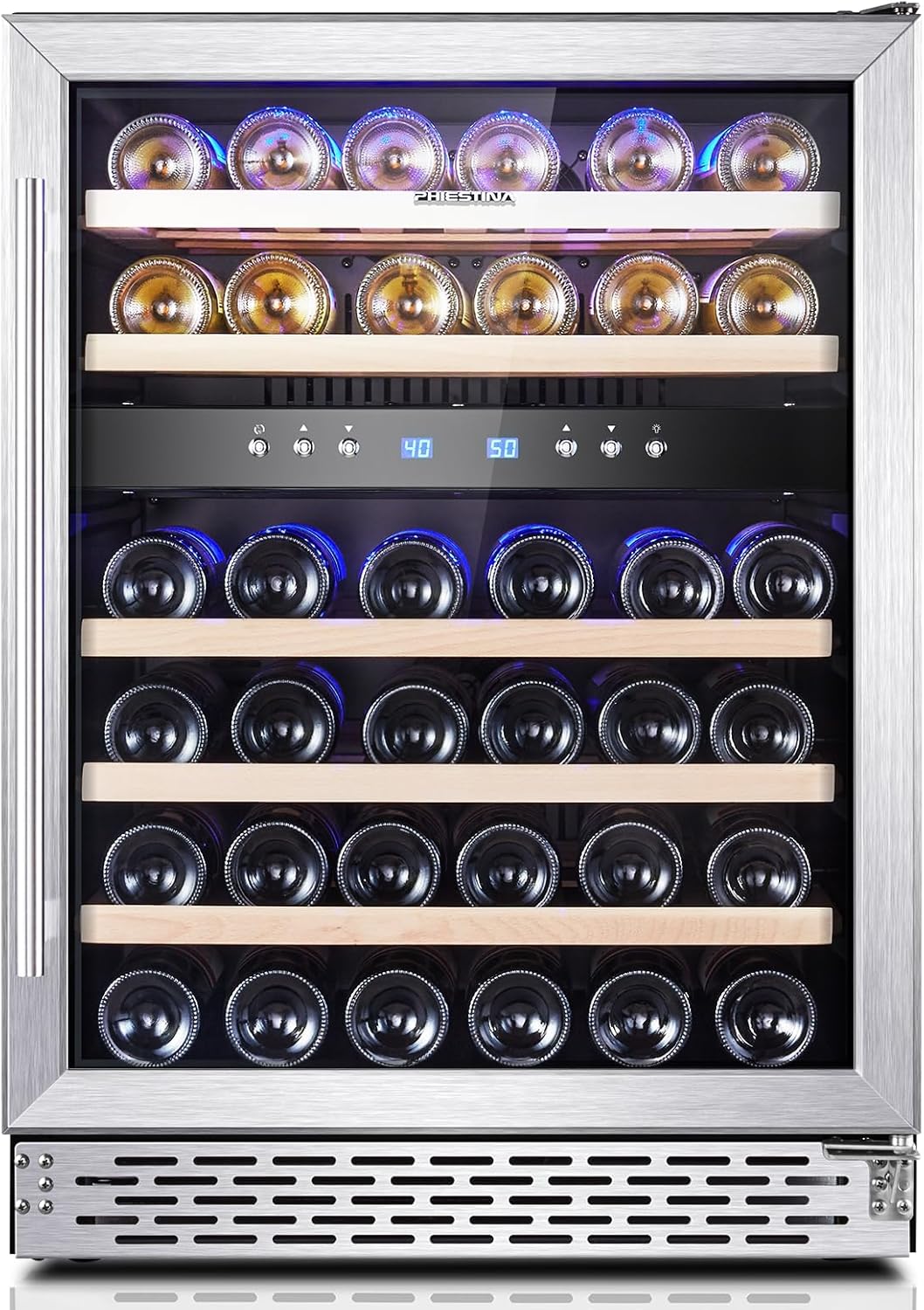
This is the professional’s choice for the homeowner mid-renovation. You’re remodeling your kitchen, building a home bar, or finishing a basement entertainment space. You want a wine cooler that looks like a high-end, integrated appliance—not an afterthought. The Phiestina is the answer. Its defining feature is front-venting, meaning it’s a true built-in unit engineered to slide into a standard 24-inch cabinet cutout (the same width as a U.S. dishwasher), producing a seamless, custom-cabinetry appearance at a fraction of the price of a Sub-Zero or Liebherr.
The performance matches the presentation: it’s a dual-zone compressor model with “French Door” style zones—two 23-bottle compartments side by side, each with its own independent digital temperature control. This side-by-side layout makes organization and retrieval cleaner and more intuitive than top-bottom zone configurations. The compressor is notably quiet for its class, the wood-fronted shelves are handsome, and the stainless-steel finish with door lock rounds out a package that punches well above its price point.
Planning a Built-In Wine Cooler Installation: What You Need to Know
A built-in installation requires more planning than simply plugging in a freestanding unit, but the payoff is a result that looks completely intentional and professional. The cabinet cutout must be accurate: the Phiestina is designed for a 24-inch standard opening, and leaving even 0.5 inches of extra space on the sides will allow warm room air to recirculate in front of the vents, reducing efficiency. The floor of the cutout should be perfectly level—a unit that tilts even slightly can affect door seal quality and place uneven stress on the compressor mount. Ensure that a dedicated electrical circuit is available nearby, as wine coolers should not share a circuit with other high-draw appliances. Finally, the front vent at the base of the unit needs 1–2 inches of clearance to the floor—a standard toe-kick space in most cabinet installations provides exactly this.
(+) Pros
- Front-venting for genuine built-in, seamless cabinetry integration
- Powerful dual-zone compressor with top-tier temperature stability
- Beautiful French-door side-by-side zone design
- High-end look: stainless steel, wood-fronted shelves, door lock
- Can also be used freestanding if plans change
(−) Cons
- Premium price reflects the built-in engineering
- Requires precise 24-inch cabinet cutout for proper installation
- Installation planning is more involved than freestanding placement
Our Verdict
The only wine cooler that makes the kitchen renovation feel complete. If you’re building or remodeling, this is the unit that will look like it belongs—because it was designed to.
First-Time Setup: A Step-by-Step Guide
Your new wine cooler has arrived. Before you start loading it with bottles, there are a few critical steps that every first-time owner needs to follow. Done right, this process protects your investment and gets the cooler operating at peak performance from day one.
- Wait Before Plugging In (Compressor Models Only): This is the most important step and the one most commonly skipped. During shipping, compressor units are often tilted or inverted, which can cause the refrigerant oil to migrate out of the compressor and into the refrigerant lines. If you plug the unit in before this oil has settled back into the compressor, you can cause immediate, permanent damage to the cooling system. After your cooler arrives, stand it upright in its final location and wait a minimum of 2–4 hours before plugging it in. Many manufacturers recommend waiting up to 24 hours. Check your specific model’s manual for the exact recommendation. Thermoelectric models have no such restriction and can be plugged in immediately.
- Clean the Interior: Before loading any bottles, wipe down the interior walls and shelves with a clean, damp cloth and a mild, non-abrasive cleaner. This removes any manufacturing residue, dust from shipping, or packaging odors that could affect your wine over time.
- Allow the Unit to Reach Temperature Before Loading: Plug in the cooler, set your desired temperature zones, and allow it to run for at least 4–6 hours before loading it with wine. Loading a warm cooler immediately with a large number of room-temperature bottles can stress the cooling system and delay reaching your target temperature.
- Don’t Overload Immediately: Load the cooler gradually over the first few days rather than filling it completely at once. A sudden large load of warm bottles requires the compressor to work hard to bring the temperature back down, and repeated hard cycling can stress the system in its early break-in period.
- Position Bottles Correctly: Always store bottles horizontally in a wine cooler, with the label facing up for easy identification without rotating the bottle. Horizontal storage keeps the cork in contact with the wine, preventing it from drying out. The only exception is bottles with screw caps, which can be stored at any angle.
💡 Setting Up Your Dual-Zone Cooler
For a dual-zone cooler used primarily for long-term storage and serving, we recommend setting the upper zone (for whites, sparkling, and rosé) to 50°F and the lower zone (for reds) to 62°F. This makes your whites ready to serve immediately and your reds ready to serve immediately for most styles. For long-term aging of everything, set both zones to 55°F and plan to move bottles to the colder zone a few days before opening. Either approach is valid—it depends entirely on your drinking habits.
How to Organize Your Wine Cooler Like a Pro
Organization is not just about tidiness—in a wine cooler, how you arrange your bottles affects how easily you can find what you want without disturbing neighboring bottles, and it directly influences your enjoyment of the cooler over time. A disorganized cooler leads to bottles being moved, rotated, and disturbed constantly, negating some of the benefits of the stable storage environment you’ve worked to create.
Zone Assignment Strategy
In a dual-zone cooler with a warmer upper zone and cooler lower zone (or warmer lower zone and cooler upper zone, depending on the model—check your manual), assign the zones based on how soon you plan to drink each bottle. Bottles you’ll open within the next week or two go in the serving-temperature zone. Bottles you’re aging for months or years go in the 55°F long-term storage zone. This way, every bottle you open is at serving temperature without any last-minute chilling or warming, and your long-term bottles are aging optimally.
Shelf-by-Shelf Organization
Within each zone, organize by varietal or region so you can find any specific bottle without moving others. Designate specific shelves: sparkling wines always on one shelf (with a note that they may need special consideration for height), whites on the next, rosé after that, light reds on the first red shelf, and bold reds at the bottom where temperatures may be slightly more stable in a single-zone unit. Label your shelves with a small piece of tape and a marker—it sounds overly formal, but in a 46-bottle cooler with the lights off and your hand reaching in at midnight, you’ll be grateful for the system.
The FIFO Rule: First In, First Out
When you add new bottles of the same wine you already have, place the new bottles at the back and move the older bottles to the front. This “first in, first out” rotation ensures that you’re always drinking the oldest bottles first, which is especially important for wines with limited aging windows. Most wines available at retail are intended to be drunk within 3–5 years of release; a well-organized cooler helps you actually consume them in the right order rather than accumulating an unmanageable backlog of bottles that have passed their peak.
Wine Cooler Maintenance: Keeping It Running Perfectly
A quality wine cooler, properly maintained, should last 10–15 years or more. The maintenance required is minimal but important. Neglecting these basic tasks is the most common reason wine coolers fail prematurely.
Cleaning the Interior
Every 3–4 months, remove all bottles and wipe down the interior walls, door seal, and shelves with a mild solution of baking soda and warm water (about one tablespoon per quart of water). This neutralizes any wine odors that have accumulated and prevents mold or mildew from developing in the humid interior environment. Never use bleach or harsh chemical cleaners inside a wine cooler—the fumes can persist and ultimately affect your wine through the cork. After cleaning, dry the interior thoroughly before reloading.
Checking and Cleaning the Door Seal
The magnetic door gasket is the first component to wear out in most wine coolers. Run your finger along the entire perimeter of the door seal monthly and feel for any areas where the gasket has become stiff, cracked, or is pulling away from the door frame. A compromised seal causes the cooler to work harder and creates temperature instability. A simple test: close the door on a piece of paper. If you can pull the paper out easily without resistance, the seal is weak and should be replaced. Replacement gaskets for most major brands are available as aftermarket parts and are simple to install.
Condenser Coil Cleaning (Compressor Models)
Freestanding compressor coolers have condenser coils either on the back or on the underside of the unit. These coils dissipate the heat removed from the cabinet, and they accumulate dust over time. Dusty coils are insulating coils—they can’t dissipate heat as efficiently, causing the compressor to run longer and hotter. Every 6 months, use a vacuum cleaner with a brush attachment to gently clean any visible coils or vent areas. For built-in units, pay particular attention to keeping the front kick-plate vent clear of debris, pet hair, and dust.
When Your Cooler Isn’t Cooling Properly
If your wine cooler is struggling to maintain its set temperature, the cause is almost always one of three things: the ambient room temperature has exceeded the unit’s operational range (most units are rated to operate in rooms up to 85–90°F), the condenser coils are dusty and need cleaning, or the door seal has failed. Diagnose in that order before assuming the compressor itself has failed. Compressor failures are relatively rare on quality units and are typically preceded by unusual noises—loud knocking, grinding, or high-pitched squealing—which give you advance warning.
5 Costly Wine Cooler Mistakes (And How to Avoid Them)
-
Plugging In a Compressor Cooler Immediately After Delivery
The Fix: Wait at least 2–4 hours (or 24 hours per the manual) after the unit has been standing upright before plugging it in. This allows refrigerant oil to return to the compressor and prevents immediate mechanical damage. -
Installing a Freestanding Cooler in a Built-In Cabinet Space
The Fix: If you’re building in, only purchase a unit explicitly rated and designed for built-in installation. Check for “front-venting” in the specifications. The cost of a burned-out compressor will exceed the cost of the correct unit. -
Buying a Thermoelectric Cooler for a Warm Room
The Fix: If your home or storage area reaches above 75°F in summer, always purchase a compressor cooler. Check the manufacturer’s specifications for “ambient operating temperature range” before purchasing any thermoelectric unit. -
Storing Bottles Vertically in the Cooler
The Fix: Always store corked bottles horizontally. Vertical storage causes the cork to dry out from below, breaking the airtight seal and allowing oxygen to enter the bottle. Only screw-cap bottles can safely be stored vertically for extended periods. -
Setting the Temperature Too Low for Everything
The Fix: Do not store all wine at 40°F just because the cooler can get that cold. Too-cold storage is hard on corks, can cause tartrate crystals to form in white wines, and does your reds no favors. The universal long-term storage temperature is 55°F. Save the colder temperatures for your sparkling wines or whites you plan to drink within the week.
Your Cooler is Set Up… Now What? (The Fun Part)
Your new cooler is humming away, protecting your collection. You are officially a wine collector. Now comes the enjoyable part: experiencing what perfectly stored and perfectly tempered wine actually tastes like. A cooler is the home base, but you need the supporting cast of accessories to complete the ritual from cooler to glass.
The Perfect Pour Ritual: From Cooler to Glass
- The Open: Pull the bottle from the cooler. Start with a clean opening—use a wine foil cutter for a perfect, clean line, then an electric wine opener for an effortless, zero-fragment pull.
- The Breathe: If it’s a big red, it needs air even from a cooler. This is the great aerator vs. decanter debate. For a quick weeknight glass, a pour-through aerator is perfect. For a special bottle, let it open for an hour in a crystal decanter.
- The Serve: Don’t let a perfectly tempered wine down with the wrong vessel. A proper red wine glass with a large bowl concentrates aromas in a way that transforms the experience. Serve with style on a wine serving tray.
- The Pause: If you don’t finish it, don’t leave it to oxidize on the counter. The right tool here is a quality wine stopper—ideally a Vacu Vin vacuum pump for anything you want to keep for more than a day. Return the stoppered bottle to the cooler for maximum protection.
- The Pair: The wine is now at its peak. Time to eat. Our guide on how to pair wine with food completes the full experience.
All these tools—from modular wine racks to wine bags—are part of a complete system, a set of eco-friendly solutions that help you get the absolute most out of every single bottle you invest in.
Frequently Asked Questions (FAQ)
Q: I just got my cooler. Can I plug it in right away?
A: For thermoelectric models, yes. For compressor models, no. After shipping, compressor units must stand upright for at least 2–4 hours (check your manual—some specify up to 24 hours) before being plugged in. This allows the refrigerant oil that may have shifted during transit to settle back into the compressor. Skipping this step can cause immediate, permanent damage to the cooling system that voids your warranty.
Q: What is the real perfect temperature for wine?
A: For long-term storage of all wine styles, the universal answer is 55°F. For serving, it varies: sparkling wines at 42–48°F, light whites at 45–50°F, full-bodied whites at 50–55°F, rosé at 48–55°F, light reds at 55–60°F, and full reds at 60–66°F. This is precisely why dual-zone coolers are so popular—they let you maintain one zone for storage and one for serving, or one for reds and one for whites, at all times.
Q: My cooler doesn’t hold as many bottles as advertised. Why?
A: Every wine cooler’s advertised capacity is based on the standard Bordeaux bottle—the thin, high-shouldered format of a typical Cabernet Sauvignon. Burgundy bottles (Pinot Noir, Chardonnay) are significantly wider and will hold fewer per shelf. Champagne bottles are both wider and taller and may not even fit standard shelf heights. This is why the Rule of 30% is so important: always buy a cooler rated for at least 30% more bottles than you currently own.
Q: Where is the best place in my home to put a wine cooler?
A: A cool, dark, consistently temperature-stable location is ideal: a basement, interior pantry, or dining room corner away from exterior walls. Avoid direct sunlight, proximity to heat sources like ovens or radiators, and areas with large daily temperature swings like a garage that is not climate-controlled. The cooler the ambient room temperature, the less the cooler’s compressor has to work, extending the life of the unit significantly.
Q: My cooler is making a gurgling or humming noise. Is it broken?
A: For a compressor model, this is completely normal and expected—it’s the sound of the refrigerant cycling through the system and the compressor doing its job. It will cycle on and off periodically. A thermoelectric model should produce only a faint, constant fan sound. If a thermoelectric unit is gurgling, something is wrong. Any noise that is sudden, loud, metallic, or grinding from a compressor unit should be investigated, as these can signal compressor bearing wear or refrigerant line issues.
Q: Can I put food in my wine cooler?
A: Technically yes, but we strongly advise against it. Wine coolers are designed and calibrated for wine storage conditions: 55°F, 60–70% humidity, minimal vibration, and a UV-filtered, low-light environment. Food introduces odors that can permeate corks over time, humidity fluctuations from packaging, and the constant opening and closing needed for food access disturbs the stable environment. More practically, the temperatures that are ideal for wine storage (55°F) are too warm to safely store dairy, meat, or many other perishables. Use a wine cooler for wine. Use a food fridge for food.
Q: How much electricity does a wine cooler use?
A: This varies significantly by technology and size. A small thermoelectric cooler (12–18 bottles) typically uses 60–80 watts, comparable to a single incandescent light bulb, and costs roughly $5–$8 per month to operate. A mid-size compressor cooler (46 bottles) typically uses 80–120 watts and costs approximately $8–$15 per month. A large 92-bottle compressor unit may use 150–200 watts and cost $15–$25 monthly. These are modest costs compared to the value of the wine being protected, but looking for an ENERGY STAR certification when buying can meaningfully reduce long-term operating costs.
Q: How long should a wine cooler last?
A: A quality compressor wine cooler, properly maintained, should last 10–15 years. Thermoelectric models, with their lack of moving parts, can theoretically last even longer—the primary failure point is the Peltier element, which in quality units has a very long service life. The most common causes of premature failure are improper installation (freestanding unit used as built-in), inadequate ventilation, not waiting before plugging in after shipping, and lack of basic maintenance like cleaning the condenser coils and checking the door seal. Follow the basic care guidelines and your cooler should outlast multiple generations of wine collections.
The Final Word: Your Best Wine Investment
A wine cooler is the most impactful purchase in the entire wine lover’s toolkit. It’s the only accessory that actively protects everything else—the bottles you’ve accumulated, the wine experiences you’ve been anticipating, and the money you’ve invested. Every other accessory improves a single moment: the pour, the serve, the presentation. A wine cooler improves every moment that comes after the purchase, silently and continuously, until the bottle reaches your glass.
You don’t need a 1,000-bottle cellar to qualify as a collector. You just need a genuine love of wine and the right environment to protect it. For most enthusiasts, a dual-zone compressor model like the Kalamera 46-Bottle is the perfect all-around choice. For small spaces, the NutriChef or Antarctic Star provide exceptional entry-level protection. For the serious collector, the Ivation 92-Bottle is a starter cellar in a freestanding cabinet. And for the homeowner building or renovating, the Phiestina delivers a genuinely professional, integrated result.
Whichever model you choose, the investment pays you back one perfect glass at a time—for years.