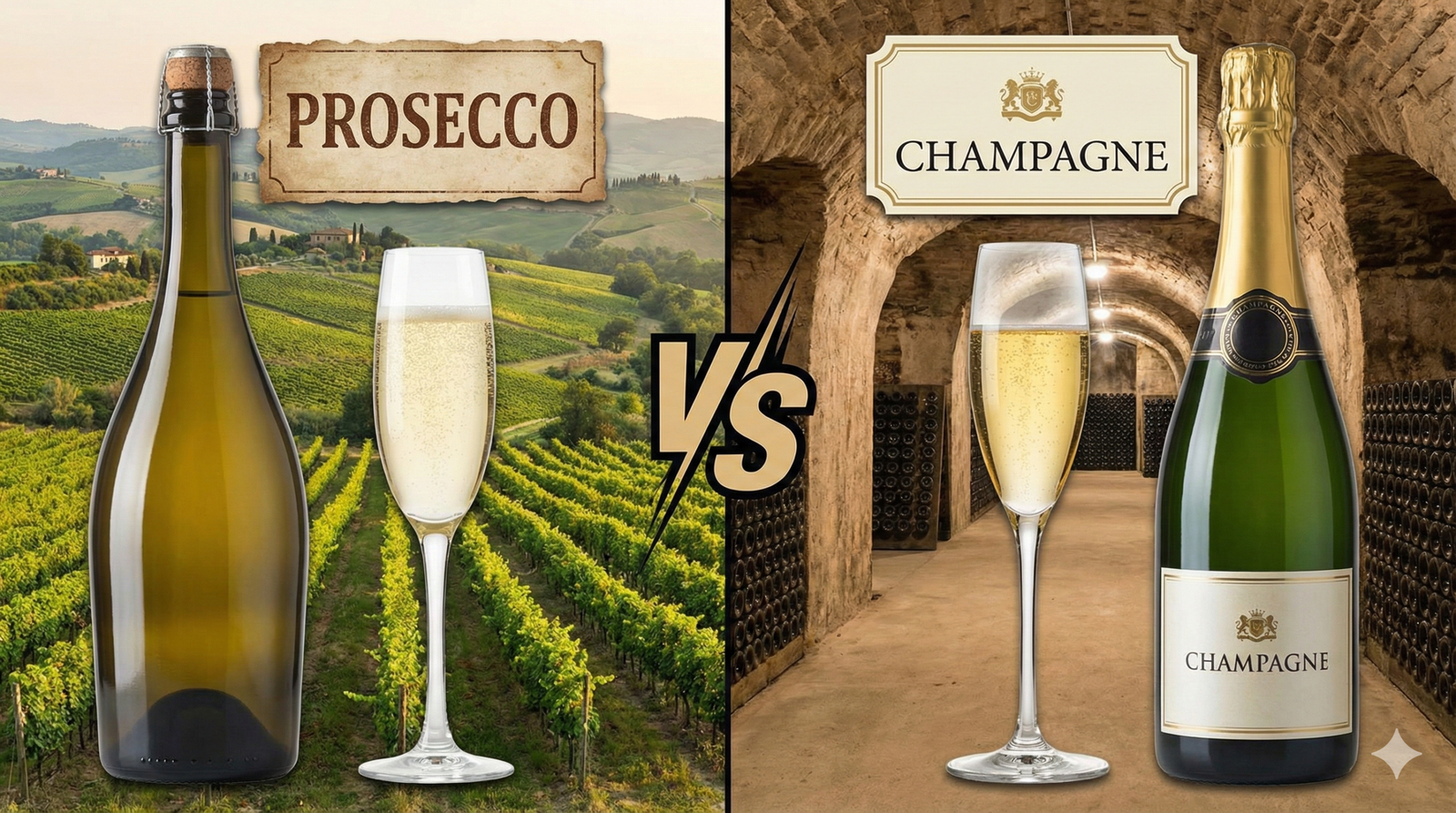
It happens at every celebration. The cork pops, the foam rises, and someone asks, “Is this Champagne or Prosecco?” To the untrained eye, they look identical: pale, fizzy, and festive. But in reality, they are as different as a crispy green apple and a buttery croissant.
The difference is not just about the price tag or the fancy French label. It comes down to a fundamental difference in winemaking philosophy, chemistry, and geography. Whether you are planning a wedding toast or just mixing Sunday mimosas, understanding Prosecco vs. Champagne will save you money and elevate your drinking experience.
The Cheat Sheet: At A Glance
If you are in a rush to buy a bottle, here is the immediate breakdown of what you are getting with each style.
| Feature | Champagne | Prosecco |
|---|---|---|
| Country | France (Champagne region) | Italy (Veneto / Friuli) |
| Primary Grapes | Chardonnay, Pinot Noir, Pinot Meunier | Glera (min 85%) |
| Production Method | Traditional Method (in-bottle) | Charmat Method (in-tank) |
| Lees Aging | Minimum 15 months (NV); 3+ years (Vintage) | Weeks (not months) |
| Bubble Pressure | 5–6 bars | 2–3 bars (Spumante) |
| Bubble Character | Fine, sharp, persistent | Light, frothy, dissipates faster |
| Primary Flavors | Toast, Brioche, Almond, Citrus, Chalk | Green Apple, Pear, Peach, Honeysuckle |
| Typical ABV | 12–12.5% | 10.5–11.5% |
| Price Range | $40–$300+ | $12–$30 |
| Aging Potential | 5–30+ years (vintage) | Drink within 1–2 years |
History & Origins: Ancient Bubbles and Royal Reputations
The histories of Champagne and Prosecco could not be more different — one is steeped in deliberate royal patronage and French prestige positioning, the other in ancient agricultural tradition and Italian conviviality. Understanding each wine’s historical journey reveals why they occupy such different places in culture and commerce today.
Champagne: The Accidental Monk and the English Bottle
The popular legend credits Dom Pérignon — a Benedictine monk at the Abbey of Hautvillers in the Champagne region — with “inventing” Champagne when he supposedly cried to his fellow monks: “Come quickly, I am drinking the stars!” The historical reality is more complex. Dom Pérignon was a real figure who worked at Hautvillers in the late 17th and early 18th centuries, and he made genuine technical contributions to winemaking — particularly in blending grapes from different vineyards to achieve consistency and in improving cork quality for bottle sealing. However, the concept of deliberately sparkling wine from Champagne appears to have emerged through the combined work of many producers, not one miraculous discovery.
Crucially, it was English glassmakers who made Champagne possible in its modern form. French glass of the era was too fragile to contain the CO₂ pressure created by secondary fermentation — bottles exploded routinely. English coal-fired furnaces produced significantly stronger glass, and it was in England that the technology and commercial appetite for bottled sparkling wine first developed. The first recorded scientific description of deliberately made sparkling wine from Champagne appears in English writing before the French accounts — an irony that French wine historians acknowledge with varying degrees of enthusiasm. By the 18th century, Champagne had been adopted as the celebratory drink of the French royal court and European aristocracy, establishing the prestige positioning that remains its most powerful commercial asset three centuries later.
In recognition of its cultural heritage, the Champagne wine region and its distinctive chalk caves where wine ages were granted UNESCO World Heritage status for the historic Champagne hillsides, houses, and cellars.
Prosecco: Pliny the Elder and the Roman Connection
Prosecco’s origins are genuinely ancient. The Roman writer and naturalist Pliny the Elder, in his encyclopedic Naturalis Historia, praised a wine called Pucinum produced near the village of Prosecco (near modern Trieste) as among the finest wines of his era — making this one of the earliest named references to a specific Italian wine. The connection to modern Prosecco is historically debated, but the continuity of winemaking in northeastern Italy from Roman times through to the present represents an unbroken thread of regional tradition.
The Charmat method that defines modern Prosecco production was not developed until the early 20th century, when Italian enologist Federico Martinotti patented the large-tank secondary fermentation process later refined by French winemaker Eugène Charmat, whose name the method came to carry internationally. Before this industrial development, Prosecco was produced as a still wine or as a gently sparkling wine using traditional methods — the frizzante and tranquillo styles that still exist today. The modern Prosecco boom — which saw Italy become one of the world’s largest sparkling wine exporters — is a relatively recent commercial phenomenon that has transformed the Veneto wine industry.
The Prosecco wine region, specifically the Conegliano Valdobbiadene landscape, received UNESCO recognition for its distinctive hillside vine landscape — a cultural recognition that mirrors Champagne’s own UNESCO heritage status.
Both the Champagne wine region and the Prosecco Conegliano Valdobbiadene landscape have received UNESCO World Heritage recognition — placing the two most globally consumed sparkling wines among the world’s most culturally significant wine landscapes.
The Grapes in Depth: Three vs One
The grape varieties used in each wine are fundamentally different, and this varietal distinction is the first reason they taste so unlike each other.
Champagne’s Three-Grape Foundation
Champagne may be made from three primary grape varieties, each contributing specific qualities to the blend:
- Chardonnay: A white grape that contributes elegance, high acidity, delicate citrus and green apple notes, and the mineral chalk character associated with the finest Blanc de Blancs Champagnes. Chardonnay-dominant Champagnes are typically the most age-worthy and the most precisely mineral.
- Pinot Noir: A red grape whose clear juice contributes body, structure, red fruit depth (cherry, strawberry), and longevity. Despite being a red grape, it produces white wine in Champagne because the juice is separated from the pigment-carrying skins immediately after pressing. Pinot Noir gives Champagne its backbone.
- Pinot Meunier: A mutation of Pinot Noir that is easier to grow in Champagne’s cold, frost-prone conditions. Pinot Meunier adds approachable fruitiness, floral notes, and early-drinking appeal that moderates the austerity of Chardonnay and the structure of Pinot Noir. It is the “secret weapon” of many non-vintage Champagnes.
The art of Champagne blending — selecting proportions of each variety, each vineyard, and each reserve wine from previous vintages — is among the most complex and skilled practices in winemaking. The goal of most non-vintage Champagne is to produce a consistent house style regardless of annual vintage variation.
The Glera Grape: Prosecco’s Foundation
Prosecco must contain a minimum of 85% Glera grapes. Glera is a thin-skinned white variety with moderately high acidity and a distinctive aromatic profile: fresh green apple, pear, white peach, and floral honeysuckle. The grape is naturally productive — it grows vigorously and yields generously — which is part of why Prosecco can be produced economically. The remaining 15% of a Prosecco blend may include several indigenous varieties: Verdiso, Bianchetta Trevigiana, Perera, and Glera Lunga, as well as more international varieties including Chardonnay and Pinot Grigio. The Glera grape was historically called “Prosecco” after its home village — the variety was renamed Glera when DOC regulations were established to prevent other regions from using the grape name to claim the wine name.
The Core Difference: Tank vs. Bottle
The most important distinction between these two wines — and the reason for the massive price gap — is how the bubbles get there. Both start as a still (flat) wine, but the secondary fermentation where yeast eats sugar and creates CO₂ happens in different places.
Champagne: The Traditional Method
In Champagne, the secondary fermentation happens inside the individual bottle. Winemakers add a mixture of yeast and sugar (liqueur de tirage) to the bottle and seal it with a crown cap. As the yeast works, it dies and settles at the bottom, becoming “lees.”
The wine must sit on these dead yeast cells for a minimum of 15 months for non-vintage and three years for vintage Champagne, often much longer. This contact with the lees is what gives Champagne its signature “bready,” “toasty” flavor — the same Maillard reaction that makes bread smell good as it bakes. It is a labor-intensive process that requires rotating bottles to consolidate the sediment, and expensive storage of millions of bottles aging simultaneously.
Prosecco skips the bottle aging. The secondary fermentation happens in giant, pressurized stainless steel tanks (autoclaves). Once the bubbles form, the wine is filtered to remove yeast immediately and then bottled under pressure.
Why this matters: Because the wine does not sit on yeast, it retains the pure, fresh flavor of the grape. This is why Prosecco tastes like fresh fruit and flowers rather than toast and biscuit. It is cheaper, faster, and intentionally clean in expression — the method is a feature of Prosecco’s character, not a shortcut.

Keep The Bubbles Alive
Whether tank or bottle fermented, bubbles die fast once opened. A standard cork won’t fit back in. You need a specialized pressure-seal stopper to preserve fizz for days.
Top Rated StopperRiddling, Disgorgement & Dosage: The Labor Behind the Label
The traditional method of Champagne production involves several additional steps after the secondary fermentation that have no equivalent in Prosecco production. These steps are the reason for the significant price premium and the reason “méthode traditionnelle” on a label means something.
Riddling (Remuage)
Bottles are placed in A-frame racks (pupitres) and rotated by hand approximately one-eighth of a turn daily while being gradually tilted neck-down. Over 4–8 weeks, the dead yeast sediment consolidates into the neck. Automated gyropalettes now do this mechanically in larger houses.
Disgorgement (Dégorgement)
The bottle neck is frozen in an ice bath, trapping the yeast plug as a solid plug. When the crown cap is removed, the internal pressure expels the yeast plug cleanly. The bottle is immediately resealed. The disgorgement date on a label tells you exactly when this happened — useful for freshness assessment.
Dosage (Liqueur d’Expédition)
After disgorgement, a small amount of wine mixed with cane sugar (the liqueur d’expédition) is added to replace the expelled sediment. The amount of dosage sugar determines the final sweetness designation — Brut Nature (zero), Extra Brut, Brut, Extra Dry, Dry, Demi-Sec, or Doux.
Corking & Caging
The final Champagne cork (a compressed mushroom of cork and agglomerate) is inserted under pressure and secured with a wire cage (muselet) twisted closed. The distinctive Champagne cork shape develops from the compression over time — a genuinely different closure from a regular wine cork.
None of these steps occur in Prosecco production. The tank method produces wine that goes directly from fermentation tank to filtration to bottling — a process measured in weeks rather than years. This is not a criticism; the Charmat method is the correct choice for a wine designed to deliver fresh, immediate aromatic pleasure. The comparison simply explains why the labor economics of Champagne production make lower price points essentially impossible.
The Science of Bubbles: Why They Feel Different
One of the most immediately perceptible differences between Champagne and Prosecco is how the bubbles feel in the mouth — and this difference is directly measurable. Champagne’s secondary fermentation in the bottle occurs under higher pressure than Prosecco’s tank fermentation, producing finer, more persistent bubbles that feel fundamentally different on the palate.
Champagne bottles are under approximately 5–6 atmospheres (bars) of pressure — roughly three times the pressure in a car tyre. This high pressure creates an enormous number of very small CO₂ bubbles that, when released, produce the signature fine, creamy mousse that Champagne lovers associate with quality. The persistence of these bubbles — visible as a continuous “bead” rising through the glass for many minutes — is a function of the high dissolved CO₂ content and the fine nucleation sites on the glass surface.
Prosecco Spumante (fully sparkling) is under approximately 2–3 bars of pressure — significantly lower than Champagne. This produces larger, livelier bubbles that create a frothy, exuberant fizz rather than a fine, persistent mousse. Prosecco Frizzante (lightly sparkling) is under just 1–2 bars — a gentle pétillance that some drinkers prefer for its softness and subtlety. The large, active bubbles of Spumante Prosecco are part of the wine’s celebratory character and its appeal for cocktail mixing — they feel joyful and accessible rather than refined and restrained.
The diameter of CO₂ bubbles in wine is inversely related to the dissolved gas pressure — higher pressure means more gas dissolved in less space, which nucleates into smaller, more numerous bubbles when released. This is why Champagne (high pressure) produces a finer, creamier “mousse” while Prosecco (lower pressure) produces larger, more visible, more vigorously rising bubbles. Neither is “better” — they serve different sensory purposes and suit different occasions.
The Full Sweetness Scale: From Bone-Dry to Lusciously Sweet
One of the most persistent sources of confusion about both Champagne and Prosecco is the sweetness labeling system — which runs counterintuitively from dryest to sweetest in a way that confuses nearly every first-time buyer. Both wines use the same sweetness classification system, based on grams of residual sugar per liter.
Bone dry
Very dry
Dry (most common)
Off-dry (sweeter than Brut!)
Noticeably sweet
Sweet (dessert style)
Very sweet
The critical counterintuitive point: “Extra Dry” is sweeter than “Brut.” This trips up virtually every first-time buyer who sees “Extra Dry” and assumes it means drier than “Dry.” The naming system is a historical artifact from an era when the scale was constructed differently — but it persists on labels globally. For Prosecco, the most popular commercial style is Extra Dry — which has 12–17 g/L of sugar and a perceptibly off-dry, fruity sweetness that makes it immediately appealing and versatile for cocktails. For Champagne, Brut is the dominant commercial style and is the appropriate benchmark for food pairing and serious tasting.
If you want a truly dry Prosecco or Champagne, look for Brut (not Extra Dry or Dry). If you want something with a pleasant hint of sweetness — perfect for brunch, cocktails, and aperitif situations — Extra Dry is the ideal choice. Demi-Sec is for dessert pairing or as a standalone sweet sparkling wine.
Champagne Styles Explained: NV, Vintage, Blanc de Blancs & More
Champagne is not one wine — it is a family of styles, each with distinct character and different aging trajectories. Understanding these styles prevents the common mistake of opening a wine at the wrong time or serving it with the wrong food.
Non-Vintage (NV) Champagne
The backbone of every Champagne house’s production. Non-vintage Champagne blends wines from multiple years — typically 3 to 5 or more vintages — to achieve consistency of house style. The legally required minimum aging is 15 months on lees, though quality houses typically age NV for 24–36 months before release. NV Champagne is designed for immediate enjoyment but can develop for an additional 2–5 years after purchase. Look for the disgorgement date on the label (usually stamped on the back as “Dégorgé en [month and year]”) to gauge freshness — ideally consume within 18–24 months of disgorgement.
Vintage Champagne
Declared only in exceptional years when the harvest quality warrants it, vintage Champagne is made from a single year’s grapes without blending of reserve wines. The minimum aging requirement is three years on lees, but major houses typically age vintage wines for five to eight years before release, and the finest vintages can age for twenty or more years after that. Vintage Champagne has deeper complexity, greater individuality, and far more aging potential than NV — but also significantly higher prices. The finest vintage Champagnes are among the most complex and age-worthy wines in the world.
Blanc de Blancs
“White from whites” — Champagne made exclusively from Chardonnay grapes. These wines are typically the most elegant, mineral, and precise expressions of Champagne — laser-focused citrus and chalk character, high acidity, and remarkable aging potential. The finest Blanc de Blancs, particularly from the Côte des Blancs sub-region (Cramant, Le Mesnil-sur-Oger, Avize), can age for thirty or more years. Salon — produced only in exceptional vintages from a single village (Le Mesnil-sur-Oger) using exclusively Chardonnay — is considered the benchmark for Blanc de Blancs at its finest.
Blanc de Noirs
“White from blacks” — Champagne made from red-skinned Pinot Noir and/or Pinot Meunier with no Chardonnay. Despite using red grapes, the juice is pressed quickly to avoid skin contact, producing a white wine with a very faint golden-pink tinge and distinctive body, richness, and red-fruit undertones (strawberry, raspberry). Blanc de Noirs Champagnes tend to be fuller-bodied and less mineral than Blanc de Blancs, with greater early-drinking appeal.
Rosé Champagne
Rosé Champagne can be produced by two methods: the direct method (brief maceration of red grape skins during pressing, imparting color) or the more common assemblage method (adding a small quantity of still red Pinot Noir wine to the Champagne blend before secondary fermentation). The result is a wine that ranges from pale salmon to deep pink, with red fruit aromas (strawberry, cherry, raspberry) alongside the typical Champagne toast and mineral notes. Rosé Champagne commands a significant price premium over white Champagne — demand consistently exceeds supply — and ages beautifully, often developing complex dried-fruit and spice notes over a decade or more.
Prosecco DOC vs. DOCG: The Quality Hierarchy
Not all Prosecco is created equal, and the Italian appellation system provides a reliable quality hierarchy that most buyers ignore. Understanding the difference between DOC and DOCG Prosecco can dramatically improve your purchase decisions.
Prosecco DOC (Standard)
The broad DOC (Denominazione di Origine Controllata) designation covers a large geographic area across nine provinces in Veneto and Friuli. DOC Prosecco encompasses the majority of commercially available bottles — the widely distributed brands in supermarkets and restaurants worldwide. The DOC guarantees Italian origin and minimum production standards but allows relatively high yields and broad geographic sourcing. Quality within the DOC tier varies enormously from fresh and genuinely delicious to thin and anonymous.
Conegliano Valdobbiadene Prosecco DOCG (Premium)
The DOCG (Denominazione di Origine Controllata e Garantita) designation is restricted to wines from the Conegliano Valdobbiadene zone — a specific area of steep, UNESCO-recognized hillside vineyards between the towns of Conegliano and Valdobbiadene in Treviso province. The hillside terrain, mineral-rich soils, and cooler microclimate of this area produce Glera grapes of noticeably superior concentration, acidity, and aromatic complexity compared to the flat valley-floor production that dominates the DOC tier. DOCG Prosecco typically costs $5–$10 more per bottle than standard DOC but represents a meaningful quality step. Look for “Conegliano Valdobbiadene” on the label.
Superiore di Cartizze DOCG (Prestige)
The pinnacle of Prosecco quality — a single-vineyard appellation of just 107 hectares on a south-facing hillside in the heart of Valdobbiadene. The Cartizze vineyards produce Prosecco of exceptional concentration, aromatic complexity, and persistent fine mousse — a wine that more closely approaches Champagne in elegance than standard Prosecco. Cartizze is almost always produced in a slightly sweeter style (Extra Dry) to honor the grape’s riper, more concentrated character. These wines can age briefly (2–4 years) and reward thoughtful tasting.
Prosecco Frizzante vs. Spumante vs. Tranquillo
Prosecco also comes in three carbonation levels:
- Spumante (fully sparkling): 3+ bars pressure. The dominant commercial style — the exuberant, frothy Prosecco most people know.
- Frizzante (lightly sparkling): 1–2.5 bars pressure. A gentle, lower-fizz style that is particularly popular in the Veneto region for everyday aperitif drinking. More subtle, less party-oriented.
- Tranquillo (still): Zero carbonation. A still wine made from Glera in the Valdobbiadene zone. Rarely exported; a curiosity for wine enthusiasts visiting the region.
Rosé Versions: Pink Bubbles for Every Occasion
Both Champagne and Prosecco now have established rosé expressions that have become significant commercial categories in their own right. The styles differ as distinctly as their white counterparts.
Champagne Rosé
As described in the Champagne styles section, Rosé Champagne is produced either by brief skin maceration or by blending in still red Pinot Noir wine. The result is a wine that adds red fruit complexity — strawberry, raspberry, cherry, wild rose — to Champagne’s typical citrus, chalk, and brioche profile. The best Rosé Champagnes are among the category’s most seductive wines, combining the aromatic exuberance of a light red with the structure and mineral precision of traditional Champagne. Most major houses produce a NV Rosé — Moët & Chandon Rosé Impérial, Bollinger Rosé, Veuve Clicquot Rosé — as well as vintage rosés that age magnificently.
Prosecco Rosé DOCG
Prosecco Rosé was formally approved as an official category only recently, reflecting sustained commercial demand for a pink Prosecco that carries official DOCG designation. It is made from a blend of Glera and Pinot Nero (Pinot Noir) — the red grape’s brief skin contact imparts the characteristic salmon-pink color and adds a delicate raspberry and cherry note to Prosecco’s typical apple and pear base. Prosecco Rosé must meet the same DOCG production standards as Spumante Prosecco and is quickly establishing itself as one of the most commercially dynamic segments of the Italian sparkling wine market.
Taste Profile: Fruit vs. Toast
Because of the production methods described above, the sensory experience of these two wines is profoundly different.
Champagne Tasting Notes
Champagne is complex and multi-layered. The high acidity from the cool northern climate is balanced by savory notes from lees aging. You will typically taste:
- Citrus: Lemon zest, grapefruit, lime — the high-acid freshness of cool-climate grapes.
- Bakery notes: Brioche, toast, biscuit, almond, fresh dough — from the yeast autolysis during lees aging.
- Minerality: Chalk, flint, limestone — a direct expression of Champagne’s chalky soil.
- Aged complexity (vintage): Honey, hazelnut, coffee, dried fruit, truffle, smoky notes.
The bubbles feel like a fine, creamy mousse — they do not prick or pop aggressively but integrate into the wine’s texture.
Prosecco Tasting Notes
Prosecco is aromatic and fruit-forward. It is generally simpler and immediately appealing. You will typically taste:
- Orchard fruit: Green apple, pear, quince — the hallmark of the Glera grape.
- Stone fruit: Peach, apricot, nectarine — particularly in riper, warmer-year examples.
- Floral: Honeysuckle, white flowers, acacia blossom.
- Creamy sweetness: Even Brut Prosecco often feels fruitier and sweeter than Brut Champagne due to the Glera grape’s naturally aromatic profile.
Want to explore other grapes that offer similar profiles? Check out our guide to wine varietals explained to understand how the Glera grape compares to Chardonnay.
Region & Grapes: The Terroir Behind the Taste
Champagne comes exclusively from the Champagne region of northern France, approximately 90 miles northeast of Paris. It is one of the world’s most northerly wine regions — a marginal climate where grapes frequently struggle to ripen and frost remains a constant risk. The region’s defining soil is a deep bed of chalky limestone that drains exceptionally well, reflects heat onto the vine canopy, and imparts the distinctive mineral, chalky character that defines Champagne’s finest expressions. This chalk extends hundreds of meters underground and was hollowed out centuries ago into vast chalk cave networks (crayères) where Champagne houses age millions of bottles at naturally stable temperatures.
Prosecco comes primarily from the Veneto region and parts of Friuli-Venezia Giulia in northeast Italy. The climate is warmer and sunnier than Champagne — more Mediterranean than Atlantic — with the protective influence of the Alps to the north moderating extreme temperatures. The Glera grape thrives in this environment, producing aromatic, naturally productive fruit that expresses its floral and stone-fruit character most clearly when the grapes retain sufficient acidity from the hillside vineyard sites of Conegliano Valdobbiadene.
If you are opening a bottle from either region and the cork breaks, don’t panic. Read our guide on how to open a wine bottle without a corkscrew (though be very careful with pressurized bottles!).
Prestige Cuvées: Champagne at Its Finest
Every major Champagne house produces a prestige cuvée — a flagship wine produced from the finest vineyards in exceptional vintages, aged significantly longer than standard releases, and priced at a significant premium. These wines represent the pinnacle of what traditional method sparkling wine can achieve and are among the most age-worthy and complex wines produced anywhere in the world.
Dom Pérignon (Moët & Chandon)
The world’s most recognized Champagne brand. Produced only in declared vintages; each release is typically 8–10 years after harvest. Equal Chardonnay and Pinot Noir blend. Layered, complex, and designed for further cellaring. Also produced in Rosé and extended “Plénitude” aged releases.
Cristal (Louis Roederer)
Originally created for Tsar Alexander II of Russia. Equal Chardonnay and Pinot Noir from estate-owned vineyards. Crystalline clarity, extraordinary precision, and remarkable longevity — typically 20+ years in great vintages. One of the benchmarks for vintage Champagne.
Krug Grande Cuvée
Unlike most prestige cuvées, Krug’s flagship is a non-vintage wine — but one of extraordinary complexity achieved through blending 120–190 different wines from 10+ vintages. Aged 6+ years before release. Hazelnut, dried fruit, and profound depth. The most complex non-vintage Champagne produced.
Salon (S de Salon)
The most exclusive prestige cuvée. Produced only in exceptional years (fewer than 40 vintages declared in the house’s entire history). 100% Chardonnay from a single vineyard in Le Mesnil-sur-Oger. Aged 10+ years before release; can develop for 30–40 years after. The Blanc de Blancs absolute benchmark.
Belle Époque (Perrier-Jouët)
Famous for its hand-painted anemone flower bottle designed in art nouveau style. Chardonnay-dominant prestige cuvée known for particularly floral, elegant, feminine character. Among the most photographed bottles in Champagne.
La Grande Dame (Veuve Clicquot)
Named in honor of “The Grande Dame” Barbe Nicole Clicquot Ponsardin, the widow who built the Veuve Clicquot house into a global power. Pinot Noir-dominant vintage cuvée with characteristic Veuve Clicquot richness and structure.
Beyond the Big Two: Cava, Crémant, and the Full Sparkling World
Champagne and Prosecco dominate the global sparkling wine market, but they are far from the only significant styles. Understanding the broader sparkling wine landscape helps buyers find exceptional value and discover wines that may suit their palate even better than the two famous names.
Cava (Spain)
Spain’s answer to Champagne — a traditional method sparkling wine produced primarily in Catalonia using native grape varieties (Macabeo, Parellada, Xarel-lo, plus Chardonnay and Pinot Noir in blended styles). Cava offers genuine traditional-method complexity at a significant discount to Champagne. Entry-level Cava ($10–$18) is exceptional value; Cava Reserva (aged 15 months) and Gran Reserva (30+ months) offer Champagne-adjacent complexity at 30–50% of the price. The earthy, nutty character of Cava — from Spain’s climate and grape varieties — distinguishes it clearly from Champagne’s chalkier mineral profile.
Crémant (France)
Crémant refers to traditional method sparkling wines produced in French regions outside Champagne — Crémant d’Alsace, Crémant de Bourgogne, Crémant de Loire, Crémant du Jura, and others. Made using the same method as Champagne but with different grape varieties reflecting each region: Alsace uses Pinot Blanc and Auxerrois; Burgundy uses Chardonnay and Pinot Noir; Loire uses Chenin Blanc. Crémant wines offer impressive quality at $15–$30, making them the best alternative for Champagne-style complexity on a budget.
Franciacorta (Italy)
Italy’s closest equivalent to Champagne — a traditional method sparkling wine from Lombardy made from Chardonnay, Pinot Nero, and Pinot Bianco. Franciacorta must be aged at least 18 months on lees (NV) or 30 months (vintage). The resulting wines have genuine autolytic complexity — brioche, almond, toast — alongside Italian stone-fruit character. Premium Franciacorta from producers like Ca’ del Bosco and Bellavista competes directly with mid-tier Champagne in quality while retaining a distinctly Italian generosity of fruit.
English Sparkling Wine
Perhaps the most exciting recent development in the traditional method sparkling world. England’s chalk soils — the same Kimmeridgian chalk that extends beneath the English Channel from Champagne — combined with the cool climate increasingly warmed by climate change have produced outstanding sparkling wines from Chardonnay, Pinot Noir, and Pinot Meunier. Producers like Nyetimber, Ridgeview, and Chapel Down are producing wines that compete directly with non-vintage Champagne in blind tastings. Several major Champagne houses have invested in English vineyard land in recognition of the region’s potential.
Why Is Champagne So Expensive?
It often frustrates buyers that an entry-level Champagne starts at $40 while a great Prosecco is $15. This is not just marketing; it is economics built on genuinely different cost structures.
- Land cost: Vineyard land in Champagne’s Grand Cru villages is among the most expensive agricultural real estate in the world — exceeding €1 million per hectare in prime sites.
- Climate risk: Frost regularly destroys significant percentages of Champagne harvests, making grapes scarce and expensive. The cold climate also produces lower natural yields than Prosecco’s Veneto vineyards.
- Time: A non-vintage Champagne spends a minimum of 15 months aging before sale; most quality houses age NV for 2–3 years. A prestige vintage may spend 8–10 years in the cellar. That is millions of euros tied up in inventory earning nothing while the wine develops.
- Labor: Riddling, disgorgement, dosage, and the extensive quality checks required by AOC regulations involve significantly more manual handling than Prosecco’s automated tank method.
- Brand equity: Champagne’s centuries-old association with celebration, luxury, and prestige allows producers to command a premium that is partly economic and partly cultural — the name itself has monetary value.
If you invest in expensive Champagne, you need to protect it. See our review of the top rated wine preservers to keep your investment fresh.
Price & Value Guide: What to Buy at Every Budget
| Budget | Champagne Recommendation | Prosecco Recommendation |
|---|---|---|
| Under $20 | Not applicable — no quality Champagne exists at this price. Consider Cava or Crémant instead. | Standard DOC Prosecco. Look for Brut style from a recognized brand. Very good value for everyday drinking. |
| $20–$40 | Crémant d’Alsace, Cava Reserva — the best traditional-method alternatives to Champagne at this price. | Conegliano Valdobbiadene DOCG Prosecco. Step-change in quality over standard DOC. Try Bisol, Nino Franco, or Ruggeri. |
| $40–$60 | Entry-level NV Champagne — Moët & Chandon Impérial, Veuve Clicquot Yellow Label, Taittinger Brut. Reliable house styles, widely available. | Superiore di Cartizze DOCG. Also excellent Franciacorta NV from Ca’ del Bosco or Berlucchi. |
| $60–$120 | Grower Champagnes (RM designation on label) — smaller producers with single-vineyard character. Blanc de Blancs from Lallier, Delamotte, or Pierre Gimonnet. Significantly more character per dollar than big house NV. | Premium Franciacorta Satèn or Vintage. Top DOCG Prosecco aged expressions. |
| $120+ | Vintage Champagne and prestige cuvées — Dom Pérignon, Bollinger R.D., Krug Grande Cuvée, Roederer Cristal. Investment-grade wines designed for long aging. | Not applicable at this tier. English sparkling wine (Nyetimber, Ridgeview) offers better value than Prosecco at premium prices. |
Food Pairing: Brunch vs. Dinner
Drink Prosecco when: You are having brunch, a picnic, or a casual aperitif. The fruitiness of Prosecco makes it the perfect partner for salty cured meats, prosciutto e melone, spicy Thai curries, or as a standalone aperitif. It is also the only sensible choice for a Mimosa or Aperol Spritz — never use expensive Champagne in a cocktail where the other ingredients will overwhelm it.
Drink Champagne when: You are eating fried food, oysters, caviar, or steak. The high acidity and fine mousse of Champagne cut through grease and fat with extraordinary efficiency. Fried chicken and Champagne is a legendary “high-low” pairing that exploits Champagne’s palate-cleansing properties brilliantly. It also works beautifully with Thanksgiving dinner, where its acidity balances rich gravy and stuffing.
Extended Pairing Guide
| Food | Champagne | Prosecco |
|---|---|---|
| Oysters & raw shellfish | ✓✓ Classic pairing (Blanc de Blancs is ideal) | ✓ Works well with lighter Brut style |
| Fried chicken / tempura | ✓✓ Legendary pairing — acidity cuts fat | ✓ Works but less effectively |
| Sushi & sashimi | ✓✓ Mineral Champagne is superb | ✓✓ Fruity style complements fish |
| Prosciutto & charcuterie | ✓ Works well | ✓✓ Classic Italian aperitivo pairing |
| Caviar | ✓✓ The ultimate luxury pairing | ✗ Too fruity; overwhelmed by caviar |
| Spicy food (Thai, Indian) | ✓ Acidity copes but wastes the wine | ✓✓ Fruit softens heat; great match |
| Rich cream pasta / risotto | ✓✓ Acidity cuts through richness | ✓ Works for lighter cream sauces |
| Fruit desserts | ✗ Dry Champagne clashes with sweet | ✓✓ Extra Dry Prosecco is perfect |
| Aperol Spritz / Mimosa | ✗ Wasteful use of expensive Champagne | ✓✓ The only logical choice |

The Right Glass Matters
Don’t drink good bubbles out of a coupe or a mug. The Riedel Veritas Champagne glass is designed to keep the bead active while directing aromas to your nose for maximum pleasure.
Check PriceCocktail Guide: Which Bubbles for Which Drink?
Sparkling wine cocktails are among the most popular and accessible drinks in any bar or home entertaining context. The choice between Champagne and Prosecco (or Cava) significantly affects the cocktail’s character — and for most cocktails, using expensive Champagne is an unnecessary extravagance.
Prosecco Cocktails
- Aperol Spritz: The defining Prosecco cocktail. Prosecco, Aperol, and a splash of soda water over ice. The fruitiness of Prosecco Extra Dry harmonizes perfectly with Aperol’s bittersweet orange character. Never use Champagne for this.
- Bellini: White peach purée and Prosecco — invented at Harry’s Bar in Venice specifically for Prosecco. The wine’s stone-fruit character mirrors the peach. The quintessential Venetian aperitivo.
- Mimosa: Orange juice and sparkling wine 1:1. Prosecco’s fruit profile and approachable price make it the ideal choice. The Brut style works better than Extra Dry here — the orange juice already provides sweetness.
- Hugo Spritz: Elderflower cordial, Prosecco, fresh mint, and soda water — wildly popular across central Europe. Prosecco’s floral, elderflower notes amplify the cordial beautifully.
Champagne Cocktails
- Classic Champagne Cocktail: Sugar cube soaked in Angostura bitters, a splash of Cognac, topped with Champagne. The one cocktail where Champagne’s complexity genuinely contributes — the bitters-soaked sugar slowly releases flavor through the glass. Use entry-level NV Champagne.
- Kir Royale: Crème de cassis (blackcurrant liqueur) and Champagne. The classic French aperitif. Champagne’s acidity balances the cassis sweetness perfectly; Prosecco works but the result is sweeter and less refined.
- French 75: Gin, lemon juice, simple syrup, topped with Champagne — one of the great pre-dinner cocktails. The lemon and Champagne are natural allies; the gin adds herbaceous backbone. A more accessible Champagne (or Cava) works perfectly here.
Never use Champagne costing more than $30 in a cocktail — the complexity you are paying for will be overwhelmed by the other ingredients. Cava, Crémant, or entry-level Prosecco deliver all the sparkle a cocktail needs. Reserve quality Champagne for drinking unadorned.
Serving, Chilling & Opening: Getting It Right
How to Chill Each Wine
Champagne: Optimal serving temperature is 46–50°F (8–10°C) for most NV styles — cold enough to keep the fine mousse active and the acidity bright, but not so cold that the complex aromatics are suppressed. Vintage and prestige cuvées benefit from a slightly warmer serving temperature (50–54°F / 10–12°C) to allow their complexity to express fully. Method: 20–25 minutes in an ice-and-water bucket (half ice, half cold water — water conducts cold more effectively than ice alone), or 3–4 hours in the refrigerator.
Prosecco: Optimal serving temperature is 41–46°F (5–8°C) — somewhat colder than Champagne, because Prosecco’s fresh fruit aromatics are more stable at cold temperatures and its simpler structure does not require warmth to express complexity. Method: 30 minutes in an ice bucket or 2–3 hours in the refrigerator.
How to Open Both Safely
Both Champagne and Prosecco are under significant pressure — opening carelessly can send a cork flying at 25–35 mph, sufficient to cause serious eye injury. The correct technique: remove the foil and wire cage (keeping your thumb on the cork while unwinding the cage), then grasp the cork firmly while rotating the bottle (not the cork) slowly, controlling the cork as it eases out rather than allowing it to pop explosively. The ideal opening produces a soft “sigh” rather than a loud pop — the champagne is telling you that none of its precious CO₂ escaped wastefully.
Never point a Champagne or Prosecco bottle at anyone’s face — including your own — when opening. Never open a warm bottle; the pressure increases significantly as temperature rises and a warm bottle can be genuinely dangerous to open. Never shake a bottle before opening unless you specifically want a fire-hose effect and wasted wine.
Sabrage: The Dramatic Alternative
Sabrage — opening a Champagne bottle by running a saber (or the back of a kitchen knife) along the seam of the bottle and striking the lip — is a theatrical technique with roots in Napoleonic military tradition. The technique works because the internal pressure of the bottle propels the neck and cork cleanly away when the glass’s structural integrity at the lip is broken at the seam. It is impressive at celebrations and genuinely works on properly chilled Champagne. It does not work reliably on Prosecco due to the lower pressure. Practice on inexpensive sparkling wine before attempting it at an important occasion.
Calories & Sweetness: The Practical Numbers
Both wines are relatively low in calories compared to other alcoholic beverages, and the differences between them are smaller than most people assume. A standard 150ml (5oz) glass of Brut Champagne or Brut Prosecco contains approximately 80–100 calories and 1–4 grams of carbohydrates. The main caloric variable is the residual sugar (dosage) — sweeter styles like Extra Dry and Demi-Sec contain significantly more calories per glass.
Brut Nature Champagne (zero dosage) is the lowest calorie option in either category — typically 80–90 calories per glass with under 1 gram of sugar. Extra Dry Prosecco, with its 12–17 g/L of residual sugar, runs slightly higher at approximately 100–110 calories. The practical difference over a glass or two is negligible; over a full bottle the sweeter styles carry a meaningful caloric premium.
Blind Tasting: How to Tell Them Apart
Could you identify Champagne versus Prosecco in a blind tasting? Surprisingly, many people cannot — the two wines look similar in the glass, and both are cold and sparkling. Here are the sensory signals that distinguish them reliably.
- Bubble character: Fine, persistent, tiny bubbles rising in a continuous column = Champagne. Larger, frothier, more active bubbles that dissipate relatively quickly = Prosecco. This is the most reliable single indicator and requires no particular wine expertise to detect.
- Nose — primary character: Immediate toast, brioche, almond, biscuit, or yeast note before the fruit = Champagne (lees aging). Pure, vivid fresh fruit (green apple, pear, white peach, honeysuckle) with no “baked” element = Prosecco.
- Nose — minerality: A chalky, flinty, almost “chalky-clean” mineral character underneath the fruit = Champagne. No mineral note; pure aromatic fruit = Prosecco.
- Palate — acidity: Very high, mouth-watering, almost sharp acidity = Champagne (cool northern climate). Medium-high, fresh but not aggressive acidity = Prosecco.
- Palate — texture: Creamy, fine-textured mousse that seems to integrate into the wine’s body = Champagne. Livelier, more frothy, more exuberant carbonation = Prosecco.
- Finish: Long, complex, mineral finish with toasty aftertaste = Champagne. Clean, fresh, fruity, relatively short finish = Prosecco.
Smell the glass before you taste. If you immediately smell toast, biscuit, or almond before any fruit: it is almost certainly Champagne. If the first impression is vivid fresh fruit (apple, pear, peach) with no bakery note: it is almost certainly Prosecco or another tank-method sparkling wine. Lees aging leaves an unmistakable olfactory signature that is essentially impossible to fake and absent in tank-method wines.
Frequently Asked Questions
They are very similar — approximately 80–100 calories per standard 5oz glass for Brut styles of both. However, Brut Nature Champagne (zero added sugar) is the lowest-calorie option in either category. Extra Dry Prosecco, with its higher residual sugar, runs slightly higher at 100–110 calories. Demi-Sec and sweeter styles carry significantly more calories per glass.
This is a wine labeling quirk that confuses nearly every first-time buyer. The sweetness scale from driest to sweetest runs: Brut Nature → Extra Brut → Brut → Extra Dry → Dry → Demi-Sec → Doux. So “Extra Dry” (12–17 g/L residual sugar) is actually sweeter than “Brut” (up to 12 g/L). If you want dry, order Brut. If you want a touch of perceptible sweetness, Extra Dry is ideal for brunch and cocktail situations.
Technically, no. Under international law, only sparkling wine produced in the Champagne region of France using the traditional method with Champagne’s permitted grape varieties can be called “Champagne.” American sparkling wines are labeled “Sparkling Wine.” However, a small number of American producers secured a legal grandfather provision allowing them to continue using “California Champagne” on labels — a loophole that is widely considered an embarrassment in quality wine circles and is being gradually phased out under trade agreements.
Yes. Prosecco is specifically designed for early consumption — it should be drunk within one to two years of the vintage date on the label. Unlike fine Champagne which can develop complex secondary character over a decade or more, Prosecco relies entirely on primary fruit aromatics and carbonation for its appeal — both of which diminish with age. An old Prosecco becomes flat, dull, and oxidized. If you find a bottle from several years ago in the back of a cupboard, do not expect a pleasant experience.
Grower Champagne (identifiable by “RM” — Récoltant Manipulant — on the label) is made by farmers who grow their own grapes and produce their own wine, rather than by the large negociant houses (NM — Négociant Manipulant) who buy grapes from many growers and blend them. Grower Champagnes typically express a more specific vineyard character — more terroir-driven, more individualistic — than the large houses’ blended house styles. Many produce exceptional quality at prices significantly below the major brands. The “grower Champagne revolution” has introduced thousands of individual winemakers to international markets and represents the most exciting value opportunity in the category.
Yes for both. Champagne produces a small quantity of still wine sold under the Coteaux Champenois appellation — still Chardonnay and Pinot Noir from the same vineyards that produce the sparkling wine. These are rarities, typically expensive, and fascinating as a demonstration of how different the same terroir’s wine tastes without carbonation. Prosecco Tranquillo is a still Glera wine from the Valdobbiadene zone — essentially the same grape without the bubbles. Both are curiosities rather than commercial mainstays.
Cava is Spain’s traditional method sparkling wine, produced primarily in Catalonia using native grape varieties (Macabeo, Parellada, Xarel-lo). Both Champagne and Cava use the same in-bottle secondary fermentation method, producing similar autolytic complexity. Cava’s earthier, slightly more rustic character reflects its Spanish grape varieties and warmer southern climate. Cava represents exceptional value — particularly at the Reserva and Gran Reserva tier — offering traditional-method complexity at $15–$30 versus Champagne’s $40+.
Yes — quality vintage Champagne and prestige cuvées genuinely reward cellaring. Store bottles horizontally (or inverted) at a stable temperature of 55–58°F (13–14°C), away from light and vibration. NV Champagne is ready to drink at release and can be kept for an additional 2–5 years. Vintage Champagne from a reputable house in a good year can develop for 10–20+ years. Avoid aging Prosecco — it will not improve and will simply decline in freshness and carbonation.
Demand significantly exceeds supply. Rosé Champagne requires additional production steps (either skin maceration or the addition of still red wine), involves greater risk of color inconsistency, and produces wines of exceptional appeal — the combination of Champagne’s mineral precision with red fruit aromatics is commercially irresistible. Major houses produce far less rosé than white Champagne, and luxury market demand for the pink style has driven prices to a persistent premium of 20–40% above equivalent white Champagne. The premium is partly economic and partly a reflection of the style’s genuine appeal for gifting and celebrations.