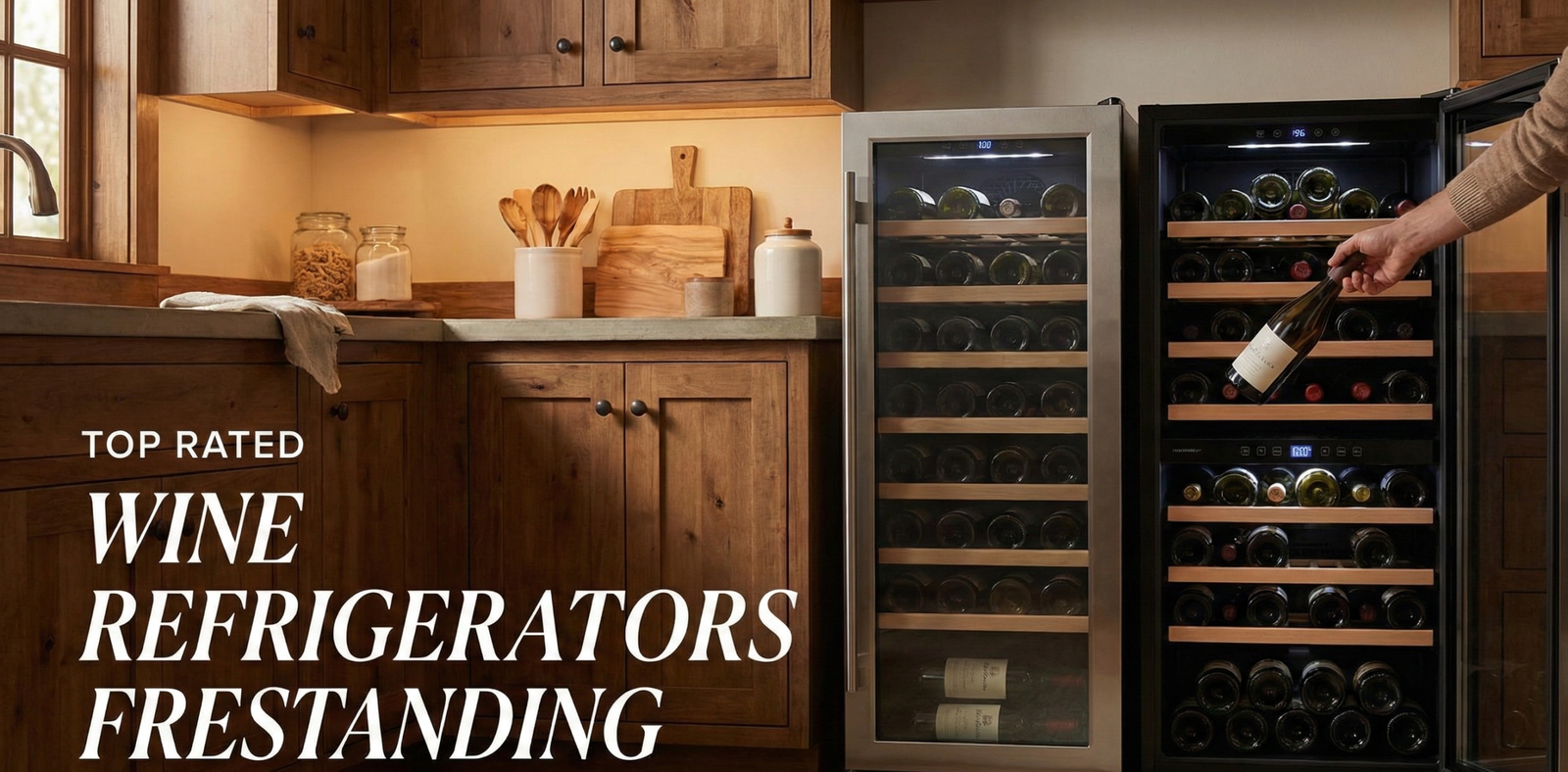
Top Rated Wine Refrigerators Freestanding: The Ultimate Guide
Move over, kitchen fridge. It’s time to give your collection the home it deserves with the best standalone cooling technology on the market.
Introduction: Why Go Freestanding?
If you have graduated from buying a bottle for tonight’s dinner to buying a case for next year’s anniversary, you have likely realized one hard truth: your kitchen refrigerator is a wine graveyard. It is too cold, too dry, and vibrates every time the ice maker kicks on. To preserve the investment you’ve made in the best affordable wines of 2025, specialized storage is non-negotiable.
Enter the freestanding wine refrigerator. Unlike built-in units that require expensive carpentry, freestanding models offer total flexibility — place them in the dining room, the man cave, the basement, or next to your desk. They are the easiest entry point into serious wine preservation. However, not all coolers are created equal. The market is flooded with units that struggle to hold temperature or hum loudly enough to disturb a movie night.
In this guide, we have tested and reviewed the top-rated models from industry leaders like Whynter, Ivation, and Wine Enthusiast. We will compare cooling technologies, discuss the vital importance of airflow, and help you find the perfect unit to anchor your wine cellar essentials.
The Tech: Compressor vs. Thermoelectric
Before buying, you must understand the engine under the hood. The performance of your fridge depends entirely on how it cools. For a complete deep dive, check our article on thermoelectric vs compressor wine coolers.
Compressor Coolers
These work like your standard kitchen fridge, using a refrigerant gas and a motor. Pros: Powerful, handle hot ambient temperatures, cool down quickly, available in large capacities. Cons: Slight vibration (problematic for sediment), heavier, audible hum when cycling.
Thermoelectric Coolers
These use the Peltier effect (electric current transferring heat). Pros: Silent, vibration-free, energy-efficient in stable cool rooms. Cons: Weak — they struggle if your room is hotter than 75°F and cannot cool effectively in a warm garage or shed.
At a Glance: Our Top Picks
| Model | Capacity | Cooling Type | Zones | Best For |
|---|---|---|---|---|
| Whynter WC-28S | 28 Bottles | Compressor | Single | Overall Performance & Aging |
| Ivation 18 Bottle | 18 Bottles | Thermoelectric | Single | Small Spaces & Silence |
| Wine Enthusiast 32-Bottle | 32 Bottles | Compressor | Dual | Dual Zone Versatility |
| Antarctic Star 24 | 24 Bottles | Compressor | Single | Budget Friendly |
1. The Powerhouse: Whynter WC-28S S-Series
Whynter has built a reputation for robust, no-nonsense cooling. The WC-28S is a standalone champion designed for those who want their wine kept at precise temperatures regardless of the weather outside.
Cooling Performance: Powered by a compressor, this unit handles heatwaves comfortably. Even if your apartment reaches 80°F, this fridge holds a steady 55°F. The internal fan circulates air evenly, ensuring the bottle at the bottom is as cool as the one at the top.
Design: Sleek platinum finish, towel-bar handle, and scalloped wire shelves. If you collect wider bottles like Pinot Noir or Champagne, you may need to remove a shelf to accommodate them. Full details in our Whynter wine cooler review.
✅ Pros
- Powerful compressor handles warm ambient environments.
- Sleek, modern platinum aesthetic.
- Lock and key included.
- Even air circulation from internal fan.
❌ Cons
- Wire shelves can scuff labels if not careful.
- Audible hum when the compressor cycles on.
- Single zone only — not for mixed red/white service.

2. The Silent Partner: Ivation 18 Bottle Thermoelectric
If you live in a studio apartment or plan to put your wine fridge in a bedroom or quiet office, the Ivation 18 is the gold standard for silent operation. Thermoelectric cooling means zero moving parts in the cooling mechanism — no vibration, almost no noise.
Storage Quality: The lack of vibration is crucial for long-term aging. The smoked glass door protects against UV light damage. See more in our Ivation wine cooler reviews.
Limitations: This unit can only cool approximately 20°F below ambient room temperature. Do not put this in a hot garage — your wine will cook.
✅ Pros
- Dead silent operation — ideal for bedrooms.
- Vibration-free — protects sediment in aged wines.
- Slide-out cedar or metal shelves depending on model.
- Compact enough for countertop or side-table placement.
❌ Cons
- Struggles in rooms hotter than 75°F.
- Slower to recover temperature after door opens.
- Not suitable for garage or basement with variable temps.

3. The Collector’s Choice: Wine Enthusiast 32-Bottle Dual Zone
When you need to store reds and whites at serving temperature simultaneously, you need a dual zone. Wine Enthusiast is a legacy brand known for reliability and excellent customer support.
Features: Two independent temperature zones. Keep your Chardonnay at a crisp 45°F on top and your Cabernet at a cellar-perfect 55°F on the bottom. The digital touchscreen allows adjustments without opening the door.
If this model is out of stock, check our Vinotemp wine cooler reviews for a comparable high-capacity alternative.
✅ Pros
- True dual-zone independent temperature control.
- Energy-efficient compressor with cycle-off design.
- Blue LED lighting showcases labels beautifully.
- Digital touchscreen for precise zone adjustment.
❌ Cons
- Larger footprint than single-zone equivalents.
- Tight fit for wider bottles like sparkling wine.
- Higher upfront cost than single-zone models.

Freestanding vs Built-In Wine Refrigerators: A Complete Comparison
The distinction between freestanding and built-in wine refrigerators is more fundamental than most buyers realize — it determines not just where the unit can be placed, but how it ventilates heat, how it’s engineered, and whether installing it incorrectly will damage it or simply reduce its efficiency.
How Ventilation Differs
Freestanding units vent heat from the back (and sometimes sides). They require open space behind and beside them — typically 4–6 inches at the rear and 2–3 inches on each side. When installed with this clearance in open floor space, they perform optimally. When placed against walls with insufficient gap, heat recirculates around the condenser coils, forcing the compressor to work harder and eventually shortening its lifespan.
Built-in (undercounter) units vent heat from the front — through a grille at the toe kick (the lower front panel). This design allows them to be installed flush within cabinetry or under a counter without any rear clearance requirement. The ventilation system is engineered specifically for enclosed installation. A built-in unit pushed into a freestanding position works fine; a freestanding unit installed under a counter will fail.
⚠️ The Most Expensive Mistake in Wine Fridge Buying
Purchasing a freestanding wine refrigerator and installing it under a counter or inside a cabinet is the single most common and costly mistake in this category. The trapped heat cannot escape, the compressor overheats, and the unit fails — often within months. The warranty is typically voided by improper installation. If you want under-counter installation, you must purchase a unit explicitly labeled “built-in” or “undercounter” with front ventilation.
| Feature | Freestanding | Built-In |
|---|---|---|
| Ventilation Direction | Back and sides | Front (toe kick grille) |
| Under-Counter Safe? | No — will overheat | Yes — designed for this |
| Price (same capacity) | Lower ($50–$400) | Higher ($150–$1,000+) |
| Placement Flexibility | High — any open space | Limited — requires cabinet cutout |
| Cooling Efficiency | Excellent in open air | Excellent when properly installed |
| Aesthetic Options | Various finishes | Typically stainless or panel-ready |
How Many Bottles Do You Actually Need? The Sizing Guide
Choosing the right capacity wine refrigerator is one of the most commonly misjudged purchasing decisions in this category. Buy too small and you are back on Amazon within six months. Buy unnecessarily large and you pay to cool empty space indefinitely. The correct approach is systematic: assess current collection, project growth, understand real vs. stated capacity, and add a buffer.
The Stated vs Real Capacity Gap
Every manufacturer’s bottle count is calculated using standard 750ml Bordeaux bottles — the slimmest and most uniform bottle shape. These are 3 inches in diameter. In reality, your collection likely includes:
- Burgundy bottles (Pinot Noir, Chardonnay): approximately 3.3 inches — 10% wider than Bordeaux.
- Champagne and sparkling wine bottles: 3.5 inches — 17% wider than Bordeaux.
- Rhône and Italian bottles: often wider-shouldered than Bordeaux.
A 28-bottle fridge with standard Bordeaux shelving may realistically hold only 22–24 bottles when half your collection is Burgundy-style or wider. Always add 20–25% to your calculated capacity need when shopping.
Capacity by Collection Type
| Drinker Profile | Typical Collection | Recommended Capacity | Unit Type |
|---|---|---|---|
| Casual (weekly buyer) | 6–10 bottles at any time | 12–18 bottle unit | Thermoelectric works |
| Regular entertainer | 12–25 bottles rotating | 24–36 bottle dual zone | Compressor recommended |
| Collector / enthusiast | 25–60 bottles | 50–80 bottle unit | Compressor required |
| Serious collector | 60–150+ bottles | 100–150+ bottle unit | Large compressor or cellar |
💡 The 80% Rule
A wine fridge operates most efficiently and maintains the most stable temperature when it is 70–80% full. The thermal mass of the bottles themselves helps maintain internal temperature during door openings and short power interruptions. An empty fridge is harder to cool and harder to maintain — the air volume is large and the bottle mass is small. If your collection is currently small but growing, buy the capacity you expect to need in 2 years, not the capacity you need today.
Where to Place Your Freestanding Wine Fridge: Room-by-Room Guide
Placement is not just an aesthetic decision — it fundamentally determines how well your fridge performs, how long it lasts, and how much it costs to run. The single most important placement factor is ambient temperature: the temperature of the air surrounding the unit determines how hard the cooling system must work.
✅ Climate-Controlled Living Room
Ideal. Stable 65–72°F year-round. Easy visual access. Compressor and thermoelectric both work well. UV protection glass important if near windows.
✅ Climate-Controlled Dining Room
Ideal. Convenient access for service. Aesthetically appropriate. Keep away from heating vents and direct sunlight.
✅ Home Office / Study
Excellent for thermoelectric units — stable temperature and silence are a perfect match. Avoid placement near sunny windows.
⚠️ Kitchen (Away from Oven)
Workable with a compressor unit. Keep minimum 3 feet from oven or range. Avoid next to dishwasher (heat and steam). Check clearance carefully in kitchen configurations.
⚠️ Basement (Insulated)
Good if temperature stays 55–75°F year-round. Can be too cold in winter for compressors. Verify ambient temperature range matches unit specification.
❌ Garage (Uninsulated)
Problematic. Summer heat (90–110°F) and winter cold (below 50°F) both exceed most standard unit operating ranges. Requires a garage-rated wine fridge.
❌ Outdoor / Patio
Never. No standard wine refrigerator is designed for outdoor use. Humidity, temperature extremes, and direct sun will destroy any unit within a season.
❌ Under Counter (Freestanding Unit)
Never. Trapped heat will fail the compressor. Built-in units only for under-counter installation.
The Ventilation Clearance Rules
- Rear clearance: 4–6 inches minimum — the most critical measurement. The condenser coils on the back of the unit must radiate heat into open air. Even 2 inches is insufficient for most units under sustained load in warm weather.
- Side clearance: 2–3 inches on each side — allows air to circulate around the unit and prevents heat buildup on adjacent walls or furniture that could conduct heat back into the unit.
- Top clearance: 5+ inches — hot air rises. If the top of the unit is within an enclosed space (even open shelving above it), hot air can recirculate back down around the unit.
- Surface: hard, flat, and level — carpet blocks airflow and insulates the bottom of the unit from the cool floor. An unlevel unit stresses the compressor mechanism and can cause vibration. Use adjustable feet to achieve perfect level.
Single Zone vs Dual Zone vs Tri-Zone: Which Configuration Do You Need?
The zone configuration of a wine refrigerator determines how many independent temperature environments it can maintain simultaneously. This is one of the most important — and most frequently over-purchased — specifications in the category.
Single Zone
The entire cabinet maintains one consistent temperature. This is the correct choice for one of two specific use cases: first, if you are aging a homogeneous collection (all aging reds, all stored at 55°F); second, if you are storing a mixed collection purely for immediate service at one temperature. Single-zone units are simpler, cheaper to manufacture, and often have better temperature consistency than dual-zone models at the same price point.
Dual Zone
The cabinet is divided into two independent temperature-controlled compartments — typically upper and lower, each with its own thermostat. A common configuration is 45°F for whites in the upper zone and 55°F for reds in the lower zone. This is genuinely transformative for households that entertain regularly and want both wine types ready to serve simultaneously without compromise.
The critical caveat: true dual-zone independence requires two separate cooling loops, or a sophisticated valve system. At lower price points ($80–$150), “dual zone” sometimes means a single cooling system with adjustable baffle vents — these are not truly independent and often cannot maintain more than a 5–8°F difference between zones consistently. Look for units explicitly stating “independent dual-zone cooling” rather than “dual-zone temperature setting.”
Tri-Zone and Multi-Zone
Premium wine refrigerators (EuroCave, Liebherr, some Wine Enthusiast models) offer three or more independently controlled zones for simultaneous aging, service-ready reds, and service-ready whites storage. These units are genuinely useful only for serious collectors maintaining 50+ bottles across multiple wine types — at which point the investment in precision is justified. For most home enthusiasts, dual zone covers all realistic use cases.
🌡️ Zone Configuration and Compressor Economics
A dual-zone compressor unit is more mechanically complex than a single-zone unit and typically costs 20–40% more at equivalent bottle capacity. However, this premium pays for itself in convenience for mixed-collection owners who would otherwise need two separate single-zone units. If you find yourself already owning a wine fridge but constantly pulling bottles early to “warm up” reds or “chill down” whites for service, a dual-zone upgrade is the most impactful improvement you can make.
Noise Levels: What to Expect from Each Technology
Noise is one of the most practically important but least consistently specified features in wine refrigerator listings. A unit that hums noticeably at 42 decibels in a quiet bedroom becomes the defining feature of that room. Understanding typical decibel levels by technology type helps you match the unit to its intended location.
Note that compressor units don’t run continuously — they cycle on for 15–20 minutes, then off for 40–60 minutes. The noise is intermittent and, in most living spaces, blends into ambient background noise. Thermoelectric units run continuously but at lower decibel levels.
💡 Vibration vs Noise: They Are Different Problems
Noise is measured in decibels and is primarily a comfort issue. Vibration is measured in Hz and is a wine quality issue. A compressor unit can be engineered to be remarkably quiet (38–40 dB) while still transmitting vibration through rubber shock absorbers to the cabinet. For long-term aging of 5+ years, both specifications matter. A thermoelectric unit eliminates both problems simultaneously — at the cost of cooling power limitations.
Shelf Types and Their Impact on Your Collection
The type of shelving inside a wine refrigerator affects bottle capacity, label protection, organization flexibility, and the ease of identifying bottles without disturbing the ones around them. This specification is mentioned in almost every product listing but rarely explained — here is what each type actually means for daily use.
🪵 Wooden / Cedar Shelves
The premium choice. Cedar or beech wood is gentle on labels, absorbs vibration, and looks elegant. Some collectors argue cedar helps regulate humidity slightly. Heavier than metal options. Found in mid-range and premium units.
🔩 Wire / Scalloped Wire
The most common type. Durable, easy to clean, allows good airflow around bottles. The scalloped design cradles bottles and prevents rolling. Can scratch labels if bottles are slid rather than lifted. Most standard shelves hold Bordeaux bottles; Champagne may require shelf removal.
🔲 Smooth Metal / Stainless
Found in premium and commercial units. Smooth surface is ideal for label protection. Often chrome-finished for aesthetics. Heavier and more expensive than wire. Some designs are angled for label-forward display.
📦 Pull-Out / Sliding
Shelves that extend outward like drawers for easy bottle access without disturbing adjacent bottles. A significant quality-of-life improvement in deeper units where rear bottles are hard to reach. Adds manufacturing cost but justifies itself in large-capacity fridges.
🔄 Adjustable / Removable
Shelves that can be removed or repositioned allow accommodation of magnum (1.5L), double magnum (3L), or unusually tall bottles. If you regularly buy larger format bottles, this flexibility is essential — verify how many shelves can be removed and what height that creates.
Label-Forward vs Standard Orientation
Some premium wine fridges feature angled shelves designed to display bottles label-forward — the label is visible through the glass door without opening. This is aesthetically appealing and practically useful for identifying bottles without disturbing others. If organization and quick visual identification matter to you, look for this specifically as a stated design feature.
Glass Door Specifications: UV Protection, Double-Pane, and Tinting
The glass door on a wine refrigerator is both a display feature and a functional barrier against wine’s most insidious enemy: light. Understanding what “UV protection,” “double-paned,” and “tinted” actually mean for wine preservation versus marketing language prevents you from paying for specifications that don’t serve your specific use case.
UV Protection Glass
UV radiation — ultraviolet light from sunlight and fluorescent sources — triggers photo-oxidation in wine, degrading organic aromatic compounds and producing flat, wet-cardboard flavors (known as “light-struck”). All quality wine refrigerators include some degree of UV-filtering glass. Look for units specifying “UV-resistant glass,” “anti-UV coating,” or “UV-filtered glass.” A unit near a window without UV protection will gradually degrade its entire contents regardless of how well it controls temperature.
Double-Pane vs Single-Pane Glass
Double-pane (or dual-layer) glass provides two functional benefits: significantly better insulation (reducing heat transfer through the door from the warm room into the cold interior), and reduced condensation on the exterior surface (the outer pane stays at room temperature, preventing moisture from forming on the glass face). Single-pane glass allows more heat ingress through the door and will often show condensation in humid environments. For units in warm rooms or humid climates, double-pane glass is a meaningful specification, not a luxury.
Tinted vs Clear Glass
Tinted (smoked) glass reduces light transmission regardless of UV coating — it provides an additional passive barrier against light exposure. The tradeoff is visibility: with heavily tinted glass, you cannot easily read labels or assess your collection through the door without opening it. Some collectors prefer lightly tinted glass that provides UV protection without obscuring the interior; others prioritize maximum label visibility through clear UV-coated glass. This is primarily a personal preference decision once basic UV protection is confirmed.
Solid Doors
A small number of wine refrigerators use solid stainless steel or panel-ready doors with no glass. These are typically found in long-term aging units where display is not a priority and maximum insulation and light exclusion are paramount. If your primary goal is multi-decade aging rather than daily-access service, a solid door offers better insulation performance than any glass equivalent.
Energy Efficiency and Running Costs: The Real Numbers
Wine refrigerators run 24 hours a day, 365 days a year. Unlike appliances you use a few times per week, the wine fridge is permanently drawing power. Understanding real running costs prevents unpleasant electricity bill surprises and helps you make an economically informed decision between technology types.
How to Calculate Annual Running Cost
Wine fridge energy consumption is measured in kilowatt-hours (kWh) per year, often shown on an Energy Star label if the unit carries that certification. To calculate annual cost: multiply the annual kWh figure by your electricity rate per kWh. The US average is approximately $0.16/kWh as of 2025.
| Unit Type | Typical Annual kWh | Annual Cost (~$0.16/kWh) | Notes |
|---|---|---|---|
| Small thermoelectric (12–18 bottles) | 60–100 kWh | $10–$16 | In a stable 68°F room |
| Small thermoelectric (warm room 78°F+) | 150–200+ kWh | $24–$32+ | Runs continuously — less efficient than compressor |
| Mid-size compressor (24–36 bottles) | 100–150 kWh | $16–$24 | Cycles on and off — efficient even in warm rooms |
| Large compressor (50–100 bottles) | 150–250 kWh | $24–$40 | Still highly affordable for the collection size served |
Wine Fridges for Garages and Basements: What You Need to Know
The garage is the most-requested wine fridge location and the most problematic one. Understanding why — and what solutions actually work — prevents the common scenario of a failed unit and a ruined collection.
Why Standard Wine Fridges Fail in Garages
Standard wine refrigerators are designed to operate within an ambient temperature range of approximately 50–90°F. Most US garages exceed both ends of this range depending on season: summer afternoon temperatures in an uninsulated garage can reach 100–115°F in warm climates; winter temperatures in northern states can drop below freezing. Both extremes cause problems.
In extreme heat, the compressor must work continuously to maintain target temperature against the enormous heat differential — it eventually burns out. In extreme cold, the thermostat may not trigger the compressor at all (it detects that the ambient temperature is already below the set point), allowing the wine to actually freeze in very cold periods. Some manufacturers make “garage-rated” or “wide-range ambient temperature” units specifically engineered to handle 32°F–110°F operation with reinforced insulation and cold-climate heating systems.
Basement Wine Fridge Considerations
Basements are generally better environments than garages for wine fridges. An insulated basement typically maintains temperatures in the 55–70°F range year-round — within standard operating ranges and close to ideal wine storage temperatures. The primary challenge is humidity: many basements are inherently damp, and high ambient humidity (above 80% RH) can cause condensation issues on the unit’s exterior and potentially promote mold on labels over time. A dehumidifier in the basement area running alongside the wine fridge resolves this in most cases.
Freestanding Wine Fridge Maintenance and Troubleshooting
A well-maintained wine refrigerator should last 8–15 years depending on technology type and usage intensity. The majority of premature failures are preventable with basic periodic maintenance. These routines require 20–30 minutes twice yearly — a trivial investment against the cost of replacement and lost wine.
Routine Maintenance (Every 6 Months)
- Clean condenser coils (compressor units) — the condenser coils are located at the back of freestanding units. Dust accumulation reduces heat dissipation efficiency, forcing the compressor to work harder. Vacuum or brush with a condenser coil brush (available for under $15). This single maintenance action is responsible for extending compressor life more than any other.
- Clean rear fan grille (thermoelectric units) — the fan that expels heat from the Peltier module must have unobstructed airflow. Even modest dust accumulation causes the module to overheat. Clean with compressed air or a vacuum brush attachment every 3 months.
- Inspect and clean door seals — warm air infiltrating through a compromised door seal is a hidden source of energy waste and temperature instability. Wipe seals with warm soapy water and a soft cloth. Test the seal by closing the door on a dollar bill — resistance when pulling it out indicates a good seal; easy removal suggests the seal needs replacement.
- Level the unit — vibration mounts in the compressor are designed to work with a level unit. Use a spirit level on top of the fridge and adjust the feet. Misalignment as small as 3–5 degrees increases vibration transmission and compressor wear over time.
- Clean interior and check humidity — remove all bottles and shelves. Wipe interior with a solution of warm water and baking soda (never bleach or scented cleaners — odors contaminate wine). Check your independent hygrometer reading: 55–75% RH is the target range.
Common Problems and Solutions
| Problem | Likely Cause | Solution |
|---|---|---|
| Not reaching target temperature | Insufficient clearance; dirty coils; warm ambient room (thermoelectric) | Check clearance (4–6″ rear); clean condenser coils; verify unit is within rated ambient range |
| Water pooling inside | Drain hole blocked; door seal failure; high exterior humidity | Clear drain hole with a pipe cleaner; replace door seal; check door closes completely |
| Excessive noise or vibration | Unit unlevel; compressor mounting loose; vibration dampers worn | Level the unit precisely; tighten mounting hardware; replace anti-vibration pads |
| Compressor runs continuously | Ambient too warm; dirty coils; refrigerant leak; thermostat fault | Clean condenser coils; verify ambient temperature is within spec; if persists, call technician |
| Temperature inconsistency between zones | Overfilled zone; internal vent blocked; zone valve failure | Reduce bottle count; clear internal air vents; check zone separation seal |
| Display not functioning | Control board fault; power surge | Unplug 60 seconds and restart; if persists, contact manufacturer warranty service |
Top Freestanding Wine Fridge Brands Compared
🏆 Whynter
The best mid-range compressor brand. Consistent temperature performance, genuine build quality, and excellent warranty support. Their S-Series freestanding line is the most reliable in the $100–$300 range. Highly recommended for first serious wine fridges.
🏆 Wine Enthusiast
The legacy brand with the broadest product range. From countertop 6-bottle units to 300+ bottle floor models. Their dual-zone compressor units consistently receive top professional reviews. Strong customer service and widely available replacement parts.
🥈 Ivation
The dominant thermoelectric brand. Their 18-bottle model defines the category at its price point. Excellent for apartments, offices, and bedroom placements where silence is mandatory. Build quality is adequate for the price and use case — not for serious collectors in warm rooms.
🥈 NewAir
Strong value compressor units in the 24–46 bottle range. Consistently outperforms its stated capacity in real-world testing. Their dual-zone models offer genuine independent zone control at accessible prices. Rapidly improving customer service reputation.
🥉 Kalamera
Rising brand competing in the built-in and freestanding 24–46 bottle segment. Stainless construction and dual-layer tempered glass compete above their price point. Worth considering for kitchen renovation projects with tight budgets.
🥉 Antarctic Star
The budget leader. Their 24-bottle compressor unit delivers adequate cooling at significantly lower cost than established brands. Build quality is accordingly modest — suitable for casual drinkers storing bottles for under a year, not for serious aging.
How to Set Up Your New Wine Fridge Correctly
The first hours after unpacking a new wine refrigerator are the most critical for its long-term health. Incorrect setup — particularly with compressor units — is responsible for a significant proportion of early failures.
- Wait 24 hours before plugging in a compressor unit — during shipping, the unit may have been tilted or inverted. Compressor refrigeration systems use oil for lubrication; this oil can migrate into the refrigerant lines when the unit is on its side. Standing the unit upright for 24 hours allows the oil to return to the compressor sump. Plugging in immediately can damage the compressor irreparably.
- Position with full clearance before plugging in — measure and confirm rear clearance (4–6 inches), side clearance (2–3 inches), and top clearance (5+ inches) before the unit has any bottles in it. Moving a fully loaded wine fridge is difficult and risks both the unit and the wine.
- Level the unit precisely — use the adjustable feet to achieve a level reading on a spirit level placed on top of the fridge. This takes 5 minutes and prevents years of unnecessary compressor wear.
- Set to target temperature and run empty for 24 hours — allow the unit to reach and stabilize at its set temperature before loading bottles. This verifies the unit is functioning correctly before you entrust your collection to it. Check the internal temperature with an independent thermometer — not the door display, which may differ from the actual interior temperature.
- Load bottles at the correct temperature — do not load warm bottles from room temperature into a fridge set to 55°F. The thermal mass of warm bottles forces the unit to work at maximum load immediately. Pre-chill bottles in the regular fridge first if possible, or load gradually over several days.
- Place an independent thermometer and hygrometer inside — the digital display on the door shows the set temperature, not necessarily the actual interior temperature at mid-shelf. An independent sensor placed at the mid-point of the cabinet provides reliable ongoing verification that the unit is performing correctly.
Best Freestanding Wine Fridges by Budget
💚 Under $100: Entry Level
Antarctic Star 24-bottle and similar compressor units. Adequate temperature control for casual storage. Build quality reflects the price — expect a 3–5 year lifespan with normal use. Not suitable for long-term aging of valuable bottles. Excellent for households that consume wine within 6 months of purchase.
🔵 $100–$250: Serious Enthusiast
Whynter and NewAir compressor units, Ivation thermoelectric. Genuine temperature stability, quality materials, and 8–12 year expected lifespan. This is where most serious home enthusiasts should buy. Dual-zone options become available at the upper end. The best long-term value tier.
💜 $250+: Collector Grade
Wine Enthusiast, EuroCave, Liebherr. Professional-grade temperature consistency (±1°F), active humidity management, premium UV-filtering glass, quiet engineered compressors, wood shelving. For collections where the bottles cost more than the fridge. Expected lifespan 15+ years with proper maintenance.
Buying Guide: What Matters Most?
1. Ventilation Is Non-Negotiable
Freestanding coolers vent heat from the back. You cannot install them under a counter. Leave at least 4 inches of space behind the unit — always. This is the most important rule in wine fridge ownership and the most frequently violated.
2. Real Bottle Capacity vs Stated Capacity
Manufacturers calculate bottle counts using slim Bordeaux bottles. Always buy 20–25% more capacity than you think you need — for wider bottles, growth, and the 80% efficiency rule.
3. UV Protection Glass
Light degrades wine. Look for double-paned, smoked, or UV-resistant glass — vital if your cooler sits in a bright living room or near windows.
4. Digital Controls
Digital controls with an external display allow precise temperature setting and adjustment without opening the door (which causes temperature swings). Analog knobs are functional but imprecise — typically providing a ±3–5°F range rather than ±1°F. For serious aging, digital control is a meaningful upgrade over analog.
Accessorize Your Wine Station
Once you have the fridge, complete the setup. Keep your best glassware nearby. Keep a top rated wine opener on top of the unit. And once you pull a bottle from the fridge, use a wine chiller bucket to maintain serving temperature at the table.
Frequently Asked Questions
Freestanding means the unit is designed to stand alone in open space, not built into cabinetry. These refrigerators vent heat from the back or sides, requiring clearance around the unit to dissipate heat efficiently. Placing them in a tight recess — like under a counter or inside a cabinet — traps heat, overloads the compressor, and causes premature failure. If you want under-counter installation, you must purchase a specifically labeled “built-in” or “undercounter” unit with front ventilation.
Leave at least 4–6 inches at the rear, 2–3 inches on each side, and 5+ inches at the top. These minimums allow the condenser coils to dissipate heat into open air rather than recirculating it back into the unit. In warm rooms or during summer, more clearance is always better than less — heat removal becomes the limiting factor in cooling performance.
For collections with both red and white wine that you want ready for service simultaneously, dual zone is significantly better. For aging a homogeneous collection at one temperature (55°F), single zone is adequate and often more temperature-consistent at equivalent price points. The key distinction: dual zone is for service versatility; single zone is for aging stability. At budget price points, verify the dual zone uses truly independent cooling loops, not just adjustable vents on a single system.
Most modern wine fridges cost $15–$40 per year to run at average US electricity rates. A 100-bottle compressor unit typically consumes 150–250 kWh/year — approximately the same as running a 60-watt light bulb continuously. Thermoelectric units are more efficient in cool, stable rooms; compressor units are more efficient in warm or variable environments because they cycle on and off rather than running continuously.
Only if the garage stays within the unit’s stated operating ambient temperature range — typically 50–90°F for standard units. Uninsulated garages in most climates exceed both ends of this range seasonally. If your garage reaches above 90°F in summer or below 50°F in winter, you need a specifically rated “garage wine fridge” with wider ambient temperature tolerance, or you need to insulate and climate-control the garage space around the unit.
Condensation is normal — it is a natural byproduct of cooling air. Most units have a small drip tray to collect moisture. If water is pooling visibly at the bottom, the drain hole may be blocked with debris (clear it with a pipe cleaner), or the door seal may be damaged, allowing warm moist air to continuously enter and condense inside. Check and clean the door seal, and test it with the dollar-bill method.
For short-term storage (under 6 months), vibration is negligible. For long-term aging (5+ years), continuous vibration disturbs sediment, can facilitate chemical reactions that dull flavor, and may accelerate aromatic compound degradation. Modern compressor units with rubber shock-absorber mounts produce minimal real-world vibration for collections aged under 10 years. If you are aging 15+ year bottles, a thermoelectric unit or a premium compressor with active vibration isolation is the appropriate choice.
A quality compressor unit should last 8–12 years with basic maintenance (primarily keeping condenser coils clean). Thermoelectric units typically last 5–7 years as the Peltier module and fans gradually lose efficiency under continuous operation. In both cases, the quality of the unit and adherence to maintenance schedules is more predictive of lifespan than the technology type alone. A premium unit properly maintained outlasts an economy unit regardless of technology.
Final Verdict: Which Fridge Fits You?
Our Recommendations by Profile
For the Serious Collector: The Whynter WC-28S offers power and consistency for aging expensive bottles safely. Pair with an independent thermometer/hygrometer for ongoing verification.
For the Apartment Dweller: The Ivation 18-Bottle is quiet, compact, and effective in a stable climate-controlled room. Zero noise, zero vibration.
For the Variety Drinker: The Wine Enthusiast Dual Zone keeps whites ready for service and reds resting comfortably — simultaneously, in one unit.
For the Budget-Conscious: The Antarctic Star 24 delivers adequate cooling for everyday wine storage at a fraction of the premium brands’ cost. Set realistic expectations for longevity.
Stop risking your wine in the kitchen fridge. Give your bottles a dedicated home, and they will reward you with perfect flavor every time you pull the cork. Cheers!

Pro Tip: Monitor Your Temps with a Digital Hygrometer
Ensure your fridge is performing correctly with an independent sensor — never trust only the door display.
Check Price on Amazon