How to Store Wine at Home: The Definitive Guide for Collectors
I’ll never forget the feeling. It was a special anniversary, and I had been saving a bottle of 2010 Barolo for five years. I’d kept it in a decorative rack in my kitchen, thinking it looked beautiful and sophisticated. When the moment came, I opened it with great anticipation, only to be met with a dull, lifeless aroma and a flat, cooked taste. The wine was ruined. That expensive, heartbreaking lesson was the beginning of my obsession with proper wine storage.
As a certified sommelier and a collector who has built a cellar from the ground up, I’ve learned that storing wine isn’t an esoteric art form reserved for the wealthy. It’s a practical science that anyone can master. This guide is the culmination of years of research, hands-on experience, and yes, a few costly mistakes. My goal is to demystify the process and provide you with actionable, real-world solutions — from storing a single bottle to building a serious collection — so you never have to experience the disappointment of a spoiled wine.
The Quick Answer: The 5 Golden Rules
In a hurry? Here’s what you need to know. To store wine properly, protect it from its five enemies. Aim for a location that is:
- Cool: A consistent temperature between 45–65°F (7–18°C), with 55°F (13°C) the ideal sweet spot.
- Dark: Away from all direct sunlight and UV radiation.
- Still: Free from vibrations from appliances or heavy foot traffic.
- Humid: Ideally around 60–70% to keep corks from drying out.
- Sideways: Bottles with natural corks should be stored on their side to keep the cork moist.
Why This Guide is Trustworthy
- Experience: Every recommendation comes from personal experience as a wine professional and home collector.
- Expertise: Formal sommelier training provides a deep understanding of the science behind wine aging and spoilage.
- Authoritativeness: This guide synthesizes leading viticulture studies, conversations with winemakers, and industry best practices. We link to other expert resources, like our guide to the best wine glasses for red wine, to create a comprehensive knowledge hub.
- Trustworthiness: All product recommendations are based on independent research and hands-on use where possible.
The 5 Enemies of Wine: A Deep Dive into the Science of Storage
To truly understand how to store wine, you need to understand what you’re fighting against. Wine is a living, breathing matrix of complex organic compounds — polyphenols, esters, terpenes, and acids in a state of constant slow chemical transformation. The goal of storage is to allow this transformation to proceed gracefully, not to have it derailed by avoidable environmental stresses.
1. Heat: The #1 Wine Killer
Heat is, without a doubt, the fastest and most destructive enemy of wine. Temperature acts as the accelerant for every chemical reaction happening inside the bottle. The ideal 55°F (13°C) allows those reactions to proceed at a slow, graceful pace. Storing wine at room temperature (70–72°F / 21–22°C) is like pressing fast-forward: the wine ages two to four times faster, and not in a good way. Delicate fruit and floral compounds burn off first, leaving behind flat, stewed, or jammy flavors. What was supposed to be an elegant, complex Burgundy becomes something resembling fruit preserves.
Anything above 80°F (27°C) is the danger zone. The wine literally begins to cook — volatile compounds escape faster than the bottle can contain them, the liquid expands and can push the cork outward, and rapid oxidation follows. A sticky residue around the capsule is the telltale sign of a cooked wine. Crucially, consistency matters as much as the number. A basement that holds a steady 62°F year-round is significantly superior to a closet that swings between 65°F in winter and 80°F in summer. Thermal cycling causes the wine to repeatedly expand and contract, gradually fatiguing the cork and compromising its seal.
2. Light: The Invisible Threat
UV radiation is a genuine chemical threat to wine, not just an aesthetic concern. UV rays penetrate glass bottles (even dark green glass offers only partial protection) and excite riboflavin and other photosensitive compounds in the wine. The resulting chain reaction produces sulfurous compounds that create a fault known as “light strike” — a condition that causes unpleasant aromas of wet cardboard, cooked cabbage, damp wool, or wet dog. You might notice this immediately on opening, or it may reveal itself gradually as the wine sits in the glass.
Light strike is irreversible. Once the damage is done, no amount of decanting or waiting will restore the wine. Sparkling wines in clear glass bottles (like Prosecco) are particularly vulnerable, which is why serious champagne houses insist on dark cellars even for short-term storage. This is especially important for organic and natural wines, which typically have lower sulfite levels and thus reduced natural protection against oxidative damage.
3. Vibration: The Silent Agitator
While less dramatic than heat or light, constant vibration is a long-term stressor with real effects on wine quality. The mechanisms operate on two levels. First, for older wines that have developed natural sediment (tartrate crystals, polymerized tannins, pigment compounds), vibrations keep these solids in suspension rather than allowing them to settle — which means the sediment remains in the liquid, affecting texture and clarity. Second, vibrations accelerate the kinetics of certain chemical reactions in the wine, potentially causing premature aging and a loss of nuanced secondary and tertiary flavors.
The occasional vibration from a passing truck is harmless. The real threats are chronic, consistent sources: the compressor of a refrigerator, a washing machine in the next room, a subwoofer, or heavy foot traffic over a storage area. These create tiny, relentless tremors that disturb the wine’s chemical equilibrium over months and years.
4. Humidity: The Cork’s Best Friend and Worst Enemy
The ideal humidity range for wine storage is 60–80%, with 70% being the target. The primary rationale is the cork: if ambient air is too dry (as it typically is in centrally heated homes in winter, where humidity can drop below 30%), the exterior of the cork desiccates, shrinks, and develops micro-cracks. These tiny channels allow oxygen to infiltrate the bottle at a rate far faster than the intended micro-oxygenation of a healthy cork seal, leading to premature oxidation.
At the other extreme, humidity above 85% promotes mold and mildew growth on labels and cork exteriors. This doesn’t harm the wine inside a properly sealed bottle, but it destroys labels (a serious issue for collector’s bottles whose resale value depends on label condition), creates a musty cellar environment, and can eventually degrade the cork’s integrity from the outside. A simple digital hygrometer costs under $15 and provides continuous monitoring of your storage area’s humidity. It’s one of the most valuable tools you can add to any storage setup.
5. Position: Why Sideways is a Must
Storing cork-sealed bottles on their sides keeps the wine in constant contact with the cork, maintaining its moisture and elasticity from inside the bottle rather than relying on ambient humidity alone. An upright bottle leaves the cork entirely dependent on the surrounding air, which, as established, is usually drier than ideal in modern climate-controlled homes.
Note: This rule applies specifically to natural cork closures. Wines with screw caps, glass stoppers (Vino-Lok), or synthetic corks do not need sideways storage — their closures are not vulnerable to desiccation. Sparkling wines can be stored upright short-term (the internal pressure keeps the cork expanded), but for long-term aging, horizontal is still the safest approach.
A sommelier explains the chemistry behind each storage condition — why 55°F, why 70% humidity, and what happens when you get it wrong.
Storage by Wine Type: Not All Wines Age the Same
One of the most significant gaps in generic wine storage advice is the treatment of all wines as equivalent. They are not. A bottle of grocery-store Pinot Grigio and a bottle of Grand Cru Burgundy require fundamentally different storage strategies — not because the physics of temperature and humidity change, but because their aging potential, chemical structure, and intended drinking windows are radically different.
Red Wines
Reds generally have the greatest aging potential due to their higher tannin content. Tannins are the natural preservatives of red wine — polyphenol compounds that polymerize over time, binding to proteins and softening into a silkier, more integrated structure. High-tannin reds (Barolo, Brunello, Cabernet Sauvignon, Hermitage) are specifically designed to be aged; drinking them young often means fighting through harsh, grippy tannins before the fruit and structure have harmonized. However, lighter, lower-tannin reds (Beaujolais, most Pinot Noirs under $30) are meant to be consumed within 2–5 years of vintage.
White Wines
Most white wines are designed for early drinking — within 1–3 years of release. The exceptions are whites with high acidity and/or residual sugar (Riesling, aged Burgundy/Chardonnay, Vouvray, Chenin Blanc) and premium Chardonnay from top producers. These can develop remarkable complexity over 5–15 years. The key differentiator is acidity: high-acid whites have the structural backbone that allows them to evolve rather than simply deteriorate.
Sparkling Wines
Non-vintage Champagne should be consumed within 1–3 years of purchase — it has already been aged by the producer and is ready to drink. Vintage Champagne and Grower Champagne from top producers can age well for 10–20+ years. Prosecco, Cava, and most New World sparkling wines are designed for immediate enjoyment; they will not improve with age. Store sparkling wine horizontally for long-term aging, but upright is fine for the few weeks before drinking.
Fortified Wines
Port, Sherry, Madeira, and Marsala are a distinct category. Vintage Port has extraordinary aging potential — 20–50 years in top vintages. However, once opened, Vintage Port should be consumed within 1–3 days. Tawny Port is pre-aged and ready to drink; it can survive for weeks after opening. Madeira is arguably the world’s most indestructible wine — properly made Madeira can outlast everything else in your cellar, and some 18th-century bottles are still remarkable. Sherry (particularly Fino and Manzanilla) is the opposite — it should be treated more like white wine, refrigerated after opening and consumed within days.
| Wine Type | Storage Temp | Aging Potential | After Opening | Notes |
|---|---|---|---|---|
| Cabernet Sauvignon (premium) | 55–58°F / 13–14°C | 10–25+ years | 3–5 days | High tannin = long aging; decant before serving |
| Pinot Noir (premium) | 55°F / 13°C | 5–15 years | 3–5 days | Delicate; light-sensitive; avoid temperature swings |
| Barolo / Brunello | 55°F / 13°C | 15–30+ years | 2–4 days | Needs at least 10 years; decant 2–3 hours before serving |
| Pinot Grigio / Sauvignon Blanc | 45–50°F / 7–10°C | 1–2 years | 3–5 days | Drink fresh; no aging benefit |
| White Burgundy / Chardonnay (premium) | 50–55°F / 10–13°C | 5–15 years | 3–5 days | High acidity supports aging; avoid over-chilling to serve |
| German Riesling (Auslese+) | 50–55°F / 10–13°C | 10–30+ years | 5–7 days | High acidity + residual sugar = exceptional longevity |
| Vintage Champagne | 50–55°F / 10–13°C | 10–30 years | 1–3 days | Store horizontally; NV Champagne: drink within 3 years |
| Vintage Port | 55°F / 13°C | 20–50 years | 1–2 days | Significant sediment; decant carefully; manage like royalty |
| Tawny Port | 55–57°F / 13–14°C | Ready now | 2–4 weeks | Pre-aged; refrigerate after opening |
| Madeira | 55°F / 13°C | Decades+ | Months | World’s most durable wine; virtually indestructible |
| Fino / Manzanilla Sherry | 45–50°F / 7–10°C | Drink now | 3–5 days | Treat like a fresh white wine; refrigerate always |
What Ages vs What to Drink Now: Understanding Drinking Windows
One of the most practically useful concepts in wine storage is the “drinking window” — the period during a wine’s life when it is at or near its peak. Understanding drinking windows prevents two opposite tragedies: drinking a wine too young (before its components have integrated into the complexity the winemaker intended) or too old (after the fruit has faded and the wine has begun its terminal decline).
“Wine is not a commodity; it is a living thing moving through time. Your cellar is not a warehouse — it is a library of experiences waiting to be read at the right moment.”
— Common wisdom among serious collectors and sommeliersWhich wines improve with age? The critical factors are tannin (for reds), acidity (for both reds and whites), and residual sugar (for whites). High-tannin reds improve because tannins polymerize and soften over time, and they serve as antioxidants protecting the wine during extended aging. High-acid whites improve because acidity acts as a preservative, allowing the wine to develop complexity without oxidizing. The best age-worthy wines come from specific varieties and regions: Bordeaux, Barolo, Brunello, Burgundy, Hermitage, Vintage Champagne, and the great German Rieslings of Mosel and Rheingau.
Which wines do not improve with age? The majority of wine produced globally is designed for immediate consumption. Unoaked whites, rosé, Beaujolais, most supermarket reds, Prosecco, and most commercial wines under $20 will not develop greater complexity with time — they will simply lose their primary fruit freshness and become dull and flat. The rule of thumb: if the wine doesn’t benefit from 2–3 years in the cellar, it almost certainly won’t benefit from 5–10.
💡 How to Find a Wine’s Drinking Window
The three best free resources: Wine Spectator‘s cellar tracker includes drinking window estimates for reviewed wines. Vivino shows community drinking window recommendations. CellarTracker (cellartracker.com) is the gold standard free cellar management platform used by serious collectors worldwide — it crowdsources drinking window recommendations from thousands of professional and experienced amateur tasters.
Storage Solutions for Every Collector and Budget
Now that you understand the theory, let’s get practical. The right solution depends on your budget, collection size, and long-term goals. I’ve organized this into four levels of commitment.
Level 1: Storing a Few Bottles (The Casual Drinker)
If you buy wine to drink within a few weeks or months, you don’t need a high-tech solution. Find the best possible spot in your existing home — a location that is naturally cool, dark, and away from vibrations. The floor of a lower-level closet, away from exterior walls and heating vents, is often ideal. A pantry floor can work. Avoid the kitchen categorically — it is typically the hottest, brightest, and most vibration-prone room in the house. The interior of a wardrobe or cupboard on the lowest floor is usually your best free option.

Best Basic Rack: Bambüsi Bamboo Countertop Wine Rack
Even for casual storage, a proper rack is better than bottles rolling around in a cabinet. This simple, elegant bamboo rack holds bottles in the correct horizontal position and is inexpensive enough that it’s not a significant investment. Use it inside a dark closet or pantry for proper short-term storage — not on a kitchen counter. Its attractive design also makes it a practical gift that consistently appears on lists of wine gift ideas for her or him.
Pros
- Very affordable and excellent value
- Sustainable bamboo construction
- Wave design holds bottles securely
- Compact for small spaces
Cons
- No temperature or humidity control
- Best for short-term storage only
Level 2: The Budding Enthusiast (Up to 50 Bottles)
At this stage, you’re buying more than you drink in a month — joining wine clubs, exploring bottles that benefit from a year or two of aging. A simple closet can no longer guarantee protection. A dedicated wine cooler (wine refrigerator) is the right investment: purpose-built to maintain consistent temperature and protect from light, they come in two main types: thermoelectric (quieter, no vibration, best where ambient temperature is stable) and compressor-based (more powerful, maintains set temperature regardless of ambient conditions, slight vibration). See the detailed comparison below.

Best Overall Wine Cooler: Kalamera 30-Bottle Compressor Wine Refrigerator
The Kalamera 30-bottle unit hits the sweet spot of capacity, performance, and value for the growing collection. Its compressor system maintains a precise temperature between 40–66°F — ideal for both long-term storage and chilling whites to serving temperature. The vibration-dampening system is genuine and effective. The double-layered UV-resistant glass door protects without sacrificing the visual display of your collection. Beechwood shelves accommodate most standard Bordeaux and Burgundy bottles with room to spare. I’ve been impressed by Kalamera’s build quality relative to its price — this is a serious upgrade that provides real peace of mind for a growing investment.
Pros
- Powerful, consistent compressor cooling
- Excellent temperature range (40–66°F)
- Minimal vibration and low noise
- UV-resistant glass door
Cons
- May not fit non-standard bottles (large Champagne) easily
- Internal fan audible in a very quiet room
Level 3: The Serious Collector (50+ Bottles & Long-Term Aging)
At this level, you’re buying wine with 5–20+ year aging intentions — futures, verticals, subscription allocations from the best wine subscription boxes focused on age-worthy bottles. A dual-zone unit is now essential: the ability to store reds at 55–58°F and whites/sparkling at 44–50°F simultaneously is not a luxury but a functional requirement for a multi-varietal collection.

Best Large Capacity Cooler: Whynter BWR-0922DZ Dual Zone Built-in/Freestanding Wine Refrigerator
The Whynter 92-bottle unit is the benchmark for serious home collectors. Its dual zone functionality — upper zone 40–50°F for whites and sparkling, lower zone 50–66°F for long-term red storage — provides the precision that serious cellaring requires. Fan-circulated cooling ensures even temperature distribution with no hot spots. The reversible tempered glass door provides UV protection with a premium stainless steel finish. The lock and key provides genuine security for valuable bottles. This can function freestanding or as a built-in undercounter unit for a seamless, professional installation — a key feature that appears on every serious list of wine cellar essentials.
Pros
- 92-bottle capacity for serious collections
- True dual zones for different wine types
- Powerful, even fan-circulated cooling
- Freestanding or built-in installation
- Security lock and key included
Cons
- Significant investment
- Takes up considerable floor space
Thermoelectric vs Compressor Wine Coolers: The Definitive Comparison
This is one of the most frequently asked questions by first-time wine cooler buyers, and the answer is more nuanced than most sources acknowledge. Both technologies work — but they work best in different circumstances, and understanding which suits your situation will prevent a costly mistake.
Thermoelectric Coolers
Thermoelectric cooling uses the Peltier effect — passing an electrical current through two different conductive materials creates a temperature differential, drawing heat from one side to the other without any moving parts. For wine storage, this means zero mechanical vibration, whisper-quiet operation, and lower energy consumption. These are genuinely meaningful advantages.
However, thermoelectric coolers have a fundamental limitation: they can only cool to approximately 20°F below the ambient room temperature. If your room reaches 80°F in summer, your thermoelectric cooler may only manage 60°F — still acceptable for short-term storage, but not ideal for long-term aging. They are best suited for temperature-stable environments (climate-controlled rooms, finished basements) where the ambient temperature stays between 60–75°F year-round. If your storage location experiences seasonal temperature extremes, a compressor unit is the safer choice.
Compressor Coolers
Compressor-based wine coolers use the same refrigeration technology as a food refrigerator — a compressor cycles refrigerant through evaporator coils, actively cooling the interior regardless of the external temperature. They maintain their set temperature even in hot garages or uninsulated rooms, making them appropriate for a far wider range of installation environments.
The trade-offs: compressor units produce slight vibration from the compressor’s mechanical cycle. Premium units feature vibration-dampening mounts and rubber-isolated shelves that reduce this significantly, but they never achieve true zero vibration. They are also slightly noisier and consume more energy. For most serious collectors, the reliability and independence from ambient temperature make compressor units the default recommendation unless thermoelectric’s specific advantages address a particular need.
✅ Which Should You Buy?
Choose thermoelectric if: Your installation environment is climate-controlled year-round, you prioritize zero vibration for aged wine sediment, and you prefer quieter operation.
Choose compressor if: Your storage environment may experience temperature extremes (garage, basement, uninsulated space), you need reliable cooling in summer above 75°F ambient, or you’re storing serious long-term aging wines where consistent temperature is non-negotiable.
DIY Cellar Options: Building Your Own Storage
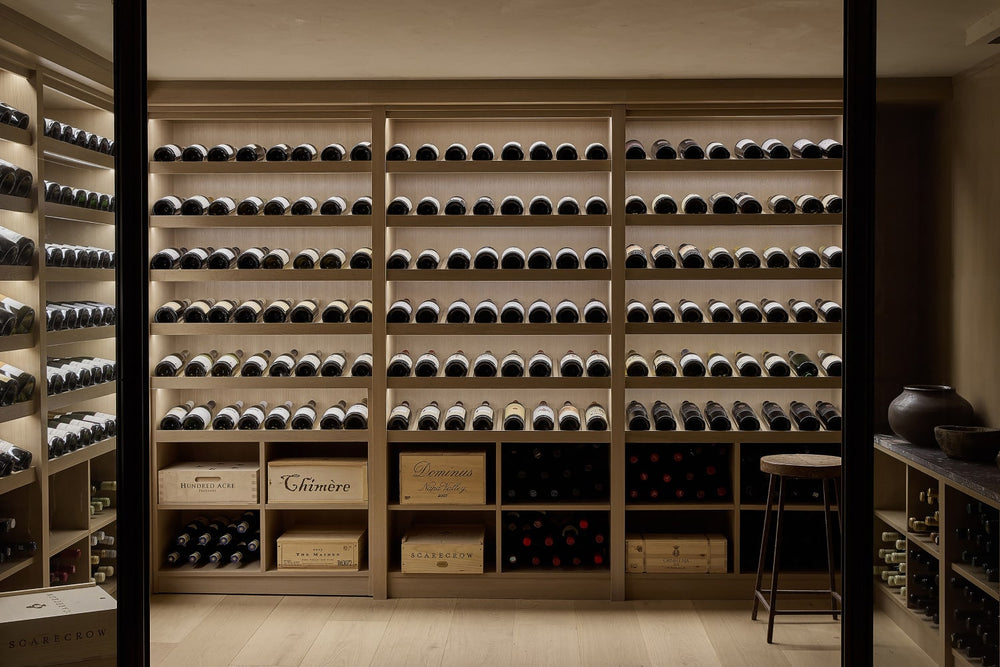
For collectors with 200+ bottles who find commercial wine coolers inadequate, a DIY or built cellar is the next step. This ranges from simple closet conversions to full climate-controlled rooms, and the investment can range from a few hundred dollars to tens of thousands. Here is a practical guide to the main options.
The Closet Cellar
Converting an existing closet into a wine storage area is the most accessible DIY option. The requirements are: insulation (the closet must be thermally isolated from adjacent warm spaces), a dedicated cooling unit (a through-wall wine cellar cooling unit like those from WhisperKOOL or CellarPro), proper vapor barrier installation, and wooden racking inside. A properly insulated and cooled closet can maintain 55–60°F even in a warm climate. This is a serious project requiring basic carpentry and HVAC knowledge, but the result is a genuinely effective, purpose-built cellar at a fraction of the cost of a standalone unit of equivalent capacity.
The Basement Opportunity
If you have an unfinished or partially finished basement, you may already have the most valuable wine storage asset in the house. Basements naturally maintain temperatures 10–15°F cooler than above-ground spaces and have higher ambient humidity. Many older homes in temperate climates have basements that maintain 55–65°F year-round without any additional cooling equipment. Before investing in a wine cooler, spend a month monitoring your basement’s temperature with a min/max digital thermometer. You may discover you have a natural cellar already waiting to be used.
Under-Stair Storage
The space under a staircase is frequently overlooked but often has excellent thermal characteristics — cool, dark, and away from heat sources. With basic insulation, simple wooden racking, and a digital hygrometer for monitoring, under-stair space can accommodate hundreds of bottles effectively. The limitation is usually height (difficult to access top rows) and irregular geometry, but custom modular racking systems accommodate these constraints.
⚠️ DIY Cellar Warning: The Vapor Barrier
The most commonly overlooked element in DIY cellar construction is the vapor barrier. Without proper vapor management, the temperature differential between a cooled cellar and the surrounding warm house will cause condensation within the wall cavities — leading to mold, structural damage, and an environment that is terrible for both wine and your home. If you’re serious about a dedicated cellar, consult a contractor or a wine cellar specialist before beginning construction.
Professional and Off-Site Wine Storage
For collectors whose homes cannot accommodate proper storage conditions, or for those who own bottles too valuable to risk in home storage, professional off-site wine storage is an excellent and increasingly accessible option. It is also essential for wines purchased en primeur (as futures), which are typically stored at the merchant’s facility before release.
What professional storage provides: Consistent 55°F and 70% humidity maintained by industrial-grade systems with redundant backup power. Insurance coverage for your collection. Specialized provenance tracking and inventory management. Pickup and delivery services at many facilities. The cost varies significantly — London’s famous merchant-managed storage facilities charge premium rates, while US-based facilities like Iron Gate Wine in San Francisco or Skyview Wine & Spirits Storage in New York offer competitive per-case rates.
When to consider professional storage: If you own bottles worth $200+ each. If you’re aging wine for more than 10 years. If you’re building a collection for investment or resale. If your home environment cannot reliably maintain the temperature and humidity standards required. The peace of mind — and the insurance — are often worth the monthly cost for serious collectors.
Wine insurance: Even with home storage, wine collections of significant value should be insured. Standard homeowner’s insurance typically covers wine only up to a very low limit ($500–$2,000). Specialized wine insurance through providers like Chubb, Clarion, or Berkley One provides coverage for full replacement value of your collection, including coverage for temperature excursion, power outage, and accidental breakage.
How to Detect a Spoiled Wine: Wine Faults Explained
Understanding wine faults is the practical payoff of understanding wine storage. If you can identify what went wrong with a bottle, you can prevent it happening again. These are the most common faults you will encounter and what they tell you about the storage history of the wine.
Cork Taint (TCA)
2,4,6-Trichloroanisole contamination from the cork. Completely masks fruit character. Unrelated to storage — this is a manufacturing defect in the cork itself. Affects 1–5% of natural corks.
Oxidation
Excess oxygen exposure — from a failed cork, too-high storage temperature, or over-aging. The fruit flattens, color turns brown-orange. Often a result of dry cork from low humidity storage.
Light Strike
UV radiation damage from storing in sunlight or under harsh lights. Irreversible. Most common in clear glass bottles (Prosecco, some rosé). Prevention: darkness always.
Cooked / Maderized
Heat damage from storage above 80°F. The wine’s volatile fruit compounds have burned off. Check capsule for stickiness or seepage — the liquid expands and pushes cork outward when cooked.
Volatile Acidity (VA)
Acetic acid or ethyl acetate, produced by bacteria (usually acetobacter). Can be a winemaking issue or result from a compromised seal. Low levels can add complexity; high VA ruins the wine.
Refermentation
Residual yeast reactivated by warmth or physical agitation. Creates unexpected carbonation. More common in natural and low-sulfite wines stored in warm conditions. The wine may appear fine until poured.
Serving Temperature: Storage Temperature vs Drinking Temperature
One of the most misunderstood distinctions in wine is the difference between storage temperature and serving temperature. These are not the same number, and confusing them leads to wines that are either too cold (suppressing aromas and making reds taste astringent) or too warm (making whites taste flabby and reds taste alcoholic).
The universal storage temperature of 55°F is a compromise designed to slow aging across all wine types, not to optimize any specific wine for drinking. Before serving, wines need to be adjusted to their ideal serving temperature — typically warmer for reds, cooler for whites and sparkling. The practical implication: never serve a red wine straight from your wine cooler. Pull it out 30–60 minutes before service and allow it to warm naturally to its serving temperature.
🌡️ Practical Serving Temperature Tips
- Red wines too cold (straight from cellar): Their tannins will feel harsh and astringent. Wrap your hands around the glass to warm it, or let it sit for 30 minutes.
- Red wines too warm (room temperature in summer): Put in the refrigerator for 15–20 minutes to bring it down to 65°F.
- White wines too cold (from a food refrigerator): Complex whites like white Burgundy should be served around 50–55°F, not at 38°F. Pull them out 20 minutes before serving.
- Champagne cold enough: Most people don’t chill Champagne enough. It should be served genuinely cold — 43–47°F — to maintain its effervescence and freshness.
The difference between storage and serving temperature, and how to adjust any wine to its ideal drinking condition before opening.
Cellar Management & Inventory: Knowing What You Have
One of the most common and preventable collector tragedies is forgetting about a wine. You buy an exceptional case of age-worthy Bordeaux with 15-year intentions, put it in the cellar, and then promptly forget about it. Years later, you rediscover it — either at its perfect drinking window by luck, or past its peak and in irreversible decline. A simple inventory system is the antidote.
Digital Cellar Management Apps
- CellarTracker (Free/Premium): The gold standard for serious collectors. A web-based platform with over 9 million community tasting notes, crowdsourced drinking window recommendations, and full inventory management. You can track the drinking window, quantity, location in your cellar, and cost basis of every bottle. The free version is comprehensive; premium adds enhanced features. Highly recommended.
- Vivino: Better known as a wine discovery app, Vivino’s cellar management feature is useful for casual collectors who want a simple inventory linked to wine information and community reviews.
- Delectable: Wine discovery and cellar management combined, with a strong social component. Good for collectors who want to share their cellar and follow other enthusiasts.
Physical Organization Within Your Cooler or Cellar
The most effective physical organization systems follow one of two logics: by drinking window (bottles you’ll drink soonest at the front/most accessible) or by varietal and region (all Burgundies together, all Bordeaux together, etc.). For collections under 100 bottles, drinking window organization is most practical. For larger collections, regional organization with a digital inventory that tracks readiness is more manageable. Label your rows clearly — masking tape and a marker works perfectly — and update your digital inventory every time you add or remove a bottle.
📋 Simple Spreadsheet Alternative
If you prefer not to use an app, a simple spreadsheet with columns for: Wine Name, Vintage, Quantity, Purchase Price, Storage Location, Drink From, and Drink By provides 90% of the functional value of dedicated software. The “Drink By” column is the most important — sort by this regularly to catch bottles approaching their peak.
Top 7 Wine Storage Mistakes to Avoid
- Storing wine in a regular refrigerator long-term: A food fridge is too cold (below 40°F), too dry, and full of odors that can penetrate corks over months. Fine for short-term (a few weeks) but not for aging.
- Keeping wine on top of the fridge: The absolute worst location — warm from the compressor coils, full of vibrations, and subject to temperature spikes every time the compressor cycles. Never.
- Storing bottles upright: Allows corks to dry out over time. Even a few months upright in a dry environment can compromise a natural cork seal.
- Forgetting about the wine: Out of sight, out of mind. Use a cellar management app or simple spreadsheet to track drinking windows and rotate through your collection before bottles pass their peak.
- Sudden temperature changes: Moving wine from a cold cellar to a hot car trunk and back is a thermal shock that stresses the seal and accelerates aging. Allow wine to acclimatize gradually whenever possible.
- Ignoring humidity: Buying a wine fridge with no humidity monitoring is a half-measure. Most residential wine coolers naturally run at 50–60% humidity — check yours with a hygrometer and add a small humidifier if needed.
- Buying wine with no storage plan: Purchasing age-worthy wines before you have adequate storage is the collector’s equivalent of buying a puppy with no yard. Know your storage capacity before you buy.
Frequently Asked Questions (FAQ)
Can I really not store wine in my kitchen?
For long-term storage (more than 2–4 weeks), genuinely no. The kitchen experiences the most frequent and dramatic temperature fluctuations of any room in the house — oven heat, dishwasher steam, refrigerator warmth, and regular cycling between occupied and unoccupied. This thermal instability will prematurely age any wine stored there. Even a decorative rack in an otherwise cool corner of the kitchen is exposed to daily temperature swings that are harmful over months.
How long can I store an opened bottle of red wine?
An opened red wine, recorked immediately and refrigerated, will hold its character for 3–5 days. The cold temperature significantly slows oxidation. Bring it back to serving temperature before drinking. A vacuum pump (Vacu Vin style) can extend this to 5–7 days by removing oxygen from the headspace. An inert gas system (Private Preserve, Coravin for specific use cases) can extend drinkability for 1–2 weeks or longer by replacing the headspace oxygen with inert nitrogen or argon. For a deeper dive, our wine glossary for beginners explains the oxidation process in detail.
Do screw cap wines need to be stored differently?
Technically, no — a screw cap (Stelvin closure) creates an airtight seal that doesn’t require moisture maintenance, so horizontal storage is unnecessary. However, all the other rules — cool, dark, still — absolutely still apply. The wine inside is identical to cork-sealed wine in its vulnerability to heat, light, and vibration. Some collectors store screw cap bottles upright for space efficiency, which is fine. For very long-term aging (10+ years), some winemakers still prefer natural cork for its micro-oxygenation properties, though this is increasingly debated in the industry.
What does “oxidation” mean in wine?
Oxidation is the chemical degradation of wine from excessive oxygen exposure — the same process that turns a cut apple brown. In wine, acetic acid builds up (turning the wine vinegar-like), fruit compounds flatten and dull, color shifts toward brown-orange, and the wine loses its vitality and freshness. A little oxygen contact is beneficial (decanting and swirling are forms of controlled oxidation), but prolonged exposure beyond the cork’s intended micro-oxygenation is fatal. If you want to learn more, our wine glossary for beginners is a great resource.
What’s the difference between a wine cooler and a wine cellar?
A wine cooler (or wine refrigerator) is an appliance that uses active refrigeration to maintain a set temperature independently of its environment. A wine cellar is a dedicated room or space — underground, in a basement, or in an insulated room — that uses passive or semi-passive means to achieve cellar conditions. True underground cellars benefit from the earth’s thermal mass maintaining near-constant temperatures year-round. Modern “wine cellars” often incorporate dedicated cooling units to supplement natural temperature regulation. The key distinction is scale: a wine cooler holds 12–200 bottles; a proper cellar typically holds hundreds to thousands.
How do I know how many bottles my wine cooler actually holds?
Wine cooler bottle capacity ratings are almost universally based on standard Bordeaux bottles (750ml, approximately 75mm diameter). Real-world capacity is typically 10–20% lower because: Burgundy bottles are wider; Champagne bottles are wider and taller; you may have half-bottles or magnum bottles; and factory shelf spacing often doesn’t accommodate real-world mixed collections optimally. When evaluating a wine cooler, look for specifications on shelf dimensions rather than just bottle count, and consider that a “50-bottle” unit realistically holds 40–45 bottles of your typical mixed collection.
Should I decant wine, and when?
Decanting serves two distinct purposes. First, for older wines (10+ years), decanting separates the wine from sediment that has formed during aging — pour carefully and stop when you see sediment approaching the neck. Second, for younger, tannic wines (young Barolo, young Napa Cabernet, young Hermitage), decanting provides rapid aeration that softens tannins and opens up the wine’s aromatics, achieving in 30–60 minutes what would otherwise take years of slow aging. Not every wine benefits from decanting — delicate older Burgundies, for example, can collapse quickly once exposed to air. If you want to understand more about this, our guide to the best wine decanters explains when and how to decant in detail.
Can I store wine in a garage?
In most climates, an uninsulated garage is one of the worst possible places to store wine for more than a few days. Garages experience extreme temperature swings — potentially from below freezing in winter to well above 90°F in summer — that are devastating to wine. If your garage is insulated, climate-controlled (by virtue of being attached to a climate-controlled house), or maintains a reliably stable temperature throughout the year, it may be acceptable. Monitor with a min/max thermometer over a full season before committing bottles to garage storage.
What is the difference between short-term and long-term wine storage?
Short-term storage (days to months) is primarily about avoiding the worst conditions — extreme heat, direct light, major vibration. A cool, dark cupboard works adequately. Long-term storage (years to decades) is about creating conditions as close to ideal as possible — 55°F consistently, 60–70% humidity, zero vibration, no light — because over extended time periods, even minor environmental stresses compound into significant quality degradation. A wine stored at 62°F for 20 years will age faster and less gracefully than the same wine stored at 55°F for the same period. For bottles you intend to age more than 3–5 years, a dedicated wine cooler or cellar is the only responsible solution.
Conclusion: Your Wine’s Guardian
Proper wine storage is the single most important thing you can do to protect your investment and guarantee your future enjoyment. It is the bridge between the winemaker’s vineyard and your glass. By understanding and defending against the enemies of heat, light, vibration, and low humidity — and by learning which of your wines will reward patience and which won’t — you become the guardian of every bottle in your collection.
Whether you are starting with a simple rack in a closet or installing a state-of-the-art dual-zone cooler, the principles remain the same. Start with the best solution you can afford today, and as your passion and collection grow, your storage can evolve alongside it. Use a cellar management system to track your drinking windows, monitor your storage conditions with a digital thermometer and hygrometer, and never stop learning about the wines you love. Here’s to many years of pulling perfectly preserved, beautifully aged bottles from your own personal cellar. Cheers.