Thermoelectric vs Compressor Wine Cooler: The Definitive Guide for Collectors
Before you invest in wine storage, you must understand the engine driving the cold. We break down the silence of thermoelectric tech against the raw power of compressors to help you save your wine from spoilage.
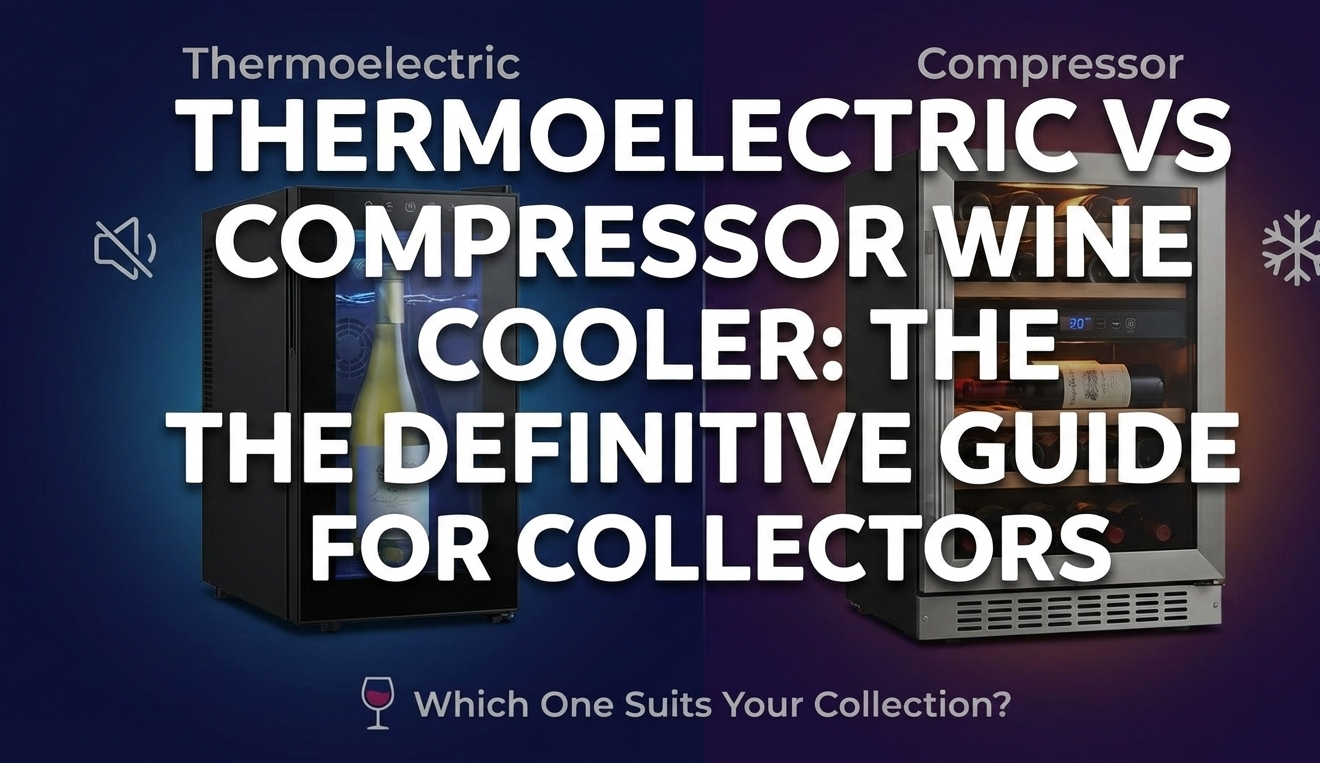
Choosing the right vessel for your wine collection is arguably as important as choosing the wine itself. You’ve read the guides on how to store wine at home, and you know that stability is the holy grail. But when you start shopping for a dedicated fridge, you hit a technical fork in the road: Thermoelectric vs Compressor.
To the untrained eye, they look identical. Both have sleek stainless steel doors, digital displays, and promise to keep your Chardonnay crisp. Yet, under the hood, they rely on physics that are as different as a battery-powered fan and a diesel engine. One offers silence but struggles in the heat; the other offers power but brings potential vibration.
In this comprehensive guide, we are going to dismantle the marketing fluff. We will analyze the cooling mechanics, energy efficiency, noise levels, and longevity of both types. Whether you need a small countertop unit for your office or a massive built-in cellar for your aging Bordeaux, understanding this comparison is critical to avoiding a costly mistake.
At a Glance: The Core Differences
If you are in a rush, here is the high-level breakdown of how these two technologies stack up against each other.
| Feature | Thermoelectric Cooler | Compressor Cooler |
|---|---|---|
| Cooling Method | Peltier Effect (Electronic Heat Pump) | Vapor Compression Cycle (Refrigerant) |
| Noise Level | Silent (Fan noise only) | Low hum (Cycles on and off) |
| Vibration | Zero Vibration | Minimal (Depends on dampening) |
| Temperature Range | Dependent on room temp (max ~20°F reduction) | Independent (Reach 39°F in 90°F heat) |
| Capacity | Small (6–32 bottles) | Large (18–300+ bottles) |
| Installation | Freestanding Only | Built-in or Freestanding |
| Lifespan | Moderate (Fans can fail) | Long (Decades with care) |
Deep Dive: What is a Thermoelectric Wine Cooler?
Thermoelectric cooling is often touted as the “eco-friendly” or “quiet” option. But how does it actually work? It relies on a scientific phenomenon known as the Peltier Effect. When an electric current flows through two dissimilar conductors (usually ceramic plates), heat is absorbed from one side and released from the other.
Inside a thermoelectric wine cooler, the “cold side” of the plate is inside the fridge cabinet, absorbing heat from your wine bottles. The “hot side” is on the back of the unit, where a small fan disperses that heat into the room. There are no moving parts in the cooling node itself, just the fan.
The “Silence” Factor
Because there is no motor or compressor pump, these units are incredibly quiet. If you are placing a small cooler in a bedroom, nursery, or a quiet home office, this is a massive advantage. The only sound you will hear is the gentle whir of the fan, similar to a computer tower.
The Vibration Advantage
Sediment is a natural byproduct of aging red wines. As we discuss in our guide to wine terminology, sediment should settle at the bottom of the bottle. Constant vibration can stir this up, making the wine taste gritty or chemically unbalanced. Since thermoelectric units lack a motor, they are virtually vibration-free, making them theoretically safer for delicate, sediment-heavy wines.
The Major Limitation: Ambient Temperature
This is where thermoelectric units often fail unsatisfied customers. A Peltier module acts like a heat sponge, but it has a limit. It can typically only lower the internal temperature by about 20°F to 25°F below the ambient room temperature.
Example: If your apartment gets up to 80°F in the summer, the coldest your thermoelectric cooler can get is likely 55°F or 60°F. If you want to store Champagne at 45°F, a thermoelectric cooler in a warm room simply cannot do it physically. It will run 24/7, fail to reach the target temp, and eventually burn out.
✅ Pros of Thermoelectric
- Virtually silent operation.
- Zero vibration (great for sediment).
- Eco-friendly (no chemical refrigerants).
- Generally cheaper upfront cost.
- Lightweight and easy to move.
❌ Cons of Thermoelectric
- Weak cooling power (dependent on room temp).
- Cannot handle large capacities efficiently.
- High electricity use if running constantly in warm rooms.
- Never suitable for built-in installation (needs back ventilation).
Best Thermoelectric Option
If you need a small, silent unit for a stable climate-controlled room, this is the industry leader.
 Check Price on Amazon
Deep Dive: What is a Compressor Wine Cooler?
A compressor wine cooler works on the exact same principle as the standard refrigerator in your kitchen, using a Vapor Compression Cycle. A motor (the compressor) pushes a chemical refrigerant (like R600a) through a system of coils. The refrigerant changes from liquid to gas, absorbing massive amounts of heat from the interior of the fridge and expelling it outside.
Brands like Whynter and NewAir have perfected this technology for wine storage. (See our Whynter wine cooler review for specific examples of high-end compressor models).
Unmatched Cooling Power
A compressor is powerful. It does not care if your room is 90°F; it can force the internal temperature down to 39°F with ease. This makes compressor coolers the only viable option for:
- Garages or basements that aren’t climate controlled.
- Homes in hot climates without central AC.
- Storing white wines and sparkling wines that need very low temperatures.
The Evolution of Noise and Vibration
In the past, compressors were criticized for being loud and shaky. However, modern technology has largely solved this. High-end units now use rubber shock absorbers to mount the compressor, isolating the cabinet from vibration. While they will never be as silent as a thermoelectric fan, most modern compressor wine coolers operate around 38–40 decibels—quieter than a standard dishwasher.
Furthermore, because the compressor is so powerful, it doesn’t run all the time. It cycles on for 15 minutes, cools the unit, and then shuts off for an hour. This cycling actually makes them surprisingly energy-efficient for larger collections.
✅ Pros of Compressor
- Powerful, consistent cooling regardless of weather.
- Can reach very low temps (down to 39°F).
- Available in large capacities (300+ bottles).
- Can be built into cabinetry (Front-Venting).
- Long operational lifespan.
❌ Cons of Compressor
- Heavier and harder to transport.
- Audible “hum” when the cycle kicks on.
- Higher upfront cost.
- Requires settling time (24 hours) after moving before plugging in.
Best Compressor Option
For serious collectors who need reliability and built-in capability.
 Check Price on Amazon
Head-to-Head Comparison: The Deciding Factors
Now that we understand the mechanics, let’s pit them against each other in the real-world scenarios that matter to you.
Round 1: Installation Versatility
Thermoelectric coolers vent heat out the back. If you slide one under a counter or put it inside a cabinet, the hot air gets trapped, the unit overheats, and it dies. They must be freestanding with at least 5 inches of clearance.
Compressor coolers (specifically those labeled “Built-In”) vent heat from a grille at the bottom front (the toe kick). This allows you to slide them flush into cabinetry for a sleek, custom look. If you are renovating your kitchen, the compressor is the winner by default. For more on maximizing space, check our guide on eco-friendly wine storage solutions.
Round 2: Long-Term Aging
For aging, you need consistency. While thermoelectric units have zero vibration, their inability to handle temperature swings in the room is a risk. If your AC goes out during a heatwave, your wine cooks. A compressor cooler acts as a fortress, maintaining that perfect 55°F regardless of the chaos outside. With modern dampening solving the vibration issues, the temperature stability of the compressor makes it the superior choice for expensive vintages.
Round 3: Daily Drinkers & Office Use
If you just want a place to keep 12 bottles of affordable wines ready for dinner, and you want it sitting on a sideboard in your dining room, you don’t need a heavy compressor unit. A thermoelectric unit is lighter, cheaper, and perfectly adequate for wines that will be consumed within 6 months.
Single Zone vs Dual Zone Wine Coolers: Which Do You Need?
One of the most important — and frequently overlooked — decisions when buying a wine cooler is whether you need a single zone or dual zone unit. This choice is independent of thermoelectric vs compressor, but it has enormous consequences for how usable your cooler actually is day-to-day.
What is a Single Zone Wine Cooler?
A single zone wine cooler maintains one consistent temperature throughout the entire cabinet. Every shelf, every bottle, experiences the same climate. This is the correct choice if you have a specific and uniform purpose — for example, a collection made up entirely of red wines you are aging, or exclusively white wines you serve chilled for parties.
Single zone units are simpler, cheaper, and easier to manage. They typically run quieter (whether thermoelectric or compressor) because the thermostat has one clear target. If your collection is homogeneous, a single zone unit is perfectly sufficient and there is no reason to pay a premium for dual zone capability.
What is a Dual Zone Wine Cooler?
A dual zone wine cooler divides the cabinet into two independently temperature-controlled compartments, typically an upper zone and a lower zone. You can set the upper zone to 55°F for red wine storage and the lower zone to 45°F for white wine and sparkling wine — simultaneously, in the same unit.
For anyone who entertains regularly or has a mixed collection, dual zone is transformative. You eliminate the compromise of keeping everything at a “neutral” 55°F that is too warm for whites and too cold for proper red wine service. Modern dual zone compressor units — particularly from Whynter, NewAir, and Wine Enthusiast — maintain each zone with remarkable precision, often within ±1°F of the target.
🍷 The Case for Dual Zone in a Compressor Unit
Dual zone capability requires two separate cooling loops or a sophisticated valve system, which is only feasible in compressor-based units. Thermoelectric dual zone coolers exist but are unreliable — the Peltier modules for each zone interfere thermally with each other, and in warm rooms, one or both zones frequently fail to reach target temperature. If dual zone is a priority, always choose a compressor cooler.
When Single Zone is the Right Answer
Don’t be swayed by marketing into buying dual zone capability you don’t need. If you are a dedicated red wine collector storing bottles for aging, a single zone unit at 55°F is ideal. If you are a white wine enthusiast who always serves within a week of purchase, a single zone at 45°F is perfect. The extra cost and complexity of dual zone adds real value only for collectors with genuinely mixed storage and service needs.
Wine Cooler Sizing Guide: How Many Bottles Do You Really Need?
Choosing the wrong size wine cooler is one of the most common and expensive mistakes in wine storage. Buy too small and you’ll be on Amazon again in six months. Buy too large and you’re paying to cool empty space while your electricity bill silently climbs. The correct approach is systematic: assess your current collection, project your growth, and add a strategic buffer.
Estimating Your Collection Size
Wine cooler bottle counts are measured in standard 750ml Bordeaux-style bottles. Note that Burgundy bottles (wider shoulders) take up more space and effectively reduce your real capacity by 10–15% in many units. Champagne and sparkling wine bottles are also wider and may not fit on standard shelves without removing a rack. When a manufacturer says “18 bottle capacity,” the practical number for mixed formats is often closer to 14–15.
| Collector Type | Typical Collection Size | Recommended Capacity | Unit Type |
|---|---|---|---|
| Casual drinker | 6–12 bottles at a time | 12–18 bottle unit | Thermoelectric (stable room) |
| Regular entertainer | 12–30 bottles rotating | 24–40 bottle dual zone | Compressor recommended |
| Enthusiast collector | 30–80 bottles | 50–100 bottle unit | Compressor, built-in option |
| Serious collector | 80–200+ bottles | 150–300 bottle unit | Large compressor or cellar system |
The 20% Buffer Rule
Whatever size you calculate your current collection needs, buy a unit that is at least 20% larger. Wine collections almost always grow. A collector who starts with 20 bottles typically has 50 within two years. This buffer also improves cooling efficiency: a cooler that is 80% full maintains temperature more easily than one stuffed to maximum capacity, because the thermal mass of the bottles themselves helps stabilize the internal climate.
💡 Measuring Your Space Before You Buy
Always measure the installation space with ventilation in mind. For freestanding units, add 5–6 inches to the back measurement and 2–3 inches on each side. For built-in compressor units, measure the toe kick height carefully — most require a standard 34-inch height clearance and the front grille vent must not be obstructed. A unit that doesn’t fit costs you return shipping fees on a very heavy appliance.
The Perfect Temperature for Every Wine: Your Storage and Service Guide
Even the most powerful wine cooler is worthless if you set it to the wrong temperature. Temperature is the single most controllable variable in wine quality — both for long-term storage and for the moment you pour a glass. The distinction between storage temperature (the temperature at which wine ages) and serving temperature (the temperature at which wine is poured and enjoyed) is fundamental, and understanding both will transform your relationship with your cooler.
The Universal Storage Temperature: 55°F (13°C)
If you own a single zone wine cooler and want one temperature setting for a mixed collection of aging wines, 55°F is the answer. This is the approximate temperature of traditional underground wine cellars in Burgundy and Bordeaux. At 55°F, all wines age slowly and gracefully. Reds, whites, sparkling wines, and fortified wines all tolerate this temperature without degradation over years or even decades.
The critical word is consistency. A wine aged at a steady 60°F will develop better than a wine aged at a fluctuating 50–65°F. Temperature swings cause the wine to expand and contract against the cork, gradually allowing air ingress. If your cooler can’t hold a steady temperature, it is worse than nothing for aging purposes.
Serving Temperatures by Wine Style
⚠️ The “Room Temperature” Myth
The common advice to serve red wine at “room temperature” dates from 18th-century European homes where rooms averaged 60–62°F. Modern air-conditioned rooms average 68–72°F — far too warm for red wine service. A full-bodied red served at 72°F will feel hot, alcoholic, and flat. If you pull a red from a 55°F cooler, it will reach ideal serving temperature within 15–20 minutes on the counter. Never microwave or use hot water to warm wine.
Humidity in Wine Coolers: The Silent Protector of Your Corks
Temperature gets all the headlines in wine storage, but humidity is the unsung guardian of your collection. Specifically, it is the guardian of your corks — and without healthy corks, even perfectly temperature-controlled wine will gradually oxidize and spoil. Understanding how your wine cooler manages humidity is essential, particularly if you are storing corked bottles for more than two years.
Why Humidity Matters
Natural cork is a spongy, cellular bark that seals the bottle neck through compression. When the air around it becomes too dry (below 50% relative humidity), the cork begins to dry out and shrink. A shrunken cork loses its seal integrity, allowing tiny amounts of oxygen into the bottle. Over months and years, this oxygen accelerates aging uncontrollably, producing oxidized, flat, or vinegary wine long before its intended peak.
Conversely, excessively high humidity (above 80%) encourages mold growth on labels and on the corks themselves, though this is primarily an aesthetic problem for bottles stored horizontally. The ideal humidity range for wine storage is 55–75% relative humidity, with 60–70% being the sweet spot most sommeliers and cellar managers target.
How Different Cooler Types Handle Humidity
Thermoelectric coolers have a natural advantage here. Because they don’t cycle on and off, they don’t create the repeated evaporation and condensation cycles that can dry out a cabinet. The interior humidity in a thermoelectric unit tends to remain more stable. However, because these units are small and their doors are frequently opened (for daily drinkers), humidity fluctuates with each door opening.
Compressor coolers act as dehumidifiers by nature — the refrigeration cycle condenses moisture from the air, which can drop humidity below ideal levels. Quality wine refrigerators from brands like Whynter, EuroCave, and Wine Enthusiast are engineered with humidity management systems including active humidification, condensate recycling, or UV-treated carbon filters that help maintain the 60–70% range. Budget compressor units often lack these systems, and owners in dry climates may need to manually maintain humidity with a small water reservoir inside the cabinet.
Checking and Managing Humidity
Place a small digital hygrometer (available for under $15) inside your wine cooler to monitor humidity continuously. If readings consistently fall below 55%, place a shallow glass of water inside — replacing it monthly. If you are in a very humid climate and readings exceed 80%, ensure the door seal is intact and consider silica gel packs to moderate excess moisture.
Glass Doors, UV Protection, and Light: What to Look For
Nearly every wine cooler on the market today features a glass door — it looks elegant, lets you admire your collection, and makes bottle retrieval easier. But glass and wine have a complicated relationship that the marketing materials rarely explain clearly. Understanding what to look for in a wine cooler door can protect your bottles from one of their most invisible enemies: light.
How Light Damages Wine
UV radiation triggers a photochemical reaction in wine called photo-oxidation — or, more precisely, the degradation of riboflavin and other light-sensitive compounds that produce “light-struck” character. Light-struck wine smells and tastes flat, wet-cardboard-like, or of cooked vegetables. It is irreversible. A single hour of direct sunlight can damage a delicate white wine. Extended exposure to fluorescent room lighting can cause gradual degradation over weeks.
This is exactly why bottles are traditionally housed in dark cellars and why wine bottles are most often dark-tinted (green or brown) glass. UV-filtering glass in your wine cooler door extends this protection to your entire collection.
Types of Wine Cooler Glass
Standard clear glass offers zero UV protection and is found on budget units. While the sealed interior provides some protection from direct light, extended placement near windows or in bright rooms makes these units risky for any long-term storage.
UV-filtering tinted glass (sometimes called “anti-UV glass” or “solar-safe glass”) filters out 90–99% of ultraviolet radiation while still allowing you to view the interior. This is the standard for mid-range and premium wine coolers. Look for this specification explicitly in product descriptions when making your purchase.
Double-paned glass (also called dual-pane or thermal glass) serves a different purpose: insulation. It reduces heat transfer through the door, making the cooler more energy-efficient and better at maintaining internal temperature when the ambient room is warm. Premium units often combine UV filtering with double paning for maximum protection.
💡 Placement and Light Exposure
Even with UV-filtered glass, keep your wine cooler out of direct sunlight. Position it away from south-facing windows and away from fluorescent task lighting that shines directly on the door. Internal LED lighting in quality coolers generates minimal UV and is safe to leave on; older incandescent bulb models generate heat and some UV and should be replaced if possible.
Built-In vs Freestanding Wine Cooler: A Complete Installation Guide
The decision between a built-in and freestanding wine cooler is as much about your kitchen renovation plans as it is about the technology inside the unit. Getting this wrong means either ruining a freestanding unit by enclosing it, or paying for built-in capability when you never plan to use it. Here is everything you need to know to make the right call.
What Makes a Wine Cooler “Built-In”?
A built-in wine cooler is specifically engineered to be installed flush within cabinetry or under a counter, with the front face sitting level with surrounding cabinet doors. The critical difference is ventilation: built-in units vent hot air from the front — typically through a toe kick grille at the bottom of the door face — rather than from the back or sides.
Without front-venting, a unit enclosed in cabinetry would overheat and fail within weeks. The compressor works by expelling heat; if that heat has nowhere to go, internal temperatures rise until the system shuts down on thermal overload or burns out entirely. Always verify that a unit labeled “built-in” has front ventilation before purchasing — some misleading listings use “built-in look” to describe freestanding units with stainless steel trim.
Freestanding Wine Coolers: Flexibility and Value
Freestanding units — both thermoelectric and compressor — offer maximum flexibility. They can be placed anywhere a standard electrical outlet exists and can be moved as your living arrangements change. They are generally less expensive than their built-in equivalents because they don’t require the engineering investment of front-venting systems.
The non-negotiable rule for all freestanding units: never enclose them. Even compressor freestanding units that vent from the back require clearance. Minimum rear clearance is typically 3–5 inches; side clearance of 2–3 inches on each side; top clearance of 5 inches or more. Read the specific installation requirements for your model and follow them precisely — these are not conservative suggestions, they are engineering limits.
Under-Counter Installation: Measurements That Matter
If you are planning an under-counter installation in a kitchen renovation, measure everything twice before purchasing:
- Width: Most under-counter wine coolers are 15 inches, 18 inches, or 24 inches wide. Match to your cutout exactly — standard cabinets leave no tolerance.
- Height: Standard under-counter height is 34 inches. Verify the unit’s height without feet and with any adjustable feet fully retracted.
- Depth: Typical depth is 22–24 inches. Account for door handle projection and ensure doors can open fully without hitting adjacent structures.
- Electrical: Ensure a dedicated 15-amp circuit is accessible without running cables across walking paths. Built-in installation rarely allows access to the plug once the unit is in place.
Energy Efficiency and Running Costs: The Real Numbers
Wine coolers run 24 hours a day, 365 days a year. Unlike a dishwasher you run three times a week, a wine cooler is a permanent draw on your electricity supply. Understanding the real energy cost of each technology type — in both ideal conditions and real-world scenarios — helps you make a financially sound decision alongside the technical one.
How Energy Consumption is Measured
Wine cooler energy consumption is measured in kilowatt-hours (kWh) per year, often listed on the Energy Star label if the unit carries that certification. To calculate annual running cost, multiply the annual kWh figure by your electricity rate per kWh. The US average is approximately $0.16/kWh as of 2026, but rates vary significantly by region and provider.
A small 12-bottle thermoelectric cooler typically consumes 50–100 kWh per year in a climate-controlled room — approximately $8–$16 annually. A large 100-bottle compressor unit might consume 150–250 kWh per year — approximately $24–$40 annually. These are genuine bargains compared to running an air conditioner, but they illustrate an important point: the size of the cooler matters more to energy cost than the technology type.
The Warm Room Penalty: When Thermoelectric Becomes Expensive
Here is where the energy calculation shifts dramatically. In a warm room (above 75°F), a thermoelectric unit cannot reach its target temperature. It runs 100% of the time at full power — never cycling off. Meanwhile, a compressor unit in the same room cycles efficiently: running at full power for 15–20 minutes, then resting for 40–60 minutes.
The result: in warm environments, a thermoelectric cooler can consume more electricity than a comparably-sized compressor unit, while still failing to achieve the target temperature. This is the fundamental reason that thermoelectric technology is appropriate only for stable, climate-controlled rooms.
| Scenario | Thermoelectric Energy Use | Compressor Energy Use | Winner |
|---|---|---|---|
| Climate-controlled room (68°F), small unit (12 bottles) | ~65 kWh/year | ~90 kWh/year | Thermoelectric |
| Warm room (78°F), small unit (12 bottles) | ~180+ kWh/year (constant run) | ~110 kWh/year | Compressor |
| Hot room (86°F), small unit (12 bottles) | Cannot reach target temp | ~130 kWh/year | Compressor (only viable option) |
| Climate-controlled room, large unit (100 bottles) | Not applicable (too large) | ~200 kWh/year | Compressor (only option) |
Top Wine Cooler Brands Compared: Who Makes the Best Units?
The wine cooler market has consolidated significantly, with a small number of manufacturers producing units under dozens of brand names. Knowing who actually builds quality units — and who is selling rebranded budget products — is essential when making a purchase that should last a decade or more.
🏆 EuroCave
The original wine cabinet specialist from France. Considered the gold standard for serious collectors. Exceptional temperature precision, active humidity control, and proprietary anti-vibration technology. Premium pricing ($800–$5,000+) is justified for wines worth protecting.
🏆 Whynter
The best balance of quality and value in the mid-range compressor segment. Their dual-zone built-in units (BWR series) consistently receive top professional reviews. Reliable compressors, solid insulation, and genuine dual-zone temperature independence.
🥈 Wine Enthusiast
Excellent range from entry-level to premium. The “Connoisseur” series offers front-venting built-in capability at accessible prices. Their humidity management and UV-filter glass are strong selling points. Good customer service reputation.
🥈 NewAir
Strong value proposition in the 28–50 bottle range. Compressor units are reliable and consistently priced below competitors. Their freestanding dual-zone models outperform their stated capacity and hold temperature well. Good for first serious purchases.
🥉 Ivation
The market leader in thermoelectric units. Their 12–18 bottle coolers are the gold standard for quiet, budget-conscious apartment storage. Build quality is modest but sufficient for the use case — daily drinkers in climate-controlled spaces.
🥉 Kalamera
Rising brand gaining serious credibility in the 24–46 bottle built-in segment. Their stainless steel construction and dual-layer tempered glass compete above their price point. Worth considering for kitchen renovation projects with a tight budget.
⚠️ Brands to Research Carefully
Many brands on major retail platforms are private-label products manufactured in the same overseas facilities and differentiated only by the logo on the front. Before purchasing any wine cooler, check verified reviews for consistent mention of temperature accuracy over time, not just on delivery. A unit that holds temperature for three months but drifts after six months is revealed only by long-term owners.
Wine Cooler Maintenance: How to Make Your Unit Last
A wine cooler is not a “set and forget” appliance. Like any precision cooling equipment, it requires periodic maintenance to perform correctly, maintain energy efficiency, and achieve its rated lifespan. The good news is that wine cooler maintenance is simple — a 20-minute routine twice a year prevents the majority of failures.
Thermoelectric Wine Cooler Maintenance
- Clean the rear fan grill (every 3 months) Dust accumulation on the fan and its grill is the primary cause of thermoelectric cooler failure. Use a vacuum with a brush attachment or compressed air to clear dust from the rear vent. A clogged fan cannot expel heat, causing the Peltier module to overheat and fail. This takes two minutes and extends unit life significantly.
- Check rear clearance (every 6 months) Verify that nothing has migrated to within 5 inches of the rear vent — books, kitchen items, or furniture rearrangement can inadvertently block airflow. Mark the minimum clearance on the floor with tape as a permanent reminder.
- Clean the interior (every 6 months) Remove all bottles and shelves. Wipe the interior with a clean, damp cloth and a solution of warm water and baking soda (1 tablespoon per quart). Never use bleach or harsh cleaners — residual chemical odors will contaminate your wine. Dry thoroughly before replacing bottles. Clean the rubber door seal with warm soapy water to keep it pliable and sealed.
- Test door seal integrity (annually) Close the door on a dollar bill. If you can pull it out easily with the door shut, the seal is weakening and needs replacement. A poor seal forces the cooling system to work harder, reducing efficiency and lifespan.
Compressor Wine Cooler Maintenance
- Clean the condenser coils (every 6–12 months) On most freestanding compressor units, the condenser coils are at the back of the unit. On built-in units, they are behind the front toe kick grille. Use a vacuum or condenser coil brush (available cheaply online) to remove dust buildup. Dirty coils are the leading cause of compressor inefficiency and premature failure in all refrigeration appliances.
- Level the unit precisely (on installation and after moving) Compressors are designed to operate level. An unlevel unit causes the compressor oil to pool unevenly, accelerating wear. Use a bubble level on top of the unit and adjust the feet. After any move, allow the unit to rest level and unplugged for 24 hours before restarting — this lets compressor oil settle back to the correct position.
- Clean interior and check humidity (every 6 months) Same process as thermoelectric above. Additionally, check your hygrometer reading. If humidity is below 55%, add a small glass of water or a dedicated wine cooler humidity pack. If above 80%, check door seals and consider a silica pack.
- Listen for compressor cycling changes (annually) Get familiar with the normal sound of your compressor starting, running, and stopping. A compressor that runs continuously without cycling off may indicate refrigerant loss or a failing thermostat. A compressor that short-cycles (starts and stops every 2–3 minutes) indicates a different issue. Both are diagnostic signs that warrant professional service.
Common Wine Cooler Problems and How to Fix Them
Even well-maintained wine coolers occasionally develop problems. Most common issues have straightforward diagnoses and solutions that don’t require professional service. Here is a systematic guide to the most frequently reported problems with both thermoelectric and compressor units.
| Problem | Likely Cause | Solution | Unit Type |
|---|---|---|---|
| Not cooling to target temp | Warm ambient room; fan blocked with dust | Clean rear fan; ensure 5″ clearance; check if room temp is within spec | Thermoelectric |
| Unit stopped cooling entirely | Peltier module failed (common after 5–7 years) | Module replacement is possible but often not cost-effective vs buying new | Thermoelectric |
| Excessive condensation inside | Door seal failure; door left open; humid climate | Replace door seal; check door closes fully; use interior silica gel | Both |
| Loud clicking or rattling | Compressor mounting bolts loose; vibration dampers worn | Level the unit; tighten mounting hardware; replace anti-vibration pads | Compressor |
| Compressor runs constantly | Refrigerant leak; dirty condenser; thermostat fault | Clean condenser coils; if persists, call certified appliance technician | Compressor |
| Temperature too warm in one zone | Dual-zone valve failure; overfilled zone; blocked vent | Reduce bottle count; ensure no items block internal air circulation vents | Compressor (dual zone) |
| Musty odor inside unit | Mold from excess humidity; old carbon filter | Deep clean interior with baking soda solution; replace carbon filter if fitted | Both |
| Display not responding | Control board fault; power surge damage | Unplug for 60 seconds and restart (factory reset); if persists, contact manufacturer | Both |
Wine Cooler vs Wine Fridge vs Wine Cellar: Clearing Up the Confusion
The wine storage category is plagued by inconsistent terminology. “Wine cooler,” “wine fridge,” “wine refrigerator,” “wine cabinet,” and “wine cellar” are used interchangeably in retail listings, yet they describe meaningfully different products and storage philosophies. Getting clear on these distinctions helps you search for the right product and set accurate expectations.
Wine Cooler / Wine Refrigerator / Wine Fridge
These three terms are functionally interchangeable and describe the same category of product: an electrically powered appliance that uses refrigeration (either thermoelectric or compressor) to maintain wine at a controlled temperature below the ambient room temperature. The term “wine cooler” is the most consumer-friendly; “wine refrigerator” emphasizes the appliance nature; “wine fridge” is informal slang. All refer to the same type of product reviewed throughout this guide.
Wine Cabinet
A wine cabinet is typically a freestanding piece of furniture that incorporates a dedicated cooling system — usually a compressor — into a cabinet body that is designed to blend aesthetically with home furnishings rather than look like a kitchen appliance. EuroCave’s flagship products are wine cabinets. They may include sophisticated humidity management, vibration isolation, and UV-filtering glass in a design that would not look out of place in a dining room or study.
Wine Cellar
A wine cellar, in the traditional sense, is a dedicated underground or semi-underground room designed to naturally maintain ideal wine storage conditions through earth’s thermal mass. Modern “wine cellars” often refers to constructed rooms in basements fitted with dedicated cooling units (called cellar conditioning units or split systems) rather than traditional underground vaults. These cooling units are different from wine coolers — they are HVAC-style systems designed to cool entire rooms, not single appliances.
Beverage Cooler vs Wine Cooler
Beverage coolers are designed to chill cans, bottled water, sodas, and beer to drinking-cold temperatures (34–40°F). They typically reach lower temperatures than wine coolers and often have wire shelves or can racks rather than wooden wine bottle cradles. While some beverage coolers can serve double duty for wine, they often run too cold for red wine storage and lack the humidity management and vibration damping needed for long-term wine aging. If you want to store wine properly, buy a wine cooler specifically — the engineering differences matter.
Which One Should You Buy?
Still undecided? Find the profile that matches you below.
The Apartment Dweller
You live in a climate-controlled space, perhaps a bit tight on square footage. You are sensitive to noise because your living room is also your office.
- Recommendation: Get a 12–18 bottle Thermoelectric Cooler.
- Why: It’s silent, compact, and your steady room temperature allows it to work efficiently.
- Check out: Ivation Wine Cooler Reviews.
The Home Renovator
You are redoing your kitchen island and want a “wine cellar” under the counter. You want to store both reds and whites for service.
- Recommendation: You must get a front-venting Compressor Cooler.
- Why: Thermoelectric units will burn out in that space. You also need the dual-zone power to keep whites at 45°F.
- Check out: Whynter Wine Cooler Review.
The Serious Collector
You have bottles worth $100+ that you plan to lay down for 5–10 years. You are worried about corks drying out and oxidation.
- Recommendation: A large format Compressor Cooler (or dedicated cellar).
- Why: Temperature stability is the most critical factor for aging. Modern compressors like those from Wine Enthusiast or EuroCave are designed for this.
- Check out: Wine Enthusiast Wine Cooler Review.
Don’t Forget the Essentials
Once you have secured the right fridge, ensure you have the tools to serve your wine correctly. Storing wine at the right temperature is only step one.
- Opening: Use a foil cutter and a quality opener to ensure the cork doesn’t crumble.
- Breathing: If you are pulling a heavy red out of your new compressor fridge, run it through an aerator or decanter to unlock the flavors immediately.
- Preservation: Did you only drink half the bottle? Don’t just shove the cork back in. Use a Coravin or Vacu Vin system to keep the remainder fresh for days or weeks.
Frequently Asked Questions
Not necessarily. While they have smaller components, they must run continuously to maintain temperature in warm rooms. A compressor cycles on and off, which can actually be more energy-efficient for larger capacities or in warmer environments. In a stable, cool room, thermoelectric units are efficient for small collections. In any room above 75°F, compressors win on energy use.
It is not recommended. Beer is best served at 35–40°F. Thermoelectric coolers generally struggle to get below 50°F unless the room is very cold. For beer, a compressor-based beverage center is superior. If you enjoy both wine and beer, look for a dual-purpose beverage fridge with a compressor system.
The most common cause is dust buildup on the rear fan or poor ventilation. If the heat cannot escape, the Peltier module overheats and fails. Ensure there is at least 5 inches of clearance behind the unit and clean the rear fan grill thoroughly. If cleaning doesn’t restore function, the Peltier module itself may have failed — a condition that is difficult and often uneconomical to repair.
For short-term storage, vibration is negligible. However, for long-term aging (5+ years), constant vibration can disturb sediment and facilitate chemical reactions that dull the wine’s flavor and aroma. Modern compressor units with rubber shock absorbers present minimal real-world vibration risk for collections aged under 10 years.
Compressor coolers generally have a longer lifespan, often lasting 10–15 years with maintenance. Thermoelectric fans run constantly and are prone to wearing out after 5–7 years. In both cases, the quality of manufacturing and adherence to maintenance schedules is more predictive of lifespan than the technology type alone.
We strongly advise against this. Even with an added fan, the airflow dynamics inside a cabinet are rarely sufficient for a Peltier unit. You void the warranty and risk a fire hazard or spoiled wine. Stick to built-in compressor models for cabinetry. The engineering of front-venting compressor units solves this problem precisely and reliably.
Compressors act as dehumidifiers, which can be a concern. However, quality wine coolers (like Whynter or Vinotemp) are designed to maintain humidity between 50% and 70%. If you are worried, you can place a small bowl of water inside the unit, but most modern compressor wine fridges manage this balance well automatically. Monitoring with a cheap hygrometer provides peace of mind.
A regular kitchen refrigerator runs at 35–38°F — far too cold for wine storage, which requires 45–65°F depending on style. Kitchen fridges also run very dry (15–20% humidity), rapidly desiccating corks. They vibrate constantly from the compressor cycling under high load, and the frequent door openings and temperature fluctuations from food storage make them hostile long-term wine storage environments. A wine cooler is purpose-engineered to avoid every one of these problems.
An empty compressor wine cooler typically reaches its set temperature within 2–4 hours. Once you load it with bottles (which carry the room’s thermal mass), expect 12–24 hours for the contents to equilibrate. Thermoelectric units take longer to cool down in warm rooms and may take 24–48 hours to stabilize. Never load a newly purchased compressor unit with your most valuable bottles immediately — allow it to run and stabilize for 24 hours first to verify it is functioning correctly.
For bottles sealed with natural cork, yes — storing horizontally keeps the cork in contact with the wine, preventing it from drying out. Screw-cap bottles and synthetic cork bottles can be stored in any orientation without risk. Most wine cooler shelves are specifically designed to cradle bottles horizontally. If you have upright bottle racks in your cooler and are storing natural cork wines for more than a few months, consider inverting or repositioning your rack system.
Final Verdict: The Winner Is…
There is no single winner, only the right tool for the job.
Choose Thermoelectric IF: You have a small collection, a tight budget, and a stable, climate-controlled room where silence is golden. It is the perfect entry point for the casual enthusiast exploring organic and natural wines.
Choose Compressor IF: You are serious about protection. If you are building into cabinetry, living in a warm climate, or aging expensive bottles, the compressor is the only responsible choice. It provides the muscle needed to keep your investment safe.
Ultimately, the best wine cooler is the one that gives you peace of mind—knowing that when you finally pop that cork, the wine will taste exactly as the winemaker intended.