How to Read a Wine Label: A Beginner’s Decoder for the Wine Aisle
You’re standing in the wine aisle. It’s a wall of 500 bottles. One has a cartoon kangaroo. One has a stark, minimalist font. Another has a crest and a word you can’t pronounce. Your eyes glaze over. You feel a familiar panic. You end up just grabbing the bottle with the “90 Points” sticker or, let’s be honest, the one with the coolest-looking label. You get it home, and it’s… fine. But it’s not what you wanted.
This is the “Wall of Wine Anxiety,” and every U.S. wine drinker has felt it. It feels like you need a secret decoder ring just to buy a bottle of red. But here’s the secret: a wine label is not a marketing poster; it’s a legal document. It’s a treasure map, and every single word (and its font size) is a clue telling you exactly what’s in the bottle. Once you learn to read this map, you will never buy the “wrong” wine again.
Here at Cooking Authority, we’re demystifying the world of wine, one bottle at a time. This is your ultimate decoder guide — we break down every piece of the label, from “New World” vs. “Old World” to what “Reserve” really means (hint: in the U.S., it means nothing), to how to read a French, Italian, Spanish, and German label like a native. By the time you’re done, you’ll walk that aisle with the confidence of a sommelier. This is the first, most important lesson in our wine glossary for beginners.
What’s In This Guide
- The #1 Concept: New World vs. Old World
- The 5 Core Elements of a Wine Label
- The Old World Cheat Sheet
- Country-by-Country Label Guide (FR/IT/ES/DE)
- Wine Quality Classifications Explained
- Reading for Sweetness & Style
- Sparkling Wine Labels: Champagne, Prosecco & Cava
- What Does Terroir Really Mean?
- Organic, Biodynamic & Natural Wine Labels
- Wine Ratings & Scores Explained
- Closures: Cork, Screw Cap & Glass Stopper
- Reading Value on a Label
- Wine Label Pronunciation Guide
- Decoding the Back Label
- 3 Label Scenarios: How to Apply What You Know
- Choosing Wine by Occasion
- The Wine Reader’s Toolkit: 5 Products
- Building Your Label Library
- Frequently Asked Questions
The #1 Concept: New World vs. Old World (Grape vs. Place)
This is it. The entire “secret.” If you understand this one concept, you’re 90% of the way there. The confusion in the wine aisle comes from two different philosophies of labeling.
1. New World (The U.S., Australia, South America, South Africa)
Labels tell you the GRAPE (Varietal).
In the U.S. and other “New World” countries, we are a varietal-driven market. We buy “Cabernet,” “Chardonnay,” or “Pinot Noir.” Our labels are clear and to the point. The most important word on the label, often right under the producer, is the grape.
- You’ll See: Bogle
- And Then: PINOT NOIR
- And Then: California
It’s simple, direct, and easy to understand. You know exactly what wine varietal you are getting. Under U.S. law, if a label says a single varietal, at least 75% of the wine in that bottle must be from that grape.
2. Old World (France, Italy, Spain, Germany)
Labels tell you the PLACE (Region or Appellation).
This is where U.S. buyers get lost. In Europe, “terroir” is everything. The region implies the grape, based on centuries of tradition and law.
- You’ll See: Domaine Vacheron
- And Then: SANCERRE
- And Then: 2022
You’re left scratching your head. “What grape is Sancerre?!” The label assumes you know that Sancerre is a region in France that, by law, only makes white wine from Sauvignon Blanc. You are not buying a “grape”; you are buying a “place.”
The Golden Rule: New World = Grape on the label. Old World = Place on the label. The place implies the grape once you know the code. Everything else in this guide is built on this foundation.
The 5 Core Elements of a Wine Label (The Decoder Ring)
Every label has a hierarchy of information. Here are the 5 things you need to find, in order of importance.
1. The Producer (Who made it?)
This is the “brand.” It’s often the biggest, fanciest text on the label — the “Château” (French), “Tenuta” (Italian), “Bodega” (Spanish), or just the brand name (e.g., “Cakebread,” “Yellow Tail”). This is your first sign of quality. Is it a mass-market producer you see everywhere, or a smaller, “estate” producer? A “Château” or “Estate” bottling often means the wine was made by the same people who grew the grapes, which is a meaningful quality signal. The producer’s reputation is something you build knowledge of over time — a reason to keep a tasting journal.
2. The Varietal or The Appellation (What’s in the bottle?)
This is the “what” and it’s linked to the “where.” As we just covered, this is the most critical piece of information on the label. If it’s New World, you’ll see the grape: “Cabernet Sauvignon,” “Sauvignon Blanc,” “Zinfandel.” If it’s Old World, you’ll see the place name: “Bordeaux,” “Rioja,” “Barolo.” Understanding the Old World place-to-grape translation is the heart of wine label literacy, which is why we’ve dedicated an entire country-by-country section later in this guide.
3. The Region & Appellation (Where exactly is it from?)
This is the “zoom-in” clue. Wine regions are like Russian nesting dolls. The smaller and more specific the region, the more “terroir” it has, and generally, the higher the price and quality.
- Level 1 (Broad): “California” — grapes could be from anywhere in the state.
- Level 2 (Region): “North Coast” — narrowing it down geographically.
- Level 3 (AVA/Appellation): “Napa Valley” — a specific, legally-defined area. In the U.S., this is called an AVA (American Viticultural Area).
- Level 4 (Sub-Appellation): “Rutherford” — a famous sub-region within Napa Valley known for its specific style of Cabernet.
- Level 5 (Single Vineyard): “To Kalon Vineyard” — the grapes came from one specific, named plot of land. This is often the highest-quality and most expensive tier.
A label that says “California Cabernet” will be one of the most affordable wines. A “Rutherford, Napa Valley Cabernet” will be substantially more expensive — and should deliver a more distinct, “place-driven” experience in the glass.
4. The Vintage (When were the grapes picked?)
This is simply the year the grapes were harvested. A “2020” means the grapes grew and were picked in 2020. This is important for two distinct reasons.
Freshness: For most white wines and rosés, you want the youngest vintage you can find. These wines are built for freshness and vibrancy; age diminishes them. Always reach for the most recent year.
Vintage Quality: For big, structured reds that are meant to age, the vintage year matters because weather varied dramatically from year to year before the wine was made. In Bordeaux, 2016 was a legendary growing season; 2013 was much harder. Understanding vintage variation is an advanced skill, but the vintage year on the label is your first clue that quality can differ from one year to the next with the same producer and region.
Non-Vintage (NV): You’ll see this on Champagne and many other sparkling wines. It means the producer blended wine from multiple years to create a consistent, reliable house style. Non-Vintage is a sign of consistency, not low quality — the great Champagne houses spend enormous effort perfecting their NV blends.
5. The ABV — Alcohol by Volume (How big is it?)
Legally required on every bottle sold in the U.S., the ABV percentage is your most reliable “body” clue. It tells you how powerful and full the wine will feel in your mouth and how warming it will be.
- Under 12.5%: Very light-bodied. Think German Riesling Kabinett, Moscato d’Asti, or a light Vinho Verde. These are refreshing, delicate, often slightly sweet.
- 12.5% – 13.5%: Medium-bodied. Think Pinot Noir, Sancerre, most Chardonnay, and Chianti. The classic “food wine” range — balanced, versatile, food-friendly.
- 14.0% – 15.0%: Full-bodied, powerful, “big.” Think Napa Cabernet, Zinfandel, Châteauneuf-du-Pape, Australian Shiraz. These are “warm climate” wines where intense sun produces very ripe, high-sugar grapes. The sugar ferments into alcohol, creating that warming, rich sensation.
- 15.0%+: Very high-octane. Often a late-harvest Zinfandel, a fortified wine (Port, Sherry), or an Australian Grenache. Handle with care — these wines can overwhelm food if not paired thoughtfully.
💡 Quick ABV Trick for Beginners
If you want a light, easy white to sip on a summer afternoon, look for under 13%. If you want a full-bodied red to pair with a steak or a rich pasta, look for 14% or above. This single data point eliminates most “wrong” bottle choices before you even read anything else on the label.
The “Old World” Cheat Sheet for U.S. Buyers
Here is a simple “translation” guide for the most common Old World labels you’ll see in a U.S. wine shop. Memorize this table and the wine aisle becomes a very different place.
| If You See This Place (Old World)… | …It Means This Grape (New World) | Style Notes |
|---|---|---|
| FRANCE: Sancerre | Sauvignon Blanc | Crisp, high-acid, mineral/grassy. |
| FRANCE: Chablis | Chardonnay (Un-oaked) | Very dry, high-acid, “flinty,” “steely.” |
| FRANCE: White Burgundy (e.g., Meursault, Puligny-Montrachet) |
Chardonnay (Oaked) | Rich, complex, buttery, toasty. |
| FRANCE: Red Burgundy (e.g., Gevrey-Chambertin, Nuits-St-Georges) |
Pinot Noir | Earthy, delicate, cherry, high-acid. |
| FRANCE: Bordeaux (Red) (e.g., Médoc, St-Émilion, Pomerol) |
Cabernet / Merlot Blend | Tannic, dark fruit, tobacco, earthy. |
| FRANCE: Châteauneuf-du-Pape | Grenache-Syrah-Mourvèdre | Big, bold, high-alcohol, peppery, gamey. |
| ITALY: Chianti Classico | Sangiovese | Savory, high-acid, cherry, tomato leaf. |
| ITALY: Barolo / Barbaresco | Nebbiolo | Very high-tannin, high-acid, “tar & roses.” |
| SPAIN: Rioja | Tempranillo | Savory, dill, coconut (from American oak). |
Country-by-Country Label Guide: France, Italy, Spain & Germany
The cheat sheet above covers the basics, but if you’re serious about navigating the wine aisle with confidence, you need to understand how each major Old World country structures its labels — and what the hierarchy of words on each label actually tells you. This is the section that transforms you from a casual drinker into a genuinely informed buyer.
France invented the “terroir” philosophy and built the world’s most imitated wine classification system. The entire French system is built around a single idea: the land tells you everything. When you read a French wine label, you are reading a geography lesson.
The French AOC / AOP System
France’s quality system is called the AOC (Appellation d’Origine Contrôlée) — now also written as AOP (Appellation d’Origine Protégée) under EU law. They mean the same thing. This designation on a French label tells you the wine was made under strict rules governing the permitted grape varieties, vineyard yields, alcohol levels, and winemaking methods for that specific geographic area.
The tighter and more specific the appellation, the more strictly controlled the wine. A label that says just “Vin de France” means almost anything goes. A label that says “Gevrey-Chambertin Premier Cru” is one of the most controlled, specific wine designations in the world.
The Burgundy System: The Most Complex in the World
Burgundy (Bourgogne) uses a four-level classification for its vineyards, and understanding this system unlocks a huge range of French wines. From broad to specific:
- Bourgogne AOC: The most basic level. Grapes can come from anywhere in Burgundy. A good entry-level Pinot Noir or Chardonnay at an accessible price.
- Village AOC (e.g., “Pommard,” “Meursault,” “Chambolle-Musigny”): The wine comes from vineyards within a specific village. A significant quality step up.
- Premier Cru: The wine comes from a specifically named, legally classified superior vineyard within a village. The vineyard name appears on the label after the village name (e.g., “Meursault Premier Cru Perrières”). A notable quality increase.
- Grand Cru: The absolute top level. These are individual vineyard plots considered so exceptional that they stand alone with their own AOC — the village name doesn’t even appear on the label. “Chambertin,” “Le Montrachet,” “Romanée-Conti” — these names ARE the appellation. The most sought-after and expensive wines in the world.
Key French Label Words to Know
- Château: A wine estate — the same people grew and bottled the wine. A quality signal.
- Domaine: Similar to Château but more commonly used in Burgundy for smaller, family-owned estates.
- Mis en Bouteille au Château / Domaine: Bottled at the estate. An authenticity and quality guarantee.
- Négociant: A merchant who buys grapes or bulk wine from multiple growers and blends and bottles it under their own name. Not necessarily bad — some of Burgundy’s most famous names (Jadot, Drouhin) are négociants — but it’s a different model from estate-bottling.
- Vieilles Vignes: Old vines. Generally produces more concentrated, complex wine. Not legally defined, but typically means vines over 25–30 years old.
- Sec: Dry. Demi-Sec: Off-dry (literally “half-dry”). Doux: Sweet. Essential for understanding Vouvray, Chenin Blanc, and Alsatian wines.
Italy is the most complex country for label-reading, with over 350 officially recognized grape varieties and 20 distinct wine-producing regions. The good news: Italy’s classification system is logically structured and once you learn the four tiers, everything else falls into place.
The Italian DOC/DOCG System
Italy’s quality hierarchy, from bottom to top:
- Vino d’Italia (formerly Vino da Tavola): Table wine with no specific geographic indication. The most basic category. Can be very good (some famous “Super Tuscans” were technically Vino da Tavola for years because they used non-traditional grapes) but provides no guarantee of quality.
- IGT (Indicazione Geografica Tipica): Wines from a broad geographic area with looser rules on grape varieties. The “Super Tuscans” — Sassicaia, Tignanello — live here. IGT can indicate exceptional quality that simply doesn’t fit the traditional DOC rules.
- DOC (Denominazione di Origine Controllata): A specific, controlled appellation with rules on permitted grapes, yields, and production methods. Most everyday quality Italian wine is DOC. Chianti, Soave, Barolo, and Amarone are all DOC or DOCG.
- DOCG (Denominazione di Origine Controllata e Garantita): The highest Italian classification, with the strictest controls and an official tasting committee that approves every wine before release. The “G” stands for “Garantita” (guaranteed). Barolo, Brunello di Montalcino, Amarone, Chianti Classico, and Prosecco Superiore are all DOCG.
The Aging Designations: Riserva, Superiore, Classico
These three terms appear on Italian labels and each means something specific and legally defined:
- Riserva: The wine has been aged for a longer, legally specified minimum period (in oak and/or bottle) before release. For Barolo, standard aging is 3 years; Barolo Riserva requires at least 5. For Chianti Classico, Riserva requires 24 months of aging. Riserva is always a higher-tier, more mature, and usually more expensive wine.
- Superiore: In many Italian DOC zones, Superiore indicates a higher minimum alcohol level (typically +0.5%) and/or lower permitted yields. It generally signals a more concentrated, structured wine.
- Classico: Refers to wines from the original, historical heartland of the appellation — the area that was defined before surrounding regions were added to the designation. Chianti Classico (the original Chianti zone between Florence and Siena) is different from and generally considered superior to plain Chianti.
Key Italian Regions and Their Grapes
- Tuscany: Sangiovese dominates. Chianti Classico, Brunello di Montalcino, Vino Nobile di Montepulciano.
- Piedmont: Nebbiolo (Barolo, Barbaresco), Barbera (Barbera d’Alba), Dolcetto.
- Veneto: Amarone, Valpolicella (Corvina/Rondinella), Soave (Garganega), Prosecco (Glera).
- Sicily & Southern Italy: Nero d’Avola, Primitivo (related to Zinfandel), Aglianico. Often the best value on the Italian wine shelf.
Spain has one of the most useful label systems for consumers because it tells you directly how long the wine has been aged and, therefore, how “ready to drink” it is. Once you understand Spain’s aging designations, you’ll know exactly what style you’re getting before you open the bottle.
Spain’s Aging Designations (from youngest to most aged)
- Joven: Young wine, typically released the year after harvest with minimal or no oak aging. Fruit-forward, fresh, easy-drinking. The most approachable and affordable style.
- Crianza: Minimum 2 years of aging, with at least 6 months in oak (for Rioja and Ribera del Duero). Medium-bodied, showing some oak influence but still relatively fresh. Excellent value.
- Reserva: Minimum 3 years total aging for reds (at least 1 year in oak). A more complex, structured wine with noticeable oak integration. Ready to drink on release but can age further.
- Gran Reserva: The highest tier. Minimum 5 years aging for reds (at least 18 months in oak, then in bottle). Only produced in exceptional vintages. A mature, complex wine that has already been extensively aged at the winery.
💡 The Spanish Buyer’s Shortcut
If you want to drink tonight: reach for a Crianza or Joven. If you want a special-occasion bottle that is already evolved and complex: reach for a Gran Reserva. Spain does the aging work for you — the label tells you the outcome.
Key Spanish Regions to Know
- Rioja: Spain’s most famous wine region. Primarily Tempranillo, blended with Garnacha, Graciano, and Mazuelo. Traditional Rioja uses American oak, giving flavors of vanilla, dill, and coconut. “Rioja Alta” and “Rioja Alavesa” are considered the finest sub-zones.
- Ribera del Duero: Spain’s answer to Napa — powerful, concentrated Tempranillo (called “Tinta Fina” locally) at higher altitude. More tannic and fruit-forward than Rioja, often without the vanilla oak character.
- Priorat: Tiny, spectacular region in Catalonia producing some of Spain’s most concentrated and expensive wines from Garnacha and Cariñena. Look for the “DOCa” designation (Spain’s highest tier, shared only with Rioja).
- Albariño / Rías Baixas: Spain’s finest white wine region in Galicia. Fresh, high-acid, floral Albariño — one of the world’s great food wines. Perfect with seafood.
Germany has the most logically constructed — and most misunderstood — wine label system in the world. The German Prädikat system classifies wines by the ripeness level of the grapes at harvest, which directly correlates to the wine’s sweetness and body. Once you learn these six levels, you will never accidentally buy a sweet wine when you wanted a dry one.
The German Prädikat System (Driest to Sweetest)
- Kabinett: The lightest, most delicate style. Made from normally ripe grapes with low alcohol (often under 10%) and crisp acidity. Can be dry or slightly off-dry. A perfect aperitif or pairing for light seafood.
- Spätlese (SHPAYT-lay-zeh — “late harvest”): Grapes picked later than normal, resulting in richer flavors. Can range from off-dry to medium-sweet. Usually the best-value category for quality German Riesling.
- Auslese (OWS-lay-zeh — “selected harvest”): Selected bunches of very ripe grapes, often with some botrytis (noble rot). Rich, complex, honeyed. Can be sweet or, in the hands of top producers, surprisingly dry.
- Beerenauslese (BA): Individually selected overripe berries, heavily affected by botrytis. Intensely sweet, rich, and complex. A dessert wine. Rare and expensive.
- Eiswein (ICE-vine): Grapes harvested while frozen (naturally, in the vineyard). Intensely concentrated sweetness with piercing acidity. Very rare and very expensive.
- Trockenbeerenauslese (TBA): The pinnacle of German wine. Individually selected grapes that have dried to raisins on the vine. Extraordinarily concentrated, intensely sweet, with incredibly high acidity that keeps them fresh. Among the world’s most expensive wines — a few milliliters in a tiny glass.
Dry vs. Sweet: Trocken and Halbtrocken
Here is the crucial practical note: if you want a dry German wine — and modern Germany makes excellent dry Riesling — look for the word “Trocken” (dry) on the label. “Halbtrocken” means “half dry” (off-dry). A Spätlese labeled “Trocken” is a full-bodied, dry, age-worthy wine completely unlike the sweeter version. Without “Trocken,” assume some residual sweetness in the higher Prädikat levels.
Key German Regions
- Mosel: The most delicate, lowest-alcohol Rieslings in the world. Slate soils, steep terraced vineyards. Look for names like Piesporter, Bernkasteler, Ürziger.
- Rheingau: Richer, more powerful Riesling than Mosel. Also famous for Spätburgunder (Pinot Noir).
- Pfalz & Rheinhessen: Warmer regions producing rich, full-bodied Riesling and the best German Spätburgunder (Pinot Noir).
Wine Quality Classifications Explained
Quality classifications are one of the most misunderstood aspects of wine labels. They appear on bottles from France, Italy, Spain, Germany, and increasingly in the New World — but what do they actually mean, and how do you use them when buying wine?
At their core, wine quality classifications are legal systems established by government authorities to define geographic boundaries, permitted grape varieties, and production methods. They are a form of consumer protection: they guarantee that a bottle labeled “Chablis” was genuinely produced in Chablis following the rules of that appellation, not a California Chardonnay renamed for marketing purposes.
The EU Quality Tier System (Applies Across All European Countries)
Since 2009, all EU wine countries use a standardized two-tier framework, though each country has its own terminology for each level:
- PDO (Protected Designation of Origin) — the higher tier: French AOC/AOP, Italian DOC/DOCG, Spanish DO/DOCa, German QbA/Prädikat. Strict rules on geography, grapes, and production.
- PGI (Protected Geographical Indication) — the lower tier: French IGP (replacing Vin de Pays), Italian IGT, Spanish Vino de la Tierra, German Landwein. Broader geographic areas with looser rules.
Bordeaux’s Classification System: Crus Classés
Bordeaux has its own classification system established in 1855 that ranks its châteaux (wine estates) rather than its vineyards. The original “Classification of 1855” ranked the châteaux of the Médoc (the most famous left-bank Bordeaux region) from First Growth (Premier Cru Classé) to Fifth Growth. This ranking has barely changed since 1855 and remains the most famous wine classification in the world.
- Premier Cru Classé (First Growth): Château Lafite-Rothschild, Latour, Margaux, Haut-Brion, Mouton-Rothschild. The most prestigious, expensive Bordeaux.
- Deuxième through Cinquième Cru: Second through Fifth Growths. Substantial quality, accessible quality at lower prices than the Firsts.
- Cru Bourgeois: A category below the Crus Classés but above generic Bordeaux. Excellent quality, excellent value — the “sweet spot” of the Bordeaux market for value buyers.
⚠️ Important: Classifications Are Not Updated Often
The 1855 Bordeaux classification has barely changed in 170 years. Some châteaux ranked highly in 1855 no longer produce top-quality wine; some unclassified properties now outperform classified ones. Classifications are a useful historical guideline but not a substitute for reading current reviews and producer notes.
New World Classifications: AVAs in the United States
The U.S. equivalent of European appellations is the AVA (American Viticultural Area), regulated by the TTB (Alcohol and Tobacco Tax and Trade Bureau). There are currently over 270 recognized AVAs in the U.S. AVAs define geographic boundaries but — unlike European appellations — they do NOT dictate which grapes can be planted or how wine must be made. They are purely geographic markers. The key rule: if an AVA name appears on a U.S. label, at least 85% of the wine must come from grapes grown within that AVA (75% for a state or county designation).
Reading for Sweetness & Style: The Complete Guide
One of the most common wine-buying mistakes is accidentally purchasing a sweet wine when you wanted dry (or vice versa). The label almost always tells you — if you know where to look.
The Sweetness Scale
Wine ranges from bone-dry (virtually zero residual sugar) to intensely sweet (dessert wines). Here is how that spectrum is communicated on the label across different wine-producing countries:
Sweetness Indicators by Country
- France: “Sec” = dry. “Demi-Sec” = off-dry/medium. “Moelleux” = soft/sweet. “Liquoreux” = luscious/very sweet. On Alsatian wines, “Vendanges Tardives” (VT) = late harvest (sweet); “Sélection de Grains Nobles” (SGN) = extremely sweet botrytis wine.
- Germany: “Trocken” = dry. “Halbtrocken” / “Feinherb” = off-dry. Kabinett through TBA = increasing sweetness by default unless “Trocken” is specified.
- Italy: “Secco” = dry. “Abboccato” = lightly sweet. “Amabile” = medium sweet. “Dolce” = sweet. On Prosecco: “Brut” is the driest; “Extra Dry” is actually slightly sweeter (confusingly).
- Spain: “Seco” = dry. “Semiseco” = off-dry. “Semidulce” = medium sweet. “Dulce” = sweet. On Sherry: “Fino” and “Manzanilla” are bone dry; “Oloroso” can be dry or sweet; “Pedro Ximénez” is intensely sweet.
- U.S. & New World: Sweetness terms are not legally regulated on U.S. labels. “Dry” on a U.S. label is not legally defined but generally indicates the winemaker’s intention. For reds, most standard varietal labeling implies dry. For whites from warmer producers, check the tech sheet or back label description.
💡 The Residual Sugar (RS) Trick
Some U.S. wine labels (particularly from transparent producers like Bonny Doon) actually list the Residual Sugar (RS) in grams per liter. Under 4 g/L is dry. 4–12 g/L is noticeably off-dry. Over 20 g/L will taste quite sweet to most palates. If you see this data on a back label, it’s the most precise sweetness indicator available.
Sparkling Wine Labels: Champagne, Prosecco, Cava & Beyond
Sparkling wine labels have their own vocabulary that confuses even experienced drinkers — particularly because the dosage (sweetness) terminology is counterintuitive. “Extra Dry” is actually sweeter than “Brut.” Here is everything you need to know.
Champagne: What the Label Tells You
True Champagne comes only from the Champagne region of France. If the label says “Champagne,” this is a legally protected designation. Any sparkling wine from anywhere else (California, Spain, Italy) cannot legally be called Champagne in most markets.
- NV (Non-Vintage) Champagne: Blended from multiple years. The house style. Most consistent and generally the most affordable. Always ready to drink.
- Vintage Champagne: Made from a single exceptional year. Only declared in the best vintages. More complex, age-worthy, and expensive. Typically needs 5–10 years from release to show its best.
- Blanc de Blancs: Made exclusively from Chardonnay. Elegant, crisp, mineral, citrus-focused.
- Blanc de Noirs: White Champagne made from red grapes (Pinot Noir and/or Pinot Meunier). Richer, fuller body than Blanc de Blancs.
- Rosé Champagne: Made by adding a small amount of still red Pinot Noir to the blend. The most food-versatile style of Champagne.
- Prestige Cuvée: The producer’s top wine, made from the best grapes in the best years. Dom Pérignon (Moët), Cristal (Roederer), Belle Époque (Perrier-Jouët).
- Grower Champagne (RM label): Look for “RM” (Récoltant-Manipulant) on the small print of the label. This means the same person grew the grapes and made the wine — a “grower Champagne.” Often much more distinctive and terroir-driven than the big négociant houses, frequently at lower prices.
The Champagne Dosage Scale (Sweetness from Driest to Sweetest)
The dosage is a small amount of sugar syrup added at the final stage of Champagne production to adjust the sweetness level. This produces the most confusing sweetness terminology in all of wine:
- Brut Nature / Zero Dosage / Brut Zéro: No added sugar. Bone dry. Becoming increasingly fashionable among wine enthusiasts.
- Extra Brut: Extremely dry, minimal dosage. Very crisp.
- Brut: The standard style. Dry, but with a small amount of dosage rounding off the edges. The default Champagne style for most drinkers.
- Extra Dry (Extra Sec): CONFUSINGLY — this is slightly sweeter than Brut. Off-dry. Most people prefer Brut, but Extra Dry pairs well with some desserts.
- Sec: Medium sweet. Demi-Sec: Distinctly sweet. Doux: Very sweet. Classic pairings for sweet desserts.
⚠️ The “Extra Dry is Sweeter than Brut” Rule
This trips up nearly everyone the first time. Remember it once and you will never make the mistake again: in Champagne and sparkling wine, “Extra Dry” is sweeter than “Brut.” If you want the driest sparkling wine, always reach for “Brut” or “Brut Nature.”
Prosecco vs. Cava vs. Crémant: What the Label Means
Prosecco (Italy): Made from Glera grapes in the Veneto and Friuli regions using the Charmat method (secondary fermentation in a tank, not the bottle). Light, fresh, floral, low-alcohol. “Prosecco DOC” is the standard level; “Prosecco Superiore DOCG” (from Conegliano-Valdobbiadene) is higher quality.
Cava (Spain): Made in Spain using the same traditional method as Champagne (secondary fermentation in the bottle). Made primarily from Macabeo, Xarello, and Parellada. Typically more earthy and toasty than Prosecco. A remarkable value alternative to entry-level Champagne.
Crémant (France): French sparkling wine made outside the Champagne region using the traditional method. “Crémant d’Alsace,” “Crémant de Bourgogne,” “Crémant de Loire” — these are high-quality alternatives to Champagne at a fraction of the price. The “traditional method” means hand-riddled, aged on the lees, with full secondary fermentation in the bottle.
What Does “Terroir” Really Mean? (And Why It’s on Every Fancy Label)
You’ve seen the word “terroir” on labels, in tasting notes, and on wine shop shelf talkers. It is the most frequently used — and most frequently misunderstood — word in wine. Understanding it genuinely changes how you read labels and how you think about wine.
Terroir (pronounced teh-RWAH) is a French concept with no direct English translation. It encompasses the total natural environment of a vineyard: the soil composition and geology, the topography (slope, aspect, elevation), the local microclimate (rainfall, temperature fluctuation, frost dates, sun exposure), and even the specific ecosystem of microorganisms in the soil. Together, these factors leave a fingerprint on the wine — a sense of “place” that cannot be replicated anywhere else in the world.
This is why a Pinot Noir from a specific plot in Gevrey-Chambertin tastes different from a Pinot Noir from a plot 200 meters away, even when made by the same winemaker using the same methods. The terroir is different. The soil mineralogy is different. The microclimate is fractionally different. And those differences are expressed in the wine.
When you read “Chablis” on a French label, you are reading a terroir statement. You are being told that these grapes grew in the unique Kimmeridgian limestone soils (an ancient seabed of fossilized oysters) of the Chablis region — and that the wines will have the signature “flinty,” “oyster shell,” mineral character that those soils impart and no other soils can replicate. This is the fundamental philosophical difference between Old World and New World labeling, and it is why Old World wines are labeled by place rather than by grape.
The Terroir Test: Close your eyes and taste a quality Chablis alongside a quality California Chardonnay. Both are 100% Chardonnay. But the Chablis tastes of mineral, lemon, green apple, and wet stone. The California version tastes of tropical fruit, butter, vanilla, and oak. The grape is the same. The terroir — the place — is everything that is different.
Organic, Biodynamic & Natural Wine Labels: What They Actually Mean
The “organic,” “biodynamic,” and “natural” wine categories have grown enormously in the U.S. market, and their labels carry a specific vocabulary that is worth understanding — because not all three terms mean the same thing, and not all are legally regulated.
Organic Wine
The most regulated of the three categories. In the U.S., the USDA National Organic Program governs wine labeling. There are two distinct certifications:
- “Made with Organic Grapes”: The grapes were grown without synthetic pesticides, herbicides, or fertilizers, but the winery may have added sulfites during production. This is the more common designation.
- “Organic Wine” (USDA Organic seal): The grapes were organically grown AND no sulfites were added during production. A stricter standard. These wines are generally less shelf-stable and should be consumed younger.
In Europe, EU organic certification (the Euro-leaf symbol) certifies the vineyard practices but does permit limited sulfite additions. European organic wines are generally labeled as “made from organically grown grapes” or carry the EU organic logo.
Biodynamic Wine
Biodynamic farming goes beyond organic in its philosophy. It treats the entire farm as a self-sustaining ecosystem, governed by a planting calendar based on lunar cycles, and requires specific preparations (herbal compost teas, etc.) applied to the soil. The most widely recognized certification is Demeter. A Demeter-certified biodynamic wine will display the Demeter logo on the label.
Many of the world’s most revered winemakers — Domaine Leroy, Domaine de la Romanée-Conti in Burgundy, Chapoutier in the Rhône, Zind-Humbrecht in Alsace — practice biodynamic farming. It is increasingly associated with the highest quality tier of wine production.
Natural Wine
Here is the important caveat: “Natural wine” has no legal definition anywhere in the world. Any producer can write “natural wine” on their label without meeting any certification standard. The term is a community-defined concept rather than a legally regulated claim.
In practice, “natural wine” typically refers to wines made with organically or biodynamically grown grapes, with minimal intervention in the cellar — no or minimal sulfites added, indigenous yeasts only, no fining or filtering, and no commercial additives. These wines are often volatile, alive, and unpredictable — sometimes brilliant, sometimes flawed. They are a philosophical statement about winemaking as much as a wine style.
If you see “natural wine” on a label, look for corroboration: Is the producer certified organic or biodynamic? Is the wine from a known natural wine importer? Without additional context, the term alone tells you very little.
Wine Ratings & Scores: What “90 Points” Actually Means
You’ve seen the shelf talkers: “92 Points — Wine Spectator” or “95 Points — Robert Parker.” Wine scores are ubiquitous in U.S. wine retail, and they genuinely influence purchasing decisions. But what do these numbers actually mean, who decides them, and should you trust them?
The 100-Point Scale
The modern 100-point wine scoring system was popularized by critic Robert Parker in the 1980s through his newsletter The Wine Advocate. The scale is now used by virtually every major wine publication:
- 95–100: Extraordinary. A classic wine — one of the best of its kind in the world. These scores are rare and drive enormous demand and price increases.
- 90–94: Outstanding. A wine with superior character. This range is the “sweet spot” — the score most wine shops use to signify genuine quality without the stratospheric prices of 95+.
- 85–89: Very good. A wine with special qualities. Reliable quality, typically good value. Many excellent everyday bottles land here.
- 80–84: Good. Straightforward, well-made wine with no major flaws. Perfectly drinkable.
- Under 80: Below average or flawed. Rarely seen on shelf talkers (retailers don’t advertise low scores).
Who Scores the Wine and Does It Matter?
The major scoring publications include Wine Spectator, Wine Advocate (Parker), Wine Enthusiast, Vinous, James Suckling, and Decanter. Each employs professional critics who taste wines blind (without seeing the label) and assign scores based on structured criteria: aroma, flavor, structure, complexity, length, and typicity for the region and variety.
The critical caveat: scores reflect one (or a few) tasters’ palates. A high score from a critic who prefers bold, oaky, high-alcohol wines may not align with your preference for delicate, elegant, restrained wines. The most useful approach is to find a critic whose palate profile aligns with yours — and then their scores become a meaningful shortcut.
⚠️ The Score Inflation Problem
Score inflation is real in the wine industry. Today, scores below 88 are rarely published prominently, and the difference between an 88 and a 92 is often as much about category expectations and marketing as genuine quality difference. Use scores as a rough guide, not a gospel — your own palate is always the final judge.
Closures on the Label: Cork, Screw Cap & Glass Stopper
The closure — how the bottle is sealed — is increasingly noted on wine labels and is a genuine quality and style signal. The debate between traditional cork and modern closures is one of the most contested topics in the wine industry.
Natural Cork
The traditional closure, harvested from the bark of cork oak trees. Natural cork allows a tiny, controlled amount of oxygen into the bottle over time (micro-oxygenation), which contributes to the gradual aging and evolution of complex wines. The downside: cork taint (TCA contamination) can affect between 1–5% of natural cork-sealed wines, producing the “wet cardboard” or “musty basement” smell that indicates a corked bottle.
On the label: you won’t always see a specific call-out for natural cork, but if the wine is a serious, age-worthy red at a substantial price, natural cork is generally assumed unless otherwise noted.
Screw Cap (Stelvin)
Increasingly common on New World whites, rosés, and lighter reds — particularly from New Zealand, Australia, and South Africa. Screw caps provide a perfect, airtight seal with zero risk of cork taint. They preserve freshness and fruit character exceptionally well, making them ideal for wines meant to be drunk young.
The old prejudice that screw caps indicate cheap wine is completely outdated. Many premium New Zealand Sauvignon Blancs and Rieslings use screw caps deliberately for their preservation qualities. On the label: the presence of a screw cap is a signal about the wine’s intended drinking style — fresh, young, fruit-forward — more than about its quality tier.
DIAM Technical Cork & Synthetic Cork
DIAM corks are made from processed cork granules with a patented technology that eliminates TCA contamination. They look like natural cork but perform more consistently. Increasingly used by quality-focused producers who want the traditional cork ritual without the TCA risk. Some premium producers (including top Burgundy domaines) have switched to DIAM.
Glass Stopper (Vino-Lok / Vinolok)
An airtight glass stopper encased in a plastic seal, primarily used by some premium Alsatian and Austrian producers. Eliminates both cork taint and oxidation risk. Zero controversy in terms of quality perception — it is seen as a premium closure choice. The wine must be stored upright (unlike cork-sealed bottles which need horizontal storage).
Reading Value on a Label: The Price-Quality Ratio
Understanding the price-quality ratio of wine regions and categories is one of the most practically useful skills a wine buyer can develop. Not every expensive region produces better wine than a cheaper one — and some of the world’s greatest values come from regions that are underappreciated in the U.S. market.
The Regions That Consistently Over-Deliver on Value
- Southern France (Languedoc-Roussillon): The largest wine-producing region in the world, and one of the most underrated. Quality has transformed dramatically in 30 years. At $12–25, Languedoc reds from Grenache, Syrah, and Mourvèdre consistently outperform wines from far more famous regions at double the price.
- Côtes du Rhône: The “entry point” of the Rhône Valley. Made from the same grape varieties (Grenache, Syrah, Mourvèdre) as the famous Châteauneuf-du-Pape but at a fraction of the price ($12–20 vs $50–200+).
- Southern Italy and Sicily: Primitivo, Nero d’Avola, Aglianico — rich, full-bodied reds with genuine character at $10–20. Among the best value propositions in the entire wine world.
- Portugal (Alentejo, Douro, Dão): Portugal uses its own indigenous grape varieties (Touriga Nacional, Trincadeira, Baga) that are rarely seen elsewhere. Complex, distinctive wines at $12–30 that consistently surprise first-time buyers.
- Spain’s Garnacha: Old-vine Garnacha (Grenache) from Aragón, Campo de Borja, and Calatayud — intensely concentrated, low-yield wines from very old vines, often available at $10–18. One of wine’s greatest value secrets.
- Argentine Malbec: Mendoza Malbec at $15–25 offers more concentration, depth, and character than most Bordeaux at twice the price. The Mendoza high-altitude terroir produces genuinely exceptional Malbec.
The Label Clues for Value
When you’re looking for the best value at any price point, these label signals indicate quality-to-price efficiency:
- Small, specific appellation: A tighter geographic designation within a larger region often means quality without the premium of the most famous label.
- Vieilles Vignes / Old Vines: Lower yields from old vines = more concentrated fruit. Often not reflected in a higher price because the term is unregulated.
- Estate-bottled from a less famous region: A dedicated small producer in an underappreciated region is often your best value bet.
- Reputable importer: In the U.S., importers like Kermit Lynch, Skurnik, Eric Solomon, and Weygandt-Metzler have strong curatorial reputations. Finding their wines at a retailer is a reliable quality signal independent of the label’s own claims.
Wine Label Pronunciation Guide: Say It With Confidence
One of the subtle barriers to wine confidence is not knowing how to pronounce the words on the label when ordering at a restaurant or describing a wine to a friend. Here is a practical pronunciation guide for the most commonly mispronounced wine terms:
Decoding the Back Label: The Fine Print
The front label is the “what”; the back label is the “how” and “who.” This is where you find the legally required information and, often, the real story behind the wine.
- The Government Warning: A legal requirement in the U.S. on all wine sold commercially.
- Contains Sulfites: On 99.9% of wine and a legal requirement in the U.S. if sulfites exceed 10 ppm. Sulfites are a natural byproduct of fermentation and are added as a preservative. Unless you have a specific sulfite allergy (which is genuinely rare), this is not what’s giving you a headache. For more, see our guide on organic and natural wines.
- The Importer: For a European wine, the U.S. importer is listed. Pro-tip: find an importer you love (like Kermit Lynch or Weygandt-Metzler) and you will likely love all their wines — their curatorial judgment is consistent.
- “Estate-Bottled” / “Mis en Bouteille au Château”: A great quality signal. It means the wine was grown, made, and bottled all in one place by the same team.
- “Reserve,” “Vintner’s Reserve,” “Private Selection” (U.S. Labels): In the United States, these words are 100% marketing with no legal definition. Don’t let them influence your purchase.
- “Reserva” (Spain) or “Riserva” (Italy): These ARE legal terms with specific aging requirements. A genuine quality signal.
- The “Story” text: Often useless marketing but can sometimes provide food pairing clues or winemaking details worth noting.
How to Use Your New Knowledge: 3 Label Scenarios
You’re not just reading the label; you’re planning your entire experience. The label tells you how to serve, store, and pair the wine.
Scenario 1: The Label Says “2022 Sauvignon Blanc, Marlborough, 12.5% ABV”
- Your Brain Decodes: “2022” (young, fresh — good). “Sauvignon Blanc” (crisp, citrusy, herbaceous). “Marlborough” (New Zealand — intensely fruity, passion fruit, gooseberry). “12.5%” (light-bodied, high-acid, low alcohol).
- Your Action Plan: This wine’s enemy is heat. Serve ice-cold (around 45°F). Use a standard white wine glass — not a large red wine bowl — to preserve the vibrant aromatics. Drink within 2 years of the vintage. This wine does not improve with age.
Scenario 2: The Label Says “2019 Cabernet Sauvignon, Napa Valley, 14.8% ABV”
- Your Brain Decodes: “2019” (young for a serious Cab — probably needs time). “Cabernet Sauvignon” (high tannin, dark fruit, structure). “Napa Valley” (powerful, fruit-forward, full-bodied). “14.8%” (very full-bodied, warming).
- Your Action Plan: This wine needs to breathe. Decant for 60–90 minutes before serving. Use your largest red wine glasses. Serve at 62–65°F, not room temperature — if your room is 72°F, put the bottle in the refrigerator for 10 minutes first. Pair with red meat or rich, fatty dishes that can match the wine’s intensity.
Scenario 3: The Label Says “1995 Bordeaux, Saint-Julien”
- Your Brain Decodes: “1995” (30 years old — a mature, potentially magnificent wine). “Bordeaux” (Cab/Merlot blend). “Saint-Julien” (one of Bordeaux’s finest appellations, known for balance and elegance).
- Your Action Plan: The cork may be fragile after 30 years. Do not use an electric opener. Use an Ah-So two-pronged cork puller or a professional-grade waiter’s corkscrew with extreme care. Stand the bottle upright for 24 hours before opening so sediment settles. Decant slowly and carefully over a light source, stopping when you see sediment reach the neck. Serve in a large Burgundy-style glass at 62°F.
Choosing Wine by Occasion: Using the Label to Match the Moment
Now that you can read a label, the next skill is matching what the label tells you to the specific occasion, setting, and food you’re planning for. Here is a practical guide to using your new label-reading knowledge in real-world situations.
For a Casual Weeknight Dinner
Look for: ABV 12.5–13.5%, a broad but reliable appellation (Côtes du Rhône, Languedoc, Barbera d’Alba, Mâcon, basic Rioja Crianza), a recent vintage (within 3 years). These wines are approachable, food-friendly, and don’t need decanting. Price point: $12–25.
For a Special Occasion or Dinner Party
Look for: A specific, named appellation (not just “California” or “France”), a single estate or château/domaine producer, a vintage 3–8 years old for reds (or the most current for whites), ABV that matches the food’s weight. Spend time on the label — the region name, the producer name, and the vintage year together tell you far more than a score sticker.
For Gifting
Look for: A recognizable, prestigious appellation name (Napa Valley, Barolo, Sancerre, Champagne) that communicates quality clearly even to a non-wine-expert recipient. Elegant, well-designed label aesthetics (yes, this matters for gifts). Consider the recipient’s taste: a Champagne lover wants Champagne; a Pinot Noir fan wants a quality Burgundy or Oregon Pinot.
For a Restaurant by the Glass Program
When a server tells you about their by-the-glass options without letting you see the bottle, ask these three questions: What region is it from? What vintage? What’s the ABV? These three data points — the same three “core elements” from the label — tell you everything you need to make an informed choice even without seeing the label itself.
For a BYOB Dinner with Food You Know
Use the label’s appellation and grape to match the cuisine. Classic pairings that the label can predict: Sancerre (Loire Sauvignon Blanc) with goat cheese and salad. Chianti Classico (Sangiovese) with tomato-based pasta. Barolo (Nebbiolo) with braised beef or truffle dishes. Riesling Spätlese with spicy Thai or Indian food. Champagne Blanc de Blancs with oysters and light seafood.
The Wine Reader’s Toolkit: 5 Products to Master the Label
Reading the label is the first step. Acting on that information is the next. Here are 5 essential tools that complete the wine reader’s arsenal.
1. The Sommelier’s Bible: “Wine Folly: The Master Guide” Book
Wine Folly: The Master Guide (Magnum Edition)

This is it. The single best book for the modern, visual, U.S. wine drinker. If this article is the introduction, “Wine Folly” is the entire college course. It takes every concept we’ve discussed — varietals, regions, label-reading, food pairings — and breaks it down with stunning, easy-to-read infographics. It’s the country-by-country cheat sheet on steroids. It’s a wine cellar essential that lives on your coffee table. This book will make you a label-reading expert faster than any other resource.
(+) Pros
- Incredibly visual and easy to understand
- Covers all major varietals and regions
- The best-selling, most accessible wine book
- Perfect cheat sheet for pairings and tasting notes
(-) Cons
- It’s a book; you still have to read it!
2. The Memory Bank: A Wine Tasting Journal
Moleskine Passions: Wine Journal

What’s the point of reading a label if you forget it next week? The #1 way to get “good” at wine is to take notes. This Moleskine journal is purpose-built for it — with sections for varietal, producer, region, vintage, and tasting notes. When you find a wine you love, you write it down. Soon, you’ll have a personal database of your own palate. It’s the perfect companion to a wine subscription box.
(+) Pros
- Turns your hobby into an education
- Helps you build a “palate memory”
- Beautiful, durable Moleskine quality
- A fantastic gift for a wine lover
(-) Cons
- Requires the discipline to write notes
3. The Bottle Opener: Oster Cordless Electric Wine Opener
Oster Cordless Electric Wine Opener
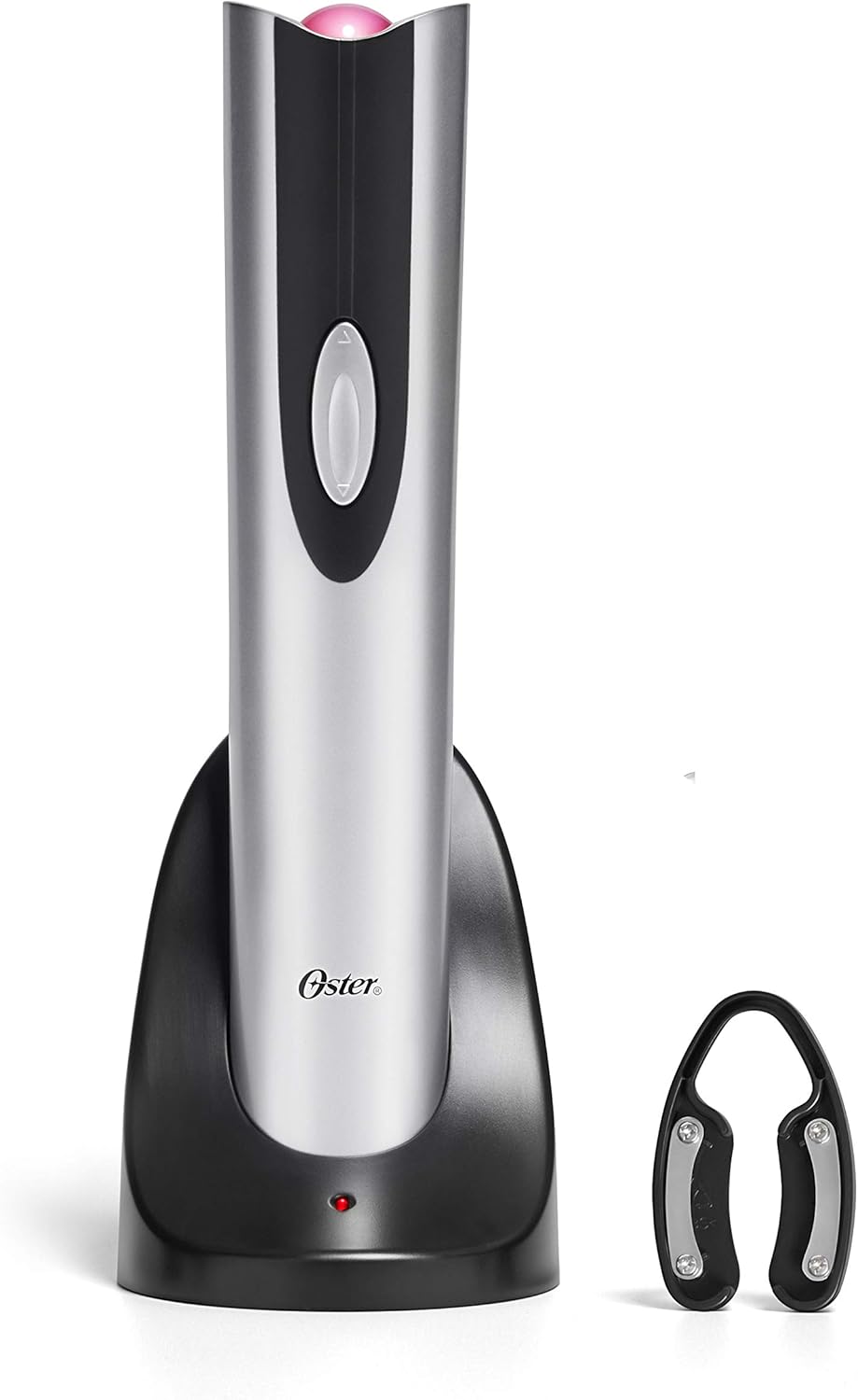
You’ve successfully read the label. You’re confident. The last thing you want now is to struggle with a bad corkscrew. An electric wine opener is the ultimate tool of convenience. This Oster is a bestseller on Amazon. You place it on top, press a button, and it pulls the cork perfectly every time. It comes with a foil cutter and a charging base.
(+) Pros
- Opens a bottle in seconds with zero effort
- Perfect for parties or for those with grip issues
- Sleek, rechargeable design
- Comes with a foil cutter
(-) Cons
- Can struggle with old, brittle corks
- Requires counter space for its charger
4. The Preserver: Vacu Vin Wine Saver Pump
Vacu Vin Wine Saver Pump with 2 Stoppers

You’ve read the label, opened the bottle, had one glass — now what? The best wine stoppers are essential. This Vacu Vin pumps the air out of the bottle, the #1 way to slow oxidation. It will extend the life of your wine by 5–7 days. It’s the most practical value in the entire Coravin vs. Vacu Vin debate.
(+) Pros
- Actively removes oxygen, extending wine life
- Patented “click” tells you when it’s sealed
- Best value in wine preservation
(-) Cons
- Requires manual pumping
- Cannot be used on sparkling wine
5. The “Action” Tool: Le Chateau Wine Decanter
Le Chateau Wine Decanter

You just read a label that said “2019 Napa Valley Cabernet Sauvignon.” Your brain screamed “AERATE ME!” This is how you do it. A decanter maximizes surface area, exposing wine to oxygen to soften tannins and open aromas. This hand-blown crystal decanter from Le Chateau is an Amazon favorite — beautiful, functional, and the perfect serving tray centerpiece.
(+) Pros
- Dramatically improves young, bold reds
- Separates older wines from sediment
- Beautiful, hand-blown design
(-) Cons
- Can be difficult to clean
- Fragile (it’s crystal)
Building Your “Label Library” (Your Collection)
Your new skill is like a superpower. You can now walk into any wine shop and find exactly what you’re looking for. The next step is to start building your “Label Library” — your own collection of known, trusted bottles whose labels you can read and interpret with confidence.
This doesn’t mean you need a 1,000-bottle cellar. It just means learning how to store wine at home. The basic rules: keep your bottles cool, dark, and on their side (to keep the cork wet and prevent oxidation through desiccation). Even if you have no space, our guide on how to store wine without a fridge is a lifesaver.
A simple modular wine rack is the perfect start. It’s an eco-friendly wine storage solution that grows with your new hobby. And for taking your bottles on the go? You’ll want a padded wine bag or a portable wine cooler.
Your “library” is not just for storage; it’s for experimenting. You can now compare a “Chablis” (French un-oaked Chardonnay) side-by-side with a “Napa Chardonnay” and truly understand the difference that terroir, winemaking style, and climate make — not because someone told you the difference, but because you tasted it yourself. That is the goal of label literacy: turning reading into genuine experience.
Frequently Asked Questions
The Final Word: The Label is Your Friend
That “Wall of Wine” is no longer a source of anxiety. It’s a library. Every bottle is a story, and now you can read the cover. You can see the clues, decode the language of Old World and New World, understand the quality classification systems of four different countries, read sweetness from a German label, know whether “Extra Dry” means drier than “Brut” (it doesn’t), and choose the right wine for the right occasion every time.
You now know that “Sancerre” is just a Sauvignon Blanc with a French accent and centuries of terroir behind it. That “14.5% ABV” means you should order the steak. That “Trocken” on a German label is your best friend if you wanted something dry. That “Riserva” on an Italian label is a genuine aging statement, while “Reserve” on an American label is just marketing. That a heavy bottle tells you nothing about the wine inside, but a specific, named appellation tells you a great deal.
The label is not there to confuse you; it’s there to inform you. Now that you have the decoder ring, go to that aisle, pick up a bottle, and read the story. Then take a note, and read the next one. You’ll be amazed at how quickly the language becomes second nature — and how much more pleasure you get from every bottle when you understand exactly what you chose and why.