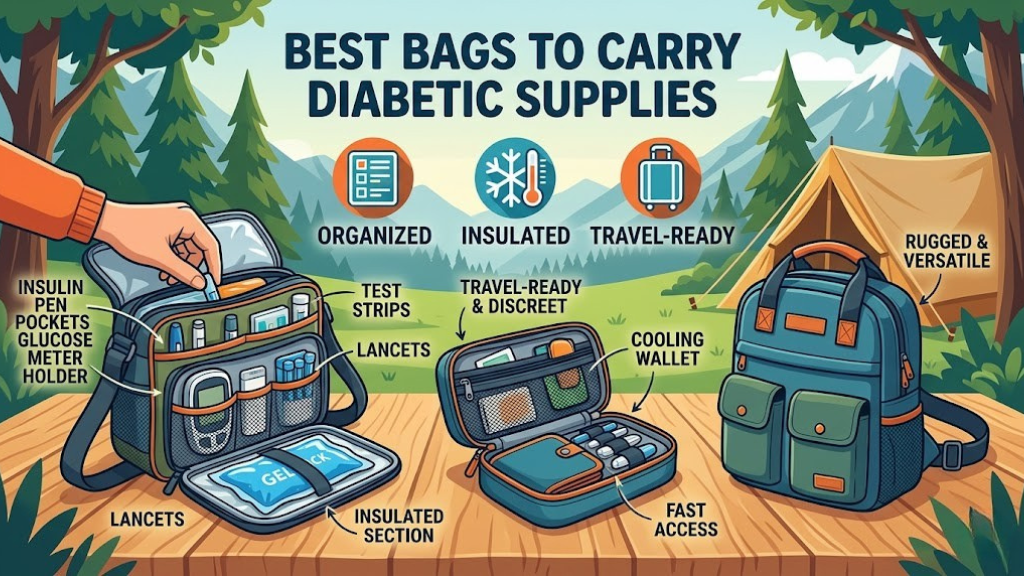
5 Best Bags to Carry Diabetic Supplies — Organized, Discreet & Travel-Ready
Whether you manage with insulin, a CGM, oral medications, or all three — the right bag keeps your supplies organized, protected, and always at hand. Here are the picks that actually work.
Living with diabetes means carrying a small pharmacy wherever you go. A glucose meter, test strips, lancets, insulin pens or a pump, a CGM transmitter, alcohol swabs, glucose tablets for emergencies, snacks, a logbook — the list compounds quickly, and the stakes couldn’t be higher. A hypoglycemic episode without your glucose tablets, or insulin left baking in a hot car — these aren’t inconveniences. They’re medical emergencies.
The right diabetic supply bag turns that chaos into organized readiness. We’ve researched and compared dozens of options to bring you the 5 best bags for carrying diabetic supplies in 2026 — evaluated for organization, insulation, portability, durability, and the kind of discretion that lets you manage your condition without announcing it to the room.
Why Your Diabetic Supply Bag Matters More Than You Think
Most people with diabetes start their supply-carrying journey with whatever they have on hand — a ziplock bag stuffed into a purse, a random pouch rattling around at the bottom of a backpack. It works, until it doesn’t. Glucose strips expire faster when exposed to heat fluctuations. Insulin loses potency when warmed above 86°F (30°C). Lancets roll loose and create needle-stick hazards. And when you’re disoriented from a blood sugar drop at 2pm, you don’t have time to excavate your meter from the bottom of a bag.
A purpose-built diabetic supply bag solves all of this systematically:
- Thermal protection — insulated compartments maintain insulin viability between 36–77°F even on hot days
- Organization by urgency — fast-access pockets for glucose tabs, deeper pockets for logbooks and extra strips
- Sharp safety — dedicated lancet holders and needle disposal compartments prevent accidental sticks
- Device protection — padded, semi-rigid compartments keep CGM receivers, meters, and pumps intact
- Discretion — well-designed bags look like everyday tech organizers or messenger bags, not medical kits
- Compliance — organized supplies mean you’re more likely to test consistently and adhere to your regimen
There’s also a psychological dimension. When your supplies are organized and your bag is something you feel good carrying, diabetes management becomes something you do rather than something you dread. That small shift in relationship to your condition has real downstream effects on compliance and quality of life.
Good diabetes management is also deeply connected to what you eat. Keeping a structured weekly diabetic meal plan alongside a properly equipped supply bag creates a complete daily management system — your tools and your nutrition working together to maintain stable blood sugar throughout the day.
What Should Be in Every Diabetic Supply Bag
Before evaluating bags, it helps to know exactly what you’re packing. The answer varies based on your treatment regimen, but here’s a comprehensive checklist organized by user type:
For All Diabetes Types
- Blood glucose meter + carrying case
- Test strips (enough for 2–3 days minimum; strips have expiration dates)
- Lancet device + extra lancets
- Alcohol prep wipes / swabs
- Fast-acting glucose (glucose tablets, juice boxes, or candy)
- Glucagon emergency kit (if prescribed)
- Medical ID card or bracelet
- Logbook or cable to connect meter to phone
- Snacks for blood sugar management
Additional for Insulin Users
- Insulin vials or pens (with pen needles)
- Syringes (if using vials)
- Sharps disposal container
- Insulated pouch or ice pack for insulin
- Extra insulin in case of breakage
Additional for CGM Users
- CGM receiver or smartphone mount
- CGM sensors (fragile — need protected compartment)
- Transmitter (if separate from sensor)
- Skin adhesive patches / tape
- Insertion device (for some CGM systems)
Additional for Insulin Pump Users
- Pump tubing / infusion sets
- Reservoirs
- Extra batteries or charger
- Skin prep wipes
Key Features to Look For in a Diabetic Supply Bag
Not all bags labeled “diabetic” deliver what they promise. Here’s how to separate genuinely useful design from marketing fluff:
1. Insulated Compartment
This is non-negotiable for insulin users. The insulated section should use food-grade foam or phase-change gel, be large enough for 2–3 insulin pens or a vial, and seal completely with a zipper. Avoid bags where the insulation is just a thin foil layer — it won’t maintain temperatures during extended outdoor exposure.
2. Dedicated Lancet / Sharp Holder
Lancets rolling loose in a bag create needle-stick risks. A proper bag has a specific elastic sleeve or rigid holder that keeps the lancet device accessible but contained. This is also important for proper sharps disposal practices.
3. Contrast-Color Interior
A dark gray or navy interior makes finding small items — glucose tabs, spare lancets, a folded emergency card — much harder than a light-colored or brightly contrasting lining. The best diabetic supply bags use light cream, white, or yellow interiors specifically so contents are visible at a glance.
4. Clear ID Window
An external or internal clear window that holds a medical ID card means first responders can immediately access emergency information about your condition, medications, and emergency contacts — without having to search through your bag.
5. Moisture-Resistant or Waterproof Exterior
Blood glucose strips are extremely sensitive to humidity. A water-resistant exterior protects against rain, spills, and sweat during exercise. Full waterproofing is better for outdoor or athletic users.
6. Material Safety
Bags that come into contact with medical supplies should be BPA-free, phthalate-free, and ideally made from food-safe or medical-grade materials in the interior. Check for these certifications, especially for the insulated compartment.
7. Size and Portability
The bag should be large enough for your complete supply kit but small enough to carry comfortably. For most users, a case in the 7″×5″ to 10″×7″ range handles everything needed for a full day. For travel, a larger dedicated travel bag (12″×8″+) allows multi-day supplies plus documentation.
Quick Comparison: 5 Best Diabetic Supply Bags (2026)
⚡ At-a-Glance Summary
Use this table to match a bag to your primary need. Full in-depth reviews follow directly below.
| Bag | Best For | Insulated | Size | Insulin Pen Slots | CGM Friendly | Price | Rating |
|---|---|---|---|---|---|---|---|
| Myabetic James | Everyday style | ✓ | Medium | 3 pens | ✓ | $$$ | ★★★★★ 4.9 |
| 4AllFamily | Travel / multi-day | ✓ | Large | 4 pens | ✓ | $$ | ★★★★★ 4.8 |
| Sugar Medical | Daily use / value | ✓ | Medium | 2 pens | ~ | $ | ★★★★½ 4.5 |
| CURMIO | Budget / beginners | ✓ | Small–Med | 2 pens | ✗ | $ | ★★★★ 4.3 |
| Vive Health | Pump / CGM users | ✓ | Large | 4 pens | ✓ | $$ | ★★★★★ 4.7 |
Price key: $ = under $30 | $$ = $30–$60 | $$$ = $60+
#1 — Myabetic James Diabetes Supply Case: Best Overall for Everyday Use
Myabetic James Diabetes Organizer Case
Myabetic is the brand that changed what a diabetic supply bag could look like. Founded by a person with Type 1 diabetes, every product in their lineup is designed with both clinical function and genuine style in mind. The James is their flagship men’s organizer — and it delivers on both fronts better than anything else in its class.
Design & Organization
From the outside, the James looks like a high-quality tech organizer — think slim, professional, the kind of thing you’d see a graphic designer or architect carrying. The exterior is made from a woven nylon that’s water-resistant, scratch-resistant, and holds its shape beautifully. It’s available in several tasteful colorways. Nothing about it says “medical supply bag.”
Open it and the engineering becomes apparent. The interior is cream-colored for maximum visibility, with a structured layout that includes three insulin pen slots with elastic loops, a removable insulated compartment that fits a gel ice pack, a dedicated lancet device holder with a separate finger-loop for single-hand retrieval, a clear front ID window, two deep zippered pockets for strips and wipes, and an outer quick-access pocket for glucose tabs.
Performance Ratings
✅ Pros
- Looks like a premium everyday organizer — zero medical stigma
- Cream interior makes finding supplies instant
- 3 dedicated insulin pen loops with firm hold
- Removable insulated inner pouch
- External medical ID clear window
- Padded side pocket fits CGM receiver or transmitter
- Outstanding build quality — zipper glides smoothly
- Founder-designed by someone with T1D
❌ Cons
- Most expensive option in this guide
- Insulated pouch is removable but not enormous
- Not ideal as a standalone travel bag for multi-day trips
- Limited color options in men’s styles

Myabetic James Case — the most thoughtfully designed diabetic supply organizer on the market, built by someone who lives with T1D.
Check Price on Amazon →Who Should Buy This
The Myabetic James is perfect for men who want their diabetes management to feel seamless and professional — not conspicuous. If you attend meetings, travel for work, or simply value aesthetics alongside function, this is the bag. It’s also the best pick for men who use insulin pens alongside a CGM device, given its dual accommodation of both.
#2 — 4AllFamily Diabetes Travel Bag: Best for Travel and Multi-Day Trips
4AllFamily Premium Diabetes Travel Supply Bag
The 4AllFamily diabetes travel bag was designed with one scenario in mind: you’re away from home, away from your pharmacy, possibly in a different time zone — and you need everything to be organized, protected, and accessible under pressure. It delivers on this promise comprehensively.
Travel-Optimized Engineering
The bag has a larger form factor than the Myabetic James — intentionally so. Its main compartment opens fully flat (like a book), giving you a bird’s-eye view of all your supplies without excavating. The dedicated insulated side pocket uses a multilayer foam-and-foil construction that maintains temperatures for up to 8–10 hours with a standard ice pack, making it appropriate for full-day travel and long flights.
The organization inside is impressively thorough: four insulin pen loops, a lancing device strap, a deep pocket for a glucagon kit, three zippered mesh pockets of graduated sizes for strips and accessories, an elastic net pocket for a CGM receiver, and an exterior document pocket for TSA letters, insurance cards, and prescriptions. The interior is bright white for maximum visibility.
Performance Ratings
✅ Pros
- Book-open design gives full supply overview instantly
- Longest-lasting insulation of all picks (8–10 hours)
- Dedicated glucagon emergency kit pocket
- External document/prescription pocket
- 4 pen loops + vial holder in insulated section
- Excellent value for feature depth
- White interior for maximum visibility
- Ballistic nylon holds up to travel wear
❌ Cons
- Larger than needed for a single-day bag
- Heavier when fully packed
- Somewhat utilitarian appearance
- Shoulder strap adds bulk when not needed

4AllFamily Travel Bag — the most comprehensive travel-oriented diabetic supply bag, with 8–10 hours of insulation and a dedicated prescription document pocket.
Check Price on Amazon →Who Should Buy This
If you travel frequently — whether for work, family, or leisure — the 4AllFamily is the definitive choice. It’s also the best pick for users with complex regimens: multiple insulin types, a CGM, a glucagon kit, and documentation requirements. For daily local use it’s slightly oversized, but the peace of mind from its insulation and organization is worth it for regular travelers.
Traveling with diabetes requires not just the right bag but the right eating strategy. When you’re on the road, following a structured diabetic eating-out menu can help you maintain blood sugar control even when restaurant choices are unpredictable — an important complement to having all your supplies organized and accessible.
#3 — Sugar Medical Diabetes Supply Organizer: Best Value for Daily Use
Sugar Medical Diabetes Supply Organizer Bag
The Sugar Medical organizer punches well above its price point. For under $30, it delivers an insulated compartment, a thoughtful organizational layout, and a compact form factor that fits comfortably in a jacket pocket or small bag. For the large segment of people with diabetes who just need a reliable, no-frills daily organizer without spending $70+, this is the answer.
Compact, Practical, Well-Considered
The Sugar Medical opens like a bi-fold wallet but with more depth — about the size of a large smartphone case when closed. The interior features two zippered mesh compartments, two elastic pen loops sized for standard insulin pens, a lancet device slot, an alcohol swab holder, and a small loop for a glucose tab tube. The interior is a warm tan color — not white, but light enough for visibility.
The insulated inner layer uses a food-grade aluminum foil sandwich construction that maintains temperatures for approximately 4–6 hours — shorter than the 4AllFamily but more than adequate for a standard workday. The exterior is a semi-rigid EVA shell covered in a water-resistant fabric, which gives it shape and protects against light drops.
Performance Ratings
✅ Pros
- Excellent price — under $30
- Semi-rigid EVA shell protects against drops
- Compact enough for jacket pocket or small bag
- Insulation sufficient for a standard workday
- 2 pen loops + lancet slot
- Water-resistant exterior
- Multiple color options
❌ Cons
- Insulation shorter (4–6 hrs vs. 8–10)
- Only 2 pen loops (not ideal for multiple insulin types)
- Tight fit for CGM receiver or larger meters
- No external ID window
- Less durable zipper than premium options

Sugar Medical Organizer — compact, water-resistant, insulated, and under $30. The best value diabetic supply bag for daily use.
Check Price on Amazon →Who Should Buy This
The Sugar Medical is ideal for people newly diagnosed with diabetes who are building out their supply kit for the first time, for users on simpler regimens (one insulin type, standard meter, no pump), or as a backup secondary organizer to keep in a car or desk. It’s also an excellent gift choice for a family member newly managing diabetes.
#4 — CURMIO Diabetic Bag: Best Beginner Option with Insulated Compartment
CURMIO Diabetic Supply Bag with Insulated Compartment
The CURMIO sits in a slightly different tier from the Myabetic and 4AllFamily — it’s a straightforward, affordable diabetic supply bag that prioritizes accessibility and clarity over premium materials or nuanced organization. For people who are new to diabetes, or who want a simple organizer without a complex layout to learn, it hits the mark reliably.
Straightforward and Functional
The CURMIO’s approach is clean and uncluttered. It opens to a single wide main compartment with a removable insulated inner pouch — large enough for two pens and a small ice pack — plus a front zippered pocket for meter and strips, an elastic side loop for a lancet device, and a key clip. The outer shell is a polyester fabric with a basic water-resistant coating.
What the CURMIO lacks in organizational refinement, it makes up for in sheer accessibility. Everything is reachable without rummaging. The zipper system is designed to be operable with one hand — useful during a hypoglycemic episode when coordination is compromised. For many users, that straightforwardness is the right design choice.
Performance Ratings
✅ Pros
- Very affordable
- One-hand zipper access design
- Removable insulated inner pouch
- Simple layout — easy to learn immediately
- Key clip for quick carry
- Lightweight
❌ Cons
- Limited organization vs. dedicated diabetic bags
- No CGM or pump accommodation
- Insulation short-lived (4 hrs)
- Polyester less durable than nylon or EVA
- No ID window

CURMIO Diabetic Bag — clean, simple, budget-friendly with one-hand access and a removable insulated pouch.
Check Price on Amazon →Who Should Buy This
The CURMIO is the right starter bag for people newly diagnosed with Type 2 diabetes who are just beginning to carry supplies, for elderly users who prefer intuitive, simple layouts, or as an inexpensive replacement when a primary bag is being repaired or shipped. It’s not a long-term premium solution, but it handles the basics competently.
#5 — Vive Health Diabetes Supply Bag: Best for Insulin Pump & CGM Users
Vive Health Diabetes Supply Bag
Vive Health is known in the medical supply space for designing products around specific clinical needs rather than generic use cases. Their diabetes supply bag reflects that approach — it’s built for the most complex diabetes management scenarios: insulin pump users, CGM wearers, and people managing multiple insulin types who need the full infrastructure of their regimen to be portable and organized.
Infrastructure for Complex Regimens
The Vive Health bag is larger than a standard organizer — think of it as a mission control center rather than a pouch. When fully opened, it presents six distinct organizational zones: an insulated insulin section with 4 pen loops and a vial pocket, a dedicated CGM compartment with a semi-rigid protective sleeve (fits Dexcom G7, Freestyle Libre 3, and Medtronic sensors), a pump tubing compartment with elastic management loops, a front-facing lancet and swab zone, a zippered medication compartment for oral drugs, and an outer document pocket.
The insulated zone maintains temperature for 6–8 hours using a phase-change gel panel rather than simple foam-foil — a meaningful upgrade that provides more consistent temperature regulation. The exterior is constructed from high-density nylon with reinforced corners, and the zippers are YKK-grade — a quality indicator that budget bags consistently skip.
Performance Ratings
✅ Pros
- Only pick with dedicated pump tubing management
- Semi-rigid CGM sensor/receiver compartment
- Phase-change gel insulation (more stable than foam-foil)
- YKK zippers — highest quality available
- 6 distinct organizational zones
- Reinforced corners for durability
- Oral medication pocket
- External document pocket
❌ Cons
- Largest and heaviest bag in this guide
- Overkill for simple oral-medication-only regimens
- Takes time to learn the full organizational system
- Appearance is functional, not fashion-forward

Vive Health Diabetes Bag — the most complete bag for complex regimens, with dedicated CGM, pump, and phase-change gel insulation.
Check Price on Amazon →Who Should Buy This
The Vive Health is the correct choice for anyone using an insulin pump, anyone using a CGM (especially those with separate receivers or multiple sensors on-hand), or anyone managing a complex multi-insulin regimen plus oral medications. It’s also a strong choice for caregivers managing supplies for a child or dependent with Type 1 diabetes who need all possible supplies organized in one place.
Complete Feature Comparison: All 5 Bags Side by Side
| Feature | Myabetic James | 4AllFamily | Sugar Medical | CURMIO | Vive Health |
|---|---|---|---|---|---|
| Insulated compartment | ✓ | ✓ | ✓ | ✓ | ✓ |
| Insulation duration | ~6 hrs | 8–10 hrs | 4–6 hrs | ~4 hrs | 6–8 hrs |
| Insulin pen slots | 3 | 4 | 2 | 2 | 4 |
| CGM support | ✓ | ✓ | ~ | ✗ | ✓ |
| Pump tubing mgmt | ✗ | ✗ | ✗ | ✗ | ✓ |
| Glucagon kit pocket | ✗ | ✓ | ✗ | ✗ | ✓ |
| External ID window | ✓ | ✓ | Interior only | ✗ | ✓ |
| Doc/prescription pocket | ✗ | ✓ | ✗ | ✗ | ✓ |
| Premium zipper (YKK) | ✓ | ✓ | ✗ | ✗ | ✓ |
| Contrast interior | Cream | White | Tan | Gray | Light blue |
| Style / discretion | Excellent | Moderate | Moderate | Functional | Functional |
| Best regimen type | MDI + CGM | Any (travel) | Simple daily | Oral/starter | Pump + CGM |
| Price range | $$$ | $$ | $ | $ | $$ |
Traveling with Diabetic Supplies: What You Need to Know
Traveling with diabetes — whether by plane, train, or car — introduces logistical challenges that your home routine doesn’t prepare you for. Here’s how to handle it correctly:
Air Travel: TSA Rules and Best Practices
The TSA explicitly accommodates people with diabetes. All diabetes supplies — insulin, syringes, lancets, glucose meters, CGM devices, insulin pumps, and glucose tablets — are permitted through airport security in carry-on bags. You are not required to declare them separately, though having them organized and accessible speeds up the inspection process.
- Carry all diabetes supplies in your carry-on — never checked luggage. Baggage holds experience extreme temperature swings and delays that can destroy insulin and damage electronic devices.
- Carry a physician’s letter for international travel detailing your diagnosis and medication list. Some countries require this for insulin importation.
- Bring 2–3× your expected supplies to account for delays, lost bags, or damaged equipment.
- Notify TSA agents of your insulin and CGM/pump before screening — insulin pumps and CGM sensors should not go through full-body scanners. Ask for a hand inspection instead.
- Pack insulin in an insulated compartment with a gel pack (not loose ice, which will be confiscated at security). FRIO cooling wallets are TSA-compliant and don’t require ice.
- Keep a simple emergency kit on your person (glucose tabs, medical ID) separate from your main bag — in case you’re separated from it or need to access it quickly during boarding.
Car Travel
Car travel presents a more manageable but often ignored challenge: heat. The interior of a car parked in summer sun can exceed 140°F (60°C) — temperatures that destroy insulin rapidly. Never leave supplies in a car, even for a short errand. Keep your supply bag in the climate-controlled cabin, not the trunk.
Time Zone Changes and Insulin Timing
For insulin-dependent travelers crossing time zones, speak with your endocrinologist before travel about how to adjust your injection schedule. General principle: move eastward (shorter day) and you may need to decrease your total daily insulin slightly; move westward (longer day) you may need to increase it slightly. Keeping a logbook — physical or digital — in your supply bag helps track this during travel.
Keeping Insulin at Safe Temperatures: A Practical Guide
This is the most critical technical consideration in choosing and using a diabetic supply bag. Insulin’s stability depends entirely on proper temperature management, and getting this wrong doesn’t just waste expensive medication — it can lead to dangerous dosing errors if degraded insulin is used unknowingly.
| Insulin Status | Recommended Temp | Max Duration at Room Temp | Action if Exceeded |
|---|---|---|---|
| Unopened (sealed) | 36–46°F (fridge) | N/A — refrigerate until use | Discard if frozen or overheated |
| Opened vial or pen | Below 77°F (25°C) | 28–30 days (most types) | Replace if above 86°F for any period |
| In transit (car/plane) | 36–77°F (ideal) | Insulated bag required in heat | Use cooling wallet or ice pack |
| Warning signs of degradation | Cloudiness, clumping, color change, or particles in clear insulin types | ||
Cooling Methods for On-the-Go Insulin
- FRIO cooling wallets — water-activated evaporative cooling, no ice required, TSA-compliant, effective for 45 hours after activation
- Gel ice packs — wrap in a small cloth before direct contact with insulin (direct contact with ice can freeze insulin at the vial contact point)
- Phase-change material pouches — maintain exact target temperatures without freezing risk (used in the Vive Health bag)
- Insulated bag compartments — all five picks in this guide include some form of insulation; pair with an ice pack for hot climates
Good thermal management of your supplies connects to good overall diabetes management. The more reliably your insulin works, the more predictable your blood sugar response. For those working on optimizing blood sugar through nutrition alongside medical management, resources like a low-carb weekly diabetic menu can help reduce the insulin doses required — simplifying the supply management challenge itself.
Complete Buying Guide: How to Choose Your Diabetic Supply Bag
Step 1: Map Your Regimen
Write down every item you carry or should carry daily. Count insulin pens, identify whether you use a CGM or pump, and note any special needs (glucagon kit, large sharps disposal, oral medications). This inventory determines the minimum size and organizational requirements of your bag.
Step 2: Assess Your Climate and Lifestyle
Hot climate + outdoor activities = prioritize insulation hours and water-resistant exterior. Office-based + temperate climate = prioritize organization and discretion. Frequent traveler = prioritize capacity, document pocket, and TSA-friendly design. Home-based caregiver = prioritize ease-of-use and comprehensive organization.
Step 3: Choose Size
| Regimen Type | Recommended Size | Best Pick |
|---|---|---|
| Oral medications only / Type 2 starter | Small (7″×5″) | CURMIO or Sugar Medical |
| Single insulin + CGM | Medium (9″×6″) | Myabetic James or Sugar Medical |
| MDI (multiple daily injections) | Medium-Large (9″×7″) | Myabetic James or 4AllFamily |
| Insulin pump + CGM | Large (12″×8″+) | Vive Health |
| Travel (2+ days) | Large (11″×8″+) | 4AllFamily or Vive Health |
Step 4: Verify Insulation Needs
If you use insulin that needs to remain below 77°F/25°C during the day — and you live somewhere that regularly gets hotter than that — insulation duration matters. Calculate your longest day (commute + work + gym + evening) and choose a bag whose insulation covers it. All five picks in this guide include insulation; they vary from 4 hours (CURMIO) to 10 hours (4AllFamily).
Caring for Your Diabetic Supply Bag
- Spot-clean the exterior with a damp cloth and mild soap monthly, or immediately after spills
- Wipe down the insulated interior compartment weekly — ice pack condensation creates mold risk if neglected
- Air dry completely before returning supplies — never close a damp bag
- Check zipper pulls and elastic loops quarterly — worn elastics don’t hold insulin pens securely
- Replace the bag when seams start separating or the insulated layer shows visible deterioration
Diabetes management extends well beyond supplies and bags — it’s a comprehensive daily practice. Alongside the right bag, making sure your nutrition is optimized matters enormously. The best diabetic snack ideas are especially relevant to what you pack alongside your meter and insulin — having the right fast-acting glucose and smart snacks in your bag is as important as having the right equipment.